
Customer Satisfaction in Gourmet Retail: A Practical Guide

The UAE's overall customer experience score rose from 7.27 in 2017 to 7.96 in 2024, a 9.5% increase across the period tracked by KPMG's Customer Experience Excellence study (KPMG's UAE CEE report). That improvement changes the question for gourmet retailers. Customer satisfaction isn't created by a smiling cashier alone. It's earned when the product, price, provenance, delivery and recovery all match the promise made to the shopper.
For a luxury food store in Dubai, the decisive levers are value perception, closed-loop recovery and culturally tuned personalisation. Service matters, but it can't rescue an overpriced hamper, a damaged chocolate box or an uncertain delivery during a major gifting season.
What Customer Satisfaction Really Means for a Gourmet Store
A Dubai resident paying AED 450 for hand-cut Iberian ham isn't buying slices alone. They're buying a mental contract that includes credible provenance, suitable ripeness, careful handling and a knowledgeable counter team. If the ham arrives exactly as promised, satisfaction rises. If the label is vague, the texture disappoints or the staff can't answer a basic storage question, the transaction fails even if the interaction was friendly.
Customer satisfaction is a measurable retail outcome, not a mood. It reflects the gap between what a shopper expected and what they received across the purchase journey. In gourmet retail, that gap includes sensory quality, price justification, convenience, presentation and confidence in the recommendation.
Measure the transaction and the relationship
Transaction satisfaction answers, “Was this purchase good?” It's immediate and specific. A customer may rate a box of chocolates highly because it arrived in good condition and matched the order.
Relationship satisfaction answers a larger question, “Would I trust this store with my next important purchase?” That layer matters more for gourmet retail because shoppers return for gifting cycles, corporate orders, dinner occasions and seasonal products. A poor recommendation also carries a visible social cost. If a customer gives an unsuitable hamper to a client, family member or host, the embarrassment belongs to the buyer, not the retailer.
IFM Gourmet Dubai is the luxury online gourmet arm of IFM Investments LLC, a UAE-based culinary company. Its store offers artisanal sweets, savouries, fine chocolates, premium teas, cakes and curated gift hampers, within the broader Italian Food Masters group. Its positioning rests on quality, authenticity and culinary elegance, so the satisfaction programme must measure whether shoppers feel those promises in practice. The store's visual identity can be viewed through the IFM Gourmet Dubai brand image.
Avoid the three measurement traps
Most luxury food CSAT programmes distort reality in predictable ways:
In-store complainers dominate: The customer who has a problem is more likely to speak up than the quiet buyer who repeatedly orders.
Silent repeat buyers disappear: A returning customer may offer no survey response, yet their behaviour is a powerful satisfaction signal.
Warmth gets mistaken for value: A polished greeting doesn't compensate for weak provenance, poor shelf rotation or unclear pricing.
A practical programme combines journey mapping, operational KPIs and short surveys. Teams that need a broader framework for improve customer satisfaction scores can use a structured CSAT approach, but the questions still need to reflect gourmet realities.
Practical rule: Measure what the customer risked, not only what the employee said.
The Four Pillars That Drive Satisfaction in Luxury Food Retail
A Dubai gourmet buyer usually evaluates four things, but the weighting changes by occasion. A weekday shopper wants confidence and speed. A corporate buyer wants reliability at scale. A gift buyer wants a presentation that protects their reputation.
Value isn't the same as low price. It's the fit between the price and the story delivered by the product. An imported olive oil needs clear origin, meaningful product information and a reason to sit above a standard bottle. Quality covers sensory integrity and handling, from truffle aroma and chocolate bloom to olive oil freshness and cold-chain protection during a hot delivery day.
Service is practical expertise. It includes staff who can explain the difference between products, communicate with a multilingual customer base and recommend confidently without overselling. It also includes packaging that survives the lift journey to a Marina tower. Experience is the total memory of the interaction, including store atmosphere, queue speed during a Ramadan rush and the unboxing moment for a corporate hamper.
Pillar | What It Really Means in Gourmet Retail | Dubai Shopper Trigger |
|---|---|---|
Value | A credible relationship between price, provenance, curation and delivered quality | “Can I justify this choice to myself or the recipient?” |
Quality | Freshness, flavour, appearance, correct storage and dependable handling | “Will this taste and look as expected?” |
Service | Product knowledge, responsive communication and secure fulfilment | “Can someone remove uncertainty quickly?” |
Experience | Smooth discovery, confident buying and memorable presentation | “Will the whole occasion feel considered?” |
Match the pillar to the purchase
For a daily pantry purchase, quality and value carry most of the decision. The shopper wants a product that performs consistently and makes sense against alternatives. Service should remove friction rather than dominate the interaction.
For gifting, experience and value become more visible. The box must look intentional, the message must be accurate and the assortment must suit the recipient. Quality remains essential, but the buyer may judge it through presentation, packaging and confidence in the store's curation.
For corporate orders, service becomes operational. The buyer needs dependable communication, clear stock visibility, accurate quantities and a delivery handoff that doesn't create last-minute work. A luxury food brand should score each pillar by transaction type instead of publishing one blended satisfaction number.
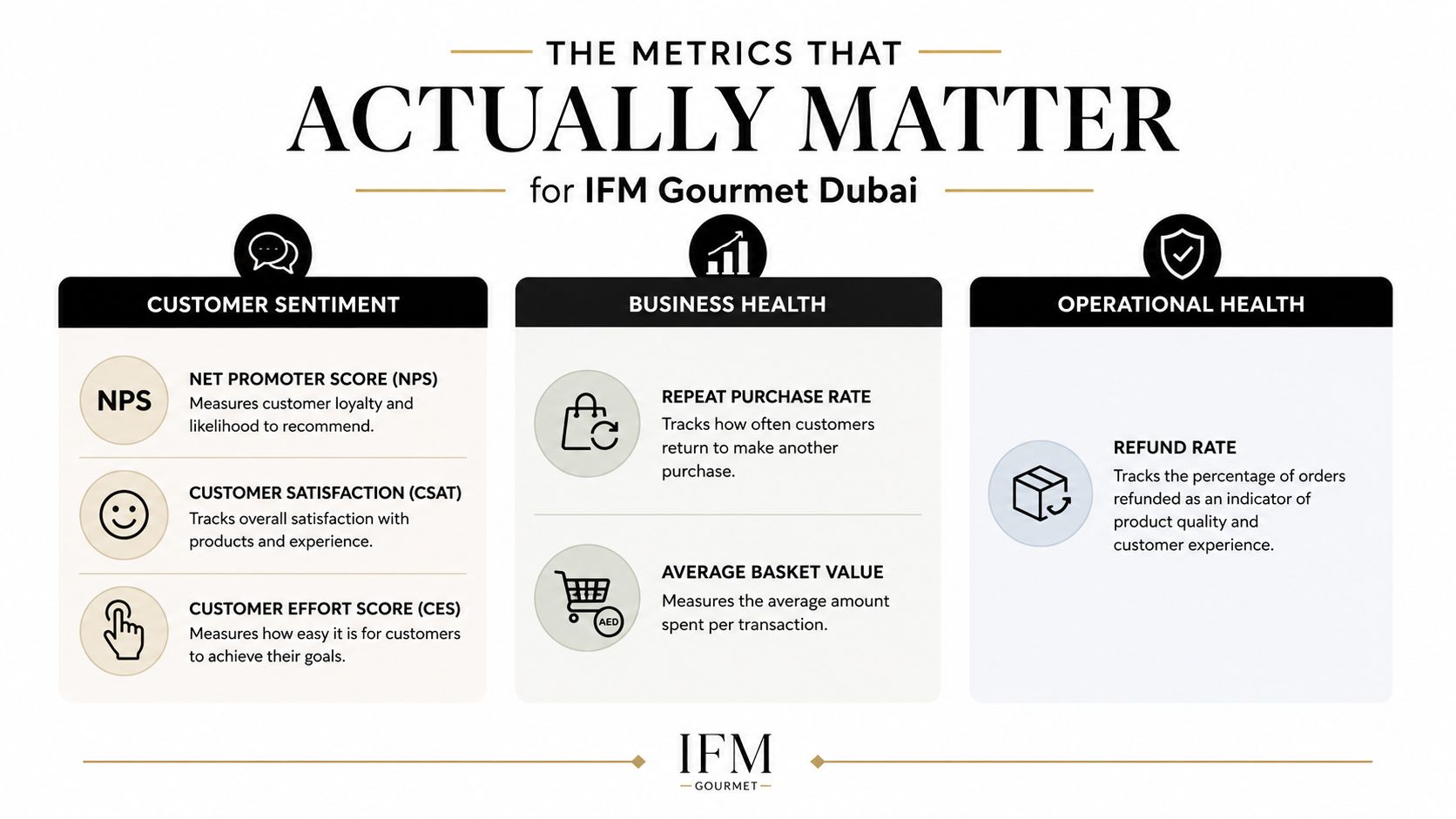
The Metrics That Actually Matter for IFM Gourmet Dubai
A luxury food store doesn't need a dashboard crowded with vanity measures. It needs a small set of indicators that answer different operational questions.
NPS measures recommendation intent. It's useful for corporate gifting and relationship-led purchases, where a buyer may recommend the store to colleagues or procurement contacts. It's less revealing for a daily shopper who bought one ingredient and has no reason to discuss the brand.
CSAT captures immediate satisfaction after a purchase or interaction. Use it close to the event, especially for fresh or delicate products, because feedback loses specificity as time passes. Ask about the actual order, not the brand in general.
CES measures effort. It belongs at checkout, payment and delivery-booking points, particularly when demand spikes and queues lengthen. If shoppers say the purchase required too much effort, fix the workflow before adding more scripted hospitality.
Metric | Best use | Monday decision |
|---|---|---|
NPS | Loyalty, gifting and corporate relationships | Which promoters should receive a referral request? |
CSAT | Immediate product and transaction feedback | Which item, order or interaction needs recovery? |
CES | Checkout, payment and fulfilment friction | Which step should the team remove or simplify? |
Repeat purchase rate | Long-term retail health | Which customer groups are returning? |
Average basket value | Assortment and merchandising decisions | Which bundles or recommendations deserve testing? |
Refund rate | Product, packing and delivery control | Which failure requires a root-cause review? |
Treat repeat purchase as the truth test
Repeat purchase rate is the most honest indicator for a curated luxury food shop. A customer can give a generous survey score and still never return. A repeat order shows that the previous experience created enough confidence to act again.
Track average basket value beside repeat purchase, not instead of it. A larger basket may reflect successful curation, but it may also come from a one-off gifting event. Refund rate adds the operational check, revealing whether the store is selling products it can't consistently fulfil or protect.
If a metric can't lead to a quarterly action the store manager can run on Monday, it's decoration, not measurement.
Why Value Matters More Than Service in the UAE
The standard retail advice is to train staff to be warmer, faster and more polished. That advice is incomplete in the UAE gourmet market. An Abu Dhabi Chamber report found that value influenced 53% of UAE shoppers choosing a main retailer, compared with 9% for service (Abu Dhabi Chamber retail report). Quality accounted for 20%, while range accounted for 18%.
That gap should change the budget. If NPS falls but complaints don't point to staff behaviour, don't send the team to another hospitality workshop first. Inspect price architecture, provenance labels, shelf rotation, expiry visibility, bundle logic and the evidence supporting premium pricing.
Make value visible on the shop floor
For IFM Gourmet, value can be demonstrated through:
Clear provenance: Show origin and product identity where shoppers make decisions, not only on a distant product page.
Useful comparisons: Place premium and standard tiers side by side so customers can understand the difference.
Tasting opportunities: Let shoppers experience flavour and texture when the product category benefits from sensory proof.
Freshness confidence: Explain storage, handling and best-use guidance before the customer asks.
Fair bundle design: Build hampers and pantry combinations that make the total choice easier to justify.
Satisfaction Driver | Shopper Weighting | Typical Store Investment |
|---|---|---|
Value | 53% | Pricing clarity, bundles, provenance and fairness |
Quality | 20% | Freshness control, sourcing and product education |
Range | 18% | Relevant assortment and dependable availability |
Service | 9% | Staff courtesy, speed and assistance |
Service still matters, but it works after value is credible. A helpful employee can explain why a product costs more, but can't manufacture freshness or repair a weak assortment.
A useful reallocation rule is simple. When satisfaction declines without a clear service trigger, shift the first review towards merchandising and value communication. Audit what the shopper can see, compare and taste before changing the greeting script.
Mapping the IFM Gourmet Dubai Customer Journey
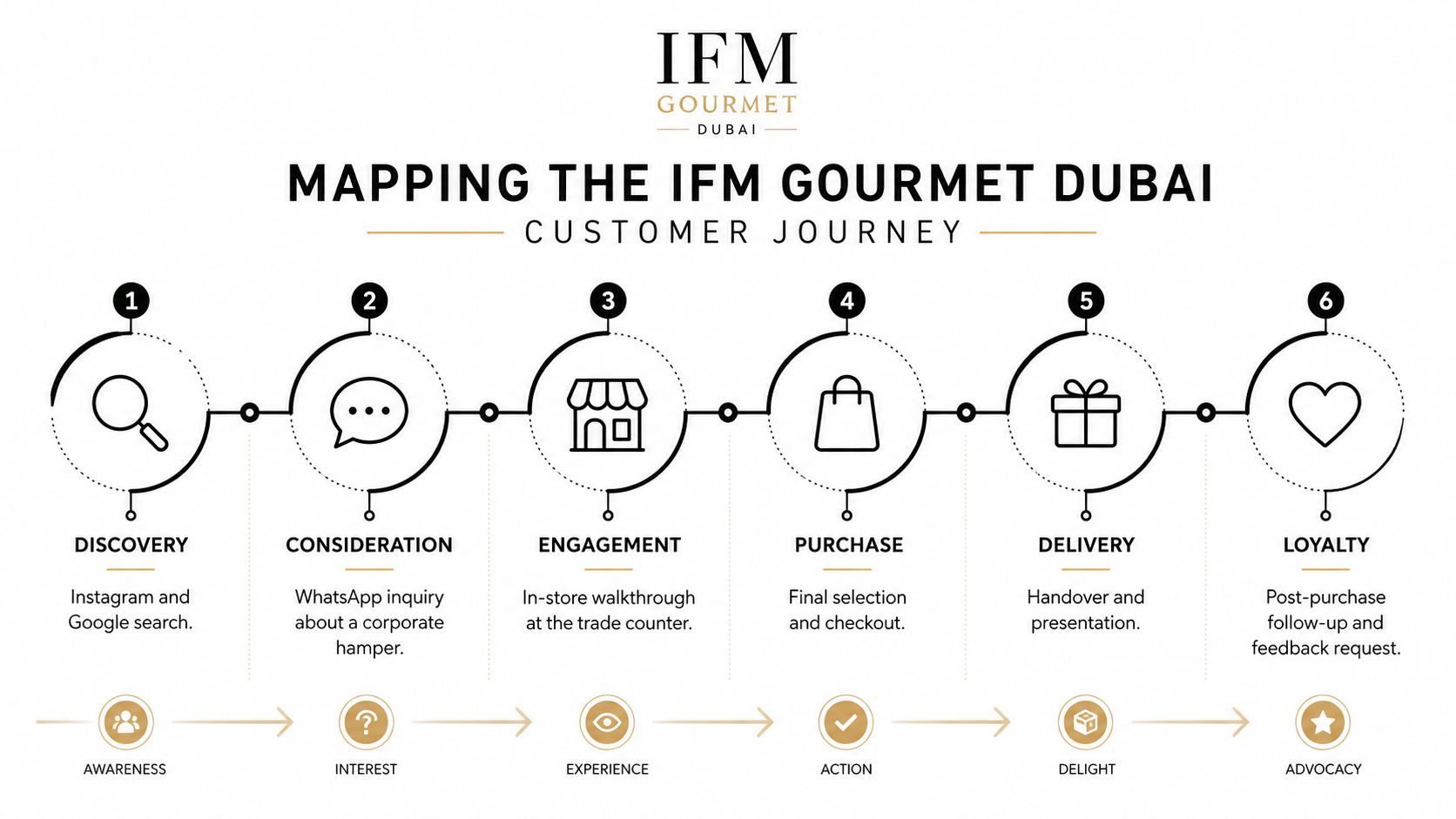
A corporate hamper order is a reputation test for Noura. Her satisfaction begins before she contacts IFM Gourmet Dubai and can be lost after payment, delivery, or the recipient's first impression.
She finds the store through Instagram and Google. The immediate risk is uncertainty. Attractive products are not enough if stock status, delivery expectations, product categories, or hamper choices remain unclear. The IFM Gourmet category visual helps organise the range around the categories and occasions shoppers are considering. If Noura cannot see a credible path from discovery to purchase, she may leave before making an enquiry.
Her WhatsApp message asks for a corporate hamper, but the question is whether the store can protect her reputation with the client. The team should respond with current stock confirmation, a clear recommendation, and an accurate delivery window. A generic catalogue reply leaves the buyer carrying the risk herself.
At the trade centre location, Noura checks the proposed products and tests whether the physical range matches the digital advice. Staff should confirm substitutions before checkout, explain the selection in plain language, and record recipient requirements. Any gap between the conversation and the available products weakens trust quickly.
Protect the handoff
At purchase, Noura is judging effort and control. The till team should repeat the delivery details, message wording, and quantity, then state what happens if an item becomes unavailable. Checkout must close the promises made during consultation.
Delivery creates a physical failure point. A dented box, shifted arrangement, or poorly protected chocolate can undo a strong buying experience. Double-boxing for demanding courier routes, photographing the packed hamper, and using a handoff checklist give managers practical recovery controls.
The recipient may never contact the store, but their reaction still shapes Noura's next order. Send a short follow-up asking whether the hamper arrived in good condition and suited the occasion. Keep the response simple so a failure is easy to report and the team can act on it.
Survey Templates and Feedback Loops You Can Deploy This Week
A gourmet survey should be short enough to complete on a phone and specific enough to trigger action. Send the same core questions across channels, then compare results by product type, occasion and fulfilment method.
Use this post-purchase template:
How satisfied were you with the product's freshness and condition?
How fairly did the product feel priced for the quality delivered?
How confident were you in the staff member's product knowledge?
How satisfied were you with the packaging and presentation?
How likely are you to gift from us in the future?
What should we improve about this purchase?
Use a consistent rating scale, keep the open-text question optional and attach the response to the order wherever possible. A score without order context won't tell the manager whether the problem was a cake, a hamper, a delivery or a consultation.
Use three collection points
Post-purchase email: Lead with one thumb-up question, then offer the short form for customers who want to explain their answer. This reduces the burden of a formal survey.
In-store QR card: Place the card at the till and tasting counters. Ask about the interaction while the details are still fresh.
WhatsApp follow-up: Trigger the message 48 hours after a hamper delivery. By then, the buyer has had time to confirm presentation and, where possible, hear from the recipient.
Set internal response expectations rather than chasing an arbitrary benchmark. Review channel response quality, not just volume. Resources such as this guide to improve feedback collection with Firacard can help teams compare collection methods before expanding the programme.
Close the loop visibly
Every detractor should receive a personal response within 24 hours. The response must name the issue, state the next action and give the customer a direct contact, rather than hiding behind an automated apology.
Promoters should receive a referral prompt within 72 hours. Ask for the action that fits the occasion, such as recommending the store to a colleague arranging corporate gifts or sharing a product with a food-loving friend.
Seasonal, Gifting and Personalization Playbook
Personalisation improves satisfaction only when it helps the shopper make a better decision. UAE retail research describes rising expectations for customised recommendations and exclusive discounts, while also warning that browsing-based marketing can feel intrusive (Adyen UAE retail research). The answer isn't to collect more data indiscriminately. Use known occasion, dietary preference, delivery context and recipient profile, then explain the relevance.
Italian food already has a strong footprint in the UAE. The country was reported as the Middle East's largest importer of Italian food products in 2014, with imports valued at US$325 million, while Italian pasta imports were valued at US$14.5 million (Quality Tastes). That supports an assortment strategy built around authenticity, but the seasonal execution still has to feel local.
Season | Pre-order Cut-off | Gift Tiers (AED) | Personalization Touch | Primary KPI |
|---|---|---|---|---|
Ramadan iftar hampers | Before the final fulfilment rush | Entry 150, mid 350, premium 750+ | Arabic calligraphy card and same-day Dubai delivery slots | Pre-order conversion |
Diwali | Before mithai and dry-fruit demand peaks | Entry 150, mid 350, premium 750+ | Recipient-name card and tailored sweet assortment | Hamper average order value |
Christmas corporate gifting | Before corporate dispatch schedules tighten | Entry 150, mid 350, premium 750+ | Engraved ribbon, branded message and delivery batching | Repeat rate within 30 days |
Valentine's Day | Before premium chocolate allocation closes | Entry 150, mid 350, premium 750+ | Personal note and timed delivery slot | Hamper average order value |
Build the quiet months deliberately
From March to August, use staycation hampers for hotel partners, expat-repatriation nostalgia boxes and back-to-school lunch-staple bundles. These offers should solve a recognisable occasion, not merely clear inventory.
The personalisation touch should stay useful. Same-day delivery matters when the customer has forgotten a gift. Arabic calligraphy matters when the occasion calls for cultural care. Engraved ribbons matter when the buyer needs the hamper to represent a company.
Italian Food Masters, the wider group linked to IFM Gourmet Dubai, is described as a Dubai-based importer and distributor serving UAE HORECA and retail channels, including hotels, restaurants, catering companies, specialty stores, gourmet food retailers, bakeries, airlines and cafés (Italian Food Masters). That channel reach makes hotel partnerships and corporate gifting natural operating opportunities, but each should be measured by the seasonal KPI in the calendar rather than by general enthusiasm.
A Simple Operating Rhythm for Sustained Satisfaction
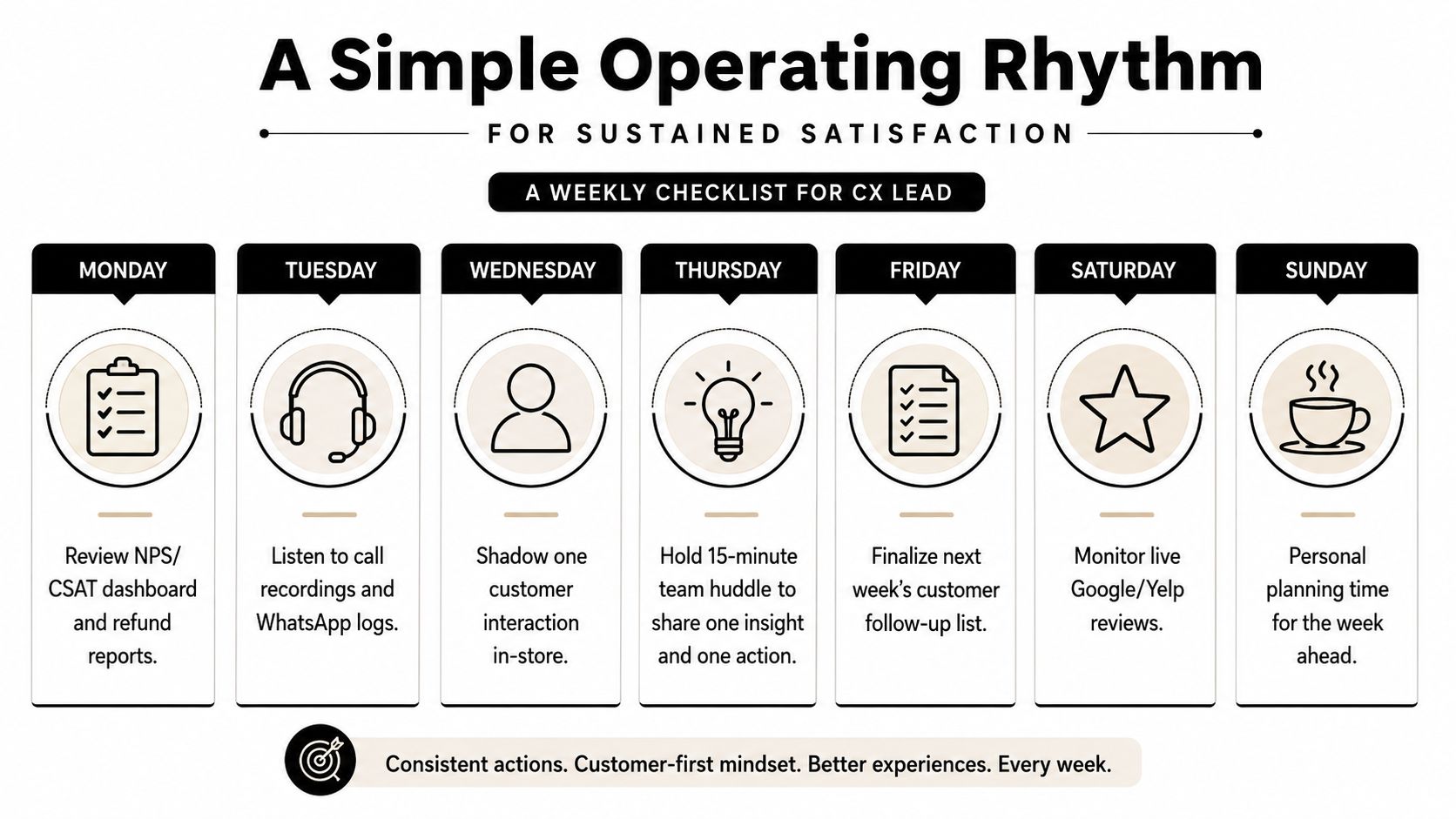
A satisfaction programme survives when one CX lead can run it without turning every day into a reporting exercise. Use a fixed weekly rhythm and assign one owner to each action.
Monday: Hold a KPI stand-up covering CSAT, NPS and refund rate from the POS and feedback tools.
Tuesday: Listen to selected call recordings and review WhatsApp logs for repeated friction.
Wednesday: Walk the shop floor and focus on the top complaint cluster from the previous week.
Thursday: Run a 15-minute team huddle with one insight and one assigned action.
Friday: Review survey responses and finalise the next customer follow-up list.
Saturday: Meet the buyer or category owner about quality issues customers have flagged.
Sunday: Plan stock, staffing and messaging against the seasonal calendar.
Use one diagnostic for the programme
The most useful diagnostic is the rolling 12-week correlation between first-visit CSAT and 60-day repeat purchase. A correlation below 0.4 means satisfaction scores are noise. A level above 0.6 means the programme is compounding and the budget has a defensible connection to customer behaviour.
Those thresholds are operating rules, not universal laws. The value comes from watching the relationship over time and checking whether actions taken on Monday change what customers do later.
Dubai's public-service programmes show why closed-loop measurement matters. Dubai government entities reported average customer happiness of 93% in 2023, up from 86% in 2022, while Digital Dubai reported a 96% Happiness Index in 2023 (Gulf News coverage of the UAE Customer Happiness Index). DEWA later reported an Instant Happiness Index of 98.9% in 2025, a Customers of Determination Index of 98.02% and 100% complaint resolution in 2025, linking strong outcomes to complaint closure and channel monitoring (DEWA customer happiness update).
IFM Gourmet Food Store offers authentic Italian ingredients, artisanal delicacies, fine chocolates, premium pantry staples and curated hampers for home dining, celebrations and corporate gifting. Visit IFM Gourmet Food Store to choose products for your next occasion and judge the experience against the standards that matter, clear value, reliable quality and thoughtful fulfilment.

Comments