
Green Tea Powder in Dubai: A Practical Guide

You're standing in a Dubai kitchen with three tins in front of you. One says “matcha”, another says “green tea powder”, and a third promises a “matcha latte”. They may all look green, but they can contain very different ingredients, deliver different flavours, and suit completely different recipes.
That confusion is understandable. Green tea powder is not one tightly defined product. It's a broad shelf category that can include finely milled Japanese tea, powdered sencha, ground gyokuro, flavoured drink mixes, and blends where sugar or milk powder appears before tea on the ingredient list. The useful question isn't just whether a product is green. It's what kind of powder is inside the package, and what do you want to do with it?
What Green Tea Powder Really Means for Dubai Shoppers
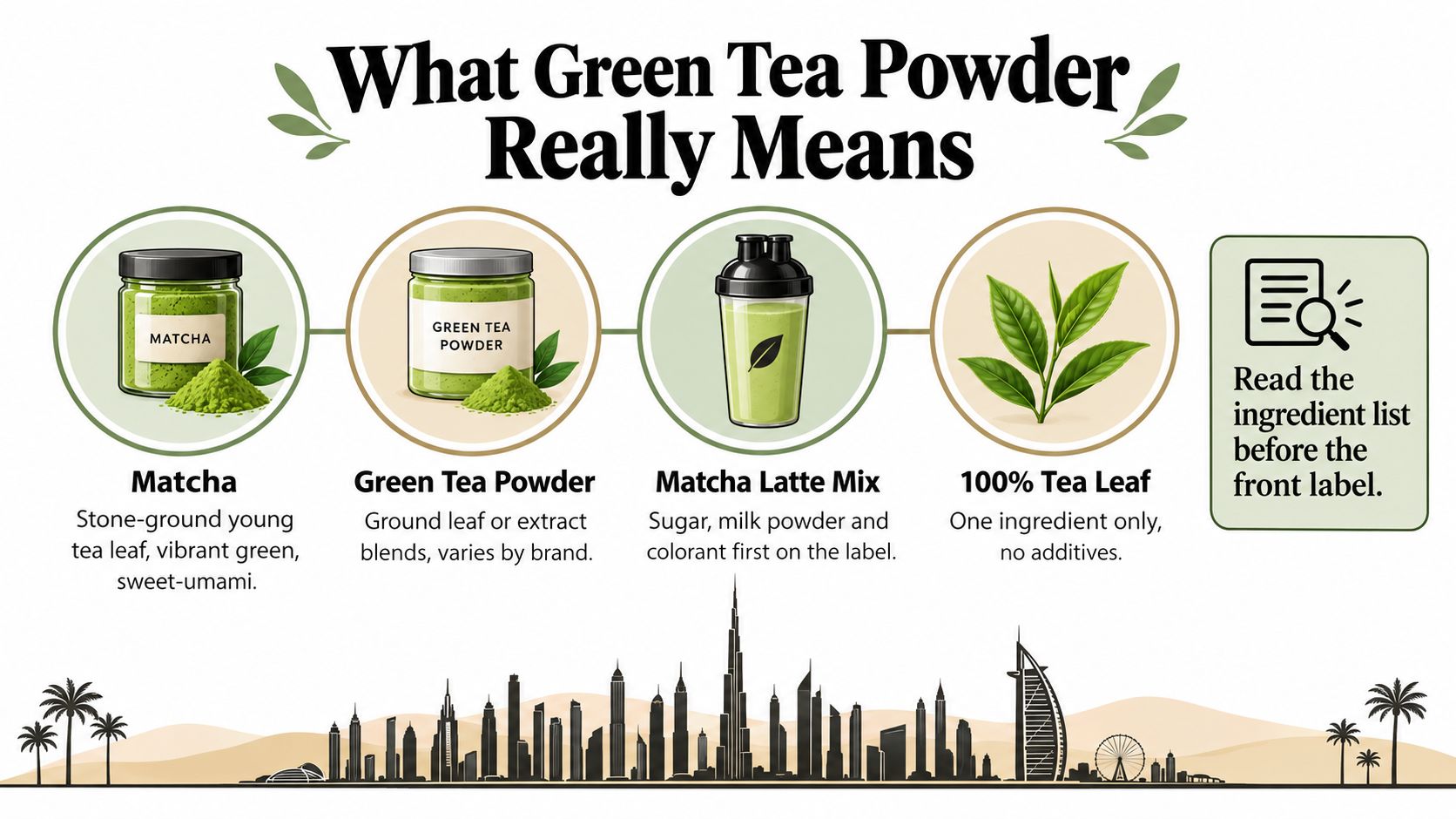
Green tea powder is best understood as an umbrella term. At one end sits matcha, traditionally made from shade-grown tencha that is steamed, dried, stripped of stems and veins, then finely milled. At another sits ground sencha or gyokuro, which can have a more grassy, yellow-green character. Some products are labelled green tea powder, while others are latte mixes containing tea alongside sweeteners, milk powder, flavourings, or colourants.
The front label can suggest one thing while the ingredient list reveals another. A jar with a matcha-coloured design may contain a small amount of tea and a much larger proportion of sugar or creamer. A plain-looking pouch may contain nothing but ground tea leaf. Read the back before judging the front.
Why the distinction matters in the UAE
The UAE depends heavily on overseas tea supply. A JETRO survey of the UAE tea market estimated total tea consumption at approximately 16,000 tonnes annually in September 2020. Black tea represented roughly 94 to 95% of consumption, while green tea and herbal teas together accounted for about 5%, or approximately 800 tonnes per year.
The same survey recorded UAE imports of green tea under HS codes 090210 and 090220 at approximately US$17 million in 2017 and US$13.9 million in 2020, a reduction of about 18%. China was the largest supplier in 2019, with exports valued at approximately US$4.4 million, while Japan's exports were approximately US$310,000. These categories cover green tea generally, not matcha powder alone, but they show the supply environment in which powdered green tea reaches Dubai shelves.
A simple first decision
Ask three questions:
Is it pure tea? Look for a short ingredient list, ideally only green tea.
Is it designed for drinking or cooking? A smoother powder may suit water or milk, while a stronger culinary powder may perform better in baking.
Can the seller explain its origin and handling? Heat, humidity, oxygen, and long storage can affect aroma, colour and flavour.
Price, vivid colour and words such as “premium” don't prove what's in the tin. Treat the label as the starting point, not the conclusion.
Matcha, Sencha Powder, and Drink Mixes Compared
Three products commonly share the green tea powder shelf, but they behave differently in a cup.
Matcha is the most specific category. It's associated with shade-grown tencha and fine milling, and it's intended to be suspended in water or milk rather than steeped and discarded. The flavour can be creamy, vegetal, umami-rich and lightly bitter. A good matcha can stand on its own, although culinary versions are often chosen for lattes, desserts and sauces.
Sencha or gyokuro powder may contain ground tea leaf without following the full tencha process. Its colour can be more yellow-green, and its flavour may lean towards fresh grass, steamed greens or a sharper tea character. It can be a sensible choice when you want tea flavour in a recipe without paying for a powder intended for a ceremonial bowl.
Pre-mixed drink powder is a different proposition altogether. It may be built around sugar, milk powder or non-dairy creamer, with green tea or matcha contributing colour and flavour. It can be convenient, but it shouldn't be treated as interchangeable with pure tea powder.
Attribute | Matcha, ceremonial or culinary | Sencha or gyokuro powder | Pre-mixed drink powder |
|---|---|---|---|
Origin leaf | Usually tencha for authentic matcha | Ground sencha, gyokuro or blended green tea leaf | Tea blended with sugar, milk powder, creamer or flavourings |
Processing | Shade-growing, steaming, drying and fine milling may be stated | Processing varies by leaf and producer | Industrial blending and flavour formulation |
Colour | Often deep green, though colour varies by quality and age | Commonly yellow-green to medium green | May be strongly coloured by tea, added ingredients or colourants |
Caffeine per gram | Product-specific, confirm with supplier testing | Product-specific, confirm with supplier testing | Product-specific, often affected by tea extract quantity |
Typical price in AED | Varies by origin, harvest, grade and documentation | Varies by origin and milling | Varies by formula, brand and pack size |
Best kitchen use | Whisked tea, simple lattes, desserts and gelato | Cooking, tea drinks and recipes with a grassy profile | Quick sweetened hot or iced drinks |
Buying rule: if the first ingredient is sugar or milk powder, you're buying a drink mix, not a tin of pure matcha.
For shoppers comparing taste experiences rather than marketing language, Peak Performance matcha feedback can be a useful supplementary resource. It shouldn't replace checking the actual ingredient panel, importer details or supplier documentation for the product you're considering.
A recipe image such as this green tea pancake example also shows why the intended use matters. Baking can hide a powder's rougher texture or sharper bitterness, while a plain whisked drink exposes every weakness.
Brewing Green Tea Powder at Home
Powdered tea doesn't behave like loose leaves. You're not waiting for water to extract flavour and then removing the leaves. You're dispersing the leaf itself, so clumps, water temperature and serving size all affect the result.
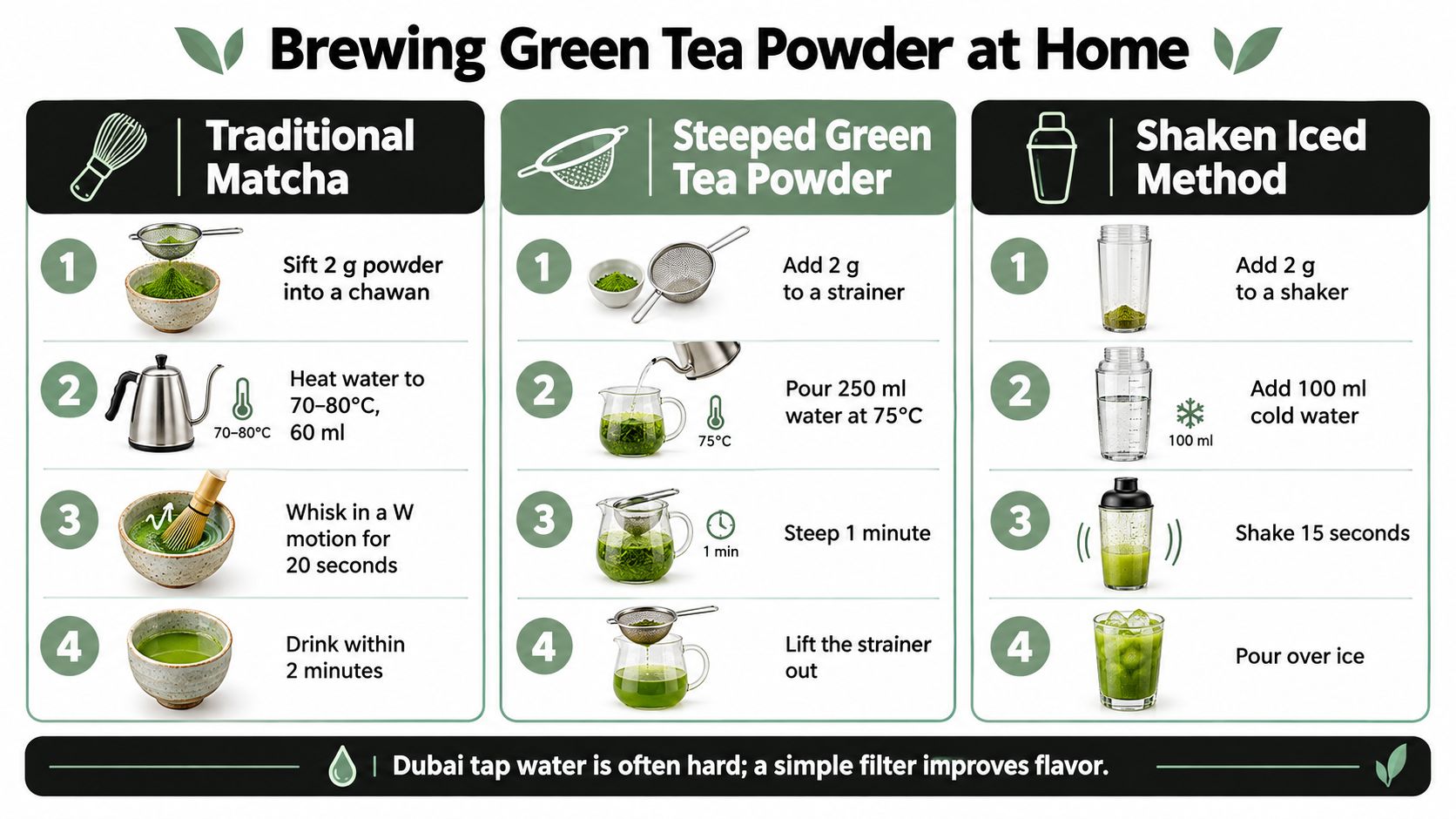
For a traditional drink, sift the amount recommended by the supplier into a bowl, add moderately warm water, and whisk briskly with a bamboo chasen or a small electric frother. A quick zigzag or W-shaped motion helps break up clumps and creates a smoother surface. Don't use freshly boiling water. Excess heat can push bitterness forward and flatten the fresh green aroma.
Three useful home methods
Traditional whisking works best when the powder is fine and the flavour is pleasant enough to drink directly. Sifting matters because compacted powder resists whisking, leaving dry pockets in the bowl.
Cold whisking is practical for an iced latte. First combine the powder with a small amount of cool or slightly warm liquid to make a smooth paste. Add cold water or milk gradually, then pour over ice. This method reduces floating clumps and lets you control sweetness separately.
Culinary mixing requires a different technique. Don't scatter dry powder across a large bowl of batter or cream. Instead, blend it with a small splash of liquid, then fold that paste into the main mixture. The result is more even colour and fewer bitter pockets.
Dubai's hot climate makes water temperature easy to misjudge. A recently boiled kettle can be far hotter than the range that brings out matcha's softer notes, while hot tap water may also be unsuitable for delicate preparation. Let boiled water cool, or use a thermometer when you're testing a new powder.
For a separate preparation walkthrough, Pep Tea's home matcha tutorial offers another practical reference. Keep your whisk clean and dry, and rinse it without leaving tea residue to harden between the bamboo tines.
Culinary Uses from Drinks to Gelato and Desserts
A useful green tea powder earns its place in a Dubai kitchen when it can move beyond one latte. Start with a drink where you can see how the powder behaves, then use the same ingredient in a dessert or frozen preparation.
For an iced matcha latte, whisk the powder into a small amount of warm water, then add cold milk and ice. Oat, dairy and nut-based milks each soften bitterness differently, so adjust sweetness only after tasting the tea and milk together. A citrus cooler takes a brighter route. Combine a small amount of powder with warm water, then add sparkling water, lemon and orange slices. Citrus can lift a grassy tea profile without requiring a heavy syrup.
A short, concentrated serving is less forgiving. Use a powder with a clean aroma and mild finish, because water alone won't disguise stale, dusty or aggressively bitter notes.
Desserts need balance
Matcha works well in financiers, madeleines, sponge cakes, cookies, panna cotta and cheesecake. Sugar and fat soften the tea's sharper edges, while the powder contributes colour and a distinct vegetal flavour. Start with the quantity recommended for the specific product, then keep notes. A stronger culinary powder may need less than a pale, mild blend, but colour alone won't tell you how bitter it will taste.
Add the powder off the heat when possible. Bringing a matcha mixture to a prolonged high temperature can change its aroma and colour. For custards, creams and gelato bases, make a smooth paste first, then incorporate it once the mixture has cooled from cooking.
The Dubai gourmet scene also makes green tea powder a natural partner for frozen desserts. IFM Gourmet Dubai is a UAE-based luxury online gourmet operation whose wider range includes premium teas, fine chocolates, cakes, gelato, artisanal sweets, savoury foods and curated hampers. In a gelato base, milk fat and sugar can carry matcha evenly and soften its grassy edge. Pistachio and white chocolate are particularly useful pairings because their richness supports the tea without erasing it.
A simple plating cue works well in a restaurant-style dessert: keep the main portion pale and creamy, then finish with a restrained green tea dusting or a thin matcha glaze. For a berry-led frozen dessert, this wild berry sorbet reference shows the kind of contrast that can make a green tea garnish look deliberate rather than decorative.
For a visual recipe demonstration, use the following video as a preparation reference.
Savoury applications are simple: try matcha salt with grilled vegetables, whisk a little into softened butter, or finish labneh with tea powder, olive oil and citrus zest.
Understanding Ceremonial, Premium, and Culinary Grades
The words ceremonial, premium and culinary appear frequently on UAE shelves, but they don't form a universal legal grading system. Outside Japan, these labels are often commercial descriptions rather than protected guarantees. The producer's origin information, leaf material, processing notes, freshness and test documentation tell you more.
Ceremonial matcha is generally presented as the smoothest option for drinking with water. Producers may describe young, shade-grown tencha, a fine grind, vivid colour and a sweeter umami profile. Culinary matcha is usually selected for baking, gelato, smoothies and lattes, where sugar, dairy, chocolate or fruit share the stage. “Premium” or “latte grade” can sit between those uses, but the term alone doesn't tell you the leaf source.
Grade | Leaf source | Best use | Typical Dubai price, 20 g |
|---|---|---|---|
Ceremonial | Often described as young, shade-grown tencha | Plain whisked tea and lightly flavoured drinks | Varies by origin, harvest and documentation |
Premium or latte grade | Producer-defined blend or harvest description | Milk drinks and everyday whisking | Varies by brand and specification |
Culinary | Often selected for a stronger flavour in recipes | Baking, gelato, sauces and smoothies | Varies by leaf, milling and pack format |
A price can be a clue, but it isn't proof. The supplied market guidance gives above AED 80 per 20 g as a typical reference for ceremonial-style products, but a high price can't compensate for missing origin, batch information or testing. Treat it as one signal among several.
Three practical rules
Choose the purpose first. If you'll drink the powder with water, prioritise aroma, texture and finish. If it's going into a cake, a versatile culinary product may offer better value.
Smell before buying when possible. Fresh tea should suggest clean grass, greens or a gentle savoury note. A flat, dusty or stale smell deserves caution.
Use colour as a hint, not a verdict. Deep green can indicate young leaf and careful handling, but colour can also be influenced by storage or added ingredients.
For an example of how preparation and flavour are discussed around a named matcha product, see Ujido matcha taste and preparation. Then return to the actual UAE pack and verify its own information.
Authenticity, Safety, and What to Verify Before You Buy
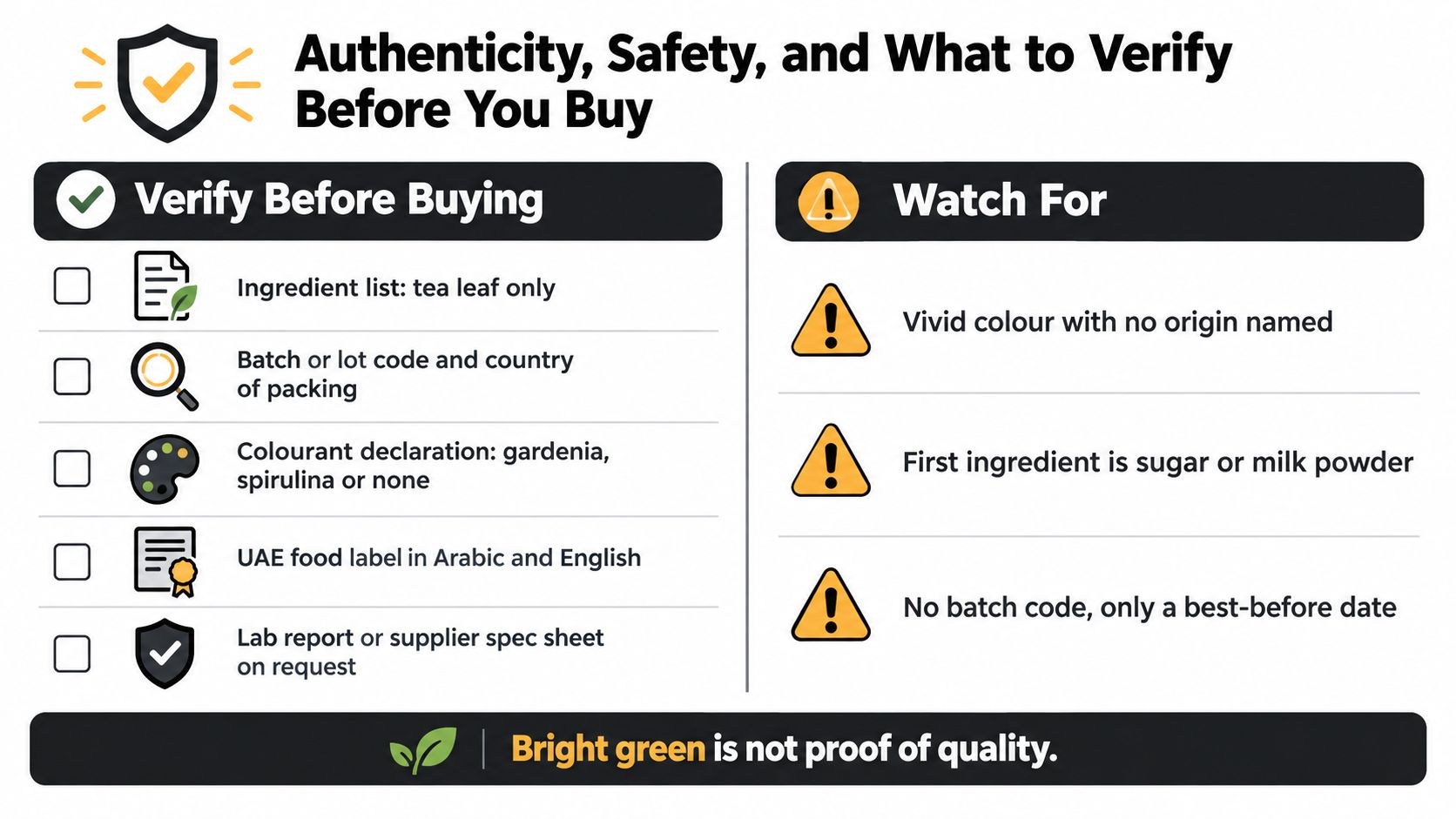
“Green” sounds reassuring, but it isn't a safety certificate. A bright colour may reflect fresh tea, careful processing, or added ingredients. Some bulk products can include approved colourants such as gardenia or spirulina, so the ingredient list matters more than the shade in the cup.
The UAE's tea supply is import-dependent, which makes traceability particularly important. A retailer should be able to identify the country and producer, explain the batch or lot, and provide a credible certificate of analysis where available. For powdered products, useful testing may cover pesticide residues, heavy metals and microbial quality.
Read the package in the right order
Start with the ingredient list. “Green tea” or “matcha” as the only ingredient gives you a very different product from a mix where sugar, milk powder or creamer appears first. Next, look for the country of origin, producer or packer, importer details, net weight, lot code and best-before date.
A UAE-compliant label and clear importer information provide useful accountability. If the product has been covered with a re-sticker, check whether the original information remains readable and whether the local details are complete. An unmarked tin, a missing importer, or a product that the seller can't explain should make you pause.
The UAE matcha market overview also highlights the importance of conformity, residue control, documentation and handling for imported matcha. Those checks matter more than the word “ceremonial” printed on the lid.
Practical rule: a vivid green powder with no named origin, no lot code and no supporting documentation is still an unknown product.
Before paying, ask:
What is inside? Confirm the ingredient list and whether colourants or sweeteners are present.
Can it be traced? Check the origin, producer, importer and batch or lot code.
How was it tested and stored? Ask whether a supplier specification or certificate of analysis is available.
Caffeine, Catechins, and How UAE Buyers Should Choose
Powder changes the way you think about tea. With a conventional infusion, much of the leaf remains in the pot or strainer. With matcha and other suspended powders, you consume the dispersed leaf, so the amount used in the bowl, latte, dessert or smoothie becomes central to your caffeine decision.
Caffeine content varies with cultivar, shading, leaf material, particle size and preparation. A product label may not provide a precise figure, so don't treat every green powder as interchangeable. A sweetened latte mix can also encourage a larger drink without making the tea quantity obvious.
Dubai Municipality's technical guideline sets a caffeine benchmark of 200 mg per single dose for healthy adults who aren't pregnant or nursing, and 400 mg per day in divided doses. The guidance is for caffeine-containing health supplements and doesn't establish the caffeine concentration of a particular green tea powder, so professional kitchens and retailers should use supplier information or product-specific laboratory testing where possible. See the Dubai Municipality technical guideline for health supplements for the regulatory reference.
Catechins need more than a colour check
Green tea contains analytically important catechins including EGCG, EGC, ECG and EC. Their availability can change with heat, oxygen, moisture, grinding and storage. Technical research has shown that extraction conditions can produce a laboratory result of 243 ± 7 mg gallic-acid equivalents per gram under a specific optimised ultrasonic process, but that result isn't a guaranteed composition for retail powder. The technical literature on green tea extraction and catechins explains why batch-specific analysis matters.
Use a simple decision path:
Morning focus: choose a pure powder with clear serving guidance and account for coffee consumed the same day.
Pre-workout or active mornings: avoid assuming a tea label means low caffeine. Check the powder mass and any added extract.
Dessert work: choose culinary powder and calculate how much tea goes into the whole recipe, not just one portion.
Caffeine-sensitive buyers: use a smaller serving, choose a naturally caffeine-free alternative where appropriate, or avoid late-day use.
Pregnant or nursing consumers, people taking medicines, and anyone with strong caffeine sensitivity should seek individual medical guidance rather than relying on a universal serving rule. If sleep is easily disrupted, late-afternoon coffee culture and repeated matcha drinks deserve particular attention.
Buying and Storing Green Tea Powder in the UAE
A tin can lose quality quickly in Dubai's heat, humidity and bright storage conditions. Buy the amount you can use while the aroma is still fresh, especially if you're choosing a drinking-grade powder rather than a product for baking.
At delivery or checkout, check the following:
Packaging: choose a sealed, opaque container with intact labelling.
Traceability: look for the country of origin, producer, importer, batch or lot code and best-before date.
Ingredients: confirm whether the pack contains pure tea or a sweetened mix.
Storage history: ask how the product was protected from heat, light, oxygen and humidity.
Purchase timing: buy a small matcha-grade pack if you won't open it regularly.
Keep an unopened tin in a dark, cool pantry. After opening, close it tightly and use a clean, completely dry spoon. Refrigeration can help extend freshness, but the container must remain sealed while it warms to room temperature, or condensation can enter the powder. Never use a wet spoon.
Ceremonial-style powder is usually the least forgiving after opening because its delicate aroma and colour are central to the experience. Culinary powder can be more practical for frequent baking, where it's blended with flour, dairy, chocolate or fruit. If the powder smells stale, looks damp or has developed hard clumps, replace it rather than trying to rescue the flavour.
Visit IFM Gourmet Food Store to explore a Dubai-based selection of premium teas, artisanal ingredients, fine chocolates, gelato and dessert products that can support both everyday home cooking and more polished green tea recipes. Use the product label and storage guidance in this article to choose a powder that matches your drink, dessert or gifting plan.

Comments