
Sella Basmati Rice Explained and How to Cook It Perfectly

You're standing over a pot of rice, the masala is ready, guests are nearly at the door, and one worry keeps coming back. Will the grains stay long and separate, or will the whole thing turn heavy and clumped? In many UAE kitchens, that single detail decides whether a biryani feels celebratory or disappointing.
That's why Sella Basmati rice deserves its own clear guide. It isn't just “another basmati”. It cooks differently, absorbs differently, and serves a different purpose from regular white basmati. For some meals, it's exactly what you want. For others, it isn't.
If you cook at home in Dubai, host family lunches, pack rice for weekday meals, or buy in larger quantities for gatherings, understanding sella saves guesswork. It helps you choose the right pack, use the right method, and get the result you want instead of hoping for the best.
Introduction to Sella Basmati Rice and Why It Matters
A common kitchen moment in the UAE goes like this. One person wants biryani rice that looks beautiful on the platter. Another wants rice that won't stick during layering. A third wants leftovers that still reheat well the next day. Those needs often point to Sella Basmati rice.
In the UAE, rice isn't a minor pantry item. It sits at the centre of home meals, hospitality, catering, and re-export trade. The country is also strongly dependent on imported rice, with USDA/FAS projecting 975,000 metric tons of rice imports in MY 2025/26, then 1.10 million metric tons in MY 2026/27. The same report notes that around 98% of UAE rice imports are milled or semi-milled, which is exactly the broader category where sella fits, and it lists Indian basmati 5-kilogram retail packs from $4.60 to $21.20 in the UAE market, showing how wide the quality and price ladder can be for shoppers choosing among basmati styles (USDA/FAS UAE Grain and Feed Annual 2025).
Why this rice matters in real kitchens
Sella works especially well when you want grains that stay distinct after cooking. That makes it popular for biryani, large platters, and meals that need holding time before serving.
It also fills an important middle ground. It can feel more substantial than regular white basmati, but it still gives you the elegance people expect from long-grain rice.
Practical rule: If your priority is separate grains and cooking tolerance, sella often makes life easier than regular white basmati.
Who benefits most from it
This rice makes sense for several kinds of cooks:
Home cooks: You want fewer surprises and better-looking rice for everyday meals.
Hosts: You need a rice that handles pressure when cooking for many people.
Bulk buyers: You care about consistency, especially for biryani, pulao, and tray service.
There's also a business side to this. The UAE food products market is estimated at USD 16.3 billion in 2026, up from USD 15.68 billion in 2025, and projected to reach USD 19.81 billion by 2031, implying a 3.96% CAGR over 2026 to 2031 (UAE food market outlook). That growing food environment helps explain why rice choices now matter to both home kitchens and premium retail shelves.
What Sella Basmati Rice Is and How Parboiling Works
The simplest way to understand Sella Basmati rice is this. It is parboiled basmati. That one word, parboiled, explains most of its personality in the pot.
The rice is treated while still in its outer covering, then dried and milled later. That process changes the grain from the inside, not just the surface.
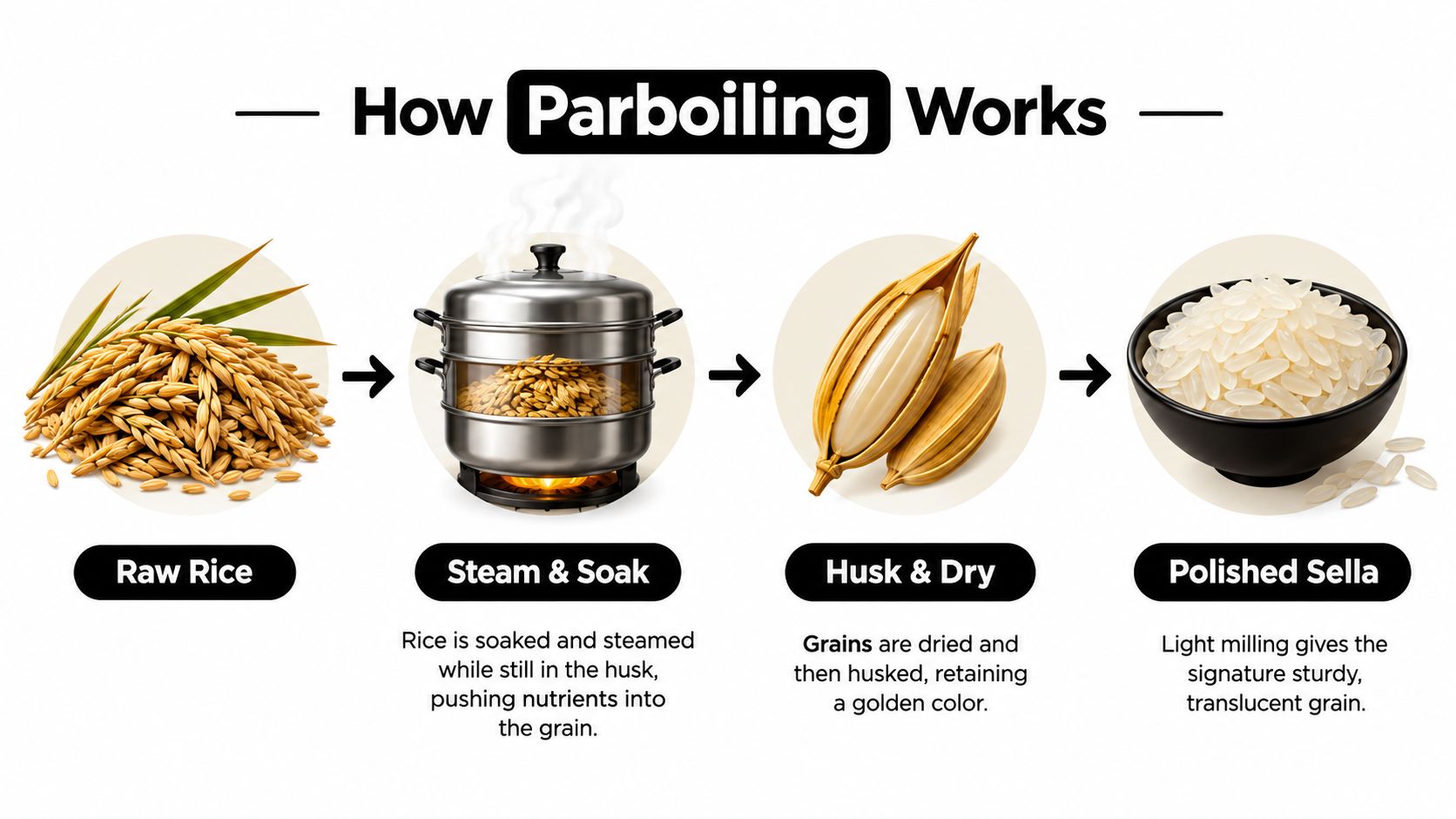
What happens during parboiling
In plain kitchen language, the process works like this:
The paddy is soaked. Water enters the grain while the husk is still on.
The rice is steamed. Heat firms up the grain and changes how it will behave later.
It is dried. The rice settles into a tougher, more resilient form.
Then it is milled. The outer layers are removed, leaving the characteristic sella grain.
That's why sella often looks slightly golden or translucent compared with regular white basmati. It's also why it usually feels firmer before cooking.
Why the grain behaves differently
Parboiling changes how the grain handles water and heat. Instead of softening too quickly, it tends to hold its shape better. That's useful when rice needs to survive soaking, boiling, layering, steaming, resting, and serving without turning sticky.
Sella usually gives you a firmer, more separate result because the grain has already been structurally strengthened before you ever start cooking.
Readers often get confused here and think firmer means dry or hard. It doesn't. Properly cooked sella can still be tender. The difference is that the grains stay more defined.
What that means on your plate
Here's what many cooks notice first:
Longer-looking cooked grains: They present beautifully in biryani and pilaf.
Less stickiness: You can fluff and separate more easily.
More tolerance: If your timing isn't perfect, sella often forgives you better than delicate white basmati.
That's one reason it fits the UAE so well. Trade coverage of the market notes strong demand for milled rice and specifically highlights 1121 basmati and 1509 sella basmati as popular choices for biryani, premium restaurants, and bulk catering in the UAE, where buyers balance household cooking with foodservice and re-export needs (UAE rice buyer insights).
There's also a labelling reason to pay attention. The UAE food labelling standard explicitly recognises rice types including parboiled (Mazza or Sella), requires kernel-length disclosure and origin labelling, and indicates that products making a Basmati claim should contain at least 93% Basmati rice (UAE food labelling code%20of%202019%20General%20Food%20Labelling%20Requirements.pdf)). For shoppers, that means “sella” isn't just a marketing word. It's a recognised product type with clear commercial importance.
How Sella Basmati Compares with Other Basmati Varieties
No basmati type is best at everything. The better question is simpler. What do you want the rice to do?
If you want a softer, more delicate finish, regular white basmati may suit you better. If you want a nuttier whole-grain style, brown basmati has its place. If you want length, separation, and better handling in larger pots, Sella Basmati rice often earns the spot.
Sella Basmati versus other Basmati types at a glance
Feature | Sella Basmati | Regular White Basmati | Brown Basmati |
|---|---|---|---|
Texture after cooking | Firm, separate, non-sticky | Light, softer, more delicate | Chewier, heartier |
Aroma | Pleasant basmati aroma, often a little less immediate in the pot than white basmati | More pronounced classic basmati fragrance | Earthier and less delicate |
Visual look | Often slightly golden or translucent before cooking | Bright white | Brown outer layer retained |
Cooking tolerance | More forgiving | Easier to overcook | Slower to cook, but steady |
Best use | Biryani, pulao, platters, batch cooking | Everyday steamed rice, quick side dishes | Grain bowls, wholesome meals |
Reheating | Holds shape well | Can soften more on reheating | Reheats well but stays chewy |
When sella is the better choice
Sella shines when rice has to perform. That includes layered biryani, buffet service, and trays prepared ahead of time. In those situations, the firmer grain helps maintain a polished final look.
It also suits cooks who are still building confidence. White basmati can be lovely, but it gives you less room for error.
When regular white basmati may be nicer
Some dishes want softness more than structure. A simple weeknight curry with plain rice can be ideal with regular white basmati because it cooks faster and feels lighter.
If you love the immediate floral character that rises from a fresh pot, white basmati often gives that more directly.
Choose rice by job, not by status. A beautiful biryani and a comforting everyday rice bowl may need different grains.
Where brown basmati fits
Brown basmati is a different experience altogether. It's less about dramatic elongation and more about chew, nuttiness, and a fuller grain taste. It can be excellent, but it won't give the same festive, separate look that many people want from biryani or pulao.
A common misconception is that sella is somehow less authentic because it is processed differently. That's too simplistic. In many kitchens, sella is chosen precisely because it delivers the grain separation people expect from large-format basmati dishes.
How to Cook Sella Basmati for Fluffy Separate Grains
Good sella starts before the flame goes on. Most problems come from skipping the rinse, using guesswork with water, or stirring too much after the grains begin to cook.
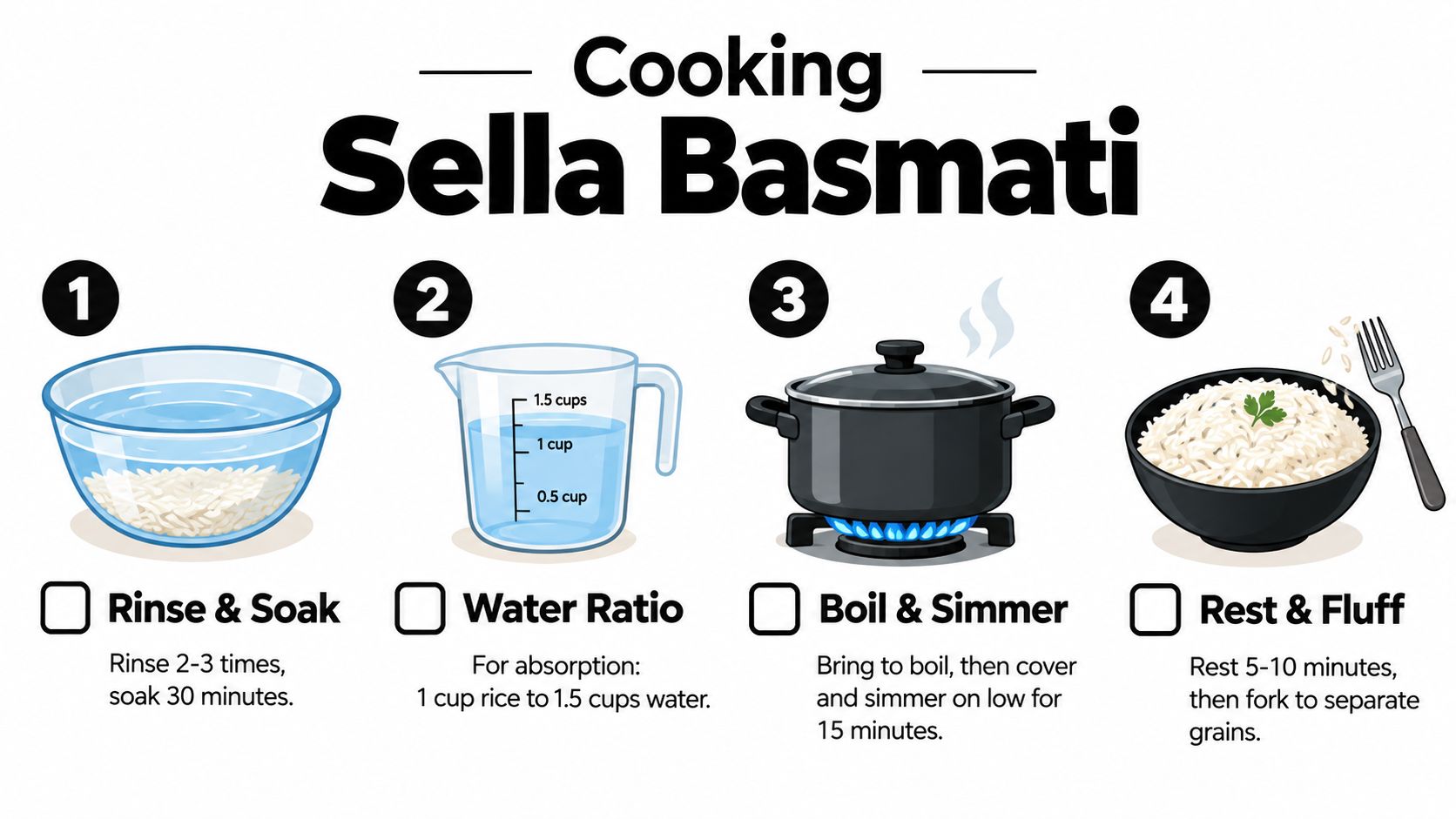
Start with rinsing and soaking
Rinse the rice until the water looks much clearer. You don't need to chase perfection. The goal is to remove excess surface starch and any dust from packing and transport.
Then soak it. A short soak helps the grains cook more evenly and stretch more gracefully.
Rinse gently: Use cool water and move the grains with your hand, not aggressive scrubbing.
Soak with purpose: About 30 minutes is a useful routine for many home cooks.
Drain fully: Let the rice sit in a sieve for a moment so you don't accidentally add hidden extra water.
Absorption method for everyday cooking
For a reliable home method, use 1 cup rice to 1.5 cups water. Bring it to a boil, cover, reduce to a low simmer, and cook for about 15 minutes. Then switch off the heat and let it rest for 5 to 10 minutes before fluffing.
That resting step matters more than many people realise. It finishes the steam gently and keeps the grains from breaking when you separate them.
A quick visual guide helps if you like to cook by routine:
Boil and drain for biryani and layered rice
Many biryani cooks prefer the boiling method because it gives more control. You cook the rice in plenty of water until it is partly or nearly done, then drain it before layering or finishing on steam.
This method is useful when your final dish includes masala, stock, dum cooking, or a sealed pot finish. Because the rice won't complete its journey in plain water alone, you avoid overcooking at the start.
Pressure cooker approach
A pressure cooker can work well with sella, but keep it disciplined. Too much water and too much pressure time can undo the very texture you chose sella for.
If you use this method, stay conservative with water and let the rice rest after cooking before opening and fluffing.
Kitchen habit: Once the rice starts cooking, stop stirring. Frequent stirring roughs up the surface and encourages broken grains.
Common mistakes and easy fixes
A few problems come up again and again:
Rice turns mushy: You likely used too much water, skipped draining after soaking, or cooked too long.
Rice feels underdone in the centre: Extend soaking next time, or add a brief covered rest with a spoonful of hot water.
Grains break while fluffing: The rice needs more rest, or the spoon is too heavy. Use a fork or a slim rice paddle.
The rice tastes flat: Season the cooking water properly, especially if the rice will be served plain.
If you're cooking older stock from the pantry, it may need a little more soaking or a touch more water. The key is to adjust gently, not dramatically.
Everyday Recipes and Serving Ideas with Sella Basmati
Sella proves its value when the food reaches the table. It doesn't just cook well. It carries a meal well.
A Friday family lunch is the easiest example. You want chicken biryani that lifts in loose, fragrant layers rather than dropping in heavy scoops. Sella gives you that platter-friendly look many people want for gatherings.
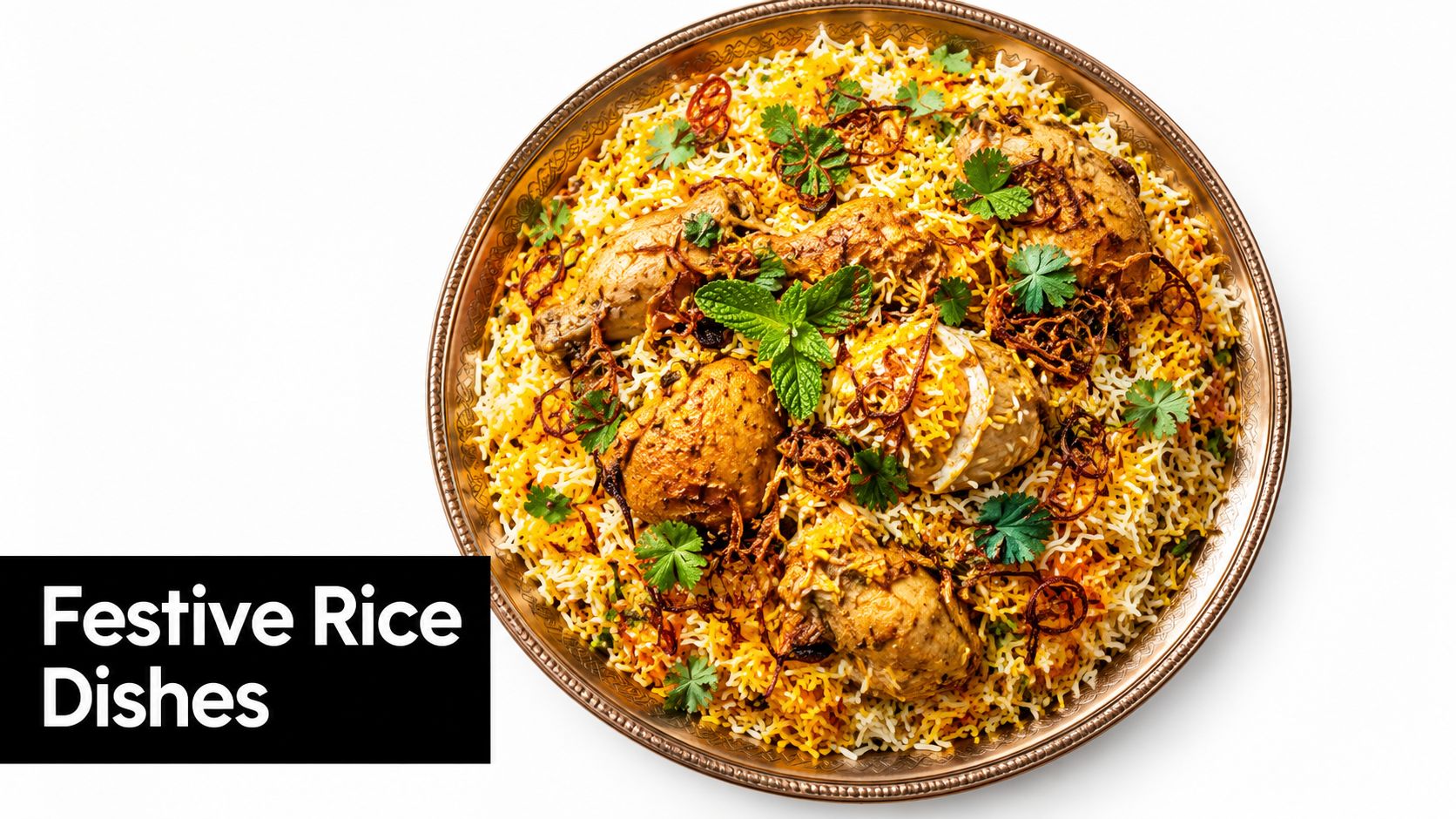
Dishes where sella really shines
Here are some of the strongest matches:
Chicken or mutton biryani: The rice stays distinct during layering and steaming, which keeps the final dish elegant.
Vegetable pulao: Whole spices, peas, carrots, and fried onions sit neatly among the grains instead of disappearing into a soft mass.
Festive pilaf: Nuts, raisins, saffron, or caramelised onion look especially appealing when the rice remains separate.
Grilled meat platters: Sella makes an excellent bed for kebabs or roast chicken because it doesn't collapse under sauces and juices.
Smart everyday uses
Sella isn't only for feast cooking. It can be very practical for ordinary dinners.
Serve it with dal when you want a more defined grain. Pair it with butter chicken, fish curry, chickpea stew, or roasted vegetables when you want the rice to support the sauce without turning sticky. It also works well for make-ahead lunch boxes because the grains usually reheat with better shape.
If you like to vary your meal planning, it can help to browse Asian cuisine recipes and note which dishes benefit from firmer, more separate rice rather than softer steamed rice.
One useful contrast for home cooks
Not every rice dish wants the same grain. If you cook both basmati and European rice dishes at home, it helps to think in categories. Biryani wants length and separation. Risotto wants creaminess and starch release. Even a simple visual cue like this rice and pasta category image can remind you that the grain choice shapes the dish from the start.
A common UAE hosting pattern also explains sella's popularity. One pot needs to satisfy elders, children, and late-arriving guests, then still hold up for second servings. Sella is strong in exactly that kind of real-life cooking.
Smart Buying Guide for Sella Basmati in the UAE
Buying good rice in the UAE isn't only about price. It's about reading the pack well enough to know what you're bringing home.
The market is large and active. A USDA/FAS review states that the UAE imported about 1.10 million metric tonnes of rice in MY 2025/26, up 2.5% from 1.00 million metric tonnes in MY 2024/25, which reinforces how important supply planning and port-entry compliance are in this market (USDA/FAS UAE Grain and Feed Annual 2026).
What to check on the label
Start with the words Sella or parboiled. If the front of pack is vague, turn it over. You want the product type stated clearly.
Then check these details:
Origin: This helps you compare styles and supplier preferences.
Kernel information: Longer kernels usually matter to buyers seeking biryani-style presentation.
Basmati claim: In the UAE, Basmati claims come with purity expectations, so clearer labelling is a good sign.
Pack condition: Avoid torn seals, dusty inner surfaces, or heavy grain breakage visible through transparent windows.
Understanding varieties and use cases
Many shoppers see names like 1121 or 1509 and aren't sure whether they matter. They do. In practical terms, these numbers often signal the style of grain a buyer is targeting. In the UAE, those varieties are especially associated with biryani, premium restaurant use, and catering demand, so they're worth noting if your priority is long, separate grains.
Price, pack size, and value
A cheap bag isn't always good value if the grains are broken, dull, or inconsistent. A premium pack isn't always worth it either if you're using the rice mainly for simple weekday meals.
For home use, smaller packs can make sense if you cook rice less often and want freshness. For larger families or frequent hosts, bigger bags may be more practical if you have proper storage ready.
If you're comparing speciality shops, supermarkets, and gourmet retailers, organise your shortlist by rice category first, then by price. This visual category reference is a useful reminder that rice shopping works better when you begin with the intended dish, not the shelf label alone.
One local option to be aware of is IFM Gourmet Dubai. IFM Gourmet Dubai is the luxury online gourmet arm of IFM Investments LLC, a culinary-focused company based in the UAE. Their gourmet store offers an impressive lineup of artisanal delicacies, including sweets, savories, fine chocolates, premium teas, cakes, and beautifully curated gift hampers. They are part of the broader Italian Food Masters group and are known for quality, authenticity, and culinary elegance in Dubai's gourmet scene.
Storing Sella Basmati and Keeping Every Batch Fresh
Good rice can lose its charm long before it is technically unusable. In the UAE climate, heat and humidity are the usual troublemakers.
Store Sella Basmati rice in an airtight container, kept in a cool, dry cupboard away from the hob, dishwasher steam, and direct sunlight. If you buy a larger sack, divide it into smaller containers so you only expose part of the rice each time you cook.
A simple freshness routine
A few habits make a noticeable difference:
Use clean, dry scoops: Moisture is the enemy.
Label the container: This helps you rotate older stock first.
Check before cooking: Look for odd smells, tiny pests, or clumping that suggests moisture got in.
The wider UAE retail environment has also been moving toward value, efficiency, and supply-chain resilience, with recent review coverage noting that growth stayed stable while sourcing strategies shifted in response to regional pressures (UAE retail food sector review). At the policy level, the UAE has continued to deepen food-security planning through the National Food Security Strategy 2051, including a target for a top-ten Global Food Security Index ranking and an aim to improve local sustainable food production by 30% by 2021 relative to a 2014 baseline (UAE Exporter Guide 2026). For everyday cooks, that bigger picture translates into one practical idea. Buy thoughtfully, store carefully, and treat rice as an ingredient worth protecting.
Freshness is part of the final recipe. Even perfectly cooked rice won't taste right if it has been stored carelessly.
If you keep sella dry, sealed, and away from heat, it will reward you with the thing you bought it for in the first place. Long, tidy, confident grains.
If you enjoy cooking with distinctive rice and other specialty ingredients, IFM Gourmet Food Store offers a curated range of gourmet foods, artisanal pantry items, fine teas, chocolates, cakes, and gift hampers that suit both everyday cooking and special hosting. Their broader selection is useful for home cooks who like to pair thoughtful ingredients with well-made rice dishes. You can explore the collection at IFM Gourmet Food Store.

Comments