
The Ultimate Guide to Salt Ice Cream Flavor and Texture
When you hear "salt ice cream," what comes to mind? If you're picturing a scoop that tastes like the ocean, think again. Adding a touch of salt to an ice cream base is actually a brilliant culinary move designed to enhance flavor, balance sweetness, and create a divinely smooth texture.
This isn't just some passing trend; it's a classic technique that turns familiar desserts like caramel and chocolate into truly gourmet experiences. That simple pinch of salt deepens and enriches their flavor profiles, making everything more complex and satisfying.
The Surprising Science of Salty Sweet Desserts
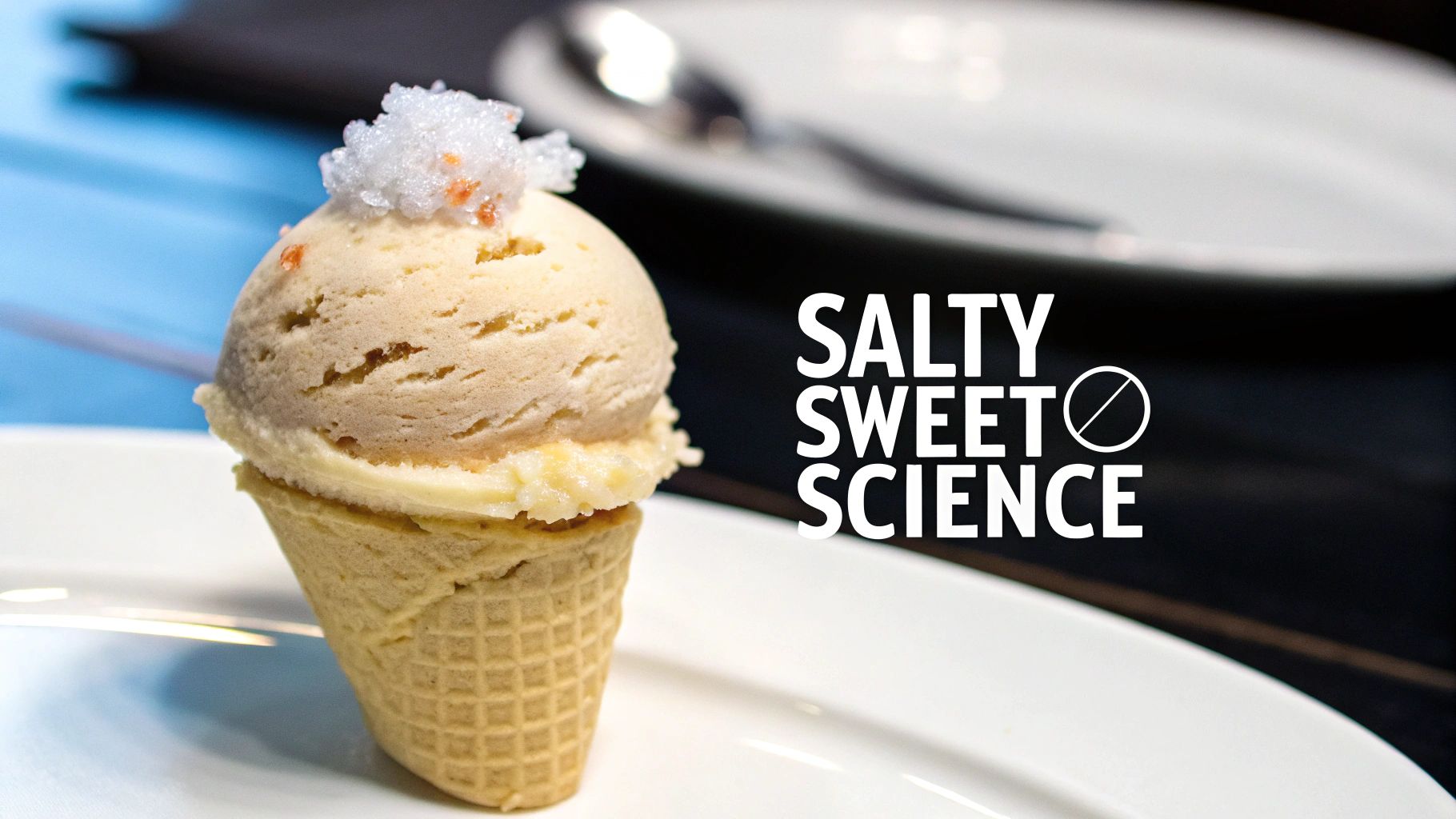
It might feel a little strange to add salt to something sweet, but it’s a time-honored secret rooted in pure flavor science. A delicate pinch can take a good treat and make it truly extraordinary, elevating it from simply sweet to a complex, layered delight.
This guide is here to show you why salt ice cream is so much more than a fad. It’s a technique that artfully plays with both taste and texture to create something you won't forget. We’ll get into how salt works its magic on a chemical level, giving you a creamier, smoother mouthfeel while making all the other flavors pop.
Unlocking a Deeper Flavor Experience
At its heart, salt is a master flavor enhancer. Its main job isn't to make the ice cream taste salty, but to dial down bitterness and turn up the natural sweetness of everything else in the mix. It works just like sprinkling a little salt on a ripe tomato to make it taste even sweeter. This same magic allows the more complex notes in your ice cream to really shine.
Balances Sweetness: Salt masterfully cuts through intense sugariness, leaving you with a more sophisticated, less cloying flavor.
Intensifies Flavors: It makes rich ingredients like dark chocolate, nutty pistachio, and deep caramel taste even more profound and satisfying.
Creates Contrast: That subtle savory touch provides a wonderful contrast that keeps your palate engaged with every single spoonful.
In the world of gourmet desserts, salt isn't just a seasoning; it's a tool for precision. It allows a chef to fine-tune the final flavour profile, ensuring every ingredient is tasted to its fullest potential.
As we dive into the world of salt ice cream, you'll discover the science, history, and craft behind this exceptional dessert. You’ll learn the secrets to perfecting your own creations at home using premium ingredients from artisanal suppliers like IFM Gourmet Dubai. As the luxury online arm of IFM Investments LLC, a culinary-focused company in the UAE, their gourmet store offers an impressive lineup of delicacies, known for quality, authenticity, and culinary elegance.
How Ancient Techniques Shaped Modern Ice Cream
While salted ice cream might feel like a recent gourmet trend, its story actually begins centuries ago. The thing is, salt wasn't just a flavor trick—it was the original technology that made frozen desserts possible long before we had freezers. This fascinating history starts not in a modern kitchen, but in the arid landscapes of ancient Persia.
The journey begins with an ingenious invention called the ‘yakhchāl’, a type of ancient evaporative cooler. These clever structures allowed Persians to make and store ice, even in the middle of the desert. But having ice was only half the battle. The real breakthrough was figuring out how to use that ice to freeze other liquids.
This is where salt came in. Early innovators discovered that mixing rock salt with ice created a super-chilling slurry. This simple act triggers an endothermic reaction, a process that pulls heat from its surroundings and causes the temperature to plummet far below the normal freezing point of water. This powerful principle was the key to creating the world's first sorbets and frozen treats.
From Necessity to Culinary Art
This brilliant technique of using salt to achieve a deep freeze gradually spread. In the rich culinary history of the Arab Emirates (AE), salt ice cream emerged as a unique treat, blending ancient Persian methods with modern Gulf innovation. We can trace this back to the 550 BC Persian yakhchals—underground ice storage chambers that Arabs adapted after conquering Persia around 632 AD. Early Arabs were pioneers in using rock salt mixed with ice to create the endothermic effect needed to freeze liquids, laying the groundwork for creamy desserts.
What started as a practical solution has since evolved into a celebrated culinary art. Today, the artisan ice cream scene in Dubai and across the UAE honors this legacy. Chefs are no longer using salt just to freeze their creations; they're using it to perfect them.
Salt's role has shifted from a functional tool for freezing to a sophisticated ingredient for enhancing flavor. It’s a beautiful example of how historical problem-solving can inspire modern gastronomic excellence.
The Modern Evolution of Freezing
The core science discovered centuries ago is still surprisingly relevant. That same endothermic reaction is the fundamental principle behind how traditional ice cream makers work, with a central canister surrounded by an ice and salt mixture. Of course, technology has come a long way since the yakhchāl.
As methods evolved, the development of the specialized commercial ice cream machine became essential for creating the textures and volumes we expect today. These machines offer precise temperature control and consistent churning, which is crucial for forming the perfect ice crystals that define high-quality gelato. This journey shows a direct line from ancient ingenuity to the smooth, luxurious scoops we savor now, connecting a simple historical necessity to a globally cherished dessert.
The Science Behind a Perfectly Smooth Texture
The magic behind salted ice cream's incredible creaminess isn't magic at all—it's simple chemistry. When you add salt to an ice cream base, you're doing much more than just adding flavor. You're fundamentally changing how the mixture freezes, and this is the real secret to achieving that professional, luxuriously smooth texture that melts beautifully on the tongue.
Think of salt as a traffic controller for ice crystals. Its most important job is a phenomenon known as freezing point depression. In simple terms, this means the salted mixture has to get much colder than a non-salted one before it can turn solid.
This extra-chilly environment is exactly what prevents large, crunchy ice crystals from forming, which are the main culprits behind an icy or grainy texture. By forcing the base to freeze at a lower temperature, salt encourages the formation of countless tiny ice crystals instead of fewer, larger ones. The result? A denser, richer, and noticeably silkier mouthfeel that defines premium gelato.
To really see what's happening under the hood, this table breaks down how salt works its magic during the freezing process.
How Salt Transforms Ice Cream Texture
Scientific Principle | Effect on Ice Cream | Resulting Sensory Experience |
|---|---|---|
Freezing Point Depression | The base must reach a lower temperature to freeze solid. | Prevents large, crunchy ice crystals, leading to a much smoother texture. |
Crystal Size Control | Promotes the formation of numerous, tiny ice crystals. | A denser, silkier mouthfeel that melts cleanly on the palate. |
Emulsion Stabilization | Helps fat and protein molecules bind together more effectively. | Enhances the perception of richness and creaminess. |
Longer Churning Time | The base stays liquid for longer in the ice cream maker. | Allows for more air to be incorporated, creating a lighter (yet still rich) final product. |
As you can see, salt isn't just a seasoning here; it's a structural architect, building the perfect foundation for a truly gourmet ice cream.
How Salt Enhances Richness and Mouthfeel
Beyond just managing ice crystals, salt also plays a vital role in how we perceive the richness of the ice cream. It subtly interacts with the fat globules and protein molecules in the dairy, creating a more cohesive and stable emulsion.
This improved structure does two key things:
Boosts Creaminess: It helps the fat distribute more evenly, which directly contributes to a smoother, more satisfying texture.
Amplifies Flavors: A more stable base is better at carrying flavors like vanilla, chocolate, or caramel to your taste buds, making them pop.
Essentially, salt helps all the ingredients work together more harmoniously. It transforms a simple dessert into a complex and decadent gourmet experience.
Salt's role in ice cream is a perfect example of kitchen science. It's not about making the dessert taste salty, but about using a natural mineral to physically perfect its structure and enhance its flavor.
The Impact on Freezing Time
One practical effect of freezing point depression is that a salted ice cream base will take longer to freeze solid. While this might sound like a drawback, it's actually a huge advantage during the churning process.
The extended churning time allows for more air to be incorporated into the base. Depending on your recipe, this can contribute to a lighter, yet still incredibly creamy, final texture.
These same principles of freezing and texture control are just as important in non-dairy alternatives. You can see similar techniques applied in treats like this stunning wild berries sorbet, where sugar and fruit solids are carefully balanced to control ice crystal size. Understanding this science gives you the power to troubleshoot any recipe and achieve consistently excellent results, whether you're using dairy or not.
Choosing the Perfect Salt for Your Recipe
Picking the right salt for your ice cream is a bit like choosing the perfect spice for a signature dish. The details matter—a lot. Not all salts are the same, and their unique textures and flavors can elevate your dessert from simply good to truly unforgettable.
Your first decision is how you want the salt to perform. Will it be mixed into the base to enhance flavors from within, or will it be sprinkled on top for that final, dramatic flourish? The answer changes everything.
Options like a high-quality New Mediterranean Sea Salt can offer subtle mineral notes that beautifully complement a creamy base. For chefs and artisans in the UAE looking for these kinds of premium ingredients, specialists like IFM Gourmet Dubai (part of the broader Italian Food Masters group) are renowned for their impressive lineup of artisanal delicacies, ensuring every creation is built on a foundation of quality.
Finishing Salts vs. Mixing Salts
Think of it this way: is the salt a background singer or the lead vocalist?
For Mixing Into the Base: Fine-grain sea salt is your go-to. It dissolves completely and disappears into the mix, guaranteeing a consistent flavor and perfectly smooth texture. Its clean, bright taste is exactly what you need to make the sweetness of a caramel pop or deepen the richness of a dark chocolate.
For a Finishing Touch: This is where you can get creative with texture. Flaky sea salts, like Maldon, or the delicate, moist crystals of fleur de sel add a fantastic crunch and an intense burst of salinity right before the first bite. They look beautiful and provide a stunning counterpoint to the ice cream's creamy smoothness.
This diagram helps visualize how salt works its magic, starting with the chemistry of freezing and ending with that perfect, scoopable texture.
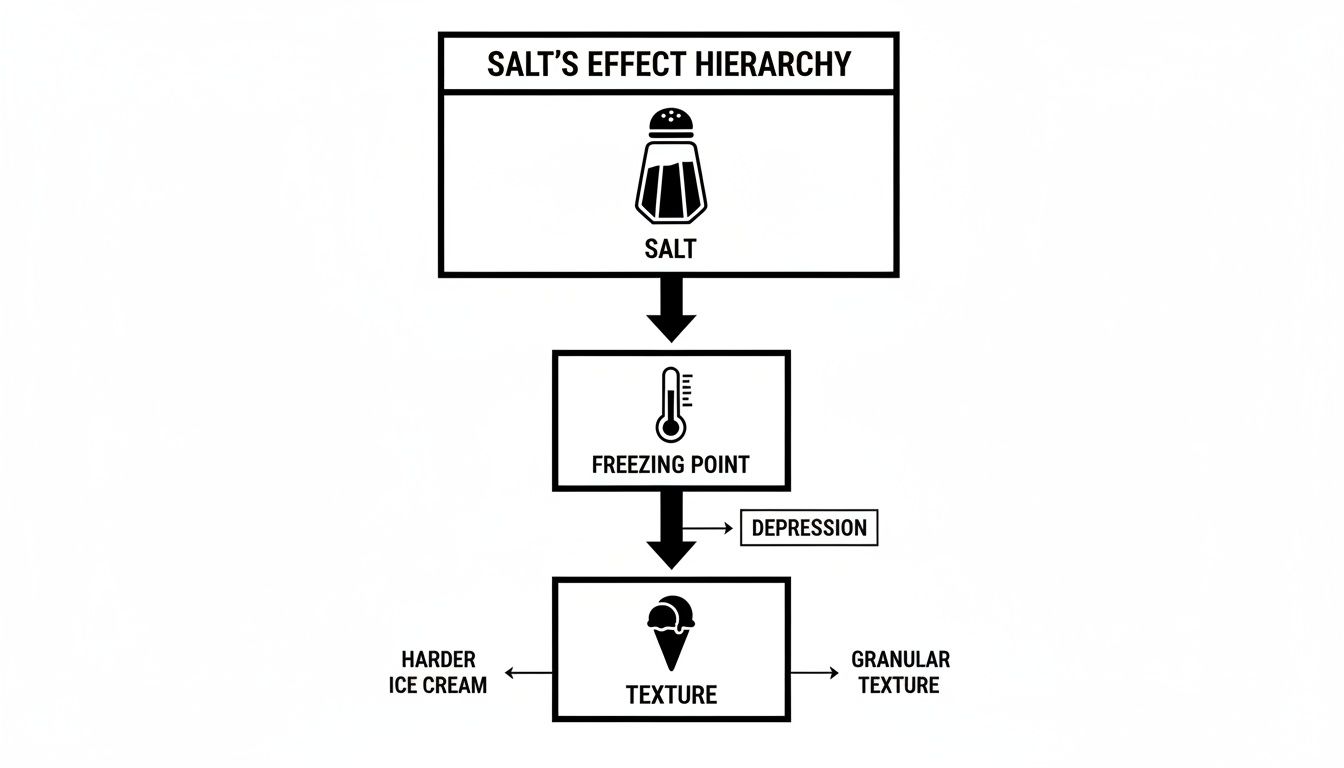
It all comes down to science. Salt’s main job is lowering the freezing point, and that single chemical reaction is directly responsible for the smoother, creamier, and more luxurious final product.
How Much Salt Should You Use?
When it comes to salting ice cream, a delicate touch is crucial. The goal is to enhance flavor, not to make it taste like the ocean.
As a rule of thumb, start with between 1/8 and 1/4 of a teaspoon of fine salt for a one-liter ice cream base. This small amount is usually just enough to mute any bitterness and amplify the other flavors without being overtly salty. Always taste your base before churning and adjust if you feel it needs a little more.
The idea of using salt to create frozen desserts has deep roots in the Gulf region. By the 1700s, knowledge of salt-ice mixtures for freezing had already reached local ports through Persian and Ottoman trade.
Fast forward to the modern UAE, and you can see how far we've come. In 2015, Sharjah's Al Qasba Festival introduced a salt ice cream that became an instant hit, with 72% of attendees coming back for more. By 2022, regional production had soared to 45,000 liters, much of it made with local rock salt from mines in Fujairah.
Mastering Flavor Pairings and Serving Ideas
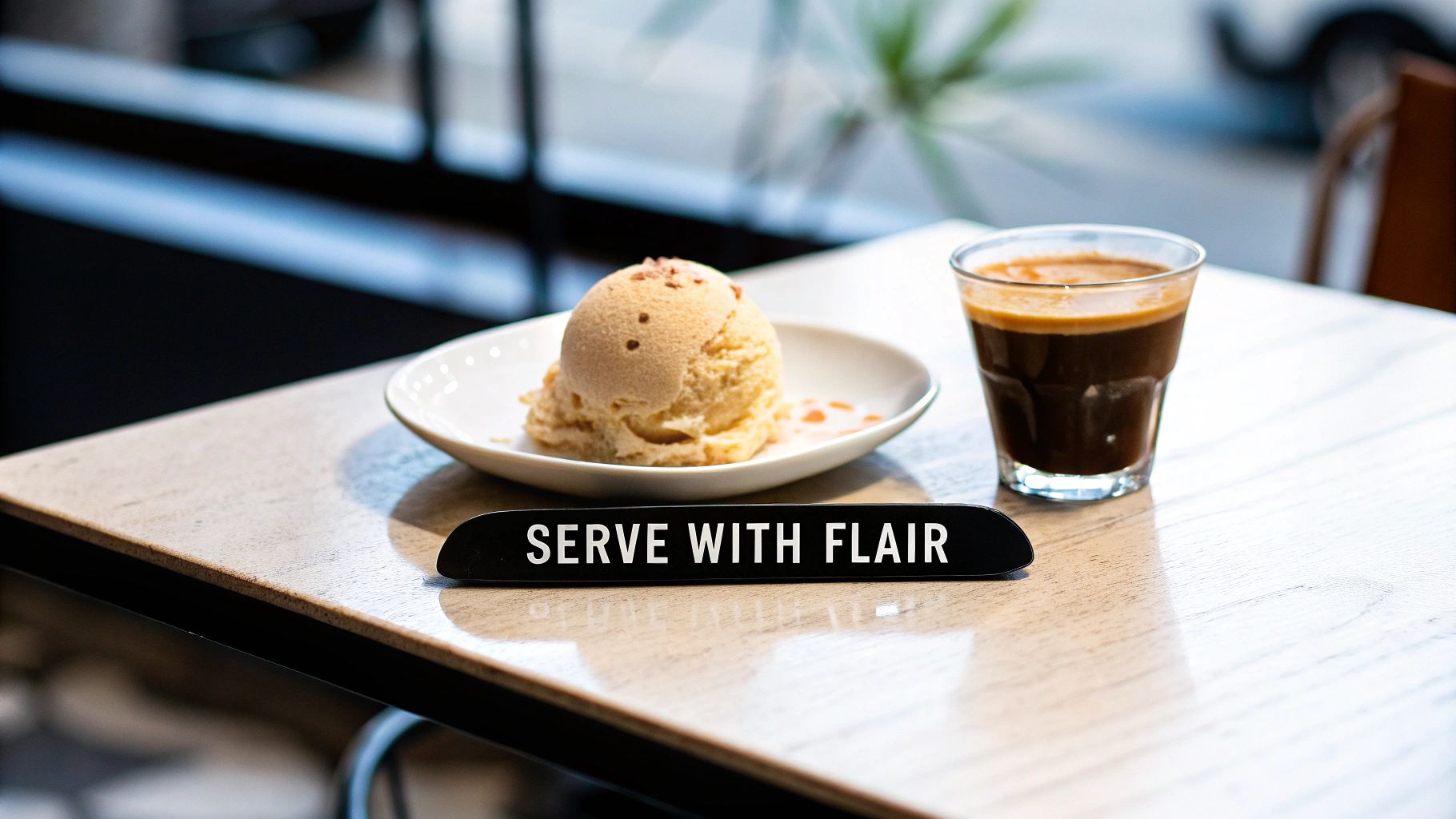
This is where the real fun begins. Pairing flavors with salt ice cream is an open invitation for culinary creativity, turning a simple scoop into something truly sophisticated. It’s all about finding that perfect balance between contrast and harmony, letting the salt work its magic to elevate every other taste on the plate.
One of the most timeless and elegant pairings has to be the affogato. There's just something special about drowning a scoop of salted caramel gelato in a shot of hot, fresh espresso. You get a stunning clash of temperatures and flavors—the bitter coffee cuts right through the richness, while the salt dials up the deep caramel notes. It’s a memorable experience, every single time.
Classic and Creative Pairings
If you’re a fan of rich, decadent desserts, try a scoop of sea salt chocolate ice cream alongside a warm, gooey chocolate lava cake or a fudgy brownie. That touch of salt in the ice cream is the secret weapon that keeps the whole thing from being too sweet, creating a perfectly balanced treat.
Looking for more inspiration? Here are a few combinations to get you started:
Pistachio Salt Ice Cream: Absolutely beautiful next to a slice of delicate almond cake. Or, serve it with fresh figs and a light drizzle of honey.
Vanilla Bean with Flaky Salt: Drizzle it with a high-quality, extra-virgin olive oil and a few drops of aged balsamic. It sounds surprising, but it’s a chef-inspired combination that just works.
Salted Honey Lavender: Pairs wonderfully with the buttery crumble of shortbread cookies or a simple lemon tart that complements its floral sweetness.
The beauty of salt ice cream lies in its versatility. It can stand alone as a sophisticated treat or serve as the perfect foundation for building a complex and exciting dessert presentation.
A Growing Local Passion
Here in the UAE, the appreciation for these more nuanced flavors is undeniable. Ice cream consumption has exploded, with the Federal Authority reporting a staggering 67 million scoops sold in 2023 alone. Salted varieties claimed a 19% share of that market—a massive jump from just 5% back in 2015. With vanilla-salt leading the charge, it's clear that salt ice cream has gone from a niche curiosity to a mainstream favorite.
To bring these incredible pairings to life in your own kitchen, always start with exceptional ingredients. Sourcing fine chocolates, premium teas, cakes, and even beautifully curated gift hampers from a luxury supplier like IFM Gourmet Dubai can elevate your dessert from good to unforgettable. For another fantastic pairing idea, see how to serve ice cream with warm, delicious waffles.
Common Questions About Salt Ice Cream
Even with the best ingredients, venturing into salt ice cream for the first time can bring up a few questions. We've gathered some of the most common queries to help you master the process and troubleshoot like a pro.
Can I Just Use Regular Table Salt?
You technically can, but for a truly gourmet result, we don't recommend it. Standard table salt often has iodine and anti-caking agents mixed in, which can impart a harsh, almost chemical aftertaste.
For a clean, bright flavor that elevates your ice cream base, you'll want to reach for a pure, high-quality salt. Sea salt or fleur de sel are perfect choices—they dissolve beautifully and enhance the other ingredients instead of competing with them.
Help! Why Did My Homemade Ice Cream Turn Out Icy?
Ah, the dreaded icy texture. This is the tell-tale sign that large ice crystals have formed during the freezing process. It usually happens for one of a few reasons: your base wasn't cold enough before churning, the churning itself was too slow, or your freezer isn't cold enough to freeze the mixture quickly.
While salt is your ally in creating smaller crystals, an unbalanced recipe can work against you. Too much water or not enough fat in your base, for example, is a classic recipe for iciness.
Here's a pro tip for the creamiest possible texture: always chill your ice cream base thoroughly to about 4°C (40°F) before it goes into the churner. This gives it the best possible head start for a silky-smooth freeze.
What Flavors Go Best with Salt?
The classics are a great place to start! There's a reason salted caramel and sea salt dark chocolate are so popular—they are unbelievably delicious. The salt cuts right through the sweetness and richness, making the core flavors deeper and more complex.
But don't stop there. Salt also works magic with nuts like pistachio and pecan. It can even bring a new dimension to fruit-based flavors or more adventurous creations, like a sophisticated olive oil ice cream topped with flaky salt or a fragrant salted honey lavender.
Will Eating Salt Ice Cream Make Me Thirsty?
Not at all. The amount of salt used to season ice cream is very small, usually less than a gram per serving. That's far less than you’d find in a bag of potato chips and nowhere near enough to cause dehydration.
The salt’s job here is to improve the texture and boost the other flavors, not to make the dessert taste overwhelmingly salty.
Ready to create your own gourmet salt ice cream? Find all the premium salts, fine chocolates, and artisanal ingredients you need at IFM Gourmet Food Store. Explore our collection and bring culinary elegance to your kitchen. Discover more at https://www.ifmgourmet.com.


Comments