زيت الزيتون البكر الممتاز UAE Gourmet Guide

You've brought home a beautiful bottle of زيت الزيتون البكر الممتاز, opened it beside a warm loaf of bread, and expected fresh olives, green herbs, and a gentle peppery finish. Instead, the label leaves you wondering whether the oil is extra virgin, whether it has travelled well, and whether storing it beside the cooker will ruin it. In the UAE, those questions matter because premium olive oil arrives through an import-heavy supply chain and must cope with heat, light, and long kitchen storage.
A good bottle should feel less like a mysterious luxury and more like a fresh ingredient you know how to select, taste, protect, and share. This guide takes you from the first pour to a carefully assembled gourmet gift, with practical advice for Dubai kitchens and UAE celebrations.
Understanding Extra Virgin Olive Oil
A home chef opens a new bottle before preparing tomatoes, grilled vegetables, and warm focaccia. The oil flows easily, smells lively, and leaves a soft green impression on the palate. That experience comes from treating olive oil as a fruit product, not just as a cooking fat.
Extra virgin olive oil is obtained from olives using mechanical methods, without chemical refining. Think of it as fresh-squeezed fruit juice. Refined or “pure” olive oils are closer to a processed concentrate, where neutral flavour and consistency matter more than the vivid character of the fruit. The word extra signals the highest virgin grade, but the label only has meaning when the oil also passes chemical and sensory requirements.
A fresh oil may suggest cut grass, green almond, herbs, or ripe fruit. Its flavour can be delicate or powerful, depending on the olive variety, harvest conditions, and origin. Colour alone doesn't prove quality. A golden oil can be excellent, while a bright green oil isn't automatically superior.
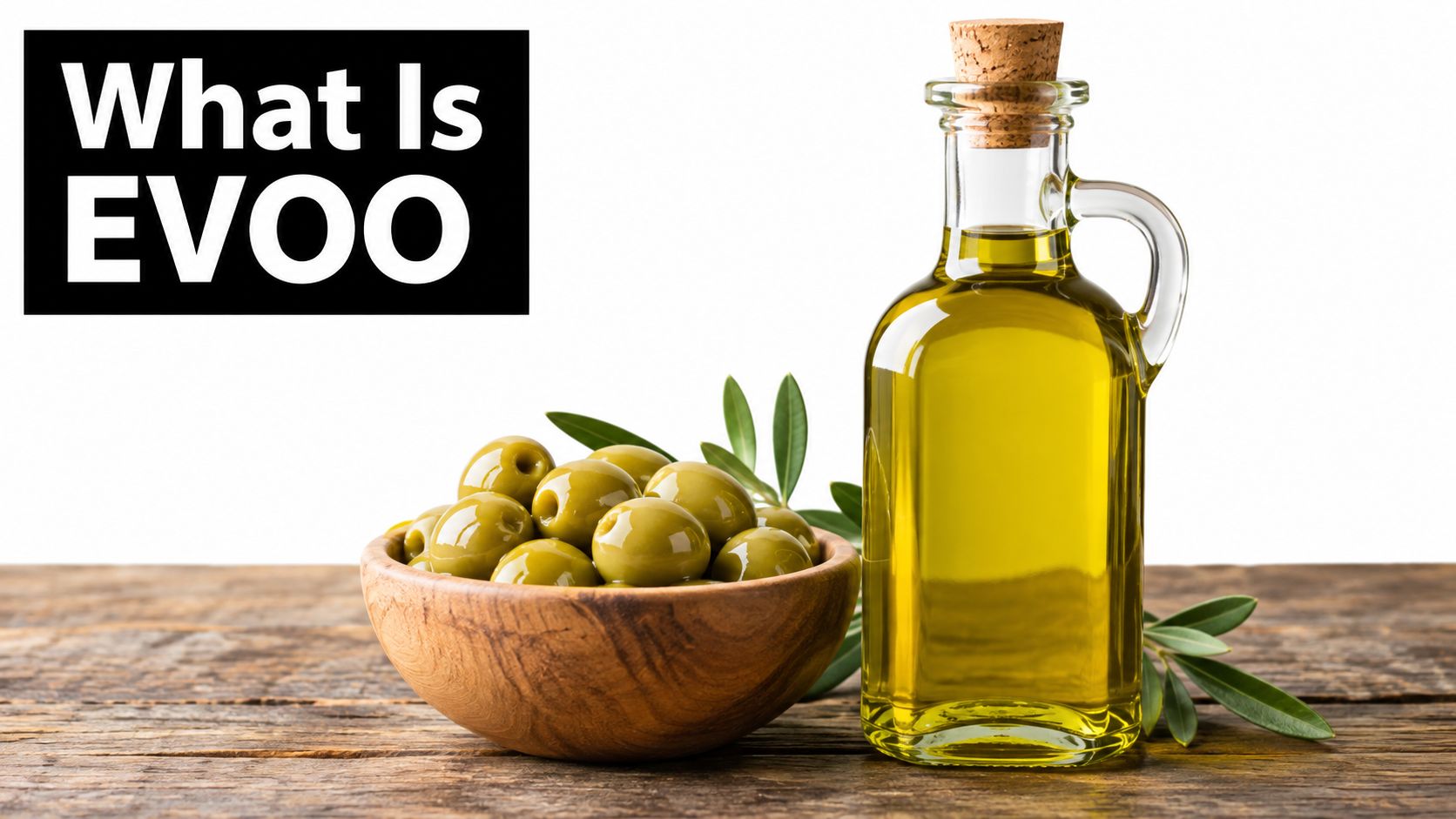
What the premium label should deliver
The UAE and GCC-aligned benchmark for extra virgin olive oil requires free acidity of no more than 0.8%, a peroxide value of no more than 20 meq O₂/kg, and sensory evaluation with zero defects alongside positive fruitiness, bitterness, and pungency. These measures are defined in the Codex-aligned olive oil specifications.
Acidity isn't something you taste directly as sourness. It helps indicate the condition of the fruit and the handling of the oil. Peroxide value helps identify early oxidation. Sensory testing then asks whether the oil actually smells and tastes fresh, rather than merely meeting a number on paper.
A useful comparison: refined oil can cook without announcing itself, while extra virgin olive oil brings the olive, the orchard, and the harvest into the dish.
Use a vibrant bottle for dishes where flavour can speak clearly. A drizzle over beans, grilled fish, ripe tomatoes, or the ingredients in these flavour-packed Mediterranean meals can show you why provenance and freshness justify careful buying.
The UAE Market and Quality Standards
A bottle bought in the UAE may have travelled through several hands before reaching your kitchen. The country's olive oil shelf reflects international trade more than local cultivation. In 2023, the UAE imported $36.886 million of virgin olive oil and fractions under HS 150910, representing 9.387 million kg. The wider HS 1509 olive-oil category reached $48 million, according to World Bank WITS trade data for the UAE. Origin, transport, bottling, and storage therefore belong in the same buying decision.
The supplier mix is strongly Mediterranean. In that year, Syria supplied $9.249 million, Spain $6.766 million, Tunisia $5.831 million, Italy $4.583 million, and Turkey $4.056 million in virgin olive oil imports, as recorded in the same WITS dataset cited above. Italian extra virgin olive oil sits within an established import market, where country reputation and regional style already influence shoppers. A familiar Italian label still deserves a close look at harvest information, lot details, and storage conditions.
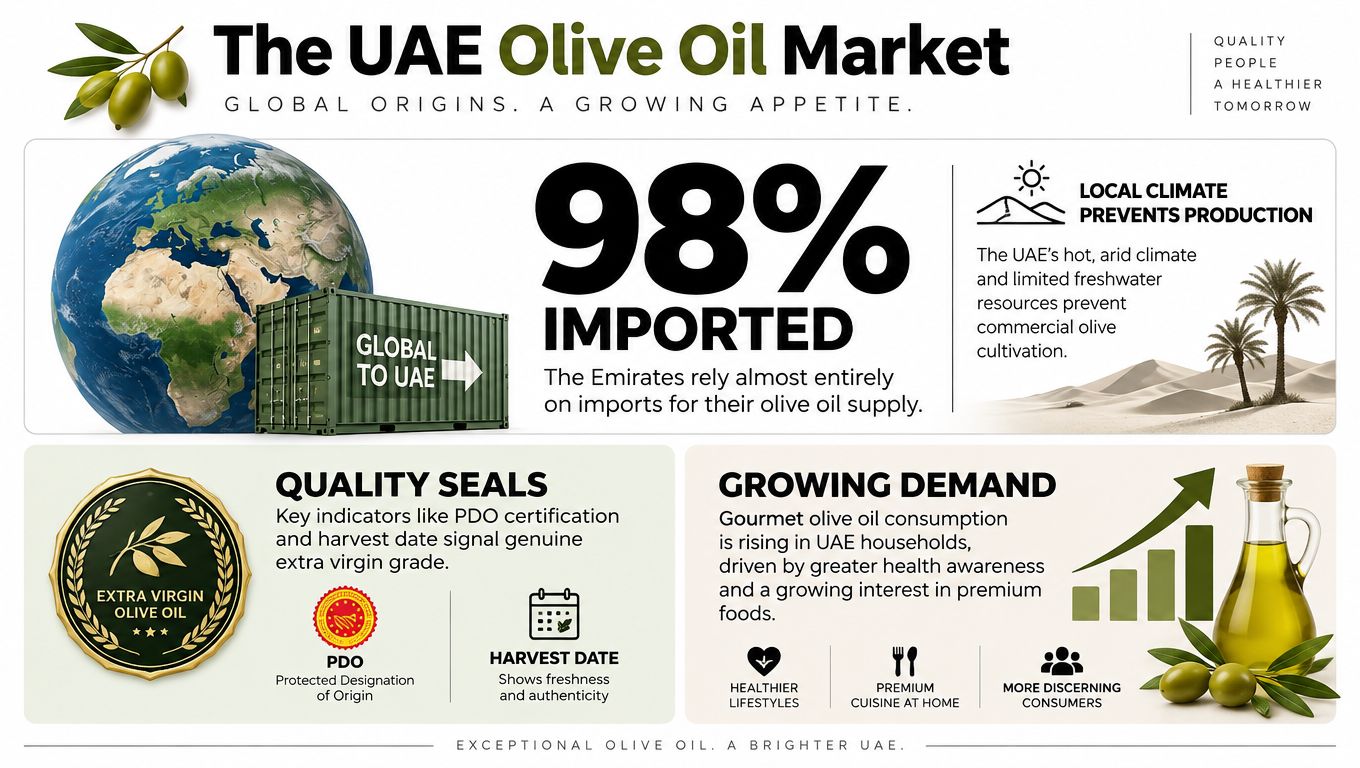
Why import history changes your purchase
Trade totals can vary sharply between years. In 2020, UAE imports of virgin olive oil and fractions were valued at $37.834 million, with a reported quantity of 35.911 million kg, compared with 9.387 million kg in 2023, according to the 2020 WITS record and the 2023 data above. The difference is a reminder to judge the bottle in front of you, not an entire category by one annual figure.
Check the harvest information, the lot or batch code, and where the bottle was kept. In the UAE heat, a long journey or warm warehouse can affect freshness even when the oil began as a high-quality product. A famous origin supports expectations, but it cannot replace evidence of careful handling.
The UAE also has meaningful familiarity with virgin olive oil. A GCC market overview reported that the country was the Gulf's second-largest virgin olive oil consumer in 2024 at 6.8K tons, and recorded per-capita consumption of 667 kg per 1,000 persons, compared with 519 kg in Saudi Arabia and 380 kg in Kuwait. Those figures appear in the regional market overview.
The quality checks behind the label
For a premium lot, ask the supplier or retailer for a certificate of analysis. It should relate to the actual batch rather than present only a general brand statement.
What to check | Why it matters |
|---|---|
Free acidity | Supports the extra virgin grade assessment |
Peroxide value | Helps identify oxidation and handling damage |
Sensory evaluation | Confirms fruitiness and the absence of defects |
Origin and lot details | Makes provenance easier to trace |
A gourmet buyer pays for sound fruit, careful extraction, protected transport, and proof that the oil arrived in good condition, not for a country name.
How to Taste and Verify Authenticity
Start with the senses before you read the marketing language. Pour a small amount into a clean glass, warm it gently with your hand, cover the top for a moment, and smell. You're looking for an aroma that feels alive, such as fresh olive, cut grass, green leaf, almond, or herbs.
Take a small sip and let the oil move across your tongue. Then draw in a little air, a technique also used in wine tasting, so the aroma opens across the palate. If you enjoy comparing aromas and finishes, this beginner wine tasting guide offers a useful parallel for slowing down and observing what you experience.
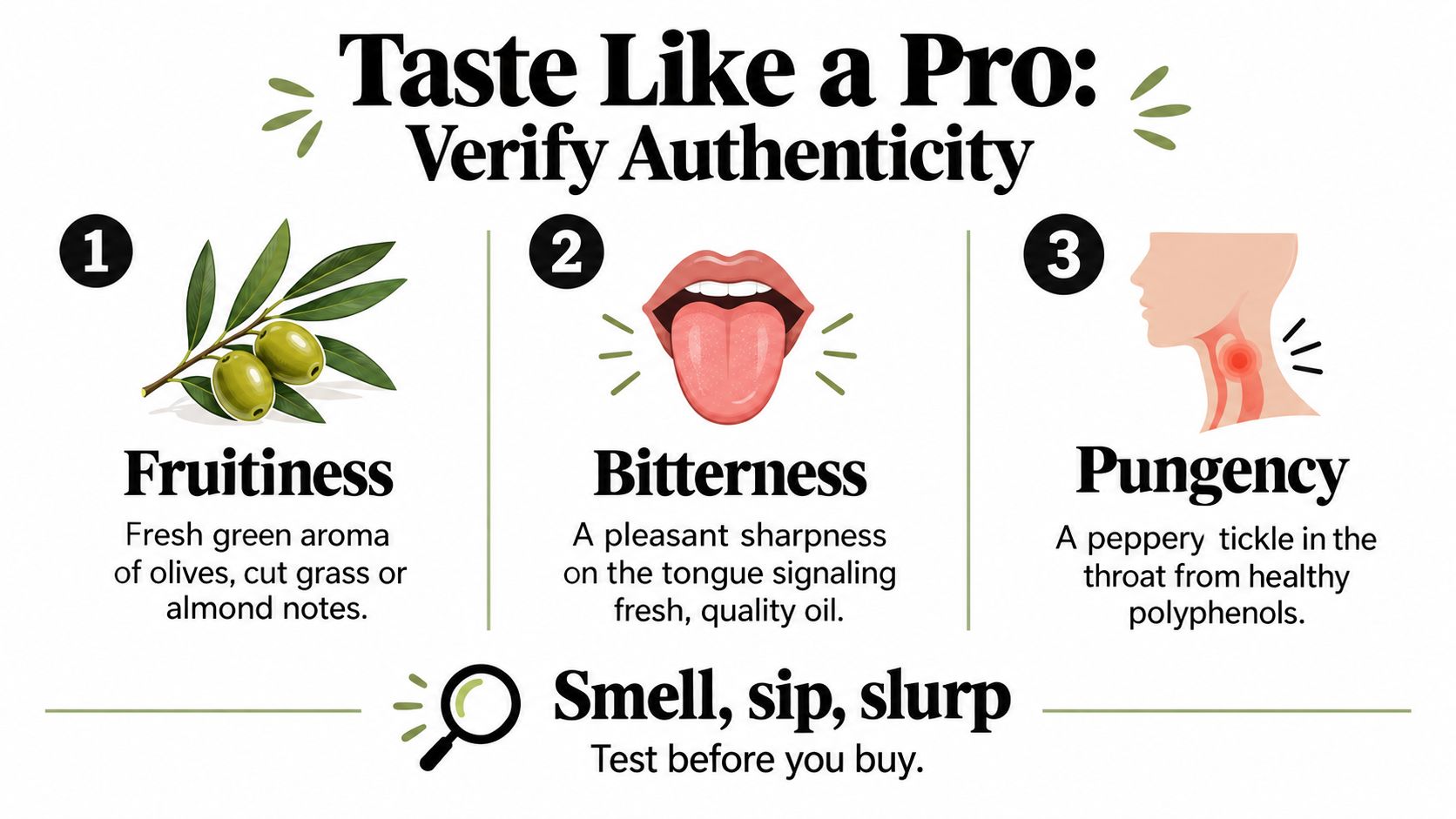
Three positive sensations
Fruitiness arrives first through aroma and flavour. It may be green and grassy, or rounder and more mature. Neither style is automatically better. The important point is that it should smell recognisably fresh rather than flat, stale, or waxy.
Bitterness appears on the tongue, often as a clean, pleasant sharpness. It comes from the olive and can give the oil structure, much like bitterness in leafy greens or dark chocolate.
Pungency is the peppery tickle at the back of the throat. A pronounced catch can be a positive sign of lively, fresh oil rather than a flaw. The sensation should be balanced, not harsh or unpleasant.
A UAE shelf checklist
Before buying, look beyond the front label.
Find the harvest date. A harvest date gives more useful freshness context than a vague statement about quality. If only a best-before date appears, ask how recently the oil was produced.
Read the origin. Look for a clearly named country or region. Blended origins aren't necessarily poor, but the label should explain them plainly.
Check the grade. The words extra virgin should appear clearly. Terms such as “pure”, “natural”, or “light” don't mean the same thing.
Look for certification and lot information. Recognised compliance marks, traceability details, and a batch reference support a more confident purchase.
Inspect the container. Dark glass or an opaque container helps limit light exposure. A dusty bottle standing under bright shop lighting deserves closer scrutiny.
Ask about storage. A retailer that can explain where and how the oil was kept is giving you useful information.
No home test can replace laboratory analysis, and a refrigerator test can't prove authenticity. Taste, label literacy, and supplier transparency work better together than any single trick.
Culinary Uses and Cooking Realities
Premium extra virgin olive oil isn't automatically the right oil for every task. Its strongest advantage is flavour, so using it for deep frying can waste the very qualities you paid for, while repeated high heat can accelerate deterioration and create an unpleasant kitchen smell.
Use a fresh, expressive EVOO where you can taste it. Finish lentil soup with a thin ribbon, dress bitter leaves with a little acidity, or pour it over grilled vegetables just before serving. It also works beautifully with bread, white beans, hummus, roasted fish, and pasta, where the oil becomes part of the final seasoning rather than disappearing into the pan.
Match the oil to the heat
For gentle sautéing and moderate-heat cooking, extra virgin olive oil can be a sensible choice when the pan is controlled and the oil doesn't smoke. The moment an oil smokes, the heat is too aggressive for that use. Lower the temperature, add the ingredients, or choose an oil designed for the task.
Deep frying is different. During Ramadan and other occasions when families prepare more fried foods, UAE coverage has highlighted limited consumer knowledge about smoke points and specifically advised against using extra virgin olive oil for deep frying in its Ramadan 2025 report. Hospitality kitchens and households that fry frequently should choose a suitable higher-stability frying oil instead.
Kitchen rule: keep your most aromatic EVOO for dipping, dressing, and finishing. Use a separate cooking oil when the method demands sustained, intense heat.
Build the plate around the flavour
A drizzle can change the character of a dish, but more isn't always better. Taste the food first, then add oil in small amounts so you can keep the fruitiness, bitterness, and pungency in balance.
For an easy supper, toss cooked pasta with garlic, herbs, and a measured pour of EVOO after the pan comes off the heat. Serve it with a simple salad and browse pantry teas online if you're creating a relaxed pantry-led meal with a warm drink afterwards. A visual serving idea can also be found in this pasta presentation image.
Storage Rules for Hot Climates
Olive oil is a perishable fruit juice, so a UAE kitchen needs a storage plan. Heat, light, and oxygen gradually flatten aroma and push the oil towards stale flavours. A premium bottle can lose its charm if it sits beside a sunny window or above a dishwasher.
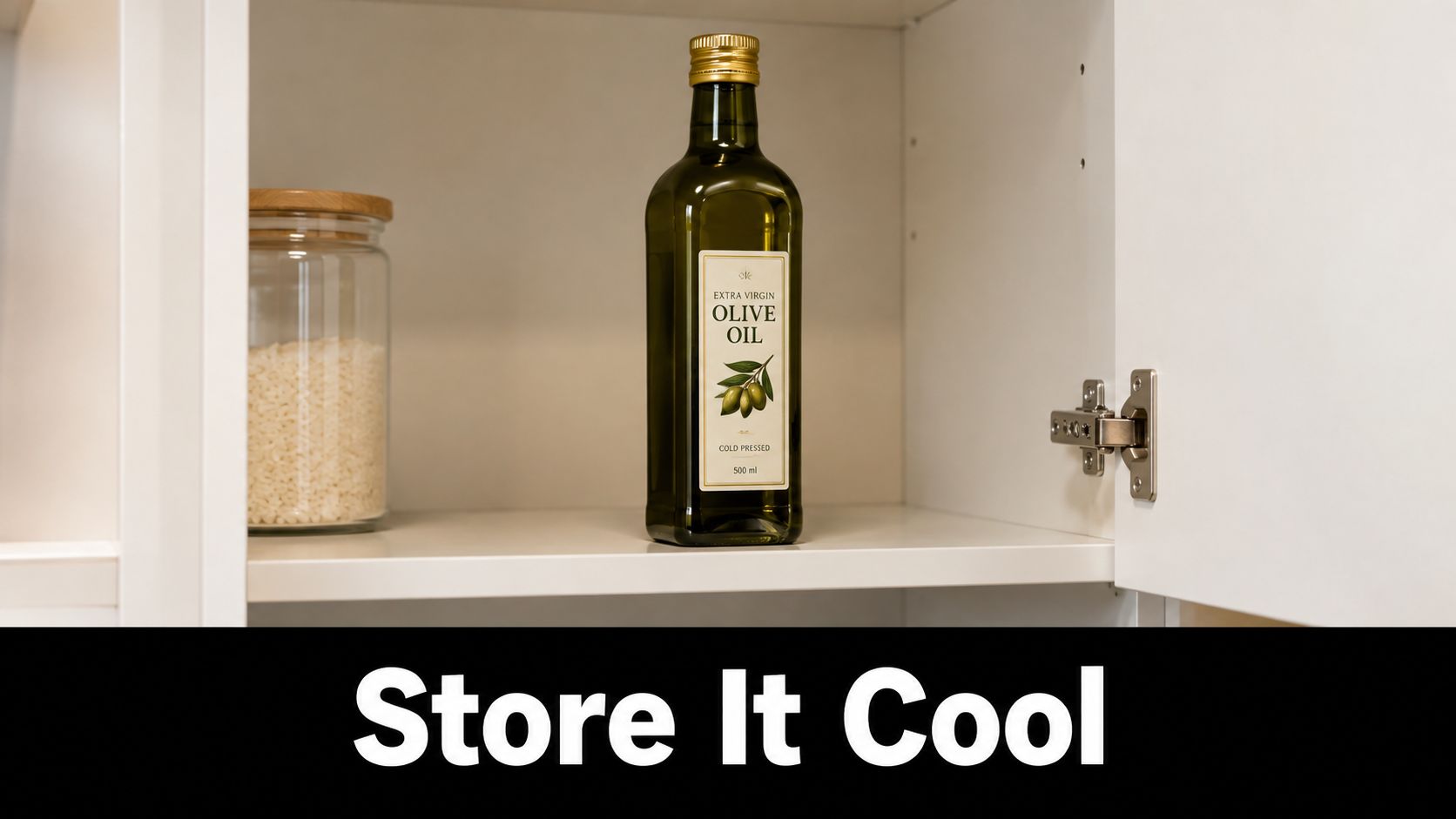
A practical cabinet protocol
Choose a cool cupboard. Keep the bottle away from the cooker, oven, kettle, dishwasher, and direct sunlight. A shaded interior cabinet is more reliable than an attractive open shelf.
Keep the bottle closed. Oxygen enters whenever the cap stays loose. Wipe the neck after pouring so residue doesn't attract dust or make the closure imperfect.
Prefer protective packaging. Dark glass, tins, and opaque bottles shield the oil better than clear containers. If a clear bottle is all you have, place it inside a closed cabinet.
Buy a quantity you'll use comfortably. A large bottle isn't economical if it remains open for a long time. In a hot climate, smaller purchases can protect flavour and reduce waste.
Smell the oil before using it after a long pause. Fresh EVOO can smell green, fruity, herbal, or pleasantly peppery. Oil that smells like old nuts, crayons, damp cardboard, or tired cooking fat has probably passed its best sensory point.
Let the bottle sit at room temperature before tasting if it has been chilled. Cold can mute the aroma and make a good oil seem dull, while warmth can make stale notes easier to detect.
This short video offers a visual reminder of sensible olive oil storage:
Storage habit: write the opening date on the label. It turns an invisible freshness question into a simple kitchen reminder.
Curating Gourmet Gifts and Hampers
A premium bottle of extra virgin olive oil becomes a more thoughtful gift when it tells a complete food story. Instead of treating it as a single expensive item, pair it with ingredients that invite the recipient to cook, taste, and share.
For Ramadan, combine a balanced EVOO with bronze-die pasta, San Marzano tomatoes, a traditional balsamic vinegar, and a small selection of dates or sweets. The recipient can build an evening meal rather than place the bottle on a shelf. For Diwali, choose a presentation that respects colour and abundance, pairing the oil with fine chocolates, nuts, and savoury delicacies. For Christmas, an Italian-themed hamper can include artisanal pasta, panettone or pandoro, balsamic vinegar, and chocolates.
Make the contents feel intentional
Start with the oil's flavour profile. A delicate oil suits a refined dressing set, while a bolder peppery oil can stand beside hearty pasta sauces, beans, and grilled foods. Add one or two complementary products rather than filling the box with unrelated items.
Packaging matters in the UAE heat. Use a secure presentation box, protect chocolate from warm delivery conditions, and keep the oil upright with enough padding to prevent movement. If the gift is travelling across the Emirates, tell the recipient to move the oil into a cool, dark cupboard as soon as it arrives.
IFM Gourmet Dubai is the luxury online gourmet arm of IFM Investments LLC, a Dubai-based UAE culinary company. Its store offers artisanal sweets and savouries, fine chocolates, premium teas, cakes, and curated gift hampers, and it operates within the broader Italian Food Masters group. For a visual centrepiece, a hamper can include this honey cornflakes cake from IFM Gourmet Dubai alongside olive oil and other Italian pantry ingredients.
Gifts for clients and hosts
A corporate hamper should be easy to understand and useful after the celebration. Include a brief card explaining the oil's origin, flavour style, and storage advice. That small note changes the gift from decorative packaging into an invitation to taste.
IFM Gourmet launched Poseidon Emporium on 30 May 2025, and its announcement distinguishes the channels clearly: retail customers can buy through IFM Gourmet, while HORECA professionals receive the full line through Italian Food Masters, the dedicated distribution division. That separation can help event planners, restaurants, and private shoppers choose the appropriate purchasing route.
IFM Gourmet Food Store offers premium olive oils, authentic Italian pantry ingredients, artisanal sweets, chocolates, teas, cakes, and curated hampers for occasions across the UAE. Visit IFM Gourmet Food Store to explore ingredients for your own kitchen or create a thoughtful gift built around the fresh flavour of extra virgin olive oil.

Comments