
250 Ml Water in Cups, Ounces, and Grams

250 ml of water equals approximately 250 grams, about 1.06 US cups (one 240 ml cup plus about 2 teaspoons), and 8.45 US fluid ounces. But if your recipe says one cup, how do you know whether the writer means a US cup or a metric cup?
That difference matters more than the size of your drinking glass. A cup is a named measure, not any cup from the cupboard, and recipes from different countries don't always use the same definition.
Choose the recipe's unit first. Then use a scale or the marked line on a liquid jug to measure the exact amount of water you need.
250 ml in Cups, Ounces, and Grams
250 ml of water in common kitchen units
Unit | Amount for 250 ml water | Kitchen shorthand |
|---|---|---|
Grams | Approximately 250 g | Same number as milliliters for ordinary kitchen measurements of water |
Liters | 0.25 L | One quarter liter |
US cups | About 1.06 cups | Just over one US customary cup |
US fluid ounces | About 8.45 fl oz | Just over 8 fl oz |
US tablespoons | About 16.9 tbsp | About 17 tbsp |
US teaspoons | About 50.7 tsp | About 51 teaspoons, impractical to count |
Metric cup | 1 cup | Used in Australia and many international recipes |
Imperial fluid ounces | About 8.8 fl oz | UK ounce, slightly smaller than the US ounce |
The gram conversion is a kitchen approximation for water, not a universal rule for ingredients. Thin liquids may be close, but their dissolved sugar, salt, or other ingredients can change their weight.
Also, fluid ounces measure volume. They aren't the same as the ounces used to weigh butter, chocolate, or flour, so choose the right setting if your scale displays both.
Why one cup can mean different amounts
A US customary cup holds about 237 ml in strict measure. Everyday kitchen guidance and nutrition-label practice also use a rounded 240 ml cup, while a metric cup holds 250 ml.
That means the useful kitchen shortcut is a rounded cup plus a little extra water. Starting with a marked 240 ml measure, add about 10 ml, roughly 2 teaspoons, to reach the metric amount.
The shortcut and the strict conversion aren't identical. The table's US-cup figure uses the customary definition, while the cup-plus-spoons method starts from the rounded kitchen measure.
An older imperial cup is about 284 ml. Filling that cup completely gives too much water for a metric-cup recipe; conversely, pouring only the metric amount underfills an imperial cup.
Check the recipe, not just its language
Australian recipes that specify a metric cup use the metric amount. A translated Italian recipe may also use that convention, but translation alone doesn't prove it, so check its measurement notes rather than assuming every translated “cup” means the same thing.
A slightly wrong cup is like a clock that's five minutes off. It may be fine for a casual walk, but it's a poor guide when you need to catch a train.
In a stew, a small water difference is usually easy to correct as the pot simmers. In a small dough or syrup, the same difference changes the balance between water and the other ingredients.
Practical rule: Check the recipe's country and measurement key. Bake by grams, cook by milliliters, and use cups mainly to translate between systems.
Don't add extra water to an American recipe because its cup is smaller. The extra spoonfuls are for reaching a metric quantity using a US measure, not for changing every US recipe.
How to Measure 250 ml of Water
A digital kitchen scale is the simplest choice for water. A clear liquid measuring jug works well too, provided you read it from the right position.
Use the method that suits your equipment, rather than combining several approximate measures.
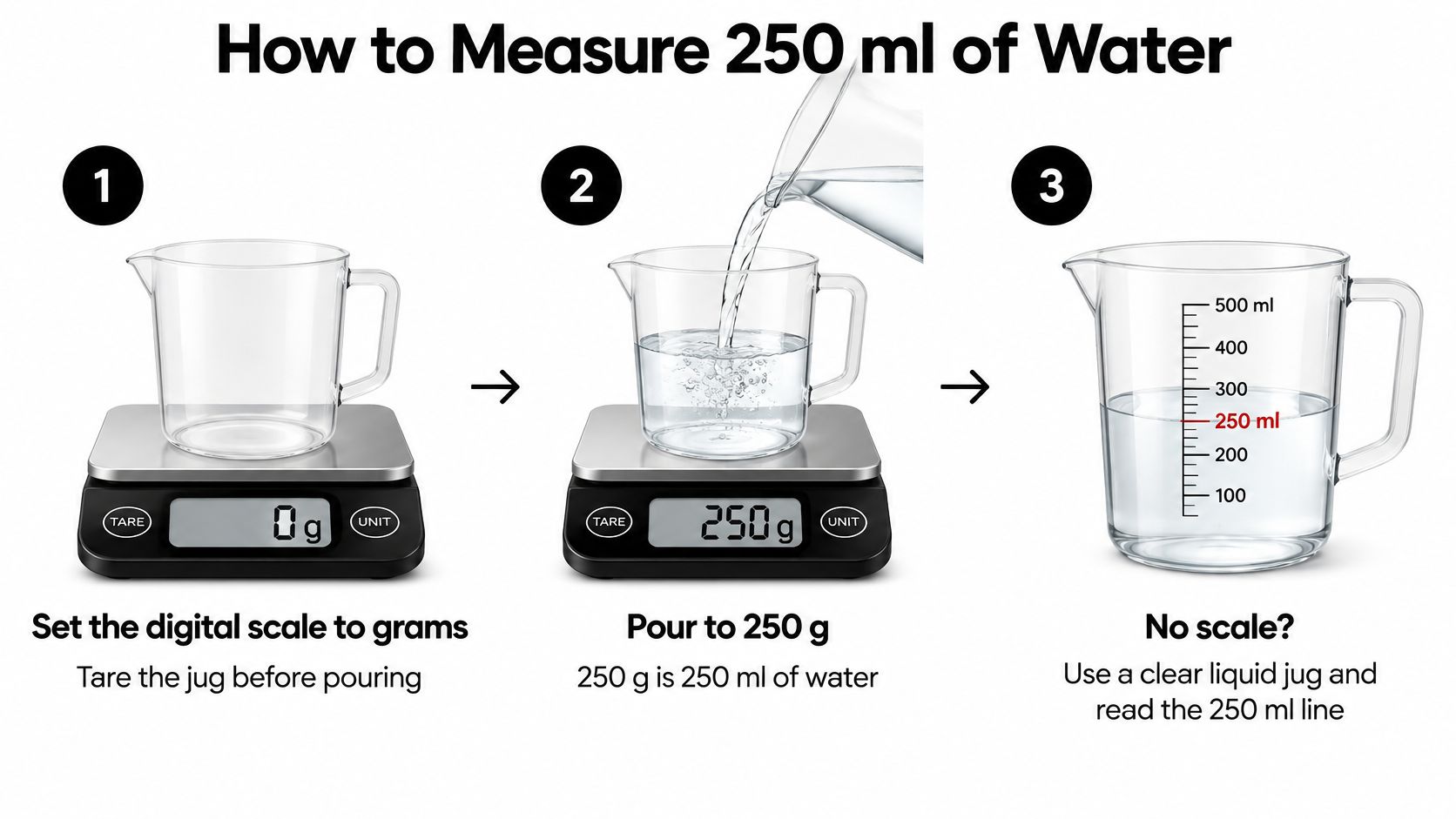
Set the scale to grams and tare the jug. Put an empty jug on the scale, press tare, and pour until the display reaches 250 g. Forgetting to tare means you're weighing the jug as well as the water.
Without a scale, use the jug's marked line. Place a clear liquid jug on a flat counter and lower your eyes to the 250 ml line. Read the bottom of the water's curved surface, called the meniscus, rather than looking down from above.
Use cups only as a fallback. With a marked 240 ml cup, add 2 level measuring teaspoons of water. Don't use a cutlery teaspoon or a heaped spoon, and don't assume an unmarked mug has the right capacity.
For baking, choose the gram method. Water doesn't need packing, leveling, or scooping like a dry ingredient. Keep the recipe's water measure separate from its flour measure, because equal volumes don't mean equal weights.
For warm dough water, heat first, then measure. Transfer the warmed water into a suitable measuring vessel before adding it to the dough. Don't estimate the amount from what appears to be left in the kettle, and keep hot cookware off an ordinary kitchen scale.
The graphic shows the scale and jug methods side by side.
Match precision to the dish
A slightly short cup is usually manageable in soup or pasta-cooking water. Bread, syrup, and a setting mixture such as a gel deserve a more deliberate measure because you can't always correct them after mixing.
Before pouring: Check the scale reading or bring your eyes level with the meniscus. Don't judge the amount while holding the jug in the air.
250 ml of Other Kitchen Liquids
The water-to-grams shortcut doesn't transfer automatically to milk, oil, or honey. Milliliters describe the space an ingredient occupies; grams describe its mass.
Two liquids can reach the same line on a jug and give different readings on a scale. That's why replacing a recipe's volume with the same number of grams can change the result.
Compare the ingredients before choosing a tool
Liquid | How its weight compares with the same volume of water | Practical choice |
|---|---|---|
Whole milk | Slightly heavier | Weigh it when the recipe gives grams |
Olive or vegetable oil | Lighter | Don't substitute water's gram value |
Honey | Much heavier | Weigh directly into a tared bowl |
Golden syrup | Much heavier | Use the recipe's specified unit |
Juice or light stock | Often close, but composition changes it | Use a jug for volume-based cooking |
Sugar makes honey and syrup heavy for their volume. Oil goes the other way, so weighing it as though it were water gives you a different amount than a jug would.
For sticky ingredients, weighing directly into the mixing bowl also avoids leaving part of the measured quantity behind in another container. Tare the bowl between ingredients so you don't need to subtract its weight.
Recipe lists grams: Weigh each liquid, including milk, oil, and syrup.
Recipe lists milliliters: Use a liquid jug unless the recipe supplies a weight conversion.
Recipe lists cups: Identify the cup system before measuring anything.
Recipes That Use 250 ml of Water
Start with a mug of tea. The measured water gives you a repeatable starting point, but you can still adjust the drink to suit your mug and taste.
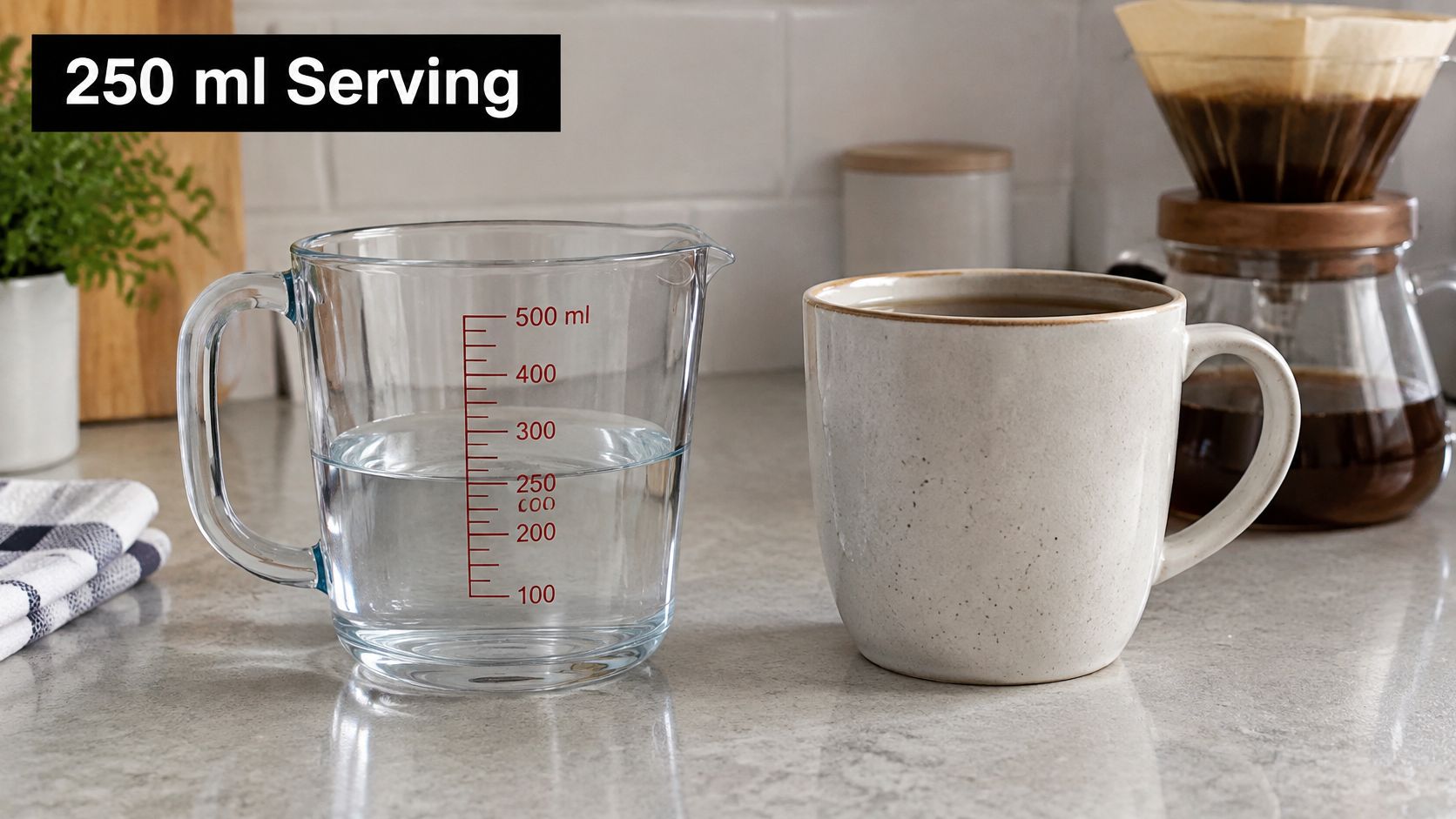
A marked pitcher makes that amount easy to see before you brew.
From a drink to a dough
For coffee, consistency matters more. If you're comparing beans or adjusting a pour-over, keep the water and coffee amounts steady so you can judge the grind and brewing technique.
The examples below are starting scenarios, not complete recipes. Bread needs a flour-specific formula, and rice needs a method suited to its variety, pot, and lid.
Kitchen uses for 250 ml of water
Use | How 250 ml is used | How exact to be |
|---|---|---|
Metric cup recipe | Equals 1 metric cup of water | Exact if baking |
Mug of tea or infusion | One large mug, provided the mug has enough room | Relaxed |
Pour-over coffee | For example, about 15 g coffee to 250 ml water | Exact |
Simple syrup | For example, 250 ml water plus 250 g sugar | Exact |
Yeast bread | About 250 ml lukewarm water in a loaf recipe designed for that amount | Exact |
Polenta side | For example, about 50 g polenta to 250 ml liquid | Fairly exact |
Rice | For example, 125 ml rice to 250 ml water in a covered absorption method | Fairly exact |
Pan sauce | A measured ladleful to loosen a reduction | Relaxed |
A syrup made with equal weights of sugar and water is a useful small-batch exercise. With bread, however, don't choose the water amount independently of the flour: follow the formula, then assess the dough as you mix.
Polenta and rice also need different handling. Stir polenta and adjust its final consistency; keep a covered absorption-rice method consistent rather than repeatedly opening the lid.
For a visual companion to your kitchen practice, use the video below.
Keep cooking methods separate
Pasta needs a cooking pot, not a single measured serving of water. Reserve a little cooking water for loosening sauce, then add it gradually so you don't wash out the flavor.
Legumes need their own timing decisions too. Before applying a rice-style method to lentils, compare lentil cooking times by variety at Just Cook It, especially when you want them to hold their shape.
Safe Water for a 250 ml Measure
A small serving doesn't qualify for a weaker water-quality standard. Measure water from a known potable source, whether you're filling a teacup or mixing bread dough.
The Abu Dhabi Department of Energy's Water Quality Regulations specify a maximum turbidity of 4 NTU, total dissolved solids of 100–600 mg/L, and absence requirements for specified microbiological indicators in a 100 ml sample. That dissolved-solids range corresponds to approximately 25–150 mg in a 250 ml portion.
Separate safety from taste
Turbidity describes cloudiness associated with suspended material. Total dissolved solids describe dissolved substances, including minerals, which can influence taste and extraction in tea and coffee.
Neither bottle size nor a clear appearance proves that water is safe. A mineral taste can be noticeable in a delicate infusion even when you'd barely notice it in a strongly flavored stew.
For a closer look at a named spring water, our guide to Lurisia water provides product context, rather than a substitute for compliance checks.
At home: Use drinking water from a trusted source and keep the measuring jug clean.
For packaged water: Check the applicable UAE compliance labeling and storage instructions.
For catering: Retain supplier batch documentation and protect water during storage and service.
A clean source doesn't excuse an open jug beside food preparation or dirty utensils. Cover stored water and avoid dipping used cups into a shared container.
If you wouldn't drink it because its safety is uncertain, don't put it in bread or tea. Taste alone isn't a safety test.
250 ml Servings in UAE Heat
Treat the serving as a tracking glass, not a daily target. A person spending the day indoors has a different routine from someone working outside or carrying trays through a hot event space.
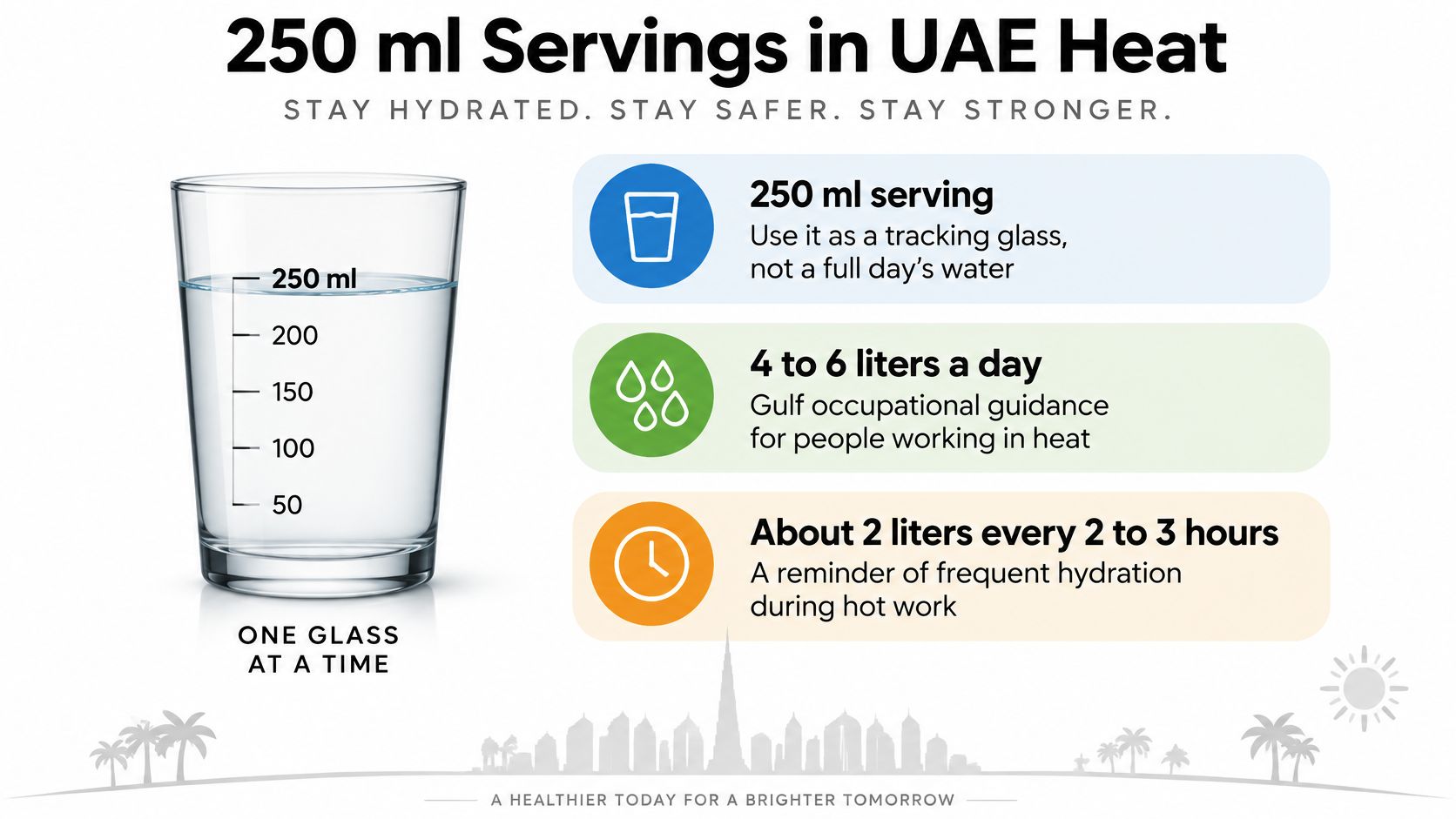
The Abu Dhabi heat-safety guideline gives occupational guidance of approximately 4–6 liters per day for Gulf working conditions and discusses about 2 liters every 2–3 hours during hot work. Those are workplace heat-management figures, not a personal prescription for every resident.
This visual keeps the serving size separate from the occupational guidance.
Plan access, not just quantities
Sweating increases fluid loss, so regular access to water matters during sustained heat exposure. Don't rely only on someone requesting a drink after they become thirsty.
For hospitality service, our small bottled water guide can help you think through serving formats. The format should make drinking convenient without replacing a proper heat-safety plan.
Indoor days: Keep water accessible without borrowing a hot-work quota.
Outdoor work and exercise: Plan regular drinking opportunities alongside rest and cooling.
Summer catering: Provide shaded breaks and don't treat coffee or tea as the main replacement fluid.
Medical considerations: Follow individualized advice if a health condition or medication affects fluid intake.
Body size, clothing, workload, acclimatization, and health all affect requirements. Prolonged heavy sweating may also call for an appropriate electrolyte-replacement plan.
Count repeat servings during the activity, rather than assuming a finished glass means you're prepared for the rest of the day.
Pour 250 ml for the Dish in Front of You
Choose your measuring tool based on the recipe. A scale suits dough, syrup, or a repeatable coffee brew; a measuring jug works for tea, soup, or rice recipes that specify volume.
A recipe's “cup” depends on its measurement system. A US cup, a metric cup, and a 250 ml pour are not necessarily the same, so follow the recipe's country-specific measure. For the most accurate result, weigh the water or read the line on a jug.
For a gathering, a refillable jug can reduce the need for individually packaged servings. Keep drinking water available throughout the event.
What is IFM Gourmet Food Store?
IFM Gourmet Food Store in Dubai is a specialty emporium offering authentic Italian gourmet ingredients, from bronze-die pastas and premium olive oils to panettone, fine chocolates, and curated gift hampers.
For your next brew or baking session, choose the dish first, then measure the water in the unit its recipe uses.
The store also offers fine spring water, Ceylon tea, herbal infusions, coffee, cereals and muesli, honey, premium jams, maple syrup, and fresh frozen juices. Visit IFM Gourmet Food Store to browse these ingredients.


Comments