
Black Caviar Food: The Ultimate Dubai & UAE Guide

You’re probably here because black caviar has caught your eye for a dinner party, a refined gift hamper, or a special table at home in Dubai, and you want to get it right. That’s a sensible instinct. Caviar is one of those foods that can feel intimidating at first, not because it’s complicated to enjoy, but because people often talk about it in a way that makes it sound distant and ceremonial.
In practice, black caviar food is much easier to understand when you treat it like any other serious delicacy. You learn what it is, how quality shows itself, how to buy it safely, and how to serve it without wasting its character. Once those pieces are clear, caviar stops feeling mysterious and starts feeling useful, elegant, and immensely enjoyable.
A customer often asks me the same question in different words. “Is it really worth it?” The honest answer is yes, when the occasion, the product, and the presentation match. A small tin can change the tone of a meal. It can also transform a gift from pleasant to memorable.
An Introduction to the World of Black Caviar
A familiar Dubai scene goes like this. You’re planning a private dinner in Emirates Hills, a corporate thank-you gift, or a festive gathering where the table needs one detail that subtly signals taste. Not excess. Taste. You already have excellent glassware, thoughtful plating, perhaps panettone, fine tea, or a proper Italian aperitivo selection. What’s missing is one centrepiece that guests notice immediately.
That’s where black caviar enters.
It doesn’t behave like an ordinary luxury ingredient. It doesn’t need a complicated recipe or dramatic garnish. A well-chosen caviar, opened at the right temperature and served with restraint, gives a table a sense of occasion that few foods can. It tells your guests that care went into the evening.
What confuses many first-time buyers is the gap between image and reality. They think caviar is only for formal banquets, only for experts, or only for people who already know the rules. It isn’t. A home chef can serve it beautifully. A gift shopper can choose it intelligently. A hospitality team can use it with confidence once they know what details matter.
Black caviar works best when it’s handled simply. The product should lead. The host should support it.
In the UAE, that practical understanding matters even more because people often want caviar for mixed occasions. One client wants it for a polished Ramadan hamper. Another wants it beside burrata and blinis at a birthday supper. A hotel buyer wants consistency across service. The product is the same luxury item, but the use is different. That’s why black caviar food deserves a calmer, clearer explanation than it usually gets.
Uncovering the Essence of Black Caviar
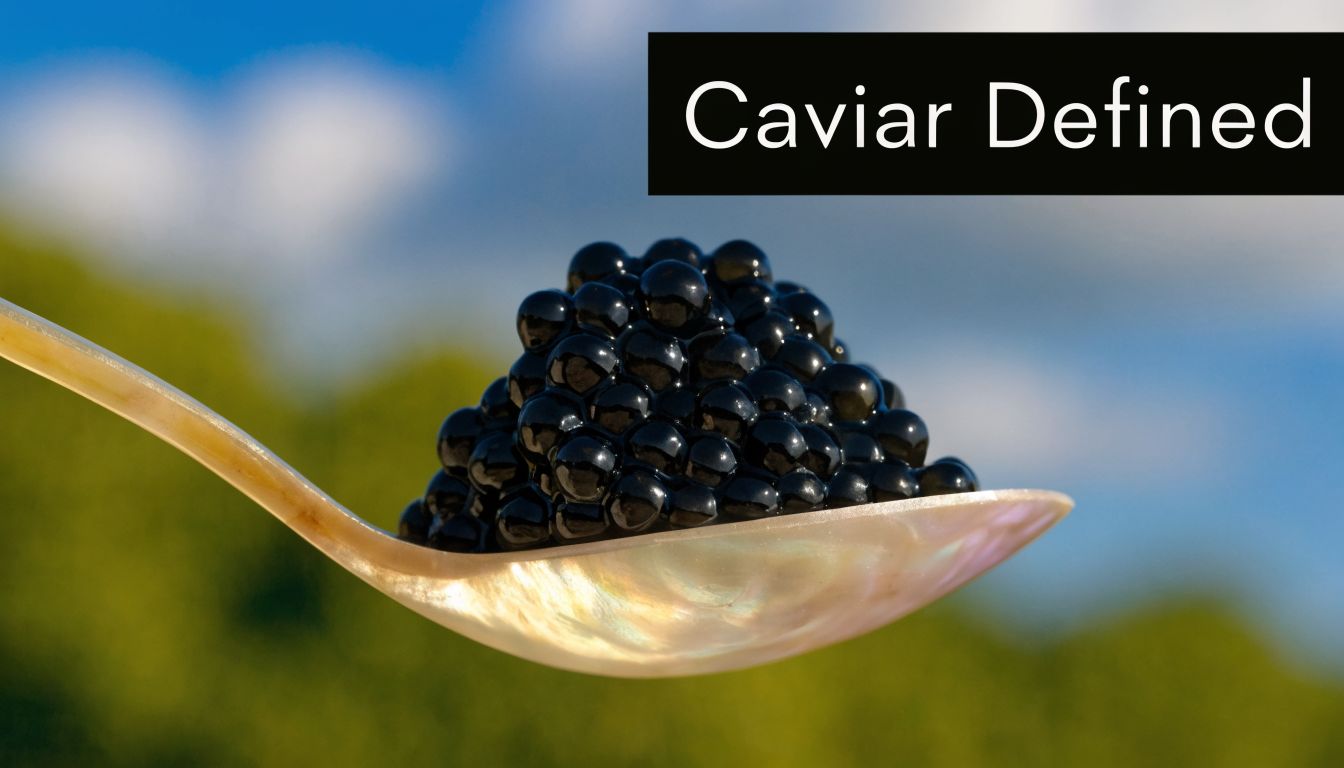
Black caviar is salt-cured roe from sturgeon. That short definition is correct, but it doesn’t explain why people value it so highly. To understand that, it helps to think of caviar the way you’d think of vintage wine or long-aged Parmigiano Reggiano. The value isn’t only in rarity. It’s in texture, timing, craftsmanship, and the way small differences produce a completely different experience on the palate.
Why caviar became so revered
Historically, black caviar was tied to the Caspian region and to sturgeon populations that made the area the heart of the caviar world. One of the clearest markers of its former scale comes from this historical account of Caspian caviar production, which notes that in 1929 the USSR exported approximately 800 tons of black caviar, generating revenue equivalent to $1 billion in today’s currency, and that the Caspian region once supplied 90% of the world’s caviar.
Those figures matter because they explain two things at once. First, caviar wasn’t a decorative footnote in food history. It was economically significant. Second, the old system depended on wild sturgeon at a scale that could not last.
By the late twentieth century, overfishing and depletion changed the market. That’s why modern buyers need to let go of one outdated idea, namely that “wild” automatically means more authentic. In today’s market, responsible aquaculture isn’t a compromise. It’s the reason black caviar food remains available at all.
What gives black caviar its identity
The character of caviar comes from a small group of factors working together:
Species of sturgeon determines the size, colour, and flavour tendencies of the roe.
Maturity of the fish influences how developed and refined the beads feel.
Curing method shapes salinity and balance.
Handling affects whether the grains stay distinct and glossy or become dull and broken.
When someone says caviar tastes “luxurious,” they usually mean a combination of gentle salinity, marine freshness, creaminess, and a clean finish. The texture matters just as much as flavour. Good caviar shouldn’t feel muddy or sticky. It should feel defined.
Why the process matters
Caviar commands respect because producers don’t merely collect roe and package it. They sort it, cure it carefully, and preserve its delicacy with minimal interference. That’s also why excellent caviar often tastes restrained rather than loud. It isn’t trying to overwhelm you. It’s trying to stay pure.
Practical rule: If caviar needs heavy seasoning, strong onion, or too many toppings to feel impressive, the product itself probably isn’t the star.
That’s the essence of black caviar food. It’s not luxury because it’s expensive. It’s luxury because every small detail, from origin to curing to service, affects the final bite.
A Guide to Black Caviar Types and Tiers
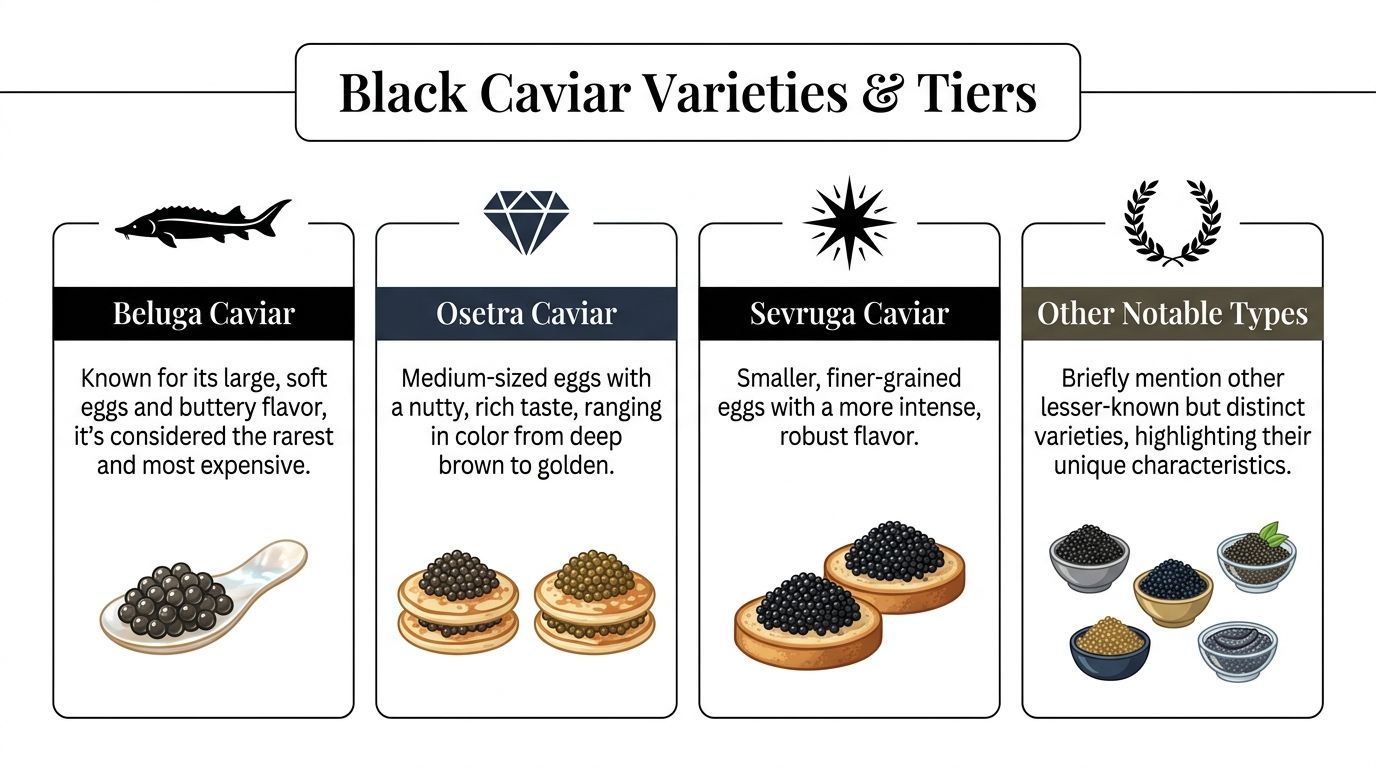
Most buyers first hear four names: Beluga, Osetra, Sevruga, and Siberian sturgeon caviar. People often assume these names are only labels for prestige levels. They’re not. They point to different flavour personalities, textures, and visual styles.
Beluga
Beluga sits at the top of the popular imagination. People know it as the rare, grand, highly prized style of caviar. Its beads are typically larger and softer in feel, and its flavour is often described as buttery and gentle rather than aggressively salty.
Beluga appeals to buyers who want softness and elegance more than intensity. If you’re serving guests who are new to caviar, Beluga-style caviar can feel surprisingly approachable because the sensation is smooth and rounded.
That said, some first-time buyers get confused here. They assume “more expensive” means “stronger.” In caviar, that isn’t always true. Beluga’s prestige often comes from rarity and refinement, not from force.
Osetra
Osetra is where many seasoned diners find their personal favourite. It usually sits in a beautiful middle ground. The grains tend to feel firm enough to give definition, but not severe. The flavour often leans nuttier and deeper than Beluga, with more savoury complexity.
For Italian-inspired entertaining, Osetra has a natural versatility. It can sit happily beside neutral accompaniments, but it can also tolerate richer pairings such as mascarpone, burrata, or a restrained butter sauce on pasta. It has enough structure to remain recognisable on the plate.
If Beluga is silk, Osetra is silk with shape.
Sevruga
Sevruga usually presents a finer grain and a more assertive personality. This is often the caviar for diners who want a clear marine impression and a more direct salty-briny profile. It doesn’t whisper. It speaks more quickly.
That makes Sevruga useful in service settings where caviar appears in smaller portions or on composed bites. A bead with stronger flavour can still register clearly even when used sparingly.
Some hosts overlook Sevruga because they equate small grains with lesser character. In truth, smaller grains can bring precision. The pleasure is different, not inferior.
Siberian sturgeon caviar
Siberian sturgeon caviar has become especially relevant for modern buyers because it often offers consistency, elegance, and strong farmed production standards. It can be a very intelligent choice for home dining, curated gifting, and hospitality.
Its appeal lies in balance. It tends to be refined without becoming shy, and polished without feeling overly formal. In practical terms, that means it works across more occasions than many buyers expect.
A simple comparison at a glance
Type | Usual impression | Texture direction | Best for |
|---|---|---|---|
Beluga | Buttery, delicate, prestigious | Larger, softer beads | Formal service, pure tasting |
Osetra | Nutty, rich, layered | Firm yet supple | Dining with refined pairings |
Sevruga | More intense, brisk, marine | Smaller, finer grain | Canapés, stronger flavour presence |
Siberian | Balanced, polished, versatile | Consistent, elegant bead | Home chefs, gifting, hospitality |
Understanding tiers without overcomplicating them
Beyond species, buyers hear terms like “premium,” “reserve,” or “selection.” These labels can be useful, but they aren’t universal. One producer’s premium tier may not mirror another’s. That’s why sensory clues matter more than marketing vocabulary.
Look for these differences when comparing tins side by side:
Uniformity of grains often suggests careful sorting.
Gloss and separation suggest proper handling.
A clean aroma signals freshness and restraint.
Balanced salinity lets the roe speak without tasting harsh.
A good caviar should taste deliberate. Not loud, not fishy, not muddy.
The most practical way to think about caviar types is this. Beluga is prized for softness. Osetra for complexity. Sevruga for intensity. Siberian for dependable elegance. Once you know which of those traits you enjoy most, buying becomes much easier.
Judging Quality and Authenticity
Many buyers can identify luxury packaging. Far fewer can identify quality once the tin is opened. That’s the ultimate test. Fine black caviar food should justify itself on the spoon, not merely on the label.
Professionals often evaluate caviar through what I like to call the four working clues: taste, texture, tone, and tenacity. Taste is obvious, but it should be clean and balanced, not bluntly salty. Texture should feel defined, with individual beads rather than a paste-like mass. Tone refers to the visual impression, including colour consistency and natural gloss. Tenacity is how well the eggs hold their shape before they burst.
What quality looks like in practice
A premium caviar usually presents itself with calm precision. The grains sit separately. They shine without looking oily. The aroma is marine and fresh, but not aggressive.
Poorer examples often reveal themselves quickly. The eggs may collapse into each other, smell overly fishy, or leave a heavy saline impression that lingers in the wrong way. If the caviar tastes mostly of salt, the curing has overtaken the ingredient.
The term Malossol is worth knowing. In caviar language, it generally signals low-salt curing, which is prized because it preserves the roe without drowning its natural flavour. Buyers sometimes mistake strong salinity for seriousness. It’s usually the opposite.
A useful benchmark for texture
One of the clearest technical examples in the UAE market concerns premium Siberian sturgeon caviar. According to this detailed note on Siberian sturgeon texture and aquaculture conditions, premium Siberian Sturgeon Black Caviar in the UAE is associated with a fine-grained texture and egg sizes from 2.6 to 3.0 mm, and that uniformity is linked to a preferred popping mouthfeel. The same source states that this consistency delivered 25% higher guest satisfaction in blind tastings compared with caviars that had less uniform grains.
That’s a helpful detail because it turns a vague idea into a concrete one. When caviar buyers say they want elegance, they often mean uniform grains that pop cleanly and look composed on the spoon.
How to check authenticity before you buy
Authenticity matters because caviar is a product where presentation can distract from provenance. A beautiful tin doesn’t prove legal origin, species accuracy, or careful storage.
Use this checklist:
Check species clarity. The seller should be able to tell you exactly what sturgeon the caviar comes from.
Ask about documentation. Imported sturgeon caviar should come with proper trade compliance.
Inspect storage conditions. If the answer sounds vague, walk away.
Look at the grains. Uniformity, gloss, and clean separation are better signs than ornate branding.
Read the curing style. If low-salt handling is emphasised clearly, that often aligns with a more quality-driven product.
If a seller can describe the caviar beautifully but can’t explain its origin plainly, you haven’t been given enough information.
Small red flags that buyers miss
A common mistake is assuming darker always means finer. Colour can be attractive, but quality isn’t measured by darkness alone. Another mistake is buying caviar solely by prestige name without checking condition. Even excellent roe can disappoint if it has been stored poorly.
The connoisseur’s habit is simple. Ask fewer romantic questions and more practical ones. Which sturgeon? How was it stored? What do the grains look like? How salty is it? Those answers tell you more than any luxury script.
How to Buy Black Caviar in the UAE
Buying black caviar in the UAE is easier than many people expect, but the market rewards careful shoppers. Dubai offers access to specialist retailers, premium food halls, and gourmet platforms, yet the right purchase depends less on where you buy and more on how transparently the product is presented.
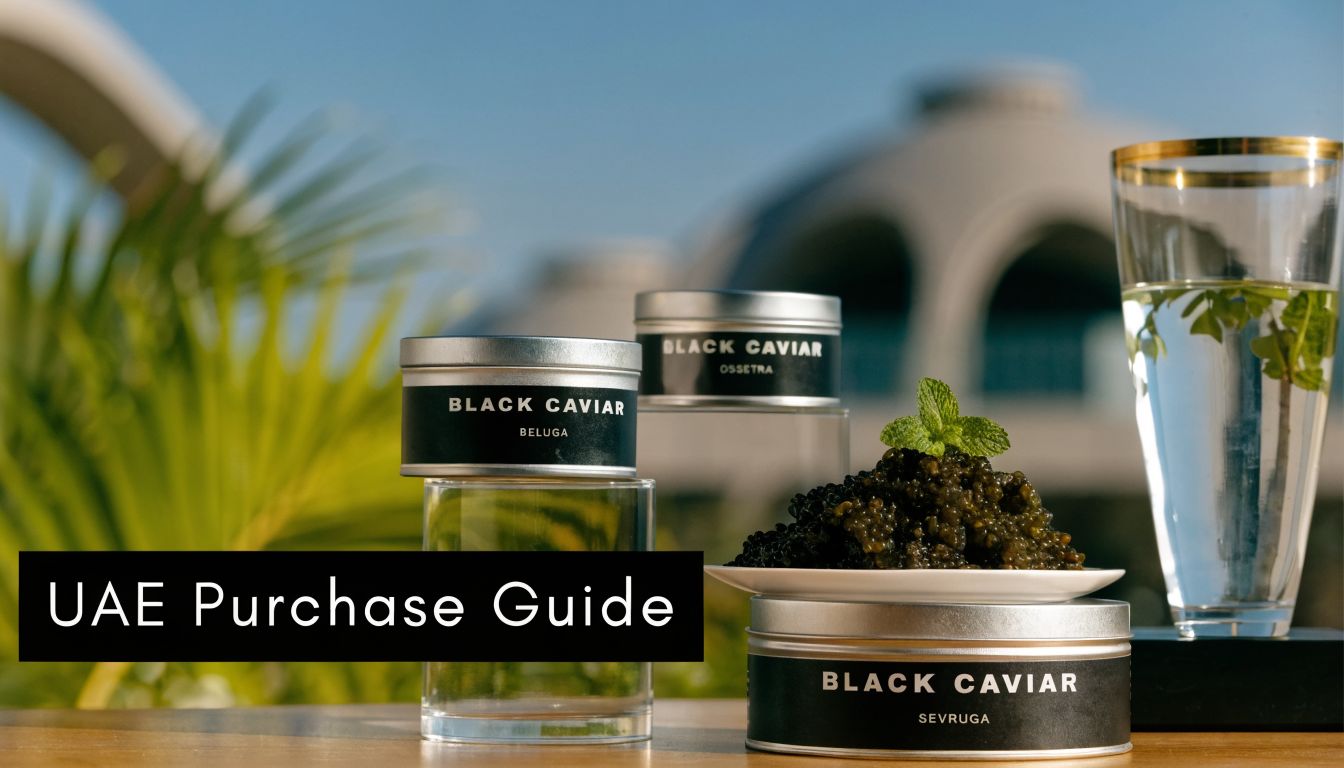
A useful market indicator appears in this overview of black caviar sourcing and demand, which notes that the UAE imported $12.5 million in fish and caviar products in 2024-2025, with sturgeon caviar demand surging 28% year over year according to Dubai Customs. The same source states that 99% of the global supply is farmed, which reinforces why CITES-compliant, well-documented sourcing is central to a sound purchase.
Where to buy and what to ask
In Dubai, sensible buyers usually choose one of three routes. A specialist gourmet store with a curated imported range. A luxury food retailer with strong cold-chain handling. Or a hospitality supplier if the purchase is for service rather than household use.
The question isn’t merely “Do you stock caviar?” The better question is “Can you tell me exactly what this tin is?” A serious seller should answer comfortably.
Ask these before you commit:
What species is it You want the sturgeon identified clearly, not described only as premium black caviar.
Is it farmed and CITES-compliant For modern caviar, documented legality and sustainability matter more than nostalgic myths about wild sourcing.
How has it been stored Good caviar can be damaged by careless temperature handling long before it reaches your table.
What style is it suited to Some caviars are better for pure tasting. Others suit canapés, pasta finishing, or gifting.
Why provenance matters so much in the UAE
The UAE market is international, fast-moving, and gift-driven. That’s a wonderful environment for luxury food, but it also means products can be bought for very different reasons. A private client may want one elegant tin for a weekend dinner. An event planner may need multiple units with consistent presentation. A festive hamper buyer may want caviar to sit alongside Italian delicacies in a coherent gift story.
That makes provenance essential. The right supplier should be able to support both authenticity and suitability.
For shoppers who want a visual entry point into curated categories, this IFM Gourmet collection image shows the kind of organised gourmet environment where caviar sits within a broader luxury food context rather than as an isolated impulse purchase. Within that sort of setting, IFM Gourmet Food Store is one option among specialist retailers in Dubai for buyers who also want to pair caviar with Italian pantry items and gifting components.
A buyer’s checklist for the final decision
Buying question | Why it matters |
|---|---|
Is the species named clearly | It prevents vague or inflated descriptions |
Is legal import documentation available | It supports compliant, ethical purchasing |
Was the product kept under proper refrigeration | Storage directly affects texture and flavour |
Is the tin size right for the occasion | Overbuying can waste a delicate product |
Do the suggested pairings make sense | A good seller understands use, not just inventory |
Buy caviar with a menu in mind. A thoughtful tin for a defined occasion nearly always outperforms an impressive tin bought without purpose.
In short, buying well in the UAE means choosing transparency over theatre. If the seller can explain origin, storage, and intended use with confidence, you’re already moving in the right direction.
Proper Storage and Serving Etiquette
Once caviar is in your hands, care becomes everything. This is the stage where many expensive tins lose their charm. Not because the caviar was poor, but because it was warmed, mishandled, or served with the wrong tools.
The storage rules that matter
Keep caviar cold from the moment you receive it. Refrigeration isn’t a suggestion. It’s part of the product. An unopened tin should remain in the coldest appropriate part of the fridge, and it should never be frozen. Freezing can damage the bead structure and flatten the elegant texture you paid for.
Once opened, caviar is at its most vulnerable. Serve what you need promptly, keep it chilled during service, and avoid prolonged exposure on a warm table. In Dubai, this point matters even more because ambient temperatures can work against delicate foods very quickly.
How to serve it properly
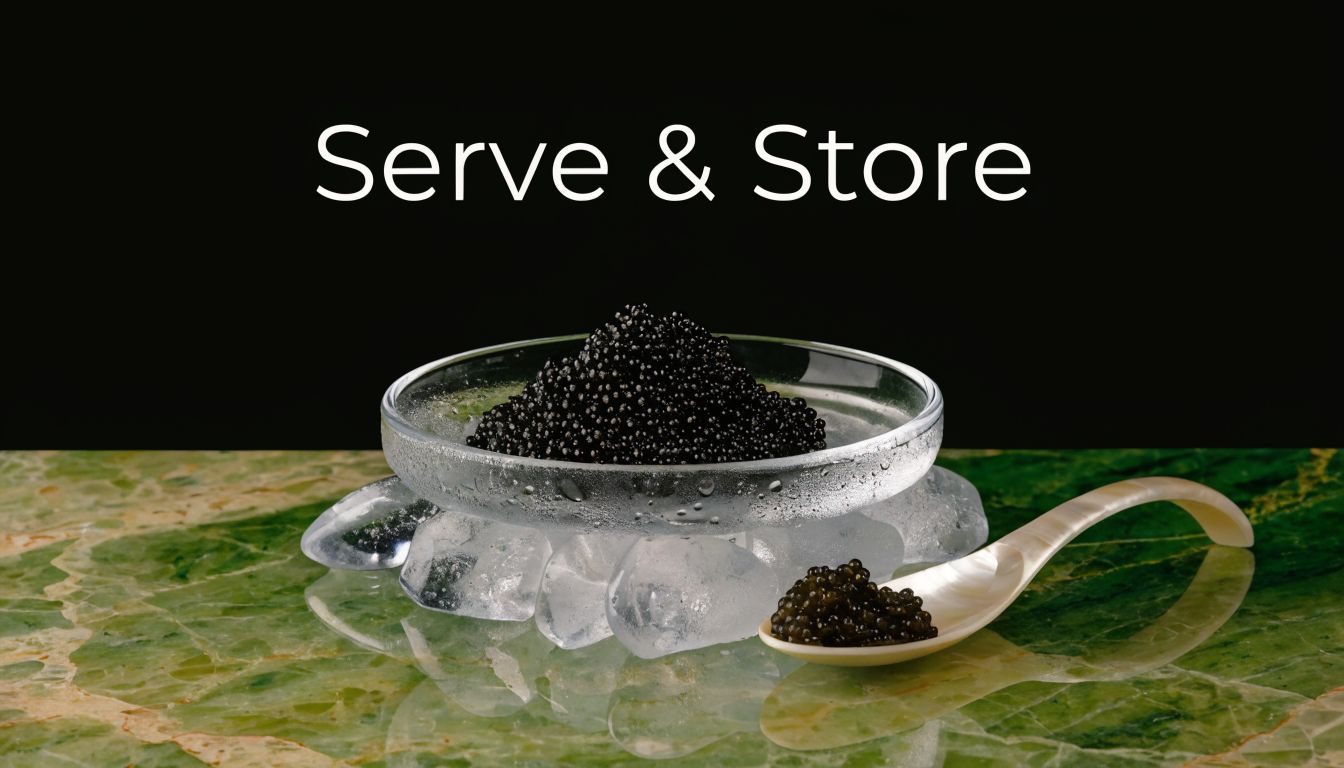
The classic setup is still the right one because it protects flavour. Use a mother-of-pearl, bone, horn, or similarly non-reactive spoon rather than ordinary metal if possible. Present the tin or serving bowl over crushed ice so the caviar stays cool without direct contact with water.
Keep accompaniments gentle. The purpose of the plate is to frame the caviar, not compete with it.
A simple service arrangement often includes:
Neutral bases such as blinis, lightly buttered toast points, or plain boiled potatoes
Soft dairy elements like crème fraîche, used sparingly
Fresh finishing touches such as chives, if the pairing calls for them
Measured portions so each guest gets a composed tasting rather than an overloaded bite
A short visual guide can help if you’d like to see the handling and presentation rhythm in action:
Small etiquette details that make a big difference
Serve caviar cool, not icy-hard. Let it remain fresh and lively rather than numbed by excessive chilling. Open the tin shortly before service, and don’t stir it unnecessarily. Rough handling breaks the grains and changes the mouthfeel.
If you’re hosting, don’t overexplain it at the table. A quiet line is enough. Name the type, invite guests to taste it first on its own, then let them try it with the chosen accompaniment.
The first spoon should always be the simplest one. That’s how guests learn what the caviar itself has to say.
Good etiquette isn’t about stiffness. It’s about preservation. Every rule exists to protect flavour, texture, and poise.
Pairing Recipes and Gifting in Dubai
Black caviar food shines when the pairing respects its delicacy. The classic companions still work because they provide contrast without noise. Blinis, crème fraîche, chilled vodka, and sparkling wine remain excellent choices for a reason. They keep the palate clear and allow the roe to stay in focus.
For readers in the UAE who enjoy Italian ingredients, the more interesting question is how to bring caviar into an Italian gourmet lifestyle without making it feel forced. The answer is restraint and clean flavours. Caviar doesn’t want a crowded sauce or a heavily spiced plate. It wants a calm stage.
Italian-inspired ways to enjoy it
A spoonful over fresh burrata can be superb when the dairy is mild and the portion is disciplined. The same goes for a warm potato base finished with caviar and a touch of cultured cream. For a pasta course, think of caviar as a final garnish over a delicate butter or cream preparation, never as something to cook aggressively into the sauce.
Low-sodium condiments are especially useful here because caviar already brings salinity. This nutritional overview of black caviar notes that black caviar is a complete protein source, providing nearly 25% of the daily value per 16g serving, and that a 16g serving contains 240mg of sodium. The same source highlights its omega-3 content and positions it as a nutrient-dense indulgence that pairs sensibly with lower-sodium ingredients such as premium balsamic vinegars.
That gives the home chef a helpful principle. Use caviar to finish, not to season. Let the other ingredients stay soft, creamy, or lightly acidic.
Pairing ideas for the Dubai table
Try these combinations when you want elegance without complication:
Burrata and caviar with a few drops of restrained balsamic, served cold
Mini blinis with crème fraîche and caviar for receptions and formal home entertaining
Warm potato rounds with caviar for guests who prefer a more classic European presentation
Fresh pasta finished with caviar when the sauce is gentle and buttery rather than tomato-heavy
Panettone-adjacent festive gifting where the caviar is presented as the savoury counterpoint in a luxury hamper
If you enjoy studying flavour structure more broadly, this guide to incredible food and wine pairings is a useful companion resource because it helps sharpen the same instinct that makes caviar pairing successful, namely balance over excess.
Caviar as a gift in the UAE
In Dubai, caviar gifting works because it suits both personal and professional occasions. It can sit elegantly in a corporate hamper, a Ramadan gift selection, a Christmas box, or a Diwali presentation when the surrounding products are chosen with care. The most successful gift sets combine caviar with items that support an experience rather than inflate value.
That might include artisanal crackers, a refined spread, sparkling accompaniments, premium balsamic, or table-ready serving pieces. Even water matters when the goal is a clean tasting experience, and this Lurisia water selection visual reflects the sort of considered detail that fits naturally into a refined caviar service or hamper.
The most memorable caviar gift isn’t the loudest one. It’s the one that feels complete the moment it is opened.
For home use or gifting, think of caviar as both food and gesture. It nourishes, certainly. But it also signals discernment, generosity, and a taste for things done properly.
Frequently Asked Questions About Black Caviar
Is farmed caviar inferior to wild caviar
Not by default. In the modern market, farmed caviar is the practical and responsible standard for most buyers. Quality depends on species, husbandry, curing, and handling. A well-produced farmed caviar can be refined, consistent, and highly satisfying.
What’s the difference between black caviar and red caviar
Black caviar comes from sturgeon roe. Red caviar usually refers to roe from other fish, commonly salmon. They can both be enjoyable, but they aren’t interchangeable in flavour, status, or texture. Black caviar tends to be more nuanced and more closely associated with traditional luxury service.
Does caviar always taste very salty
No. Good caviar should taste balanced. Salinity is part of the profile, but it shouldn’t dominate the experience. If the main impression is just salt, the curing may be too heavy or the product may lack finesse.
Can black caviar fit into a health-conscious diet
Yes, if it’s treated as a measured indulgence rather than a casual snack. It offers protein and omega-3s, but it also contains sodium, so portion control matters. That’s one reason caviar works well in small, thoughtful servings.
What’s the safest way for a beginner to serve it
Serve it chilled, unadorned, and with a non-reactive spoon if possible. Let guests taste a little on its own first. Then offer one gentle accompaniment such as a blini or crème fraîche. That approach keeps the experience clear and avoids wasting the product.
Is black caviar only for formal events
Not at all. It can work beautifully for intimate dinners, refined weekend lunches, and carefully assembled gifts. The key is context. A small, well-served portion at home often feels more luxurious than a grand but careless presentation.
If you’re ready to explore black caviar with the same care you’d give any fine Italian ingredient, IFM Gourmet Food Store offers a broader gourmet context for building elegant meals, thoughtful gifts, and polished hosting moments in Dubai and across the UAE.


Comments