
Corporate Gifting Solutions: UAE Hamper Programs

Your brief is probably sitting in two tabs right now. One from HR asking for employee hampers that feel generous without being wasteful, and another from sales asking for client gifts that don't look copied from last year's supplier list. You need something polished, culturally safe, easy to deliver across Dubai and the wider UAE, and memorable enough that it isn't opened, photographed, and forgotten in the same afternoon.
That's where most corporate gifting programmes start to wobble. The market is crowded with predictable options, but the standard in the UAE is no longer “nice enough”. It's thoughtful, well presented, and aligned with the recipient.
What is IFM Gourmet Dubai? IFM Gourmet Dubai is the luxury online gourmet arm of IFM Investments LLC, a culinary-focused company based in the UAE. Their gourmet store offers an impressive lineup of artisanal delicacies, including sweets, savories, fine chocolates, premium teas, cakes, and beautifully curated gift hampers. They are part of the broader Italian Food Masters group and are known for quality, authenticity, and culinary elegance in Dubai's gourmet scene.
The New Standard for Corporate Gifting in the UAE
A common brief arrives like this. A private bank in DIFC needs year-end gifts for key clients. The executive team wants something polished and premium, but it also has to be culturally appropriate, easy to deliver across the UAE, and distinct from the usual dates, oud, and branded desk items.
That combination has raised the standard. In the UAE, a corporate gift is read quickly and closely. Recipients notice whether the sender chose with care, whether the contents suit local preferences, and whether the presentation reflects the level of the relationship.
The strongest gifts now show judgement. They do not rely on size, noise, or novelty.
In practice, three factors shape how a hamper is received:
Presentation: The box, wrapping, and finishing details need to feel refined enough for the occasion.
Usefulness: Recipients should be able to enjoy and share the contents easily, whether at home or in the office.
Cultural fit: Products should respect local standards, especially around Halal suitability, non-alcoholic selections, and modest luxury.
In the UAE, a gift is part courtesy, part brand signal.
This is why gourmet hampers continue to perform well as corporate gifting solutions. They give companies room to personalise without becoming overfamiliar, and they suit a wide range of business moments, from Ramadan acknowledgements to client thanks after a major deal closes.
Italian gourmet products have a clear advantage here when they are chosen properly. A hamper built around artisanal biscuits from Italy, premium tea, fine chocolates, pistachio dragées, truffle savouries, and a non-alcoholic sparkling grape beverage feels elegant and different, but still safe for the UAE market. It keeps the sense of luxury while avoiding the common mistake of importing European gifting habits that do not travel well locally.
I have seen this work particularly well with mixed recipient groups. If a company is sending gifts to Emirati clients, expatriate executives, and regional partners at the same time, Italian gourmet hampers create a strong middle ground. They feel international, tasteful, and giftable, without the predictability of standard seasonal assortments. For brands reviewing formats beyond food, this round-up of best corporate gift ideas for clients is useful because it shows how different gift types fit different business relationships.
What stands out now is restraint with quality behind it. A carefully packed hamper of halal-conscious sweets, savoury Italian pantry items, premium tea, and elegant non-alcoholic accompaniments often makes a stronger impression than a louder gift with less thought behind it. In the UAE, that balance matters.
Defining Your Gifting Strategy and Objectives
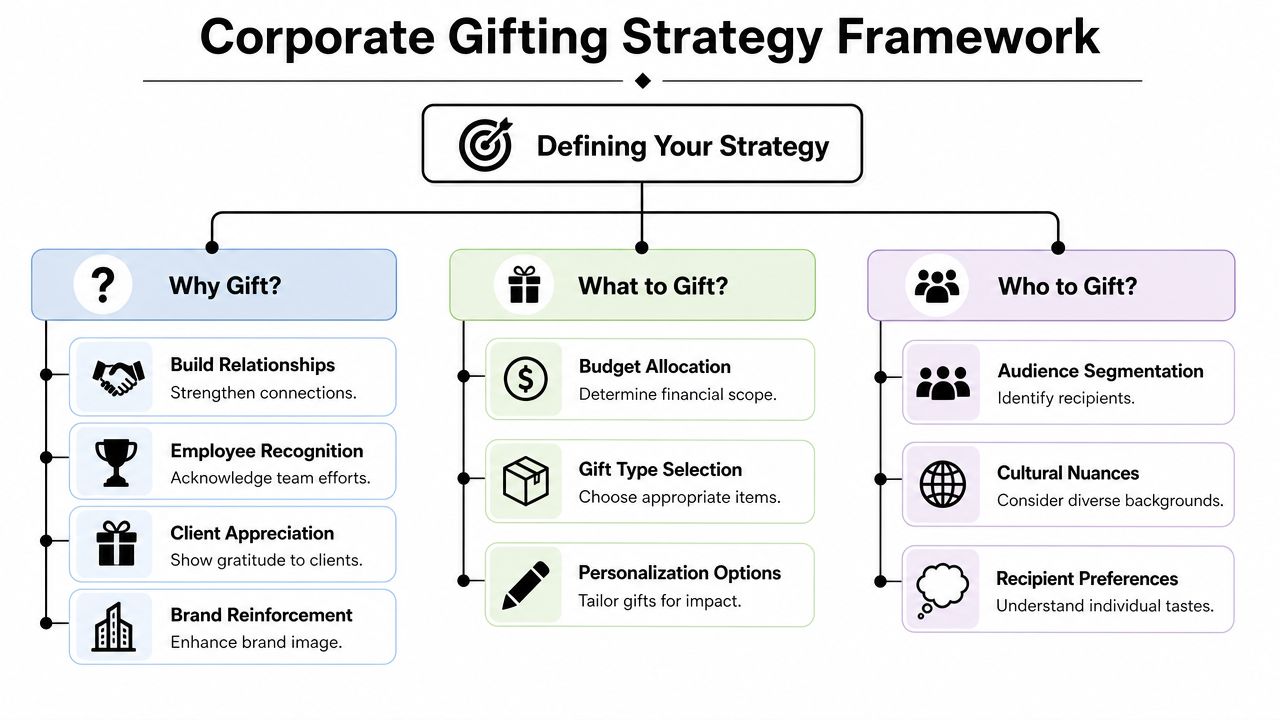
A regional sales director closes a difficult account in Abu Dhabi, sends the same festive hamper to that client, a long-standing Emirati partner, and an internal leadership team, then wonders why the response is muted. The gift may be polished, but the strategy is blurred. In the UAE, a hamper only works when the purpose is clear, the recipient group is defined, and the selection respects local expectations without feeling predictable.
Start with the business reason
Each gift should do one job well.
Some programmes are built to retain top clients. Others are meant to thank staff after a demanding quarter, support senior relationship managers with polished outreach, or reinforce a brand's standards through presentation and taste. Those goals sound similar in a meeting. They lead to very different hamper choices in practice.
A client retention gift, for example, should feel restrained and considered. An Italian gourmet hamper with artisanal cantucci, premium chocolate, Sicilian pistachio sweets, savoury crackers, and a non-alcoholic sparkling grape beverage can feel distinctive in Dubai because it avoids the usual dates-and-oud formula while still staying culturally appropriate. An employee appreciation gift usually needs broader appeal, easier sharing, and simpler customisation.
If you need inspiration for recipient-facing formats, this round-up of best corporate gift ideas for clients is useful because it shows how different gift types suit different business contexts.
Decide what success should look like
A gifting programme needs a defined outcome before anyone approves products or packaging.
Success may mean reopening dormant client conversations before year-end visits. It may mean giving account directors a refined follow-up touch after a successful negotiation. It may mean helping employees feel recognised in a way that does not look generic or rushed. As noted earlier, companies across the UAE increasingly treat gifting as a relationship tool, not just a seasonal courtesy.
Keep the objective specific enough to guide decisions. “Send gifts for Ramadan” is too loose. “Thank top-tier clients before Ramadan with a halal-conscious Italian hamper that feels premium, discreet, and different from standard market gifts” is a workable brief.
Practical rule: If the objective cannot guide product choice, recipient tiering, and message tone, it is still too vague.
Segment your recipients properly
One uniform hamper rarely suits a mixed list.
A senior executive in a family-owned business, a procurement lead at a multinational, and an internal team manager do not read the same gift in the same way. In the UAE, status, occasion, and cultural fit shape how a gift is received. The smartest programmes keep a shared design language but adjust contents and presentation by tier.
Recipient group | What matters most | Suitable hamper style |
|---|---|---|
Senior clients and executives | Discretion, origin quality, elegant presentation | Curated Italian gourmet selection with premium tea, fine chocolates, savoury delicacies, and a non-alcoholic celebratory bottle |
Long-term clients and partners | Warmth, consistency, relevance to the relationship | Balanced sweet and savoury hamper with personalised note and polished presentation |
Team leaders and high performers | Recognition, usability, shareability | Gourmet hamper designed for home enjoyment, with biscuits, chocolates, premium pantry items, and tea |
Wider employee groups | Fairness, simplicity, festive appeal | Standardised selection with broad taste appeal and clean packaging |
The trade-off is straightforward. The more tiers you create, the more precise the programme becomes, but the more coordination you need. For many UAE companies, two or three recipient tiers are enough.
Set the key requirements early
Before curation starts, agree on the basics in writing:
Budget range
Recipient tiers
Cultural and dietary requirements
Delivery locations
Branding level
Approval timeline
This matters even more with imported gourmet products. If the brief is unclear, teams often approve items that look luxurious on paper but create problems later, such as alcohol-adjacent products, ingredients that raise halal concerns, or flavours that feel too niche for a broad recipient group. Clear requirements prevent those mistakes early and make the final hamper feel intentional, not assembled at speed.
Budgeting for Impact and Value
The quickest way to misprice a gifting programme is to focus only on the contents. A hamper is never just the basket, the bottle, the biscuits, or the cake. You're paying for selection, packing, presentation, coordination, and delivery. In a luxury market, those layers matter.
In the UAE, companies in mature markets typically spend between $60 and $110 per employee on corporate gifts, as noted earlier in the same source. That range is useful, but it shouldn't be read as a rule. It's a benchmark, not a strategy.
Build your budget around the full experience
A low-cost hamper can become expensive once teams start adding details late in the process. Premium sleeve printing, branded cards, velvet-lined boxes, hand-tied finishes, and split-address deliveries all affect total spend.
The cleanest budgeting model usually includes four cost areas:
Core products The actual edible selection. Quality matters most in this aspect, and poor choices are hardest to hide.
Presentation Boxes, trays, ribbons, printed inserts, tissue, sleeves, and finishing details.
Customisation Brand cards, personalised messages, occasion-specific sleeves, or customized recipient tiers.
Distribution Packing coordination, address handling, and delivery execution.
Match spend to recipient importance
A useful mistake to avoid is spending evenly instead of intelligently. If your list includes strategic clients, internal award recipients, and broad seasonal sends, those groups don't need identical gifts.
A practical structure looks like this:
Priority relationship hampers: Use premium pantry items, polished presentation, and tighter personalisation.
Mid-tier appreciation hampers: Focus on strong product quality and elegant but simpler presentation.
Scaled employee sends: Keep the visual standard high, but simplify custom elements to protect the budget.
You don't create value by putting more items in the box. You create value by choosing the right items and presenting them well.
Where budgets often slip
The most common overspend points aren't glamorous:
Late approvals: These force substitutions and compress packing time.
Too many SKUs: Complex product mixes increase handling and sourcing risk.
Over-branding: Excessive logos can make a gift feel like merchandise.
Unclear recipient data: Wrong names, incomplete addresses, and missing access details all add friction.
A better approach is to decide what must feel premium and where simplicity is acceptable. For example, it's usually wiser to choose a smaller hamper with excellent artisanal products than a larger hamper filled with filler items. Premium olive oil, fine chocolate, elegant tea, crisp savoury biscuits, and one standout seasonal piece often outperform a box that tries to impress through quantity alone.
A simple budgeting lens
Ask three questions before approval:
Question | Strong answer | Weak answer |
|---|---|---|
Does the product selection reflect the recipient? | Yes, it suits the audience and occasion | It's generic and broad |
Does the presentation justify the spend? | Yes, it feels polished on arrival | It looks rushed or overly branded |
Can operations deliver this smoothly? | Yes, the plan is realistic | It depends on last-minute fixes |
That's how gifting budgets hold their shape. Not by cutting quality, but by refusing unnecessary complexity.
Curating the Perfect Gourmet Hamper
A good hamper feels selected. A weak one feels stocked.
That distinction matters even more in the UAE, where recipients notice both taste and restraint. A thoughtfully built Italian gourmet hamper can stand apart from standard gifting patterns because it feels cultured, useful, and memorable without becoming theatrical.
Why thoughtful curation beats generic luxury
A common mistake is assuming “luxury” means expensive objects placed together. It doesn't. Recipients respond better to coherence than excess.
A hamper built around authentic Italian pantry staples and refined festive treats has a clear identity. San Marzano tomatoes, bronze-die pasta, artisanal biscuits, premium tea, fine chocolates, panettone, honey, nougat, and elegant savoury accompaniments tell a story. They also give the recipient something they can enjoy over time, not just display.
A key advantage is differentiation. Many UAE gift programmes default to the same familiar references. There's nothing wrong with dates and Arabic coffee, but they're no longer distinctive on their own for every occasion. Italian gourmet products create contrast while still feeling appropriate when chosen with care.
The Halal-certified Italian gap
One issue deserves much more attention. A critical gap exists in explaining how premium Italian staples such as San Marzano tomatoes, bronze-die pasta, or panettone are sourced and certified for Muslim recipients, a nuance often overlooked by general gifting guides that only warn against alcohol and pork without offering positive, certified alternatives, as noted by Pataaree on corporate gift ideas.
That's exactly where many companies hesitate. They want European gourmet quality, but they don't want uncertainty. The answer isn't to avoid imported luxury food. It's to curate with precision.
Look for hampers built around:
Non-alcoholic products
Clearly suitable sweet and savoury items
Ingredients that fit regional expectations
Seasonal products reviewed for recipient context
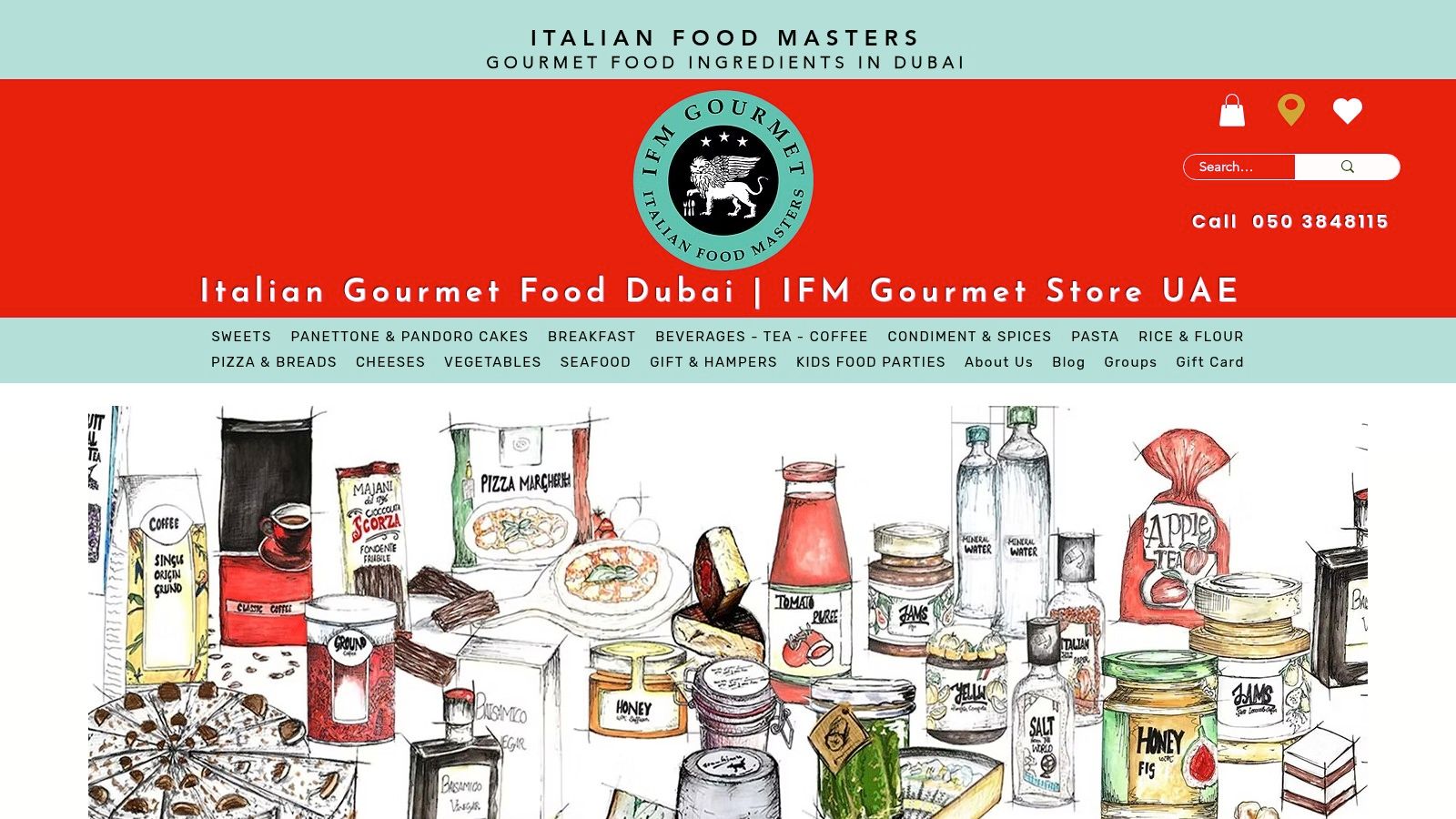
One practical way to review category options is to look at a visual range of gourmet gifting formats such as these Italian gourmet hamper categories, then narrow by audience and occasion.
Personalisation that feels elegant
The strongest personalisation is rarely the loudest. A small handwritten note, a message from the account lead, or a sleeve designed for Ramadan, Diwali, or Christmas usually lands better than putting a large logo on every visible surface.
Use brand cues carefully:
Outer presentation: Keep branding discreet and clean.
Message cards: Personalise by recipient segment or relationship.
Contents: Match product style to the occasion instead of forcing a fixed hamper year-round.
If you need custom wrap materials or outer protection for bulk dispatch, suppliers that handle bulk polythene packaging solutions can be useful at the operations stage, especially when gifts require extra transit protection without compromising presentation.
Seasonal gourmet gifting ideas
Occasion | Hamper Theme | Featured IFM Gourmet Products |
|---|---|---|
Ramadan | Refined evening hosting hamper | Premium teas, fine chocolates, savoury biscuits, honey, elegant non-alcoholic treats |
Diwali | Festive sharing hamper | Fine sweets, artisanal chocolates, nougat, tea selections, celebratory confectionery |
Christmas | Italian festive classic | Panettone, premium tea, biscuits, chocolates, savoury pantry items |
Client thank-you | Executive pantry hamper | Bronze-die pasta, San Marzano tomatoes, olive oil, biscuits, fine chocolate |
Employee appreciation | Home enjoyment hamper | Cakes, sweets, savouries, teas, shareable treats |
One supplier model that fits this well
For companies looking at UAE-based gourmet options, IFM Gourmet Food Store operates as the luxury online gourmet arm of IFM Investments LLC, with a physical and operational base in Dubai. That local footing matters when the brief requires authentic Italian products, curated hampers, and practical coordination inside the UAE rather than a generic cross-border catalogue.
If the hamper could be sent by any company to any recipient in any country, it probably isn't curated tightly enough for the UAE market.
Navigating Logistics and Supplier Selection
A strong gifting idea can still fail at the final stage. The products are approved, the cards are printed, and the hampers look right in samples. Then delivery data arrives late, one item goes out of stock, addresses need splitting by tower and villa, and the budget starts bending under courier costs.
That's why logistics deserves the same attention as curation.
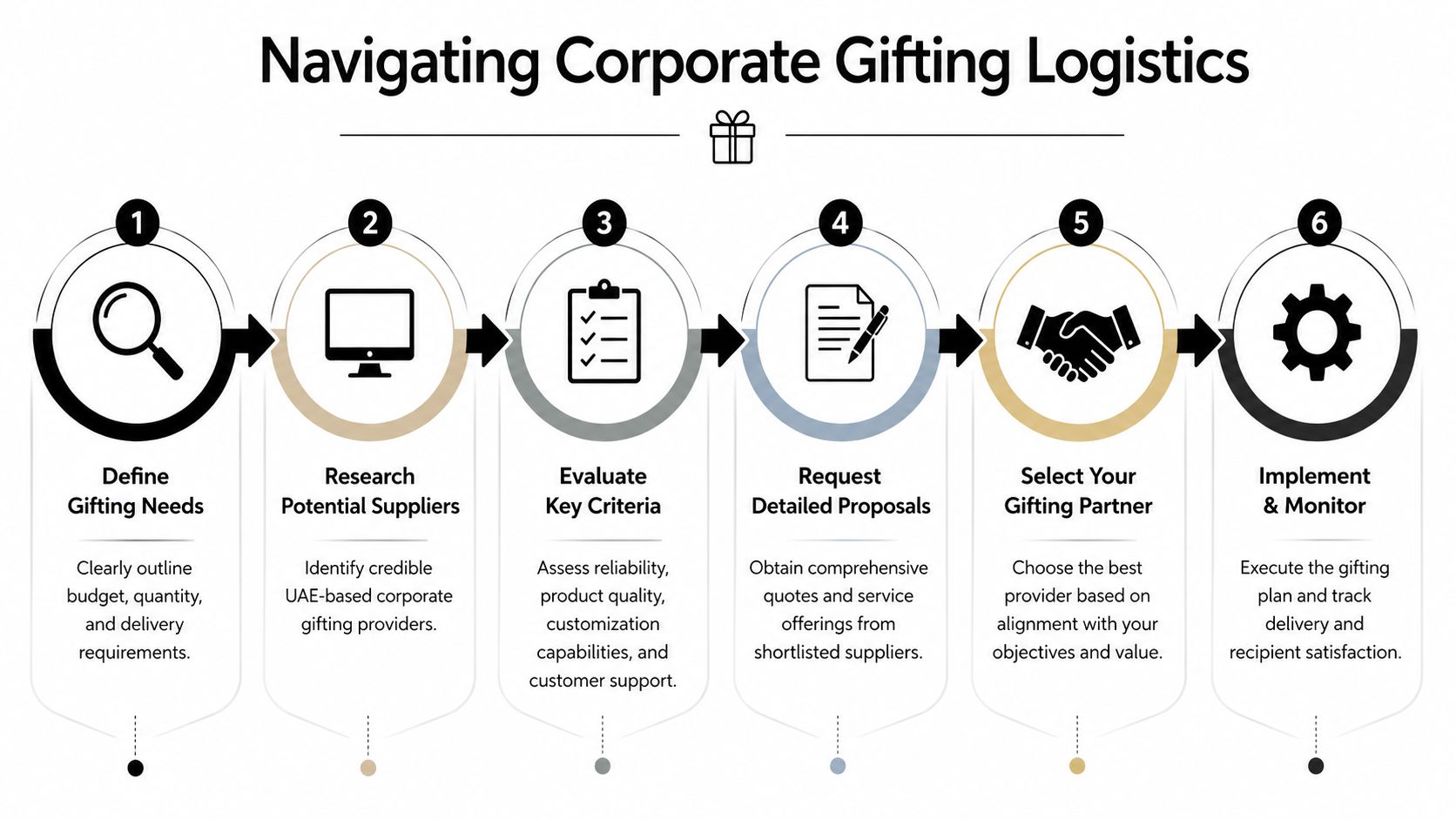
Choose suppliers like an operator, not a shopper
A polished website is not the same as a reliable gifting partner. In the UAE, ask practical questions early:
Can they handle split deliveries across multiple emirates or office sites?
Can they maintain product quality during staging and dispatch?
Can they adapt contents if a specific item becomes unavailable?
Can they support branded inserts without slowing fulfilment?
Do they understand cultural exclusions and seasonal timing?
A supplier should also show you how they package fragile or premium items. If a hamper includes glass bottles or delicate gourmet pieces, transit protection matters. Even category examples such as this premium bottled product format reveal why careful internal packing is more than a cosmetic detail.
Understand where the real risk sits
The hidden strain in most programmes is delivery planning. Shipping costs typically consume 20 to 25% of the total programme budget, especially when teams scope late and need overnight dispatch, according to BirdieBox's corporate gifting guide.
That single line changes how budgets should be built. If your plan only prices the hamper and packaging, it isn't complete. It also means late approvals are expensive in two ways. They increase courier cost, and they reduce your room to solve mistakes calmly.
A gifting programme usually breaks in operations before it breaks in aesthetics.
Build a delivery timeline with slack
The safest gifting calendar is earlier than many organizations realize they need. Product selection, approvals, card copy, branding, packing, and route planning all take time. Gourmet gifts add another layer because substitutions can affect the balance of the hamper.
A practical delivery sequence often looks like this:
Lock the recipient list early Names, numbers, and locations should be checked before curation is finalised.
Approve a primary and backup composition If one artisanal item becomes unavailable, the replacement should already be agreed.
Stage by segment Executive hampers, employee hampers, and festive sends should be packed separately.
Plan routes by geography and access type Residential towers, offices, gated compounds, and hotel destinations all require different handling.
Leave room for vendor friction Delays rarely arrive one at a time.
What works better than overnight fixes
Late gifting almost always costs more and feels worse. A cleaner method is to budget around standard delivery, confirm stock earlier, and avoid cramming five supplier dependencies into a narrow dispatch window.
Supplier selection should reward steadiness:
Supplier trait | Why it matters |
|---|---|
Local operating presence | Faster coordination and easier issue resolution |
Product knowledge | Better substitutions and cleaner curation decisions |
Customisation capability | Branding and messaging without awkward workarounds |
Delivery coordination | Fewer errors across multi-address sends |
Cultural awareness | Lower risk of unsuitable product choices |
When teams treat logistics as part of the gift, not an afterthought, the whole programme feels more professional. Recipients notice that too. A hamper that arrives on time, intact, and properly presented does more work for your brand than a more expensive one that arrives stressed and late.
Measuring Success and Planning for Next Time
If gifting is handled like a courtesy exercise, nobody learns much from it. If it's handled like a business programme, the next round gets sharper.
Measurement doesn't need to be complicated. It needs to connect back to the reason the gifts were sent in the first place.
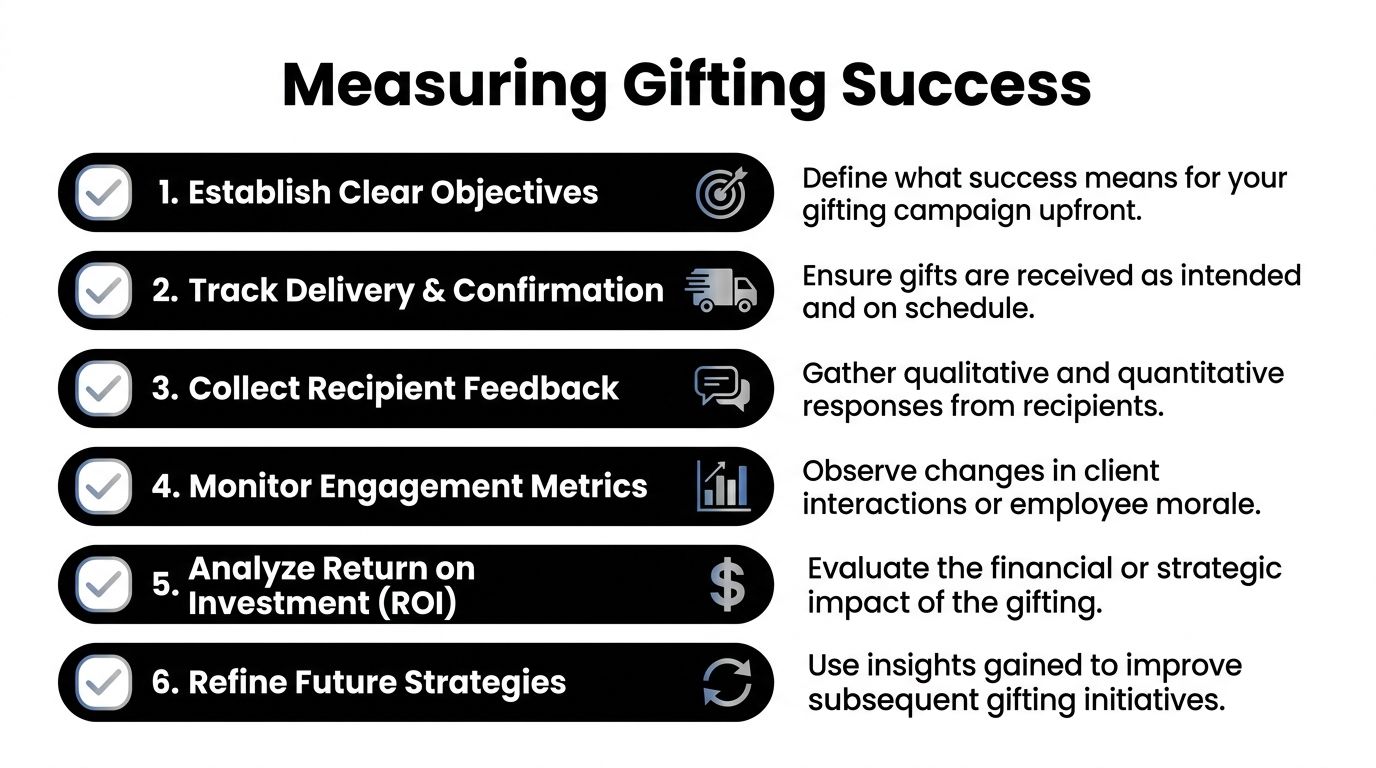
Track the signals that matter
Start with operational basics. Did the hampers arrive on time? Were there address issues? Did any packaging fail? Before you measure sentiment, make sure execution was sound.
Then review response by audience. For internal programmes, culture is an important metric. 46% of employees indicated that gifts positively influenced their perception of company culture, according to GiftAFeeling corporate gift statistics. That doesn't mean every hamper transforms morale. It does mean people attach meaning to how employers recognise them.
Use a simple review framework
A clean post-programme review can be built around five questions:
Delivery: Did gifts reach recipients in the intended condition and timeframe?
Fit: Did the hamper suit the recipient, occasion, and cultural setting?
Response: Did account teams, managers, or recipients report positive engagement?
Efficiency: Did the programme stay within budget and approval timelines?
Reuse: Which products, formats, or packaging styles should stay in the next round?
Review lens: Keep the hamper, change the process, if the gift was well received but difficult to execute.
Gather feedback without overdoing it
Most recipients won't complete a long survey about a gift, and they shouldn't have to. Better feedback comes from light-touch methods:
Sales and account notes: Ask client-facing teams whether the gift helped reopen conversation.
Manager check-ins: For employee gifting, ask team leads what feedback came back naturally.
Pattern review: Note which hamper types generated thanks, photos, or follow-up messages.
Exception logs: Record damaged deliveries, access problems, and unsuitable items.
That last point matters. Problems contain some of the most useful planning information. If a hamper looked beautiful but wasn't suitable for a fasting recipient's schedule, or if a premium bottle format made delivery harder, that should shape the next brief.
Turn one campaign into a reusable system
The most effective corporate gifting solutions improve over time because teams stop reinventing them. They keep a shortlist of approved hamper structures, a record of recipient segments, a delivery checklist, and a seasonal calendar that starts earlier.
A practical internal checklist might include:
Review area | What to record |
|---|---|
Recipient segmentation | Which tiers worked and which were too broad |
Product selection | Which items felt distinctive and which felt filler |
Packaging | What protected the gift well and what slowed packing |
Messaging | Which note styles felt personal without being excessive |
Logistics | Which delivery windows and routes caused issues |
Corporate gifting works best when it's treated as relationship design, not seasonal admin. In the UAE, that means curation with taste, logistics with discipline, and cultural judgement at every step. Italian gourmet hampers can do that job exceptionally well when they're built for the recipient, not just for the sender's catalogue.
If you're planning your next gifting programme and want a UAE-based source for authentic Italian gourmet hampers, IFM Gourmet Food Store is worth considering for curated corporate gifting options, seasonal food hampers, and customized edible gift selections that fit the standards of the local market.


Comments