
Double Choc Ice Cream: Discover the Best of 2026

You open the freezer after dinner, hoping for relief from the heat and a little comfort at the end of a long day. What you want isn't just something cold. You want chocolate that feels deep, rounded, and lingering. Not a sugary brown scoop that disappears the moment it melts on your tongue, but something darker, silkier, and more satisfying.
That's where Double Choc Ice Cream earns its place.
A proper double chocolate scoop doesn't taste like “more cocoa” in a simple sense. It tastes layered. One note lands first, another unfolds after it, and the texture carries the flavour instead of thinning it out. If you love pastry, gelato, or fine chocolate, you can feel the difference immediately. It's the difference between a shortcut dessert and one built with intention.
The Unmistakable Craving for True Chocolate
Some cravings are vague. This one isn't.
You don't stand in front of a freezer wanting “dessert”. You want the kind of chocolate that tastes full and adult, with bitterness, sweetness, creaminess, and aroma all moving together. That craving often arrives after a rushed week, a late-night dinner, or one of those Dubai evenings when the air still feels warm long after sunset.
Standard chocolate ice cream can miss the mark because it often leans on sweetness first. The colour may look promising, but the flavour can feel flat. Double choc ice cream answers a more specific desire. It aims for intensity, but also depth.
When chocolate needs more than sweetness
Think of the difference between hot chocolate made with cocoa powder alone and one enriched with melted dark chocolate. Both are chocolatey, but one has more weight, more perfume, and more finish. Ice cream works the same way.
That's also why chocolate lovers often enjoy learning how flavour begins at the ingredient level. If you're curious about how cacao differs from another roasted staple people often compare it to, Cartograph Coffee's guide to beans gives helpful context in plain language.
A memorable scoop doesn't just taste sweet and cold. It tastes built.
What makes the craving feel resolved
Double choc ice cream satisfies because it gives you two pleasures at once. First, the base itself tastes richly chocolatey. Second, there's another chocolate element folded in, melted into the base, shaved through it, or added as pieces and ripples.
That second layer changes everything. It creates contrast. It slows the eating experience. It gives the spoon something to discover.
When it's done well, the dessert feels luxurious without being complicated. You can make it at home with care, or buy a premium version that respects the same principles. Either way, the goal is the same. Real chocolate flavour, fully expressed.
Defining Double Chocolate Indulgence
Double choc ice cream doesn't mean random excess. It means layered chocolate design.
One chocolate element builds the foundation. Another adds depth, richness, or texture. That could mean cocoa in the custard and dark chocolate melted into the mixture. It could mean a dark base with chocolate shards. The point isn't just doubling quantity. The point is creating a fuller chocolate experience from more than one form.
The idea is older than many people realise
Chocolate ice cream isn't some modern novelty. It has documented roots in Naples, Italy, where Antonio Latini published The Modern Steward in 1692. That book included two recipes for frozen chocolate made with only sugar and chocolate, and this is widely treated as the first modern chocolate-ice-cream-style preparation. It also predates vanilla as an ice cream flavour by nearly 70 years, with vanilla appearing in the 1760s, according to this history of chocolate ice cream.
That heritage matters. In premium dessert culture, especially where Italian culinary tradition carries weight, chocolate ice cream belongs to a serious lineage.
What “double” usually means in the bowl
Here's the simplest explanation:
Base chocolate gives the scoop its overall identity. This is the flavour you taste in every bite.
Secondary chocolate changes the experience. It may add richness, chew, snap, or a wave of darker flavour.
Texture contrast keeps the scoop from feeling one-dimensional.
A good double chocolate scoop doesn't hit you with one loud note. It unfolds in stages.
A useful way to recognise the real thing
If you're buying rather than making, ask a few quiet questions:
What to notice | Why it matters |
|---|---|
Is the base dark and aromatic, not just sweet? | That usually signals stronger chocolate character |
Is there a second chocolate element? | This is often what makes it “double” rather than standard chocolate |
Does the texture feel dense and smooth? | Rich chocolate needs body to carry flavour well |
Chef's view: Double chocolate is less about excess and more about layering. One chocolate note should support another, not blur it.
That's why the best versions feel deliberate. They honour chocolate as an ingredient with personality, not just as a flavour label.
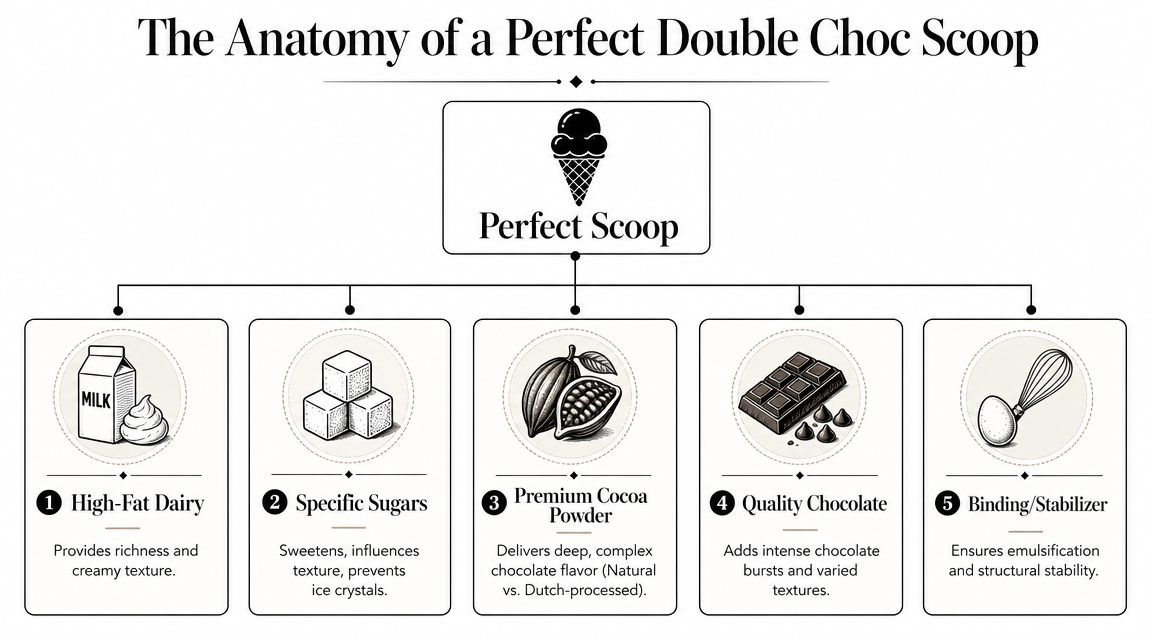
The Anatomy of a Perfect Scoop
A fine scoop begins long before churning. It starts with structure.
If double choc ice cream tastes muddy, icy, or oddly thin, the problem usually sits in the balance of ingredients. Richness, sweetness, aroma, and body have to support each other. When one part dominates, the scoop loses elegance.
Cocoa powder and chocolate do different jobs
For premium double choc ice cream, the key technical move is balancing Dutch-processed cocoa powder with semisweet or dark chocolate. That combination increases chocolate solids and fat content, which gives the ice cream a denser body and a more intense flavour than a cocoa-only base, as explained in this double chocolate ice cream preparation guide.
Many home cooks often find this confusing: cocoa powder and melted chocolate are not interchangeable.
Cocoa powder brings concentrated chocolate flavour and colour.
Dark or semisweet chocolate adds cocoa butter, body, and a rounder mouthfeel.
Together, they create both intensity and plush texture.
If you use only cocoa, you can get a clean chocolate flavour but miss the lushness. If you rely only on melted chocolate, the scoop can become heavy without enough aromatic lift.
The supporting cast matters
A scoop that tastes luxurious usually depends on a few quiet choices:
High-fat dairy helps the texture feel smooth instead of brittle.
Sugar does more than sweeten. It helps soften the freeze and keeps the texture more scoopable.
Egg yolks or another binder help hold fat and water together so the mixture stays coherent rather than separating.
These details are why premium ice cream feels different on the tongue. It melts evenly, not in watery stages.
Temperature decides texture
The custard base is typically heated to about 170 to 175°F so the yolks thicken and the fats emulsify without boiling. Push too far and the mixture can turn grainy. Stay too low and the base may not develop enough body.
That small temperature window is one of the hidden luxuries of proper ice cream making. It produces a scoop that feels polished rather than improvised.
When the base is heated carefully, chocolate tastes smoother because the texture no longer fights the flavour.
How to judge quality quickly
If you're reading a product description or planning your own batch, look for these signs:
More than one chocolate source suggests layered flavour.
A custard-style approach usually points to a richer texture.
Dark chocolate listed clearly often signals a deeper profile than generic “chocolate flavour”.
A perfect scoop isn't accidental. It's built from ingredients that each have a specific role.
Gourmet Craft Versus Mass Market
Two tubs can both say chocolate. They won't deliver the same experience.
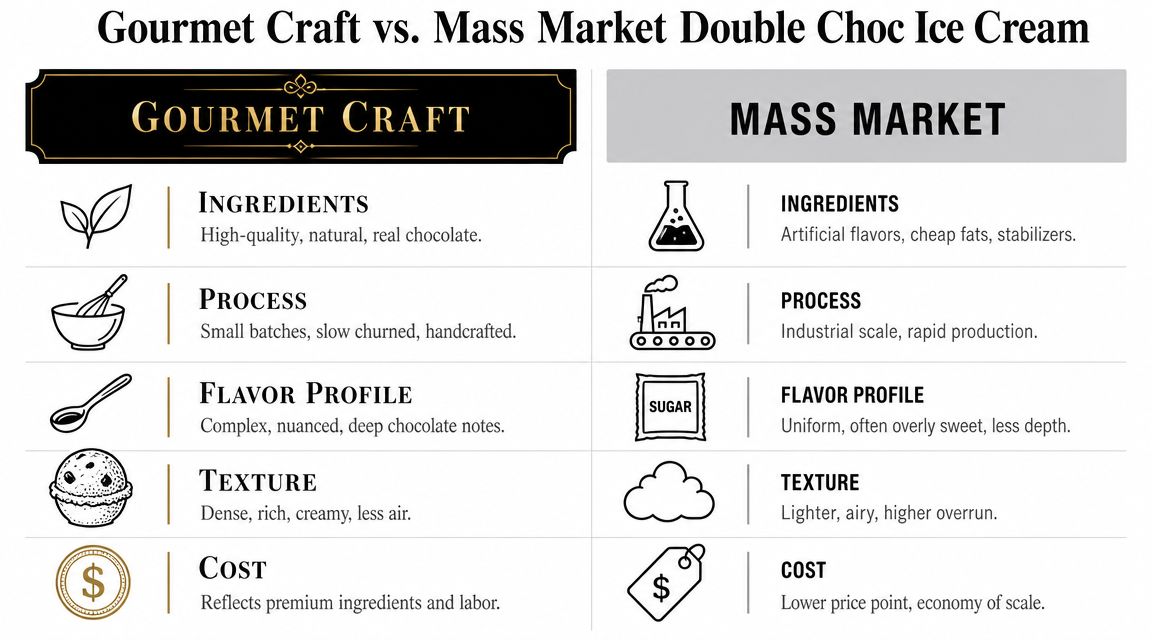
Craft double choc ice cream usually feels slower, denser, and more composed. Mass-market versions often aim for broad appeal, easy storage, and low-friction sweetness. Neither is mysterious. They're made with different priorities.
Where the difference shows up first
You notice it at the spoon.
Artisanal ice cream often resists slightly, then yields in a clean, creamy curl. The mouthfeel is fuller. The chocolate lingers longer. You may taste roasted notes, cocoa depth, or the gentle bitterness of dark chocolate.
Mass-market ice cream often feels lighter and fluffier. That can be pleasant, but it usually gives less concentration and less finish.
A side-by-side view
Feature | Gourmet craft | Mass market |
|---|---|---|
Chocolate character | Layered, often darker and more nuanced | Simpler, sweeter, more uniform |
Texture | Dense, creamy, slow-melting feel | Lighter, airier feel |
Inclusions | Chocolate pieces with real snap or melt | Chips can feel waxy or separate from the base |
Overall impression | Dessert with personality | Dessert built for consistency |
Why premium costs more
The difference isn't only branding. It often comes from choices that are expensive in both labour and ingredients.
Real chocolate costs more than flavour shortcuts.
Small-batch handling asks for more attention at each stage.
Texture is managed carefully so the scoop feels composed rather than padded.
That's what you're paying for. Not just the product, but the standard behind it.
What to buy if you care about flavour
Choose the version that tastes like chocolate first and sweetness second. That doesn't mean severe bitterness. It means balance.
If you're selecting for a dinner party or gifting, a craft-style scoop also behaves better in a plated dessert. It holds presence beside berries, coffee, pastry, or a warm brownie instead of disappearing into sugar.
Crafting Your Own Double Chocolate Masterpiece
Making double choc ice cream at home is less difficult than people think. It just rewards patience.
The process has two parts. First, you build a strong chocolate custard. Then you give it time to mature before churning. That pause is one of the secrets to a scoop that tastes professional.
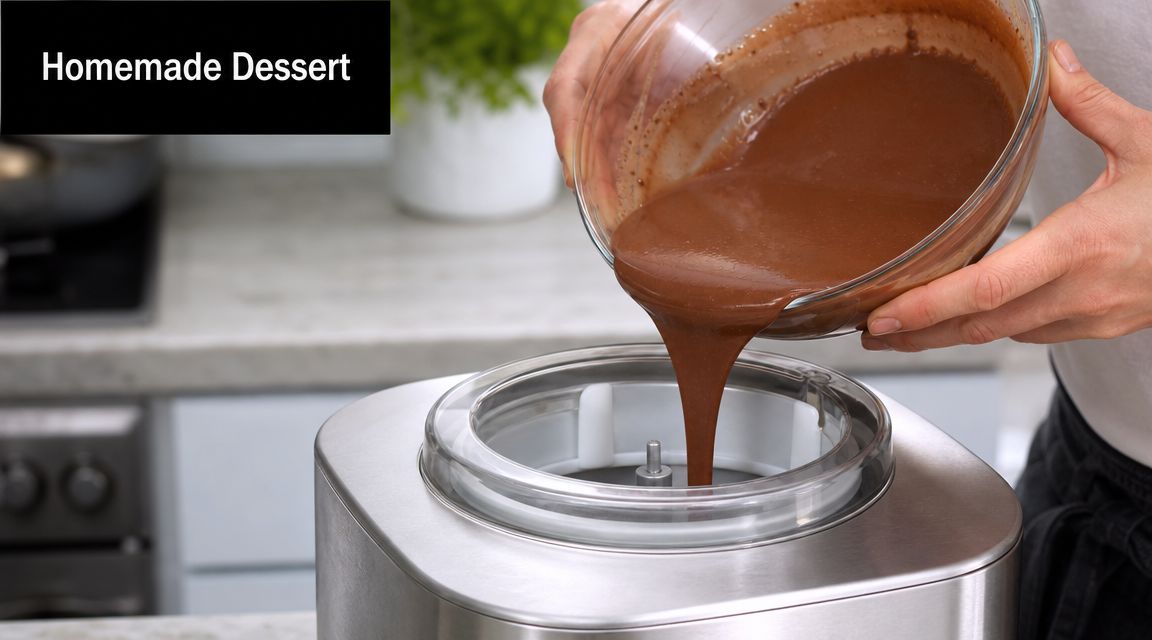
A home method that works
Use this as a framework rather than a rigid formula.
You'll need
Cream and milk for the dairy base
Sugar for sweetness and smoother texture
Egg yolks for custard richness
Dutch-processed cocoa powder for deep flavour
Good semisweet or dark chocolate for body and intensity
A pinch of salt
Optional chopped chocolate to fold in near the end for extra texture
How to build the base
Warm the dairy gently. Heat milk, cream, cocoa powder, and part of the sugar until steaming and smooth.
Whisk yolks with the remaining sugar. This keeps them fluid enough to temper.
Temper carefully. Add some of the hot dairy into the yolks while whisking, then return the mixture to the pan.
Cook the custard with attention. Stir until it thickens lightly and reaches the stage where it can coat a spoon.
Add the chocolate off the heat if needed. Stir until fully melted and glossy.
Strain the base. This catches any tiny cooked egg bits and keeps the texture refined.
The step many people rush
For the smoothest texture, the base should rest in the refrigerator for at least 4 hours, and ideally overnight. This chilling time allows the fat to crystallise and the proteins to hydrate, which leads to a firmer structure and less ice crystal growth during churning, as noted in this guide to ageing an ice cream base.
That waiting time isn't wasted time. It's part of the recipe.
Practical rule: If your base is cold, rested, and fully mature before churning, your final scoop will taste calmer, smoother, and more expensive.
Churning without frustration
A few handling details make home results much better:
Don't overfill the machine. Keeping the canister around 2/3 to 3/4 full helps it churn properly.
Stop at soft-serve texture. That's usually the right moment, not the moment when it seems fully frozen.
Freeze promptly after churning. A further 4+ hours helps the ice cream firm up and limits ice-crystal growth.
If you like seeing the movement and texture in action, this walkthrough is useful:
Easy ways to personalise the flavour
Once the base is reliable, you can shape it to your taste.
For a café-style note, add a little espresso flavour. Chocolate often tastes deeper next to coffee.
For contrast, swirl in caramel. The bitter edge of chocolate and the toastiness of caramel play well together.
For warmth, add a touch of spice such as cinnamon or chilli.
For texture, fold in chopped dark chocolate at the end of churning.
The most elegant homemade version is usually the one that stops before excess. Let the chocolate lead.
Serving Pairing and Storing Like a Pro
A great scoop can still be mishandled at the last minute. Serving and storage matter more than commonly assumed.
If ice cream is too hard, the flavour hides. If it softens too far on the counter, the texture suffers. The sweet spot is a brief temper before serving so the chocolate can open up aromatically.
Pairings that flatter chocolate
Double choc ice cream loves contrast.
Fresh raspberries bring acidity that brightens a dense scoop.
Sea salt sharpens the chocolate flavour in a subtle way.
A short espresso turns dessert into a more complete ritual.
Crisp waffles make an excellent partner when you want temperature and texture contrast, especially if you like the look and feel of a café-style plate inspired by this waffle serving idea.
The UAE factor changes everything
In the UAE, summer temperatures can exceed 40°C, and frozen foods need to be kept at -18°C or colder. In these conditions, insulated packaging, rapid transport, and proper freezer storage matter as much as the recipe for preserving texture and preventing melting, according to this hot-climate guidance for frozen dessert handling.
That one fact changes how you shop.
Buy frozen desserts at the end of your trip, go straight home, and clear freezer space before the order arrives.
Small habits that protect the scoop
Use a container with a tight-fitting lid. Keep it deep in the freezer rather than in the door, where temperature swings are stronger. When serving, return the tub quickly instead of letting it linger on the counter.
If you're ordering delivery in warm weather, timing matters. A superb ice cream can lose its edge before you ever taste it if the frozen chain breaks on the way.
Source Your Finest Chocolate Experience in Dubai
You step into your kitchen in Dubai, the freezer is ready, and the craving is very specific. Not just something cold and sweet, but a scoop with real chocolate depth. The kind that tastes of cocoa beans, cream, and careful craft rather than sugar and shortcuts.
That is the moment ingredient sourcing starts to matter.
Once you know why double chocolate ice cream works, shopping becomes more precise. Cocoa powder gives breadth and a dry, aromatic backbone. Melted chocolate brings fat, silkiness, and length on the palate. Use both well, and the flavour feels layered rather than flat. Buy a finished tub made with care, and you should taste that same balance in the first spoonful.
For home cooks, the smartest approach is to start with chocolate you would happily eat on its own. A good bar tells you a great deal before it ever meets the cream. If it tastes dull at room temperature, it will taste even quieter when frozen. If it has clear notes of roasted cocoa, dried fruit, or gentle bitterness, those qualities will still speak through the cold.
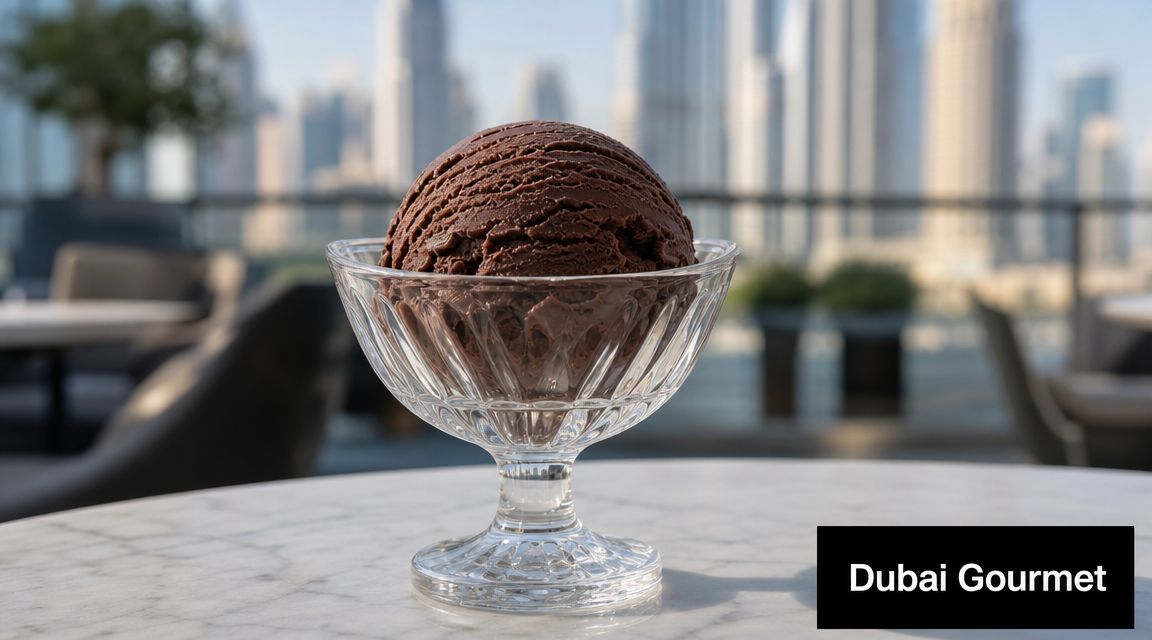
In Dubai, IFM Gourmet Food Store is a practical place to shop for that higher standard. Its range of Italian gourmet products suits both sides of the craving: ingredients for cooks and premium desserts for shoppers who want a ready-made option. If you want a clearer sense of the products in that category, you can browse their artisanal dark chocolate and milk chocolate selection for dessert making and gifting.
A useful rule helps here. Cocoa powder behaves like the bass note in music. It grounds the flavour and gives it resonance. Melted chocolate acts more like the orchestra around it, adding richness, roundness, and texture. Premium ice cream usually respects both roles. Mass-produced versions often push sweetness forward and let true cocoa character fade into the background.
What to look for before you buy
Choose with a clear purpose.
If you're making it yourself, pick dark chocolate with a flavour profile you enjoy eating plain, then match it with a cocoa powder that smells full and fresh.
If you're buying ready-made, look for a product that signals real chocolate ingredients and a dense, creamy body rather than novelty flavours doing all the work.
If you're serving guests in the UAE heat, buy close to serving time or protect the cold chain carefully so the texture stays smooth and the scoop keeps its shape.
The finest chocolate experience comes from informed choices. Understand the role of each ingredient, respect what freezing does to flavour, and source products that still taste luxurious straight from a Dubai freezer.


Comments