
Extra Virgin Olive Oil Uses for Every Kitchen

You're standing in a Dubai kitchen with a beautiful bottle of Italian extra virgin olive oil, wondering whether to save it for guests or open it for tonight's dinner. Perhaps it arrived in a gift hamper, or you chose it for its peppery aroma and elegant packaging, then used it only for salad dressing. That bottle has a much broader role. Used thoughtfully, it can season hummus, enrich pasta, roast vegetables, finish grilled seafood, support gentle cooking, and add polish to a gourmet gift.
IFM Gourmet Dubai is the luxury online gourmet arm of IFM Investments LLC, a culinary-focused company based in the UAE. Its gourmet store offers artisanal sweets, savouries, fine chocolates, premium teas, cakes, and curated gift hampers. As part of the wider Italian Food Masters group, it brings quality, authenticity, and culinary elegance into Dubai's gourmet scene.
Rethinking Your Bottle of Liquid Gold
A premium bottle of extra virgin olive oil often begins as an occasion purchase. You might buy it for an Italian dinner, place it beside crusty bread, and then return to a neutral oil for everyday cooking. That habit misses much of the oil's character. Extra virgin olive oil uses extend from raw applications to gentle heat, finishing, baking, marinades, and carefully chosen household rituals.
A pantry essential for the UAE
The UAE has a familiar relationship with olive oil that reaches beyond private kitchens. In 2023, the UAE exported 3,273,620 kg of virgin olive oil and fractions, valued at US$10,056.84K, with Saudi Arabia and Oman among the major regional destinations, as reported in the UAE olive oil market outlook. That trade activity reflects both local culinary demand and the country's role as a distribution hub for premium Mediterranean foods across the Gulf.
For home cooks, that means a bottle can move easily between cuisines. Use a grassy oil with tomatoes, basil, and bronze-die pasta, then pour it over warm flatbread, labneh, or a plate of roasted aubergine. In a hospitality setting, the same ingredient can serve as a table condiment, a finishing touch for plated dishes, or part of a breakfast and mezze presentation.
Practical rule: Choose the oil for the flavour you want at the table, not simply for the cooking method printed on the recipe.
Think in layers of flavour
Mild oils can support delicate fish, fresh cheese, and lightly dressed vegetables. More assertive oils, with peppery or herbaceous notes, can stand up to grilled meat, beans, bitter greens, and tomato sauces. The oil's aroma matters most when it stays close to the finished dish, which is why a final drizzle often delivers more pleasure than using the same oil where its flavour disappears.
That versatility also makes EVOO useful in gifting. A bottle paired with balsamic vinegar, fine pasta, chocolates, or tea creates a practical hamper rather than a decorative one. The recipient can use each item in daily cooking, serve it to visitors, or keep it for a special meal.
Culinary Applications and Heat Management
In a UAE kitchen, the same bottle may dress a salad at lunch, flavour a family meal, and finish a hospitality platter that evening. Extra virgin olive oil performs best when you match its flavour, freshness, and heat exposure to the dish. Raw use preserves its aroma most clearly. Gentle cooking carries that character into food, while prolonged or repeated high heat can make a different oil more practical.
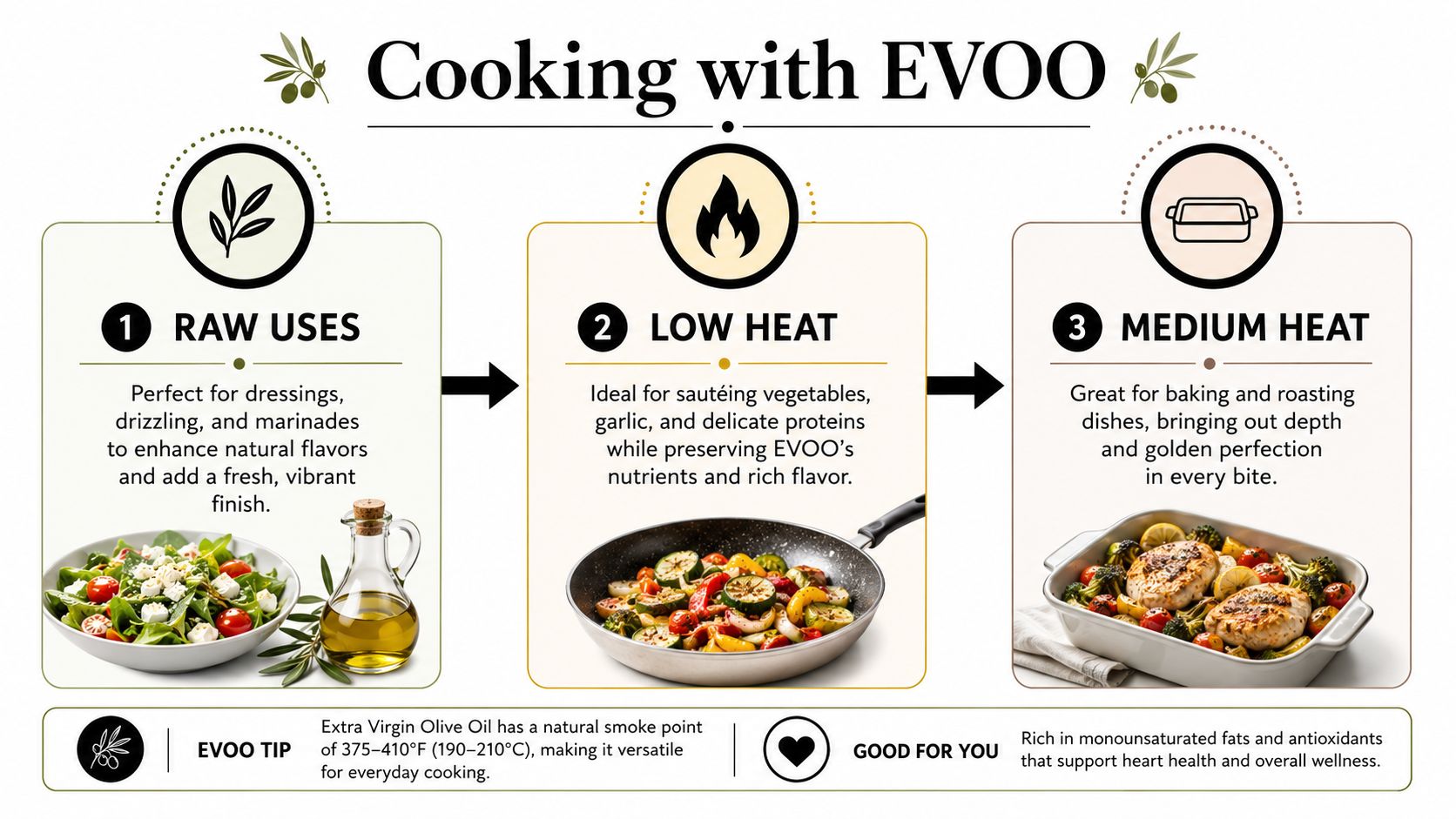
Start with raw applications
Use EVOO when the oil forms part of the eating experience:
Dressings: Whisk it with lemon juice, vinegar, herbs, or mustard for salads and grain bowls.
Marinades: Combine it with garlic, rosemary, citrus, and spices for vegetables, poultry, seafood, or meat.
Dipping: Serve it with bread, za'atar, cracked pepper, or aged balsamic vinegar.
Finishing: Spoon it over hummus, labneh, soup, grilled vegetables, pasta, or warm beans just before serving.
A raw drizzle brings balance to Arabic-Italian dishes. Try it over a mezze plate with hummus and roasted peppers, or finish pasta with chilli, garlic, lemon, and a pour of EVOO. Add the oil after the main cooking stage, like adding fresh herbs at the end, so its fragrance remains distinct.
Cook gently, then taste
For UAE kitchens, reserve extra virgin olive oil mainly for low- to medium-heat methods and finishing. Overheating unrefined oils can release harmful compounds, while stable refined oils are preferred for deep frying or stir-frying, as explained in this regional guide to oil smoking points.
Sauté onions, garlic, mushrooms, courgettes, or spices over gentle heat. Use EVOO to soften vegetables before adding tomatoes or stock. It also suits roasting and baking when the recipe benefits from noticeable olive flavour. The oil coats vegetables, helps herbs cling to food, and adds richness to savoury doughs.
For a practical explanation of smoke point and oil selection, consult the Monopack ltd oil guide. Also consider heating time, whether the oil is reused, and whether its flavour suits the recipe.
Keep the premium flavour visible: Use a characterful EVOO where your palate can notice it, particularly on finished dishes and raw preparations.
A pasta dinner provides an easy test. Cook the pasta separately, prepare the sauce with gentle heat, then finish the plate with a modest pour of EVOO. The oil should taste fresh and integrated, rather than greasy or overpowering. For visual inspiration, explore this Italian pasta serving reference.
When to Choose EVOO Over Neutral Oils
EVOO contributes flavour and aroma, while a neutral oil stays in the background. Choose according to whether you want the oil to be tasted and recognised in the finished dish.
EVOO suits hummus, focaccia, tomato sauces, grilled seafood, roasted vegetables, salad dressings, and pasta. Its fruitiness can make familiar ingredients feel complete, while peppery notes provide contrast against creamy or sweet components. It also works for baking, sautéing, grilling, and frying. Smoke point alone does not reliably measure cooking stability, according to this olive oil FAQ.
A neutral oil fits a recipe where olive notes would compete with subtle flavours, or where the oil needs to provide a clean background. It can also be practical for deep frying, since the quantity used is substantial and the distinctive character of premium EVOO may not remain noticeable after the process.
A useful decision matrix
Cooking Method | Best Oil Choice | Why |
|---|---|---|
Salad dressing | EVOO | It provides aroma, fruitiness, and structure to the dressing. |
Hummus or labneh | EVOO | The oil becomes part of the final flavour and presentation. |
Focaccia | EVOO | It supports a savoury, fragrant crumb and a rich finish. |
Roasted vegetables | EVOO or a neutral oil | Choose EVOO when its herbal notes suit the vegetables. |
Delicate sponge cake | Neutral oil or mild EVOO | A neutral oil keeps the flavour profile restrained. |
Gentle sautéing | EVOO | It carries aromatics and adds depth to the base of the dish. |
Grilled seafood | Mild EVOO | It complements the seafood without masking its texture. |
Deep frying | Neutral or refined oil | A neutral profile and appropriate heat performance may be more practical. |
Premium EVOO is easiest to justify when it remains recognisable in the dish. A bold bottle poured over grilled prawns, warm bread, or ripe tomatoes has a clear sensory role. In a strongly spiced preparation, however, the spices may dominate its aromatic character. This matters in the UAE, where a bottle may serve both everyday meals and a hospitality table. Reserve expressive oils for dishes where guests can notice their freshness and finish.
The category also carries significant international demand. EU extra-EU exports in May 2025 totalled 74,914 tonnes, and 74.6% of that volume was EVOO, while average EVOO export values were €595 per 100 kg, according to the olive oil FAQ cited above. Quality-conscious shoppers, hosts, and gift buyers still need to match the oil to the plate, serving occasion, and storage conditions of a hot climate.
Beyond the Kitchen Beauty and Home Care
A well-made EVOO can serve outside cooking, although not every culinary bottle is ideal for every personal-care purpose. Keep non-culinary use separate from food preparation, use a small amount first, and stop if your skin or scalp reacts poorly. The value lies in the oil's emollient texture and practical versatility, not in treating it as a substitute for every formulated product.
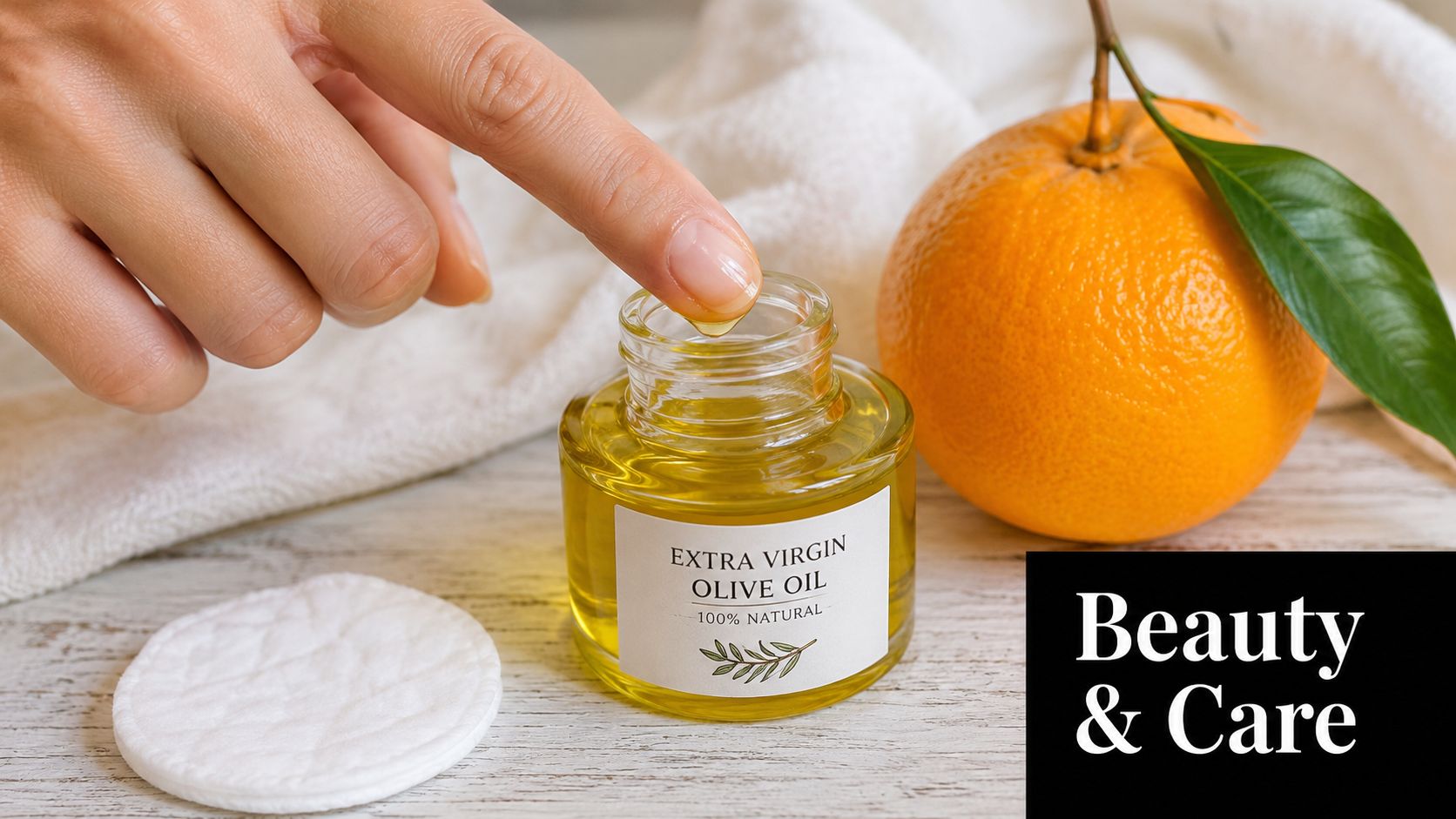
Simple beauty applications
Apply a tiny amount to dry areas such as elbows, hands, or heels, then massage it in. EVOO can leave a protective, supple feel, but it may feel heavy on oily or blemish-prone skin. A patch test on a small area is sensible before adding it to a regular routine.
For makeup removal, place a little oil on a cotton pad and work gently around the face, avoiding direct contact with the eyes. Follow with your usual cleanser so the skin doesn't retain an unwanted oily film. This approach suits people who already enjoy simple, single-ingredient routines, but those with sensitive skin should choose products formulated for their needs.
Hair care is another familiar use. Warm a small amount between your hands, smooth it through dry lengths, and leave it briefly before shampooing thoroughly. Concentrate on the ends rather than the roots if your hair becomes weighed down easily.
Useful household tasks
EVOO can also help with small maintenance jobs around the home:
Wood cutting boards: Rub a very small amount into a clean, dry board, then wipe away the excess. Use a food-safe board conditioner for regular maintenance where appropriate.
Stainless steel: Apply a drop to a soft cloth and polish in the direction of the grain. Buff the surface so it doesn't remain slick.
Sticky residue: Dab oil onto adhesive residue, allow it to loosen, and wipe the area clean. Test first on an inconspicuous surface.
Leather care: Use caution, as oils can darken or mark leather. Test on a hidden area before applying anything broadly.
These uses are especially appealing in a wellness or gourmet hamper. A bottle can sit alongside natural soaps, tea, chocolates, or pantry ingredients, connecting food, hospitality, and everyday care without making exaggerated promises.
Preserving Freshness in a Hot Climate
Heat and light are two of the biggest practical concerns for EVOO storage in the UAE. A bottle may arrive in excellent condition, yet lose aroma if it sits beside a cooker, near a bright window, or in a warm delivery area. Storage isn't an afterthought. It determines how much of the oil's original sensory character reaches your plate.
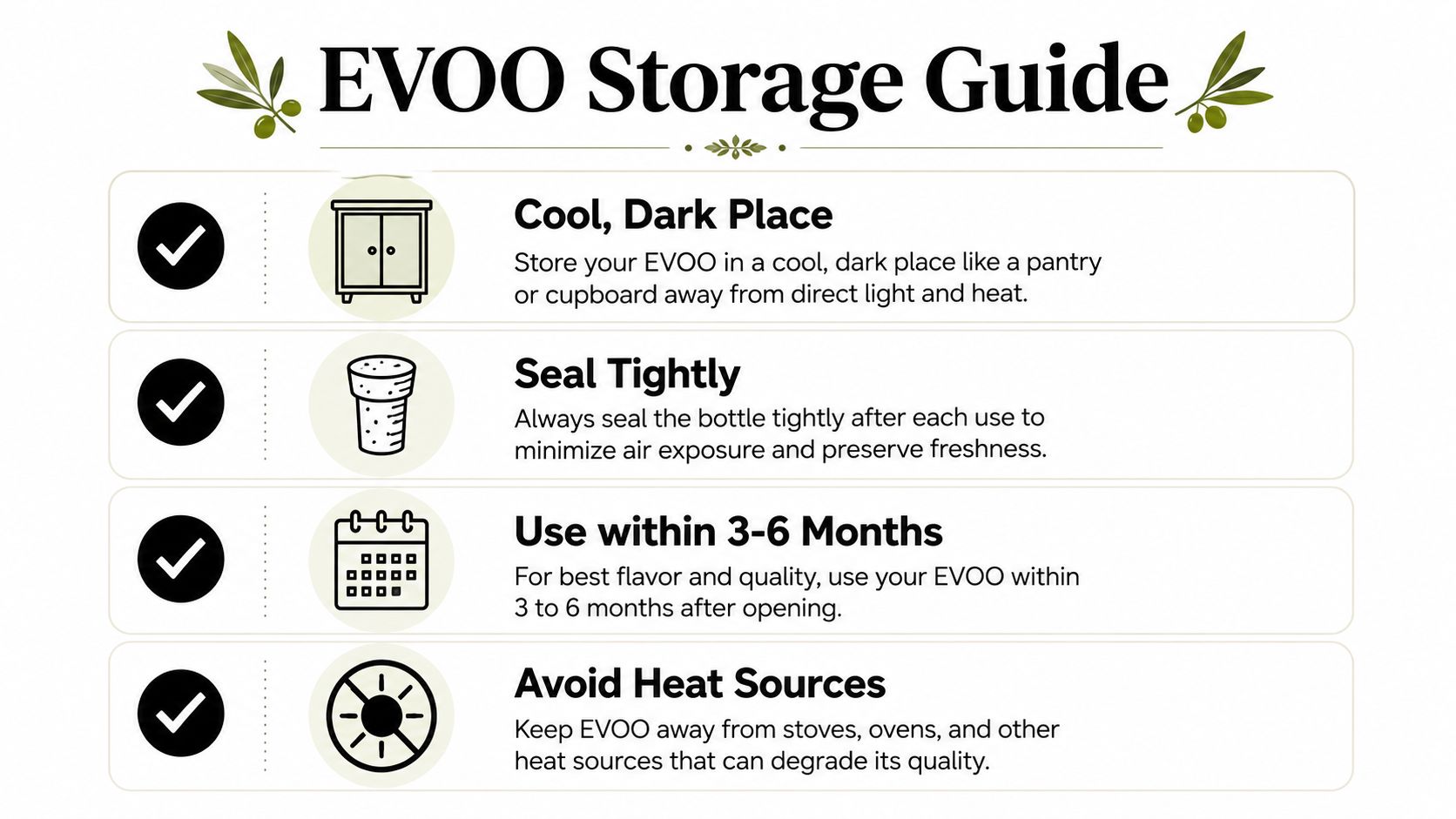
Build a cool, dark routine
Keep the bottle in a cupboard away from the oven, hob, dishwasher, and direct sun. A closed pantry or interior cabinet is usually more suitable than an open shelf beside a window. If you decant oil for service, use an opaque or dark container and refill it in small quantities rather than leaving a large volume exposed.
Peer-reviewed evidence found that tin containers and dark glass bottles preserved physicochemical and sensory quality better than clear glass or polyethylene, without appreciable oxidation for up to six months at ambient conditions. The findings are particularly relevant to UAE kitchens and hospitality storage, where heat exposure can be difficult to avoid. Read the peer-reviewed storage study for the full evidence.
Protect the bottle after opening
Replace the cap firmly after every use. Oxygen enters when the bottle is left open, and a loose closure also allows aromas to escape. Avoid storing EVOO in a decorative cruet for long periods unless the cruet blocks light and seals properly.
Use a simple rotation system in restaurants and at home. Open the bottle you expect to finish first, keep backup bottles sealed, and avoid buying more than your household or service team can use while the oil is at its freshest. For gift buyers, include storage advice with the hamper. The recipient may appreciate the bottle more when they know how to protect it.
A bottle is part of the ingredient: Dark packaging, a tight seal, and a shaded storage place help preserve the flavour you paid for.
Learn the signs of decline
Fresh EVOO can smell fruity, grassy, herbal, or pleasantly peppery. Oil that has turned may smell flat, stale, waxy, or reminiscent of old nuts. If the aroma seems wrong, taste a small amount. A dull or rancid flavour is a practical reason to stop using it for finishing dishes, even if the bottle looks normal.
A 2025 consumer study found that 35.9% of respondents didn't know the maximum recommended shelf life for EVOO, while only 31.3% correctly identified 12 months. The same study found that 70% didn't know the legal maximum acidity level for EVOO classification. These findings, reported in the consumer study on EVOO knowledge, show why labels and storage guidance matter as the premium category expands in the UAE.
Selecting Authentic Italian EVOO in the UAE
A shopper standing in a UAE supermarket may see several attractive Italian bottles under bright lights. The useful questions are practical: freshness, provenance, packaging, and intended use. These details help a home cook choose confidently and help a gift buyer match the oil to the recipient, hamper, or hospitality setting.
Read the label with purpose
Begin with the product category, country or region of origin, producer information, and a clear best-before date. A harvest date adds context by showing when the olives were picked. A lot or batch reference supports traceability. If the bottle carries a PDO designation, it links the oil to defined regional production rules.
Acidity can help classify EVOO, yet one figure cannot describe the whole bottle. The consumer study cited earlier found uncertainty around the legal acidity threshold, so shoppers should assess technical information alongside packaging, freshness, sensory character, and transparent producer details. A low number is not a substitute for a sound aroma and balanced flavour.
For the UAE's warm conditions, dark glass or a tin offers sensible protection. Check that the cap is intact, the label is legible, and the bottle has not spent long under strong retail lighting. Corporate hamper buyers should usually choose an oil with a balanced, versatile flavour unless they already know the recipient enjoys a bold, peppery style.
Provenance includes compliance
Imported food entering the UAE passes through formal safety and registration procedures. The UAE gourmet and fine foods guidance states that food imported into the country for the first time must receive approval from the Ministry of Climate Change and Environment. Food products sold in UAE markets must also be registered in the national ZAD electronic system before handling or sale.
The guidance also highlights origin documents and clear, non-removable labels. For olive oil, these records connect the bottle to its declared source and supply chain. The same principle applies to other hamper items, including chocolates, teas, and balsamic vinegars. Compliance gives retailers and buyers a clearer chain of responsibility.
A wider Italian presentation might place EVOO beside Lurisia water, artisan pasta, balsamic vinegar, or fine chocolate. IFM Gourmet Food Store is one Dubai-based specialist offering imported Italian ingredients and curated food gifts. Buyers can therefore consider both the oil's character and the occasion the hamper must serve.
Elevating Your Pantry and Gifting Strategy
A reliable bottle is the one you reach for regularly and store carefully. Keep a milder EVOO for dressings, marinades, and gentle cooking. Reserve a more expressive bottle for bread, hummus, grilled seafood, roasted vegetables, pasta, or the final spoonful over a finished plate. In the UAE's heat, this two-bottle approach also helps limit repeated exposure of a delicate oil to warm kitchen air.
Premium oil can serve as a hamper's practical centrepiece. Pair it with traditional balsamic vinegar for salads, bronze-die pasta for an easy supper, fine chocolates for contrast, or Italian tea and coffee for a broader hospitality selection. These combinations suit home cooks, corporate recipients, festive occasions, and hosts who want to offer guests something more considered than a standard food basket.
A wider Italian presentation can place EVOO beside Lurisia water, artisan pasta, balsamic vinegar, or fine chocolate. IFM Gourmet Food Store is a Dubai-based specialist offering imported Italian ingredients and curated food gifts, giving buyers a way to match the oil's character with the occasion.
Store the bottle away from heat and light, use it where its flavour can be noticed, and choose neutral oil when a recipe needs restraint or a different heat profile. These habits make extra virgin olive oil a dependable part of cooking, entertaining, and thoughtful gifting.
Explore IFM Gourmet Food Store for premium Italian olive oils, balsamic vinegars, artisanal pastas, fine chocolates, teas, and curated gift hampers across the UAE. Choose ingredients that make everyday meals more expressive and build a gourmet gift around flavours your recipient will use.


Comments