

Is Maple Syrup Better Than Honey for UAE Kitchens

The most popular advice about whether maple syrup is better than honey often promises a single winner: choose the one with fewer calories, more minerals or a healthier-sounding label. But a sweetener has more than one job. The right choice for pancakes may not be the right one for tea, an Italian dessert or a festive gift, and a favourable nutrition label doesn't make either product unlimited.
For UAE shoppers, it helps to weigh flavour, portion, provenance and confidence in what's in the jar separately. Maple syrup has a modest edge in sugar and calories by the tablespoon, while honey has a closer connection to local beekeeping and a more established place in UAE trade. Neither is a poor choice. The better one depends on what you're making and how much you use.
Kitchen decision | Maple syrup | Honey |
|---|---|---|
Flavour | Distinct, warm sweetness | Floral character that varies by type |
Useful for | Pancakes, baking and modern desserts | Tea, cheese and dishes where floral notes suit |
UAE provenance | Imported specialty, especially associated with North American producers | Local beekeeping tradition alongside imported varieties |
Portion perspective | Slightly less sugar and energy per tablespoon | Still a concentrated sweetener, even when locally sourced |
Why Neither Sweetener Wins Every Time
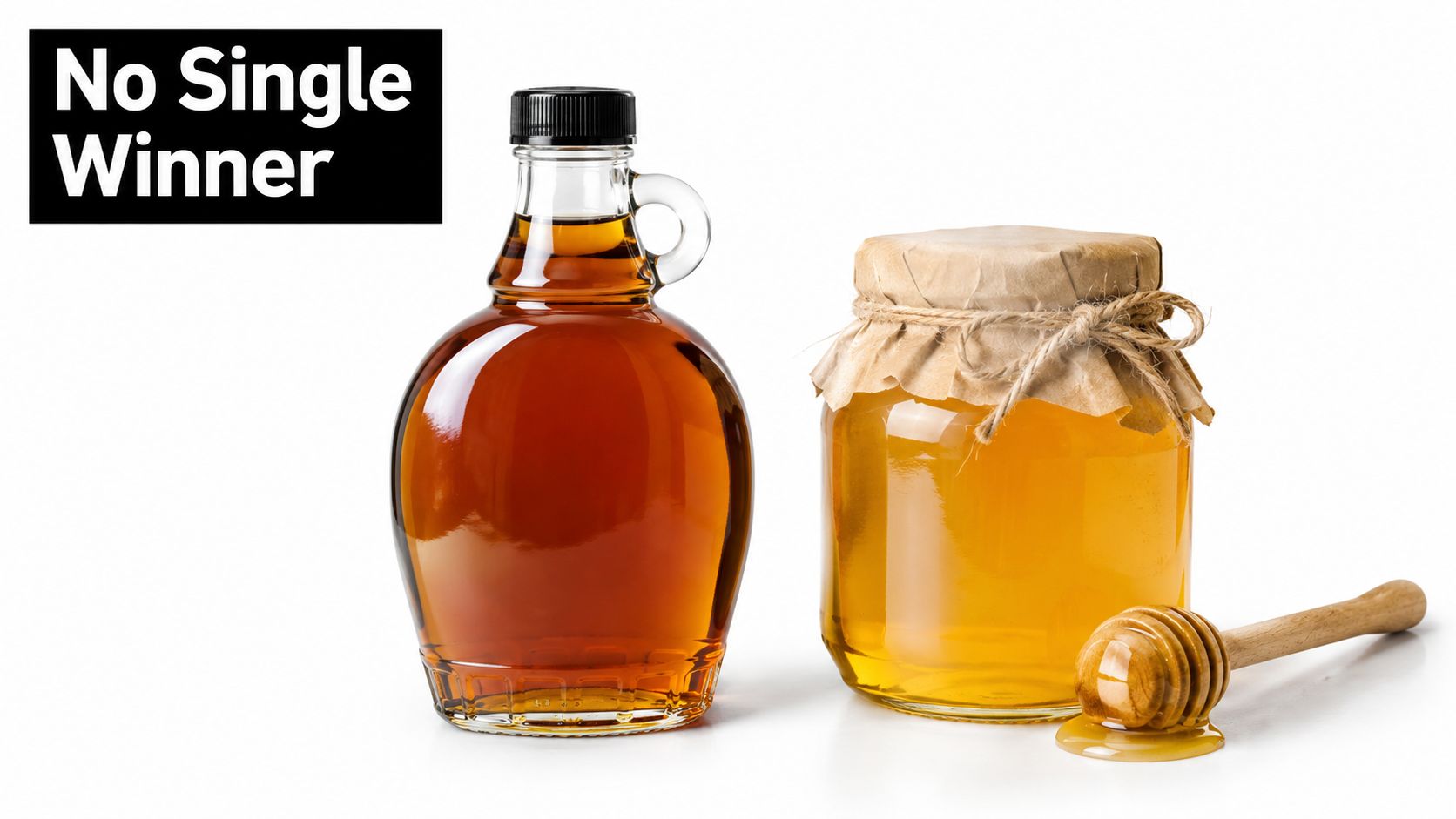
A single “healthier” verdict tends to combine three different questions: what a sweetener contributes nutritionally, how it tastes in a dish, and how confident you are about its origin. Those aren't interchangeable. A spoonful of maple syrup can be a useful choice for pancakes without being the right match for tea, just as a traceable honey can suit a gift without being a low-sugar food.
The practical starting point is the kitchen job. For a breakfast plate, maple syrup's distinctive, rounded sweetness may be exactly what you want. For tea or a cheese board, honey's floral character may fit better. If you're choosing a bottle for a festive hamper, origin and presentation may matter as much as how it performs in a recipe.
Separate the jobs
Maple syrup is slightly lower in sugar per tablespoon and supplies more of several minerals than honey. Honey, meanwhile, is connected to regional beekeeping, and UAE trade data show it has a larger export presence than maple syrup. Those distinctions help shoppers compare products, but they don't prove that one is universally superior.
A better question than “Which one wins?” is “Which one suits this dish, household and occasion?” That keeps a small nutritional difference in proportion and leaves room for provenance and flavour.
The comparison ahead follows that logic: first where each product comes from, then what a spoonful contains, how added sugars fit into everyday eating, and finally which sweetener makes sense for cooking and gifting. The aim is a useful choice for breakfast, Italian desserts or a hamper, not a health crown for one bottle.
How Maple Syrup and Honey Reach UAE Tables
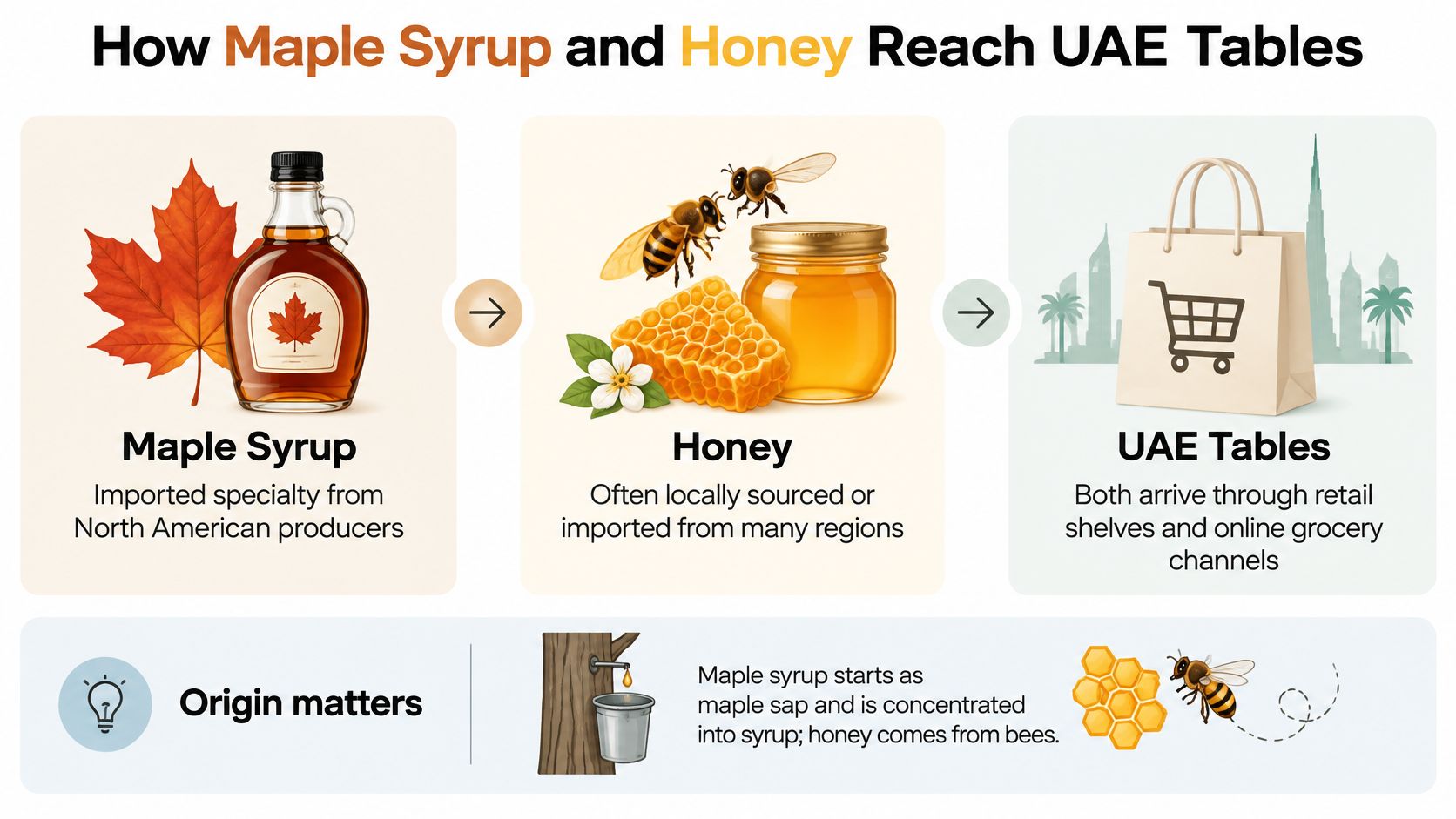
Authentic maple syrup is an imported specialty, tied especially to North American producers. Honey has a different story in the UAE: alongside imported floral and premium varieties, it has a local beekeeping tradition. That difference can matter to shoppers who value a clear origin or want their purchase to reflect local agricultural activity.
A trade route for maple syrup
World Bank WITS data record UAE imports of 606,212 kg of maple sugar and maple syrup in 2019, valued at approximately US$2.024 million. The United States supplied 274,163 kg worth US$948,040, while Canada supplied 74,280 kg worth US$512,960. These figures describe an import-dependent supply route, not domestic maple production. (World Bank WITS trade data for UAE maple imports)
The category remained measurable in 2023, when UAE imports reached 601,807 kg valued at US$3.119 million, or about US$5.18 per kg in customs value. The UAE also exported 243.6 tonnes of maple syrup worth US$830,122 that year, indicating a role in regional redistribution as well as consumption. These trade numbers don't tell us how much UAE households bought at retail or how they used it. (World Bank WITS 2023 trade data for maple sugar and syrup)
A local thread for honey
Abu Dhabi's agriculture authority reported that the eighth generation of the Emirati honey-bee strain was bred in 2023, producing 4,138 queen bees across spring and autumn breeding stages. A 2025 Abu Dhabi programme distributed 1,350 tenth-generation queen bees to 39 beekeepers and expanded monitoring of colony diseases and pests. A related initiative calls for samples to be checked for pesticides, antibiotics and other quality concerns, alongside inspections of production sites and extraction operations. (Abu Dhabi's 2025 Emirati honey-bee programme)
Honey's UAE export value was US$10.2 million in 2023, compared with US$830,122 for maple syrup exports. The products and trade datasets aren't identical measures of retail demand, but the contrast shows honey's stronger presence in UAE trade. (OEC data on UAE honey exports)
The point isn't that local honey is automatically better, or that imported maple syrup is less authentic. It's that provenance confidence starts with knowing what each product is and where it comes from.
Comparing Calories Minerals and Sugar by Spoon
For a kitchen comparison, start with the same measure: one tablespoon. Maple syrup comes in at about 52 kcal, 13.4 g carbohydrate and 12.1 g sugars. Honey provides about 60.8 kcal, 16.5 g carbohydrate and 16.4 g sugars per tablespoon. (Gulf News overview of sweeteners and UAE nutrition guidance)
Measure | Maple syrup | Honey |
|---|---|---|
Calories | About 52 kcal | About 60.8 kcal |
Carbohydrate | About 13.4 g | About 16.5 g |
Sugars | About 12.1 g | About 16.4 g |
Mineral edge per tablespoon | More calcium, potassium, zinc, manganese and riboflavin | Lower amounts of those named minerals |
The tablespoon comparison makes the difference concrete: replacing one tablespoon of honey with maple syrup saves about 8.8 kcal and 4.3 g of sugar. In a recipe that uses five tablespoons, that becomes roughly 44 kcal and 21.5 g of sugar. The difference scales with the amount used, but it doesn't turn maple syrup into a low-sugar ingredient.
What the table does and doesn't say
Maple syrup has the mineral edge for calcium, potassium, zinc, manganese and riboflavin per tablespoon. Both sweeteners provide negligible protein, fat and fibre, so neither is a meaningful source of those nutrients. A mineral difference between two spoonfuls isn't a reason to treat syrup as a substitute for more substantial foods.
UAE nutrition guidance classifies sugars from both honey and syrups as added sugars. That makes the figures useful for portion management, rather than a free pass to pour more maple syrup. The table can help you judge a recipe swap, but the quantity in the bowl or on the plate still matters.
Practical rule: Compare the portion you actually use, not just the number on a nutrition panel.
If you're making a dressing or topping where a smaller amount still tastes good, that's a more useful adjustment than switching sweeteners and keeping an especially generous pour.
What Better Means in a High-Sugar Pattern
A natural label can make a sweetener feel like a lighter choice, but honey and maple syrup still add concentrated sweetness to food and drinks. The practical test is simple: can you use less and keep the flavour you enjoy?
In the UAE, shoppers may weigh that question alongside provenance and product type. Honey has a significant place in the sweet-spreads market, while interest in reduced-sugar and minimally additive options has also been reported among Millennials and Generation Z. Those preferences describe what shoppers seek, not a reason to treat either sweetener as unlimited.
Market figures can help explain honey's visibility, but they do not measure its healthfulness. Analysts projected UAE honey sales to rise from US$52.6 million in 2025 to US$64.7 million in 2029, with a projected 2.9% compound annual growth rate. In 2024, honey accounted for about US$50.0 million in UAE retail sales, or 31.0% of the sweet-spreads category. The wider category was forecast to reach US$171.5 million in 2025, and a 2025 market profile valued immune-support honey at US$11.3 million, or 23% of the honey market. (Agriculture and Agri-Food Canada's UAE sweet-spreads market analysis)
Try an equal-flavour tasting
For a useful kitchen comparison, start with plain yoghurt or unsweetened coffee. Add a small amount of honey, taste, then repeat with maple syrup. Adjust each until the flavour feels balanced, rather than using the same volume by default. Equal flavour is the fairer test because a floral honey and a warm, caramel-like maple syrup can register differently in the same dish.
A local origin story or careful honey testing may matter when choosing a jar in the UAE. Those details help assess provenance and product quality; they do not cancel out the amount of sweetener used. The same goes for a reduced-sugar label: it can guide a purchase, while portion size remains a separate decision.
Choose the pour that gives the dish enough character with less added quantity. If either sweetener needs a heavy hand to come through, try a better flavour match before adding more. A balanced spoonful matters more than a universal winner.
Matching Flavor to Breakfast Desserts and Gifts
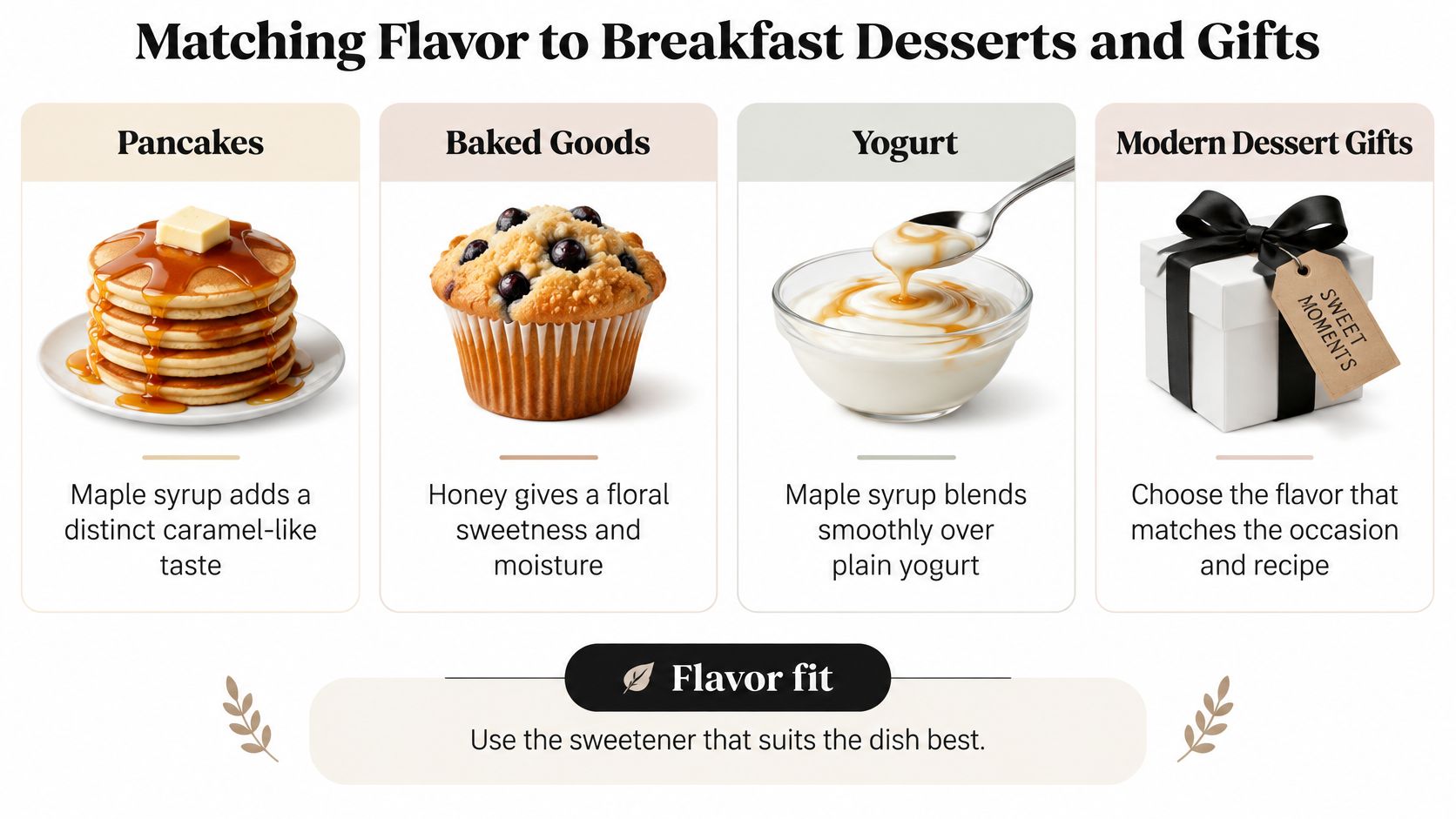
On pancakes, maple syrup brings a distinctive sweetness that suits a warm breakfast. Over plain yoghurt, it can add a rounded note without taking the dish in a floral direction. Honey is often the more natural fit when you want its character to stand out in tea, beside cheese or in a wellness-style breakfast.
Choose for the dish, not the label
Italian desserts call for a light hand. For mascarpone, try a small amount of maple syrup when you want a warm sweetness that won't compete with the creamy flavour. Choose honey when its floral note suits the fruit or other elements on the plate. Taste before adding more; the goal is to complement the dessert, not make the sweetener the main event.
For panettone glazing, either can work. Maple syrup brings a deeper, distinctive taste, while honey gives the finish its own floral character. Test each in a small portion of glaze and judge by the result on the cake. In coffee, the same approach applies: start with a modest amount, then decide whether the flavour fits the roast and milk.
For a savoury seasonal side, try this maple roasted squash as an example of maple syrup paired with a roasted dish rather than poured over breakfast.
Put the bottle in context
At a festive table for Ramadan, Christmas or Diwali, a bottle can be part of a broader food gift. Honey can highlight local provenance; maple syrup offers a distinct imported option. Either can sit alongside Italian sweets or a dessert plan, as long as the intended use is clear.
IFM Gourmet Dubai is the luxury online gourmet-store division of IFM Investments LLC, founded in 2011 with its registered base in Dubai Investments Park 2, Dubai, UAE. Its catalogue includes artisanal pasta, sauces, condiments, panettone, chocolates, nougats, sweets, premium teas, cakes and luxury gift hampers. (IFM Investments LLC and IFM Gourmet Dubai)
That range makes the sweetener choice easier to think about as part of a meal or hamper, rather than as an isolated bottle. For more context on curated sweets and online gifting, see luxury sweets online.
Three useful dish rules follow: choose maple syrup for pancakes and a warm note in desserts; choose honey when its floral quality belongs in the dish; and for a gift, let the recipient's likely use and the product's origin guide the pick.
Buying Storage and Allergy Checks That Matter
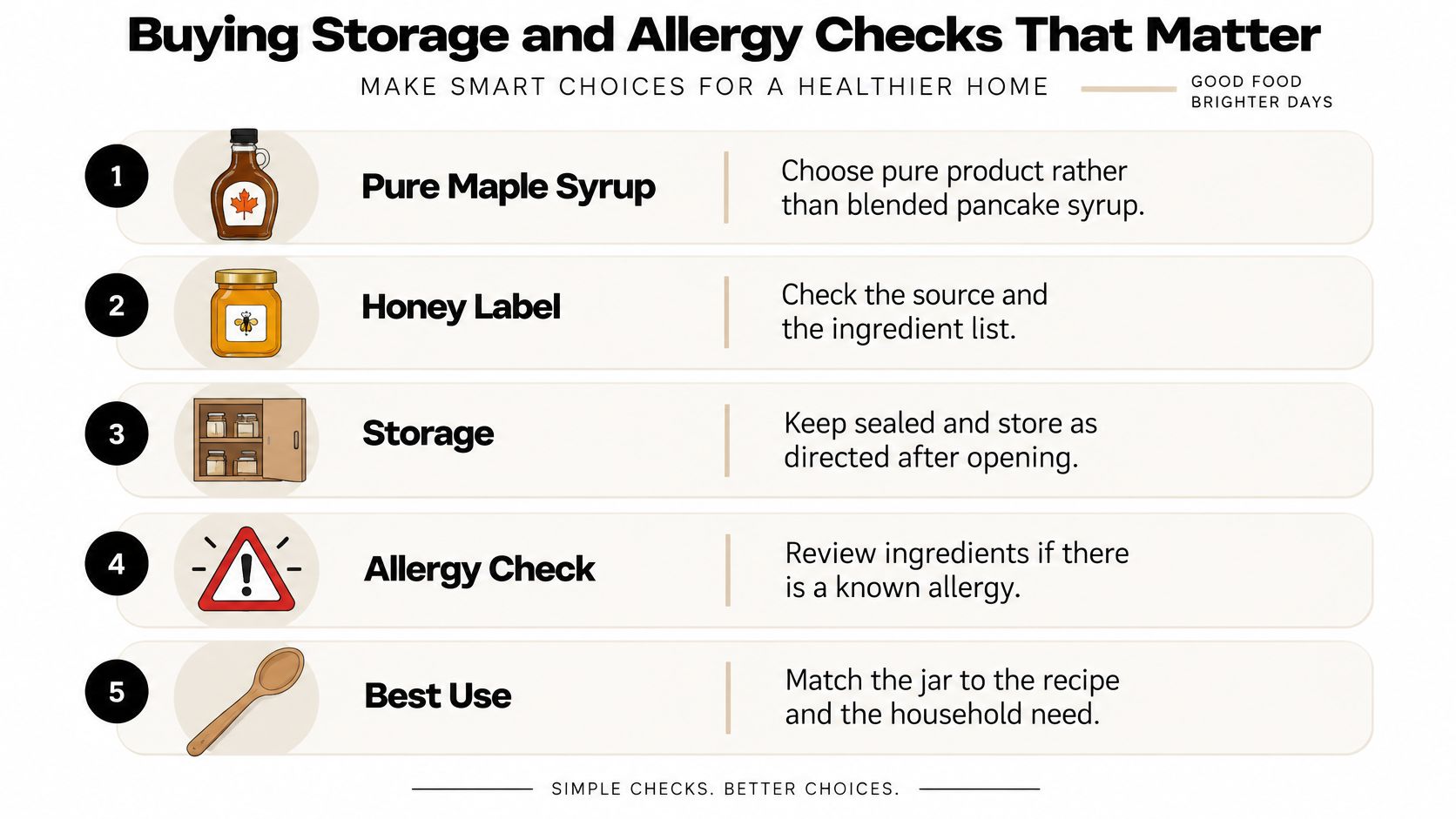
A bottle's label should answer the basic question: does this product match the recipe and the provenance you want? For maple syrup, look for a pure product, not a blended pancake syrup. Because authentic maple syrup is imported into the UAE, buy from a retailer that can explain the product's origin.
Read, store and serve carefully
Honey labels can describe everyday floral honey, premium imported styles such as Manuka, or Emirati honey. Check the stated source and ingredient list. If local provenance matters to you, look for clear traceability and information about relevant quality checks, rather than assuming every jar with a local-sounding name has the same verification.
Keep both products sealed and away from heat and strong odours. In a warm kitchen, clean handling matters: use a clean spoon and close the container promptly to help preserve its flavour and texture. Follow the storage directions on the individual product label, especially after opening.
If someone in your household has a known sensitivity to bee products, treat honey as a product to avoid and review labels carefully. Maple syrup is a different ingredient, but blended products can contain additional ingredients, so check the label rather than relying only on the front-of-pack name.
Before adding a bottle to your pantry or hamper, use this quick checklist:
Maple syrup: Confirm that it's pure, not a blended pancake topping, and check what the seller says about origin.
Honey: Read the ingredient list and identify whether the jar is local, floral or an imported premium style.
Storage: Keep the container sealed, away from heat and strong odours, and use a clean spoon.
Allergy: Check ingredients carefully if anyone who'll eat the food has a known sensitivity.
Best use: Match the bottle to the recipe, the person receiving it and the provenance you value.
For a dessert plan that uses another sweet flavour, explore white chocolate syrup as a separate ingredient, and check its label and intended use just as carefully.
Choose Maple Syrup or Honey for the Job
Choose maple syrup when you want a distinctive imported flavour for pancakes, baking or a modern dessert, or when a slightly lower sugar and calorie count per tablespoon suits the recipe. Its higher amounts of selected minerals may be a point of comparison, but they shouldn't be the main reason to pour freely.
Choose honey when local provenance and beekeeping heritage matter to you, or when its floral flavour belongs in tea, a cheese pairing or a breakfast dish. A traceable product with clear information about its source and checks can make honey a particularly meaningful choice for shoppers who value local production.
Neither choice removes the need to moderate added sugars. The most useful winner is the sweetener that delivers the flavour you want with the smallest satisfying amount. For a pantry decision, that may mean pure maple syrup for pancakes and honey for tea. For a gift, it may mean choosing the bottle whose origin and intended use you can explain to the recipient.
Make the choice concrete
If you're planning a breakfast, dessert or hamper, decide on one clear use before you shop. Think panettone glazing, a weekend pancake table or a festive gift. Then compare the products by origin, ingredient list and how they'll taste in that specific setting, rather than buying both because one label appears to promise a health advantage.
The UAE-focused IFM Gourmet online store brings gourmet ingredients and curated gifting into one shopping context. Browse its breakfast and gifting range, compare a pure maple syrup with the honey available, and choose the bottle that fits your next dish or hamper.
Explore IFM Gourmet Food Store for artisanal Italian ingredients, sweets, teas and curated gift hampers. Choose maple syrup or honey for a clear use, then build a breakfast, dessert or festive gift around the flavour you want.


Comments