White Chocolate Syrup Guide: Uses, Storage & UAE Tips 2026

You've just poured white chocolate syrup into a latte, only to find that the drink tastes cloying, the bottle feels warm, and the sauce has started separating near the pump. The same product may behave perfectly in a chilled dessert and poorly beside a busy espresso machine. That difference comes from formulation, temperature, portion control, and handling, not from the recipe name alone.
For cafés, home kitchens, dessert counters, and gourmet gift designers in the UAE, white chocolate syrup needs to be treated as a technical ingredient as well as a flavouring. It can add creamy cocoa-butter character to coffee, gelato, pastries, and plated desserts, but the finished result depends on how you buy, label, store, portion, and pair it.
What is White Chocolate Syrup Really Made Of
A barista reaches for the bottle, presses the pump, and adds a pale ribbon to a cup of espresso. The action takes seconds. Inside that bottle, however, several ingredients must stay together as a stable, pourable emulsion.
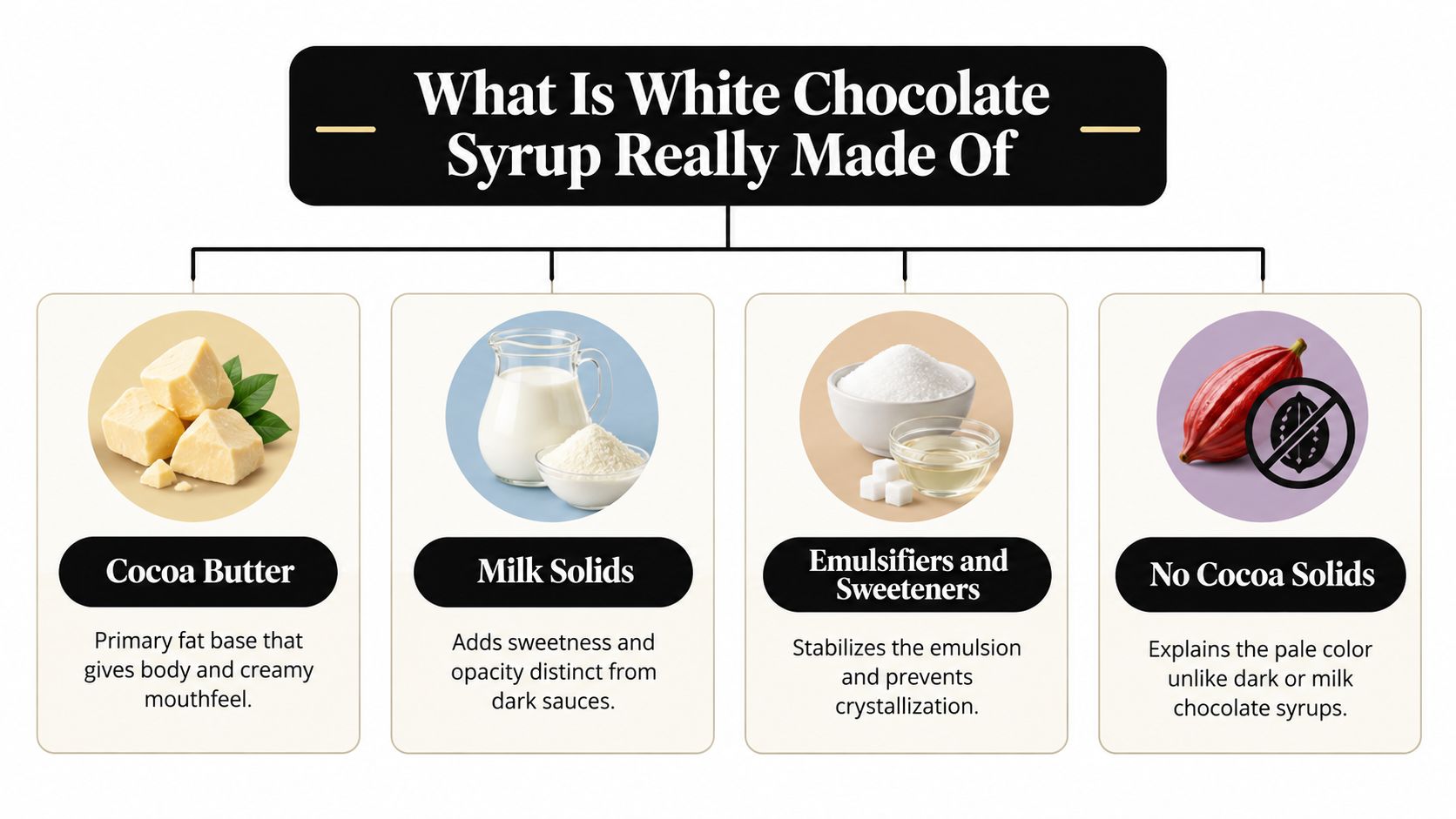
Cocoa butter provides much of the fat-based body associated with white chocolate. Milk solids, or milk-derived ingredients, add creaminess, opacity, and a rounded dairy note. Sugar supplies sweetness, while water controls how easily the product flows. Emulsifiers and stabilising ingredients help keep the fat and water phases from splitting.
Why the colour and texture differ
White chocolate syrup behaves differently from a dark chocolate sauce because it doesn't rely on the same cacao components. A pale syrup generally contains cocoa butter and dairy solids, but no cacao solids in the way dark or milk chocolate products do. That helps explain its light colour and its softer, milkier flavour.
The distinction also affects heating. Warmth can loosen the fat phase, while cooling can make the syrup thicker. If the mixture isn't properly stabilised, the fat may rise, the texture may become uneven, or the product may look separated after sitting.
Practical rule: Judge a syrup by its declared formulation and performance, not by its colour alone.
Reading the ingredients list
Before buying, look for cocoa butter, milk or milk-derived solids, sweeteners, water, flavouring, and stabilising or emulsifying ingredients in a formulation that matches the intended use. A product relying heavily on vegetable oils may still pour smoothly, but it won't necessarily deliver the same cocoa-butter mouthfeel or finish.
The useful test comes after opening. Pour a small amount into a warm coffee, a cold milk drink, and a dessert application. You're checking whether it dissolves cleanly, keeps its texture, and delivers enough flavour without forcing the team to use an excessive portion.
How UAE Food Standards Shape Syrup Labeling
A white chocolate syrup sold in the UAE should be handled as a liquid prepackaged food, not casually grouped with every dark or milk chocolate product. The UAE adopted GSO 2518/2016, a Gulf standard for cocoa, chocolate, and related products, and later approved UAE.S GSO 567:2021 for cocoa and chocolate through a 2022 Cabinet Resolution. The formal framework matters because the product description and label must match the formulation and intended use. UAE cocoa and chocolate labelling guidance
White chocolate has a specific complication. Cocoa-solids percentages generally apply to listed chocolate products, but white chocolate is exempt from that percentage-display requirement. If a percentage is displayed, it refers to the chocolate portion after other ingredients are deducted. For syrup, a clearer description should identify the actual composition, such as a sugar syrup containing cocoa butter, milk-derived solids, and flavouring, rather than suggesting a cacao percentage that the rules don't require.
What the receiving team should verify
UAE labelling guidance requires the product name, ingredients in descending order by weight, country of origin, net volume, storage conditions, expiry information, instructions for use where applicable, and nutrition information. The label must be in Arabic or Arabic and English. Dubai food labelling requirements%20of%202019%20General%20Food%20Labelling%20Requirements.pdf)
Use this checklist before a bottle enters stock:
Identity: Confirm that the product name matches the technical data sheet.
Ingredients: Check that the list is in descending order by weight.
Allergens: Verify the milk declaration and any other declared allergen information.
Dates and lot code: Confirm that production and expiry details are printed or stamped on the original label or primary packaging for imported syrup.
Storage: Match the stated conditions to the storage space and dispensing routine.
Nutrition: Check that the nutrition panel is present and consistent with the product documentation.
A removable sticker alone shouldn't be used to add the production and expiry dates to imported syrup. The receiving record should also connect the lot code, supplier documentation, Arabic label, and bottle condition. That simple chain prevents a café from approving a product that looks correct on the shelf but lacks a compliant original date mark.
Storage and Handling in Dubai's Climate
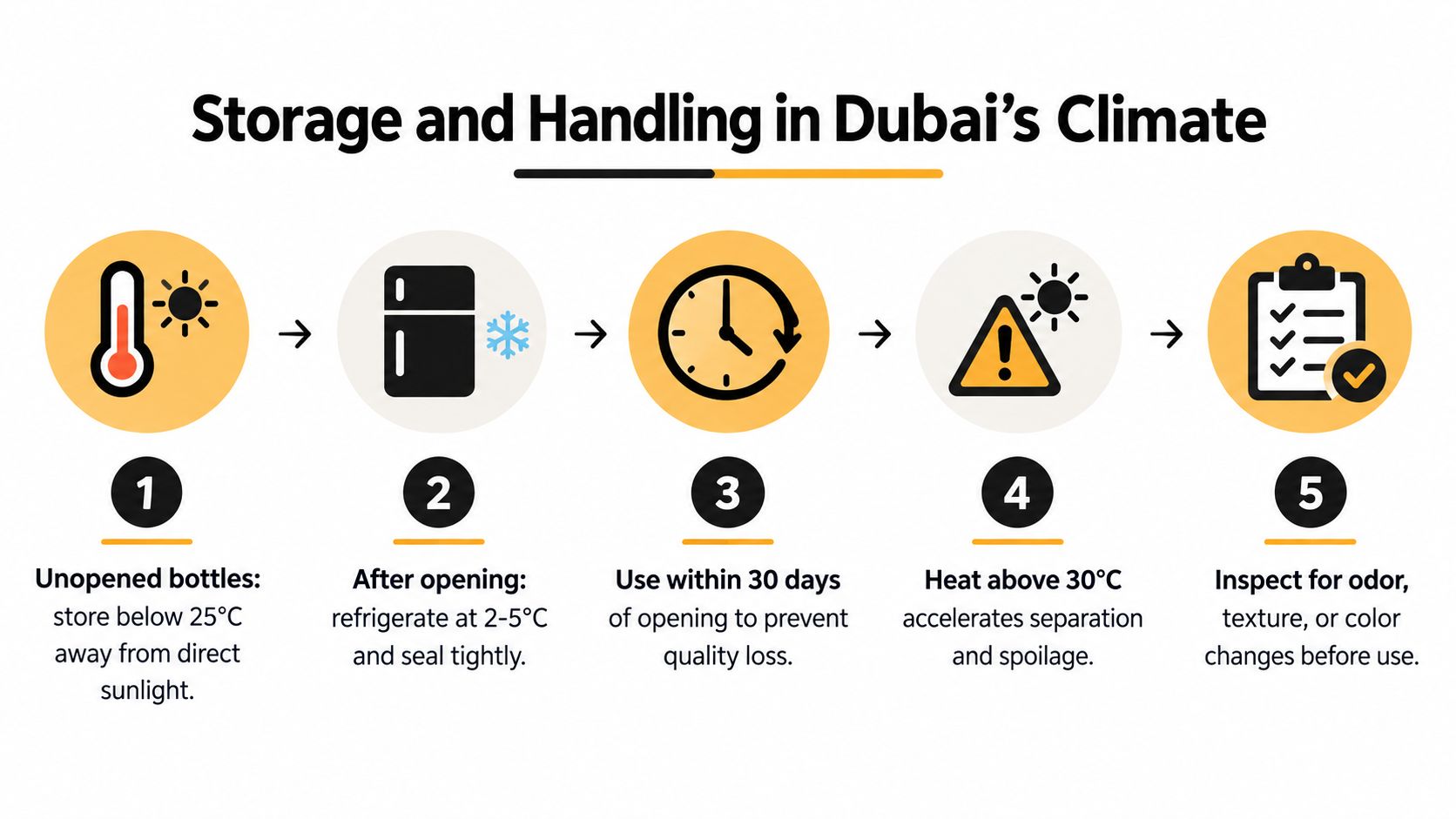
Heat changes white chocolate syrup before a customer notices a problem in the cup. Cocoa butter and dairy solids respond to temperature, while sugar and water influence viscosity and microbial risk. In Dubai, poor protection from heat and direct light can lead to thinning, oil separation, flavour deterioration, or pressure changes in unsuitable packaging. UAE food safety and storage guidance
Build the check into receiving
A delivery check should happen before the bottle reaches the bar. Inspect the seal, cap, bottle walls, label, and visible product. Reject or quarantine containers showing swelling, leakage, broken seals, phase separation, or an abnormal odour.
Then record the manufacturer's recommended storage range and place unopened bottles away from direct light and heat. Don't assume a standard pantry is suitable just because the product was delivered at room temperature. The product label and technical sheet take priority.
Protect the opened bottle
Once opened, follow the manufacturer's stated refrigeration or use instructions rather than relying on the unopened shelf life. Keep the pump or cap clean, close the bottle tightly, and don't leave it beside an espresso machine, hot display, or sunny service counter.
Use first-expiry-first-out rotation. A bottle intended for iced coffee, gelato, or delivery hampers may move between cold storage and warmer surroundings, so staff should avoid repeated temperature swings wherever possible. Before each service period, check the smell, colour, flow, and surface. A small change in texture can become a visible separation problem once the syrup enters a cold milk drink.
A reliable storage routine protects both food quality and the consistency of the menu.
Culinary Applications for Drinks and Desserts
White chocolate syrup works best as an accent, not as the entire flavour design. In a latte, it can soften espresso bitterness and add a creamy cocoa-butter note. In a frappé or milkshake, it contributes sweetness and body, but the dairy, coffee, ice, and toppings still need room to register.
Start with the application, then decide the portion. A hot drink needs a syrup that disperses into espresso and milk without leaving a heavy layer at the base. A cold drink needs enough agitation to distribute the syrup through the liquid. A plated dessert may need a controlled drizzle rather than a full mix, because the sauce should provide contrast against pastry, fruit, cream, or gelato.
A simple service sequence
Prepare the base. Brew the espresso, chill the milk, or portion the gelato before adding syrup.
Add the syrup where it will disperse. For a latte, combine it with the espresso before adding steamed milk. For a cold drink, blend it with the liquid before adding ice.
Taste for balance. Ask whether the syrup supports the coffee or hides it. If the drink tastes one-dimensional, add bitterness, acidity, spice, or texture rather than more syrup.
Finish with a contrasting element. Unsweetened foam, espresso dust, citrus zest, toasted nuts, or a restrained garnish can make the sweetness feel deliberate.
For a recipe-led variation, you can browse white chocolate mocha and use the flavour structure as inspiration, then adjust the portion for your own cup size and milk choice.
Managing warmth without industrial equipment
Ambient temperature affects the bottle and the finished drink in different ways. A warm bottle may pour more thinly, while a cold dessert can make the syrup thicken on contact. Keep the bottle protected from heat, pour onto a stable base, and serve the finished item promptly.
For a dessert counter, white chocolate syrup can be drizzled over gelato, used as a finishing layer on pastry, or paired with panettone. A visual reference such as this pancake presentation can help a team think about drizzle control and plate composition, but the principle remains the same: keep sweetness measured and let the main ingredient stay recognisable.
For UAE menus, separate the syrup's role in a dessert from its role in a drink. A topping may remain on the plate, while a beverage distributes it through the entire serving. Keep the product's declared nutrition information available, and don't assume that a “natural”, “light”, or “sugar-free” marketing phrase removes the need to verify the formulation.
Premium Pairings and Local Flavor Trends
A Dubai café can turn white chocolate syrup into a local signature by pairing its creamy sweetness with ingredients that add aroma, bitterness, acidity, or texture. The UAE chocolate market has broad appeal for milk and white chocolate, which together represented 56.12% of the market in 2025, while the same market coverage identifies interest in darker, vegan, organic, and sugar-reduced choices. UAE chocolate market analysis
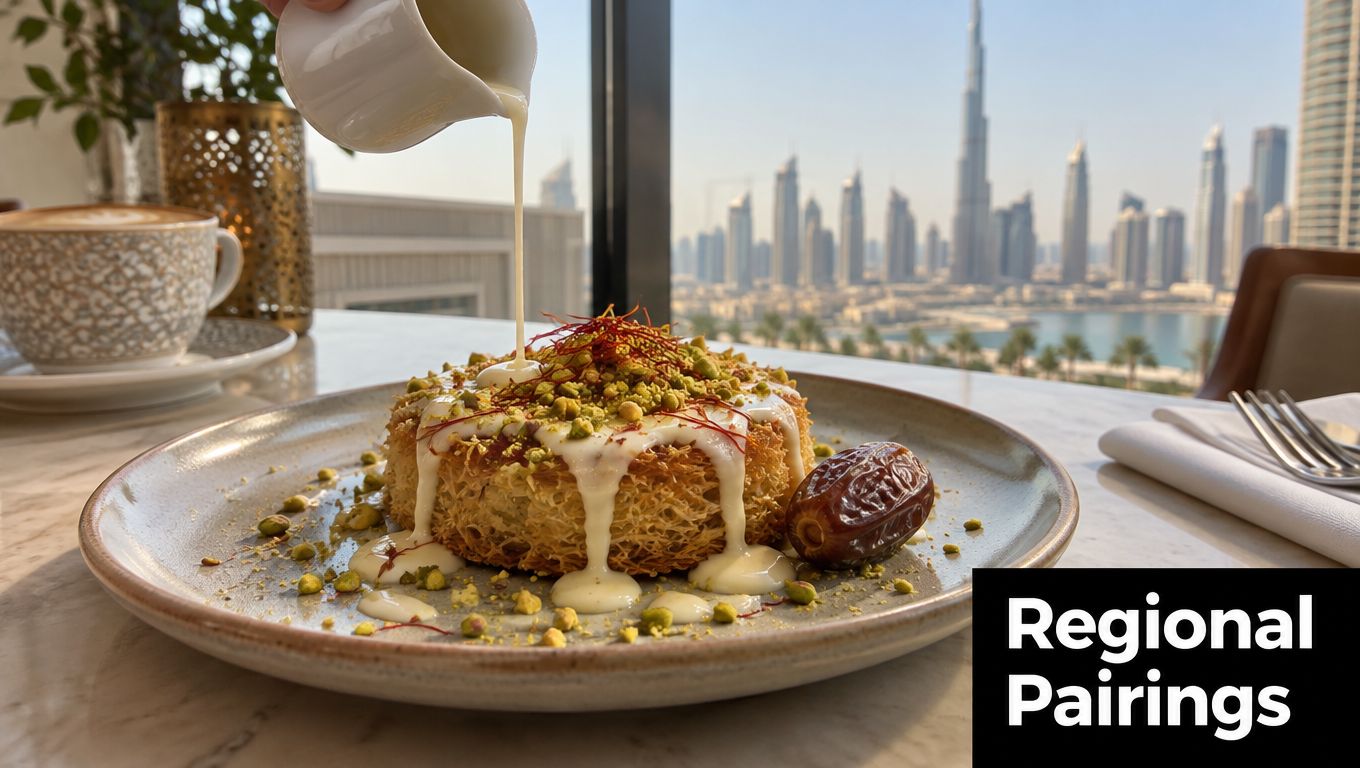
Build the pairing like a café formula. White chocolate supplies richness, while cardamom, saffron, espresso, citrus, tahini, pistachio, and dates give the finished item definition. On local menus, hazelnut, almond, mango, and chai masala also provide practical pairing directions. Each ingredient should have a job, whether it adds fragrance, crunch, freshness, or a deeper finish.
Pair by application
Hot drinks: Add cardamom or saffron to a white chocolate latte. The spice gives the milk and cocoa-butter profile a clearer finish.
Desserts: Combine the syrup with pistachio, toasted kataifi-style crunch, or almond. These ingredients create contrast against its smooth texture.
Gelato: Pair it with espresso or citrus so the cold dessert has bitterness or brightness alongside the sweetness.
Date-based plates: Use the syrup as a restrained accent, allowing the date to provide depth and chew.
The Dubai-chocolate format demonstrates why contrast matters. White chocolate with pistachio butter, toasted kataifi, and crushed pistachios combines creamy, nutty, and crisp elements. A café can apply the same structure to a drink or a giftable dessert. If the product tastes too sweet, check its texture and aroma before increasing the syrup or adding another sweet component.
Balance the experience: One creamy component, one aromatic component, and one contrasting texture often create a more premium result than a larger syrup portion.
A small dessert can carry this idea into hospitality and gifting. White chocolate with pistachio, date with cardamom, or citrus with espresso can create a recognisable signature without requiring an elaborate production line.
For a frozen contrast, this wild berry sorbet presentation shows how acidity and colour can keep an indulgent menu from feeling visually or flavourfully heavy.
Integrating Syrup into Gifting and Hospitality
A bottle of white chocolate syrup isn't merely a sweetener. In a well-designed hamper, it can connect several products: coffee, tea, panettone, biscuits, gelato ingredients, or a dessert recipe. The recipient sees a usable flavour component, not just another decorative item.
The strongest combinations control sweetness. Pair white chocolate syrup with cardamom tea, pistachio confectionery, espresso, or a plain artisanal cake, and the recipient can adjust the intensity. Pairing it with only highly sweet products removes that choice and can make the hamper feel repetitive.
Design the hamper around use
A premium set might include a white chocolate syrup with a panettone for breakfast service, a coffee or tea for balance, and a crunchy biscuit or nut-based confection for texture. A savoury item can also belong in the same collection, because a gourmet hamper doesn't need to follow one flavour family from beginning to end.
IFM Gourmet's documented assortment demonstrates this broader approach. Its range includes artisanal sweets and savouries, fine chocolates, premium teas, cakes, and curated gift hampers. One listed AED 750 winter hamper includes a 1-kilogram artisanal panettone, 500 grams of bronze-die pasta, Italian candies, coffee, 500 millilitres of extra-virgin olive oil, pasta sauce, balsamic products, premium tea with 30 individually sealed filters, and a three-compote gift set. IFM Gourmet assortment
Another documented AED 450 gourmet hamper includes basket decoration and wrapping, 500 grams of bronze-die pasta, 250 millilitres of balsamic glaze, an 80-gram mini panettone, specialty compote or honey products, Italian candies, and herbal fruit-flower infusion filters. Roma gift hamper details
For corporate teams, families, partners, and colleagues, the practical question is whether the syrup gives the recipient a clear use. A small recipe card can suggest a cardamom latte, a panettone drizzle, or a pistachio dessert without prescribing a single serving. If you're planning several occasions, a gift list for special occasions can help organise recipients and preferences before the hamper components are selected.
IFM Gourmet Food Store offers authentic Italian gourmet ingredients, artisanal sweets and savouries, fine chocolates, teas, cakes, and curated hampers across Dubai and the UAE. Visit IFM Gourmet Food Store to explore products that can complement white chocolate syrup in café service, home desserts, festive entertaining, and premium gifting.

Comments