Pistachio Nut Paste: Dubai Guide to Buying and Using

You can stand in a Dubai kitchen with a dessert halfway planned, a recipe tab open, and three jars on the counter that all look suspiciously similar. One says pure pistachio paste, another says pistachio cream, and a third looks like a bulk baking ingredient that seems too soft, too sweet, or just not quite right. That confusion is normal, because pistachio products often get mixed together even though they behave very differently in pastry, gelato, gifting, and everyday home baking.
The fix starts with a simple idea. Pistachio nut paste is not just another spread, and it's not always a sweet cream either. In UAE kitchens, the difference affects flavour, pipeability, shelf life, and even whether a filling holds properly inside a tart shell or softens too quickly in the heat. Once you know what to look for, buying becomes easier, recipes get more consistent, and you stop guessing with expensive ingredients.
Your Pistachio Paste Journey Starts Here
A home baker in Dubai often meets pistachio paste at the exact moment a festive dessert needs a polished finish. The cheesecake base is ready, the kunafa topping is waiting, or the gelato machine is already cold, and then the jar labels create doubt. Pure paste, compound paste, and cream all sound close enough to work, but they don't behave the same way.
That's why this ingredient deserves a proper explanation before it hits the bowl. In a market like the UAE, where premium desserts, gifting, and hospitality presentation matter, the wrong pistachio product can change the result more than people expect. A filling can become too loose. A mousse can taste flat. A praline can lose the clean nut finish that makes pistachio feel luxurious in the first place.
The practical goal here is straightforward. Learn what pistachio paste is, how it's made, why its texture varies, and how to read the label before you buy. Then you can match the right product to the right use, whether you're making Italian-style pastries, Middle Eastern sweets, or a batch of gift-ready jars for guests.
Practical rule: if the jar doesn't tell you whether it's pure, sweetened, or compounded, assume it may not behave like the paste you had in mind.
What Pistachio Nut Paste Is and How It's Made
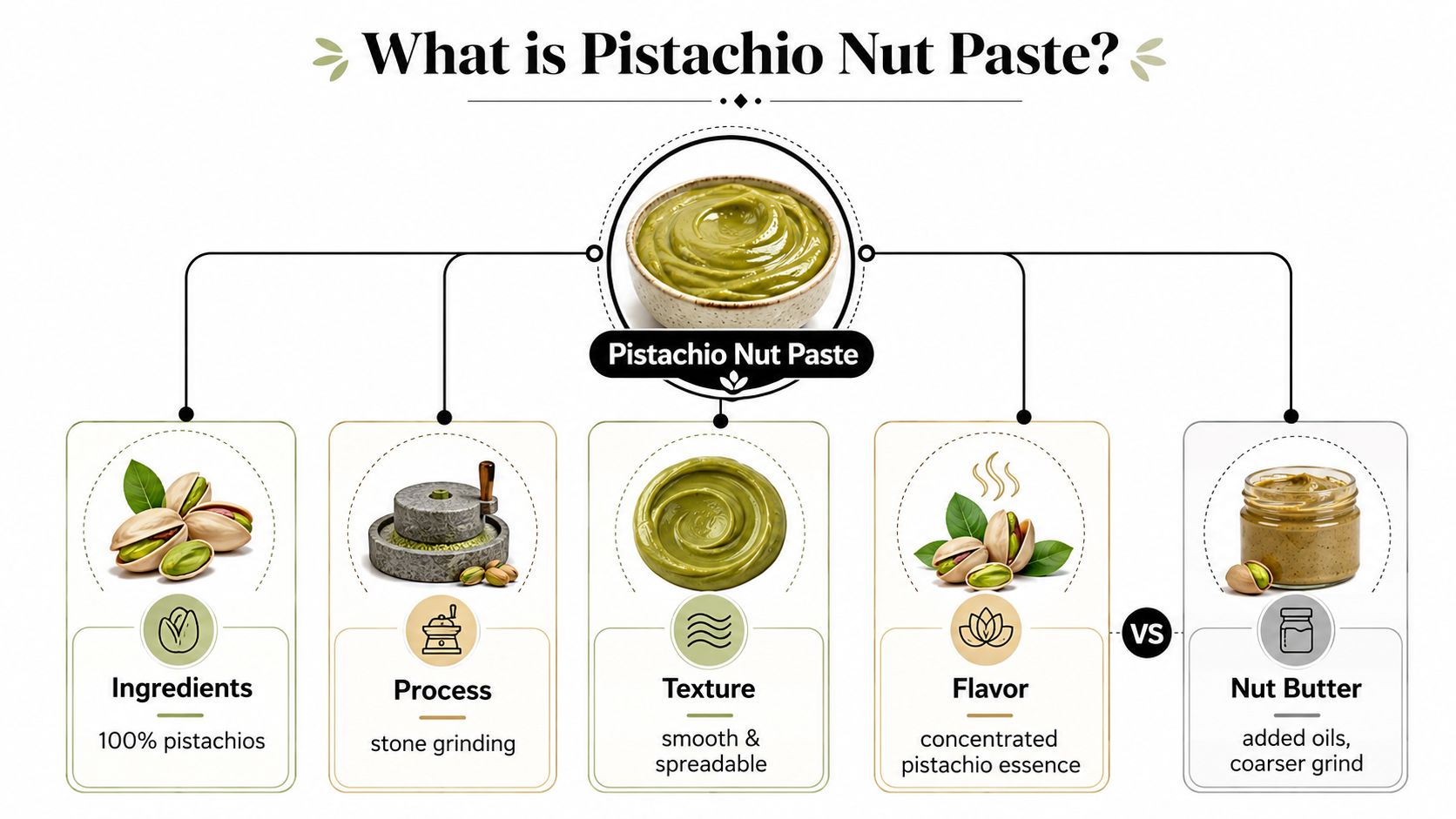
Pistachio nut paste is best understood as concentrated pistachio, not a casual spread. This mirrors the difference between orange juice and orange zest. Both come from the same fruit, but one gives you a broad, easy flavour and the other gives you a tighter, more intense expression. Paste sits closer to the latter idea. It's designed to bring pistachio flavour into creams, fillings, and desserts without needing to chew through whole nuts.
How the texture comes together
Most pistachio paste starts with roasted pistachios that are ground until the natural oils turn the mixture smooth. Some makers keep it simple and stop there. Others add oil, sugar, milk powder, or emulsifiers, which changes the way the paste behaves in dessert work. That's where the labels get confusing, because a product can still be called “pistachio” even when it's no longer a single-ingredient paste.
A home processor can make a rough version too, but the timing matters. Available instructions note that blending can take anywhere from 3 to 15 minutes depending on the machine, and the mixture often moves through a sandy stage before becoming smooth. That in-between phase is normal, not a sign that something has gone wrong. Heat, friction, and the pistachios' own oil are doing the work.
The more you grind, the more the nuts release their natural oil, so the paste changes from grainy to glossy in stages.
Why the label matters
Buyers often get tripped up. A paste, a butter, and a cream may all look spreadable, but they aren't interchangeable. Unsweetened paste usually gives the strongest nut flavour and the cleanest control in pastry. Sweetened cream feels softer and more dessert-like. Compound products are built for convenience and standardisation, which can help in large kitchens, but they change the flavour balance and the label story.
If you're cooking for a specific result, start with the intended use, not the jar design. A tart filling, a gelato base, and a brunch spread do not need the same texture or sweetness. Once you read pistachio products as formulas rather than just flavours, the whole category gets much easier to understand.
Pistachio Heritage and Global Market Roots
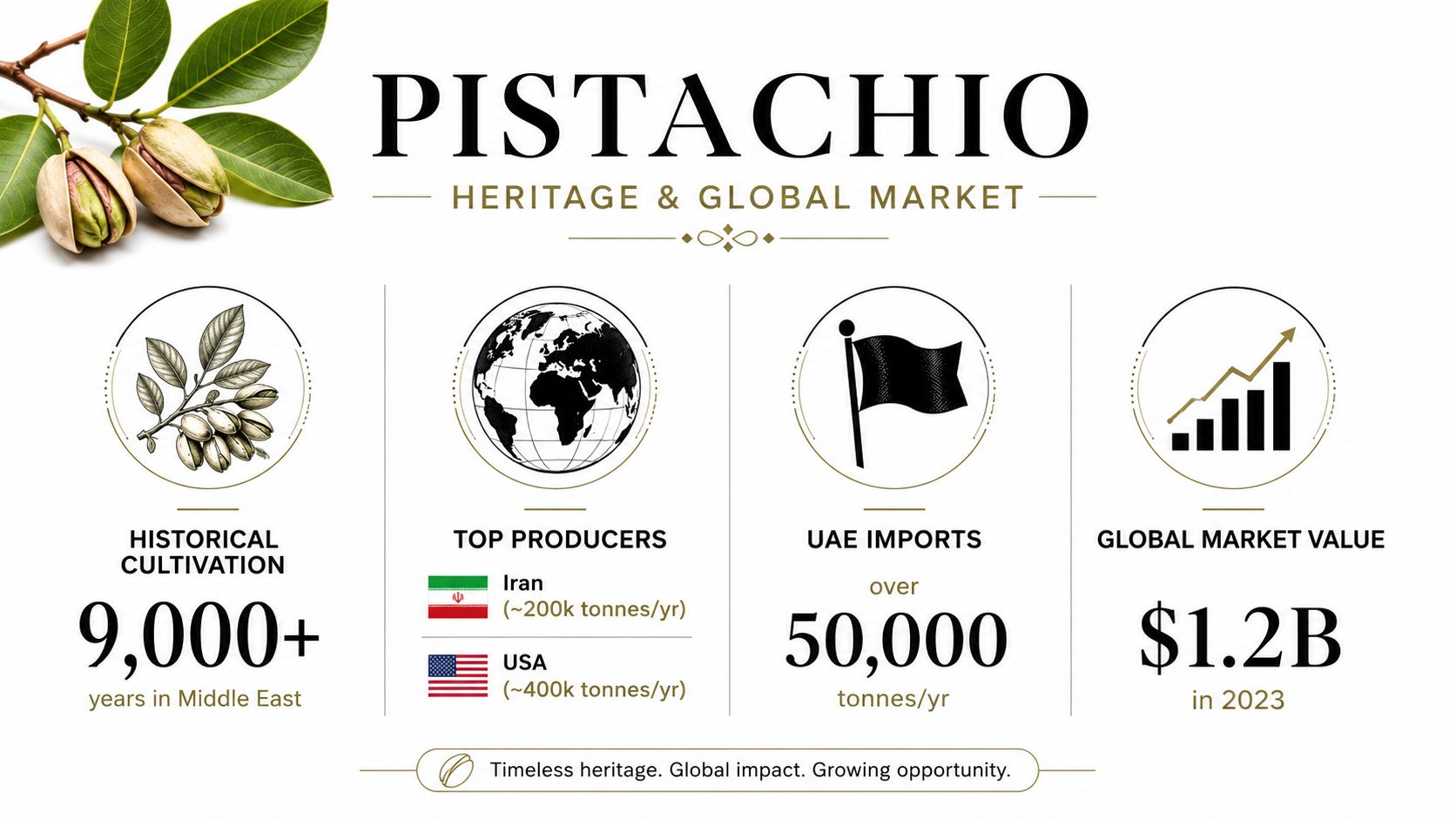
Pistachios bring a long culinary history with them, and that background gives pistachio paste a sense of trust in desserts that value tradition as much as flavour. Academic reviews describe pistachios as native to western Asia and spread through the Middle East, Mediterranean countries, and Europe through trade, with archaeological evidence of consumption reaching back to Neanderthal-era use and later remains found in Afghanistan and southeastern Iran historical review of pistachio origins. In the UAE, that history fits naturally with baklava, Italian pastries, and luxury gifting, where ingredients with cultural depth carry real appeal.
Why the modern supply chain shapes the jar on your shelf
The modern market tells a different part of the story. The International Nut and Dried Fruit Council reported that global pistachio exports rose from 514,625 metric tons in 2014 to 615,515 metric tons in 2023, a rise of about 19.6% over the decade, and that the United States held 65% of the global export market in 2023 with 398,799 metric tons global pistachio export statistics. The same council's statistical yearbook also shows world pistachio production at 1.4 million tonnes in 2024, with the United States, Turkey, and Iran accounting for 87% of output.
That concentration shapes what buyers in the UAE can source. Pistachio paste usually reaches the market through international exporters rather than local production, so availability and consistency depend on a relatively small set of origin countries. For bakeries, hotels, caterers, and home cooks, that means the jar on the shelf is tied to a supply chain that can influence flavour, texture, and how reliably a filling performs in premium desserts.
Heritage and commerce meet in dessert use
The same heritage that gives pistachios prestige also helps pistachio paste fit naturally into Middle Eastern and Mediterranean sweets. In practice, the ingredient is doing two jobs at once. It brings flavour, and it signals refinement. A curated gourmet store can matter in Dubai for that reason, because the choice is not only about stock. It is about selecting products whose origin and form fit pastry work, gifting, and hospitality, and that is where sourcing partners such as IFM Gourmet Food Store can help buyers compare options with more confidence.
Reading Quality Grades and Technical Specs
A jar of pistachio paste should give clues before it reaches your tongue. In a UAE kitchen, the first useful clues are on the spec sheet, not the front label. A high-solids filling paste is often described with 74.0–77.0 °Brix, pH 5.30–5.65, and water activity 0.75–0.78 in one UAE pistachio paste specification. Those figures help buyers separate a paste made for pastry work from a looser product that behaves more like a spread.
What the numbers mean in plain language
°Brix shows how concentrated the soluble solids are. In a pistachio paste, a higher reading usually points to a denser body and more sweetness coming from the formulation itself. pH shows acidity, while water activity shows how much free water is available for microbial growth. For praline, cream filling, and pastry work, that lower water activity is useful because it supports shelf stability, but the paste still needs careful storage in warm or humid rooms.
A good way to read the label is to ask what job the paste has to do. A filling for kunafa, macarons, or layered cakes needs a body that holds shape, while a topping for breakfast bowls can be looser. In other words, the spec is not just a chemistry note, it is a clue about behaviour in the bowl and in the oven.
Storage rule: low water activity helps, but it does not protect the paste from humid rooms or warm counters.
Comparing pure paste with compound formats
The clearest way to judge quality is to compare ingredients, not only flavour descriptions. A 100% pistachio paste benchmark lists 630 kcal per 100 g, 55 g fat, 22 g protein, 9.5 g fibre, and 1.5% moisture 100% pistachio paste benchmark. Integra's product lists 567 kcal per 100 g, 20.95 g protein, 44.82 g fat, 5.45 g saturated fat, and 29.38 g carbohydrates, while identifying the ingredient as 100% roasted pistachios without husks Integra pistachio paste specification. Kataifi Factory EU gives another single-product reference point with 625 kcal per 100 g, 49 g fat, 19 g carbohydrates, 22 g protein, 10 g fibre, and salt below 0.01 g Kataifi Factory pistachio paste listing.
These profiles are useful because they show what pure paste looks like on paper. The fat, protein, fibre, and moisture levels sit in a range that supports a concentrated pistachio taste and a thicker texture. A baker in Dubai reading these labels can quickly tell whether the paste is meant to behave like a nut ingredient or like a sweetened filling base.
By contrast, an industrial confectionery paste can be much less nut-forward. One listing shows only 16% pistachios, with vegetable fat, sugar, milk powders, and emulsifiers. That is a different tool, even if the jar still says pistachio. Pure paste gives a stronger pistachio identity. Compound paste gives more control over sweetness, texture, and cost.
A simple way to choose
A clean-label ingredient works best for ganache, gelato, or a premium tart filling, especially when the goal is a direct pistachio flavour and a short ingredient list. A compound product can be useful when a bakery needs the same texture every time and wants easier handling in large batches. The label tells you which world you are buying into, and that reduces trial and error at the mixing bench.
For a quick visual check, a waffle-style pistachio filling example shows how a firmer paste can hold shape inside layered desserts, while a softer compound would spread differently. That kind of comparison helps UAE buyers match the product to the job before they place an order.
Sweet and Savory Culinary Applications
A jar of pistachio paste can go in directions that surprise people. In a Dubai kitchen, one spoon might end up folded into a gelato base, another spread into a croissant filling, and a third loosened slightly for a savoury sauce over roasted vegetables or meat. The ingredient works because it brings both richness and a distinct green nut aroma, so a small amount can shape the whole dish.
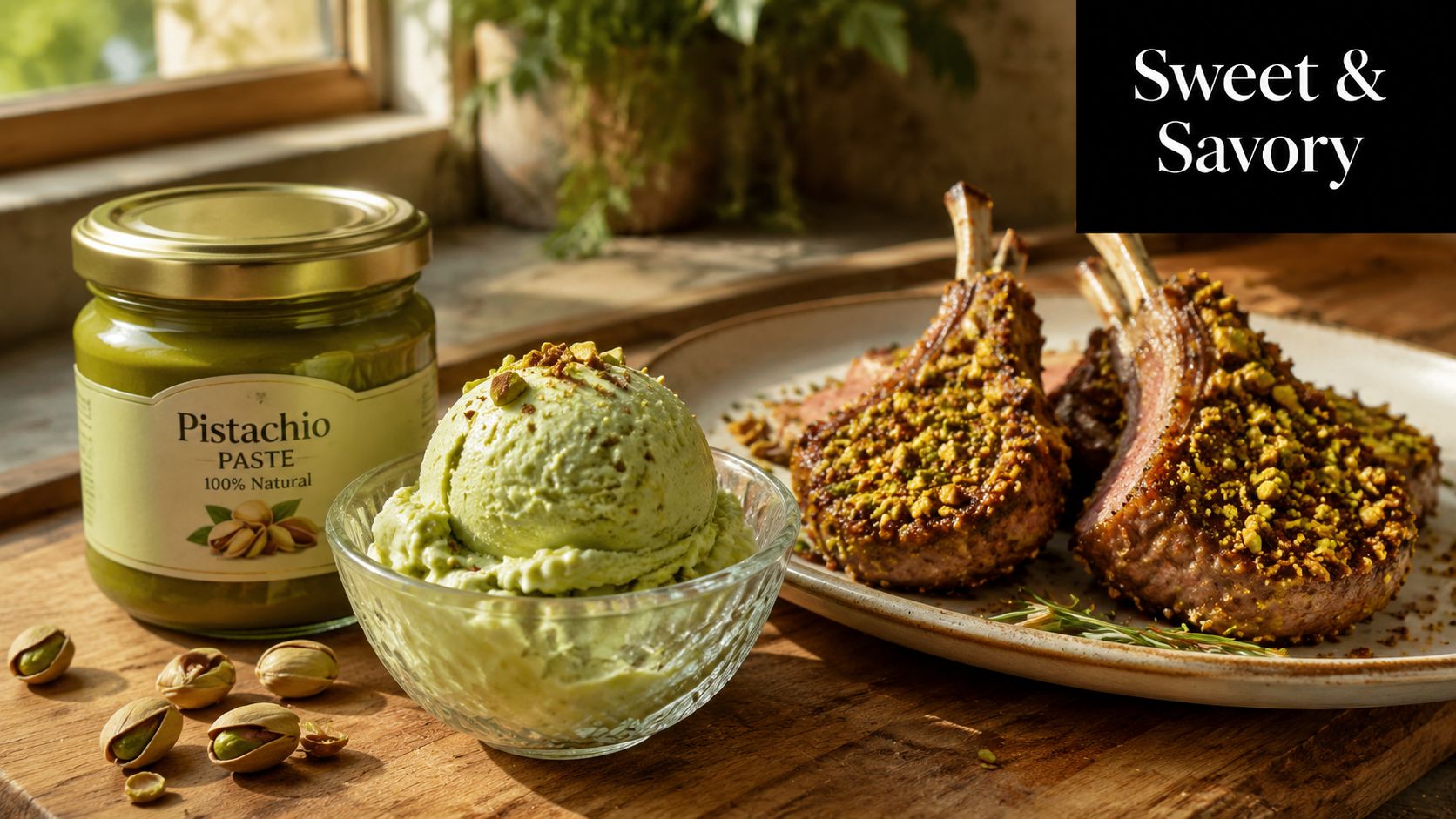
The easiest way to think about it is by texture control. For gelato, praline, and pastry cream, a smooth paste blends cleanly and gives an even nut note. For savoury use, you usually want the paste loosened or blended into a dressing, dip, or crust mixture so it doesn't dominate with heaviness. A little lemon, rosewater, or citrus zest can make it feel brighter, while a richer dairy base pushes it toward dessert territory.
A practical measuring habit helps here. ChefSolver gives pistachio paste a density of 0.95 g/mL and estimates 1 tablespoon as 14 g pistachio paste conversion reference. That matters because spoon-sized portions can look harmless, but fat, flavour, and sweetness balance shift fast once the paste hits a recipe.
For a visual recipe reference, the waffles example at this image resource shows how pistachio paste can be used in breakfast-style plating, not just dessert service.
The same ingredient can also be handled differently depending on the fat structure. A pure paste tends to give a stronger flavour and a denser mouthfeel. A sweeter or thinned product is easier to drizzle or pipe, but it may not hold the same intensity once it's mixed into creams or baked fillings. That's why experienced cooks taste it before committing. One jar may be perfect for a tart, while another fits a brunch spread better.
Buying and Storing Pistachio Paste in UAE
A buyer in the UAE often faces the same small problem in the shop or online cart. The label says pistachio, but the jar may be a pure paste, a sweeter spread, or a compound product with extra fats and solids. That difference matters because each one behaves differently in the kitchen, much like three tools that share a shape but do not do the same job.
The safest starting point is to ask what the paste needs to do. If it has to carry clean flavour in a tart, ganache, gelato, praline, or premium bakery filling, a pure paste usually gives better control. Compound versions still have a place, but they are built more for easy handling and consistent texture than for the full pistachio note that pastry work often needs.
What to look for before you buy
Read the label as if you were checking the recipe, not just the name. Single-ingredient or high-pistachio formulas are usually easier to work with when the goal is flavour clarity. In a UAE kitchen, that can mean the difference between a filling that tastes distinctly nutty and one that feels dulled by sugar, milk solids, or added fats.
IFM Gourmet Dubai is part of that sourcing conversation as a local option. It operates as the luxury online gourmet arm of IFM Investments LLC in the UAE, and it sits within the broader Italian Food Masters group. Its gourmet range includes artisanal sweets, savories, fine chocolates, premium teas, cakes, and curated gift hampers, so pistachio products are viewed within a wider gourmet selection rather than as a single-purpose baking item.
The store's sweet cream spreads selection also includes a pistachio-based spread, which helps when you are comparing a softer cream-style product with a firmer paste. That comparison is useful because many UAE buyers need to decide whether they want something that spreads easily for serving or something that holds shape in pastry work. For category browsing, the sweet cream spreads collection places pistachio alongside other dessert-friendly options.
How to store it well
Storage belongs in the buying decision, not after it. As noted earlier, the product spec with water activity 0.75–0.78 shows that the paste is made with some shelf stability in mind, yet it still needs protection from humidity and temperature swings. Keep the jar sealed tightly, away from heat, and out of damp cupboards. If you are piping or spreading it, bring only the portion you need to a workable temperature, then return the rest to an airtight container.
That habit keeps the flavour steady and the texture usable. It also helps prevent the paste from loosening too much in warm weather, which is a real issue in UAE kitchens where room temperature does not always match what a recipe assumes.
For shoppers who are also comparing pistachios in broader diet planning, the guide on are pistachios okay for keto gives useful context.
Nutrition Pairing and Final Takeaways
Pistachio paste is energy-dense by design, and that's part of why it performs so well in desserts. The product benchmarks above show a range of high fat, meaningful protein, and useful fibre, with salt staying low in one reference at below 0.01 g Kataifi Factory pistachio paste listing. That combination makes it feel rich without needing much volume, which is exactly what you want in a filling or accent ingredient.
The flavour pairings are just as important as the numbers. Rosewater softens the nuttiness and pushes the paste toward Middle Eastern dessert territory. Citrus brightens it and keeps the flavour from feeling heavy. Aged cheese can work when you want a savoury counterpoint, especially in small, carefully balanced applications. If you're thinking more broadly about dietary fit, this guide on are pistachios okay for keto gives useful context for how pistachios are viewed in low-carb eating.
The main takeaway is simple. Pistachio nut paste is not one product, it's a spectrum. Pure paste gives you flavour clarity and better pastry control. Compound paste gives you convenience and standardisation. Cream gives you softness and immediate spreadability. Once you read the jar correctly, the ingredient stops being confusing and starts being useful.
For Dubai cooks, that clarity matters because the ingredient often sits inside expensive desserts, celebration trays, and hospitality service where the result has to look polished. A little attention to formulation saves a lot of disappointment.
If you want to shop with more confidence, visit IFM Gourmet Food Store for curated gourmet ingredients and pistachio-related sweet cream options that fit dessert and gifting use in the UAE. You'll find a broader Italian-inspired selection that makes it easier to choose the right format for baking, plating, or festive hampers.


Comments