
Soft Shell Crabs: A Gourmet Guide to This Delicacy

A chef in Dubai once pulled a platter of just-fried soft shell crabs from the pass and sent them out with lemon, herbs, and no apology for their simplicity. That first bite said everything. Crisp, delicate, sweet, and almost creamy at the centre.
An Introduction to a Culinary Treasure
There are ingredients you admire, and there are ingredients you wait for. Soft shell crabs belong firmly in the second category. They arrive with a kind of urgency because their best qualities depend on timing, handling, and restraint in the kitchen.
What makes them so memorable isn't novelty alone. It's the contrast. The outside turns beautifully crisp, while the inside stays tender and sweet, giving you a texture that hard-shell crab cannot offer in the same way. For cooks who value clean flavour and elegant plating, that balance is profoundly satisfying.
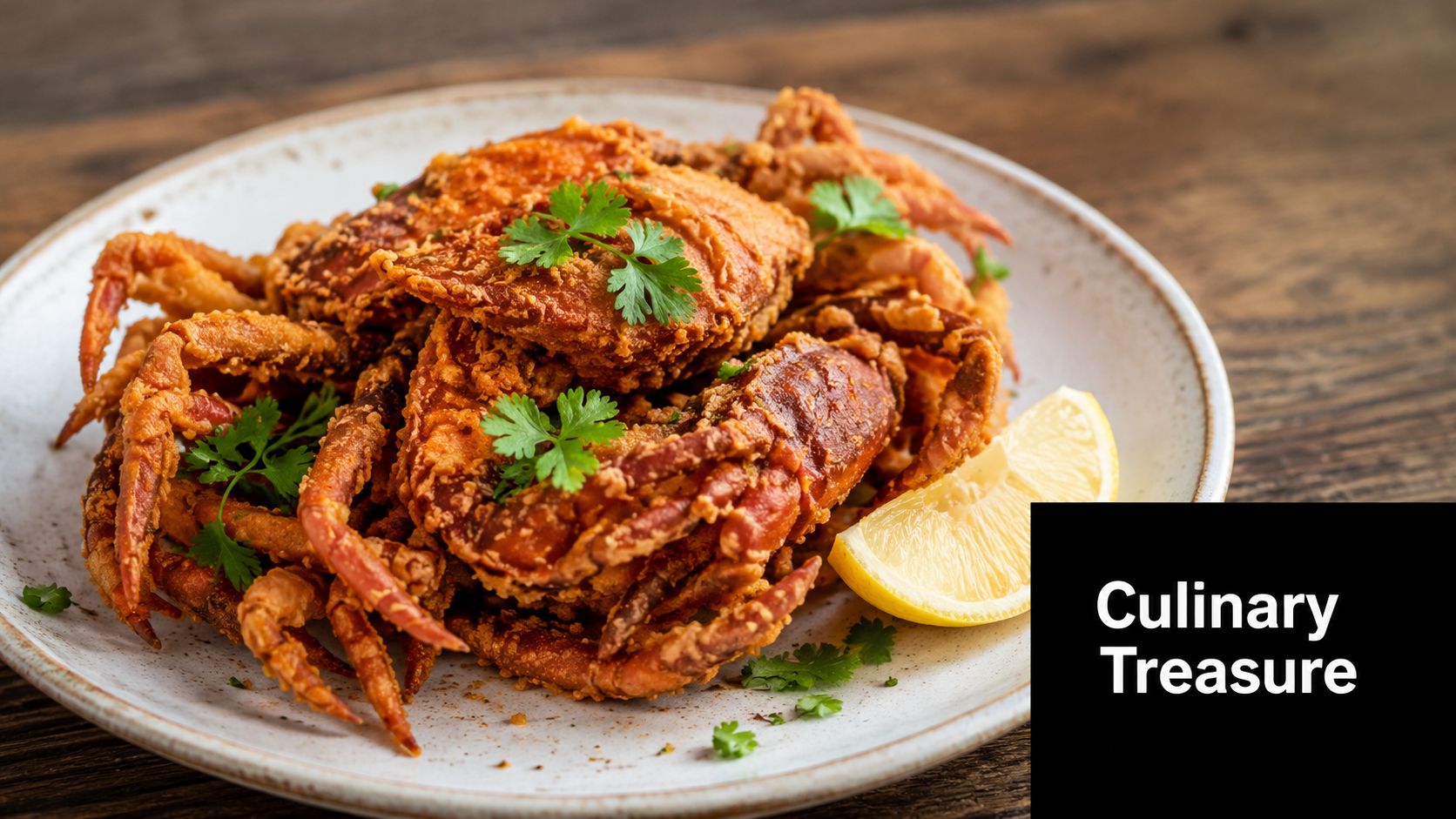
In the UAE, soft shell crabs hold a special appeal because they suit the way many people here like to cook and entertain. They can be plated as a refined starter, tucked into a brioche bun for a more relaxed lunch, or served over pasta for a dinner that feels generous without feeling heavy. They work just as well in an Italian-leaning kitchen as they do in a modern fusion one.
Why they feel luxurious
Luxury in food isn't always about rarity alone. Often, it's about an ingredient demanding care. Soft shell crabs reward attention. Rush the dredge and the crust turns patchy. Overcook them and the sweetness fades. Pair them with too much sauce and you lose the point.
A well-cooked soft shell crab doesn't need culinary theatre. It needs:
A hot pan or fryer so the surface sets quickly
A light hand with seasoning so the crab stays at the centre
Sharp acidity from lemon, vinegar, or a bright dressing
A thoughtful plate with enough space to let the crab look like the star
Soft shell crab is one of those dishes that tells you immediately whether the cook understood the ingredient.
What is IFM Gourmet Dubai
IFM Gourmet Dubai is the luxury online gourmet arm of IFM Investments LLC, a culinary-focused company based in the UAE. Their gourmet store offers an impressive lineup of artisanal delicacies, including sweets, savories, fine chocolates, premium teas, cakes, and beautifully curated gift hampers. They are part of the broader Italian Food Masters group and are known for quality, authenticity, and culinary elegance in Dubai's gourmet scene.
The Biological Wonder of Soft Shell Crabs
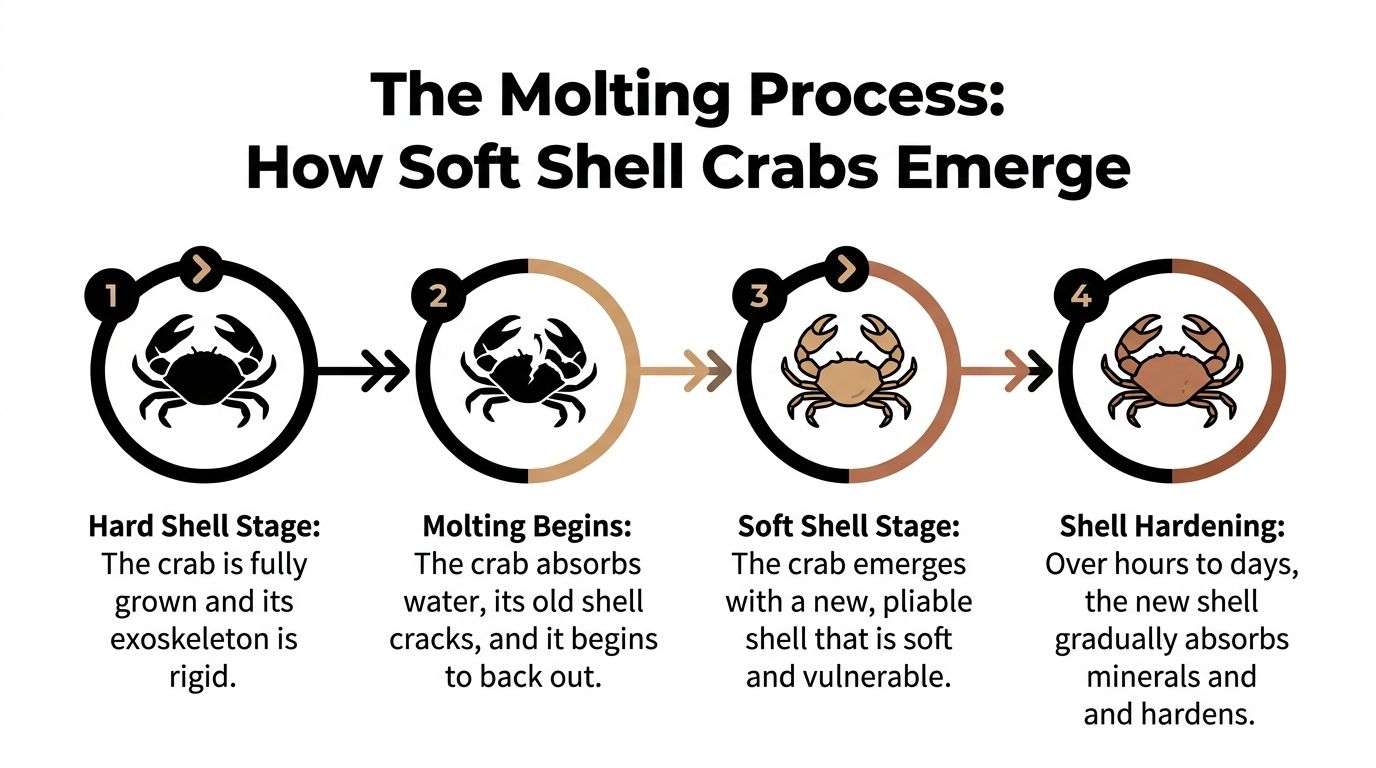
Soft shell crabs aren't a separate species. They are a brief life stage. A hard-shell crab sheds its old exoskeleton in a process called molting, and for a very short period the new shell remains soft enough to eat.
That short window explains almost everything about their appeal. It explains why they feel seasonal, why they need careful sourcing, and why kitchens treat them with unusual respect.
How molting actually works
The process is easier to understand if you think of the shell as a fitted suit the crab has outgrown. The crab absorbs water, its body swells, the old shell splits, and the crab pulls itself free. For a short time, the new shell is pliable.
According to this soft shell crab facts guide, soft-shell crabs are a transient life stage where hard-shell crabs shed their old exoskeleton, resulting in a shell that remains soft for only 24 to 48 hours. In the AE region, this aligns with regional mud crab (Scylla serrata) cycles, which face pressure from over-exploitation of juveniles.
In global cuisine, the species most commonly associated with soft shell crabs is the Blue crab, Callinectes sapidus. In other regional markets, including those relevant to the UAE, mud crab cycles matter more from a sourcing point of view.
Why timing decides quality
Harvest timing isn't a technical detail. It's the whole business.
A Fortune Fish overview of Blue crab soft shells notes that soft-shell crabs are harvested within a narrow 2 to 6 hour window immediately after molting, before the shell calcifies. The crab must also measure at least 3.5 inches tip-to-tip across the carapace to be legally harvested and sold. The same source explains that warmer water above 20°C accelerates this process, with early summer in temperate regions often bringing the peak.
That means buyers and chefs are dealing with an ingredient defined by a countdown. Miss the moment, and the shell hardens. At that point, the crab may still be perfectly edible, but it no longer delivers the signature experience people expect from a soft shell dish.
Practical rule: If a supplier can't speak clearly about timing, handling, and whether the product is fresh or frozen, that's usually a sign to look elsewhere.
Seasonality in the UAE context
In the United States, soft shell season typically peaks when water temperatures rise in spring and summer. In the UAE, diners often encounter soft shell crabs through imported product, regional mud crab cycles, or frozen supply designed for consistency.
For professionals in Dubai, that creates a clear trade-off:
Consideration | Fresh local or regional availability | Frozen premium product |
|---|---|---|
Excitement | Strong seasonal appeal | Less romantic, more dependable |
Kitchen planning | Harder to predict | Easier to schedule |
Consistency | Can vary with timing | Often more stable |
Best use | Feature specials | Repeatable menu execution |
Sustainability matters here as well. When juvenile crabs are over-harvested, quality and long-term availability both suffer. Discerning buyers should care not just about flavour, but about whether the supply chain respects the biology of the animal.
Sourcing and Storing Premium Soft Shell Crabs in the UAE
In the UAE, buying soft shell crabs well is less about chasing romance and more about accurately assessing the product. The first question isn't whether they're fresh. It's whether they're right for the dish, the service window, and the kitchen handling them.
For many buyers, especially in hospitality, frozen product is often the smarter choice. Soft shell crabs are delicate, and consistent freezing can preserve texture far better than poorly handled “fresh” stock that has spent too long in transit.
What to ask before you buy
The strongest buyers ask simple, direct questions:
Was the product frozen promptly? Good soft shell crabs benefit from rapid post-harvest handling.
How are they packed? Loose, damaged, or frost-burnt crabs are rarely worth rescuing.
What size suits the menu? A sandwich, pasta plate, and fine-dining starter all ask for different proportions.
Can the supplier maintain cold-chain discipline? This matters as much as the crab itself.
IFM Gourmet Dubai, founded in 2011, is the luxury online arm of IFM Investments LLC and a premier distributor serving hotels, restaurants, and retailers across the UAE, making it a key source for high-quality gourmet ingredients, as noted on the IFM Gourmet company profile.
For teams moving delicate frozen seafood across long distances, cold-chain reliability becomes paramount. A useful reference is BFC Logistics cold transport expertise, which gives a practical view of how temperature-sensitive food should be handled in transit.
Fresh versus frozen in a real kitchen
This decision is often misunderstood. Fresh sounds superior, but that isn't always true in practice.
A disciplined frozen product usually gives you:
Predictability for service planning
Cleaner prep flow in busy kitchens
Less waste risk when demand fluctuates
Fresh product gives you immediacy and prestige, but only if the supplier and the receiving kitchen both handle it exceptionally well. Otherwise, you're paying for fragility, not quality.
A soft shell crab that arrives in excellent frozen condition will outperform a “fresh” one that's been mishandled every time.
Storage that protects texture
Once the crabs arrive, don't improvise.
If they're frozen, keep them frozen until you're ready to thaw under controlled refrigeration. Don't leave them at room temperature, and don't let thawed crabs sit in pooled liquid. In professional kitchens, lay them on absorbent paper, keep them cold, and cook them as soon as practical after thawing.
At home, the same rules apply in simpler form:
Store flat if possible so the crabs keep their shape.
Thaw gently in the fridge, not on the counter.
Pat completely dry before cooking because surface moisture ruins browning.
Preparing Your Soft Shell Crabs for Cooking
Many people hesitate at this stage, but they shouldn't. Cleaning soft shell crabs is quick, tidy, and much easier than picking meat from a hard-shell crab.
The reward is excellent. Once the gills, mouthparts, and apron are removed, the rest is edible, which makes soft shell crabs unusually satisfying to prepare.
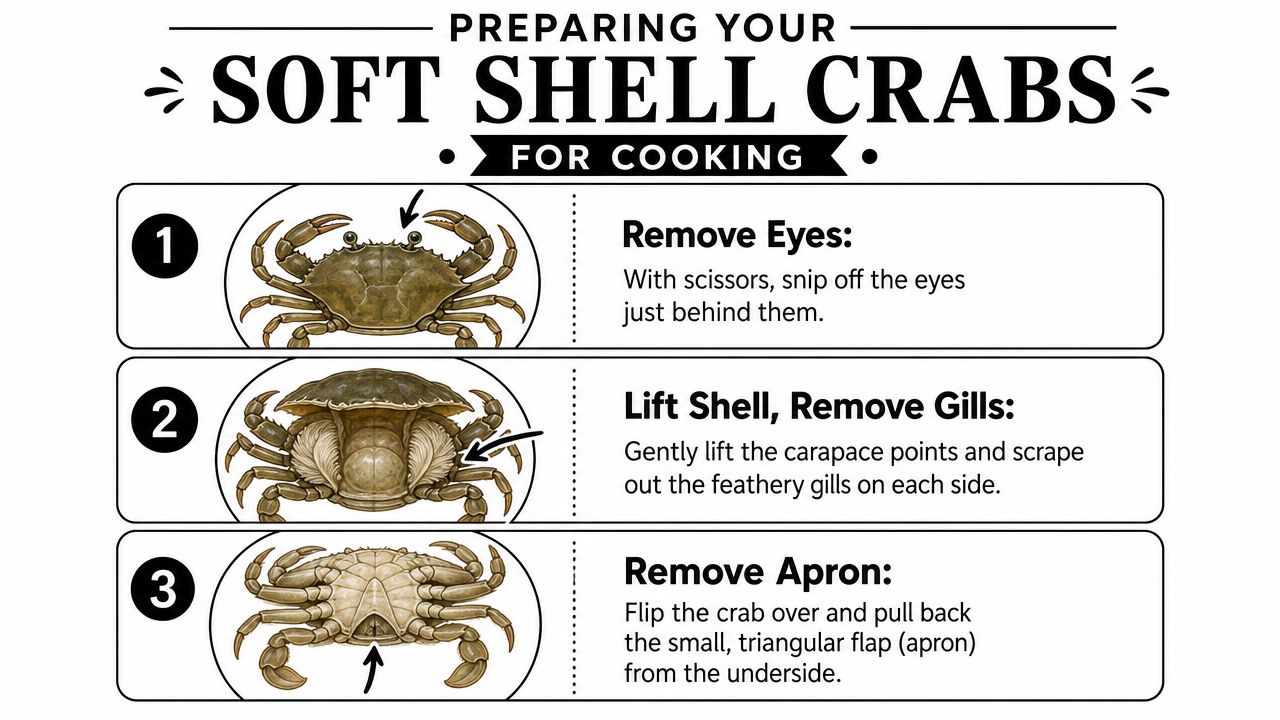
The simple cleaning sequence
Set up a board, a pair of kitchen scissors, and paper towel. Work with cold crabs, because they are firmer and easier to handle.
Snip off the front section just behind the eyes and mouthparts. A decisive cut is cleaner than a hesitant one.
Lift the pointed sides of the top shell and remove the feathery gills from both sides.
Turn the crab over and pull away the small apron flap underneath.
Rinse briefly if needed, then dry thoroughly.
That last step matters. Water left on the surface creates steam, and steam fights crispness.
A good visual guide helps if you're doing this for the first time:
Why this ingredient is so cook-friendly
The Virginia Seafood soft shell crab fact sheet states that the entire soft-shell crab is edible after removing the gills, mouthparts, and apron, resulting in 100% yield efficiency. The same source notes that a 100g portion provides 83 calories and 18.1% protein, making it a high-protein, low-fat choice.
That edible yield changes how you plan a dish. With hard-shell crab, much of the weight goes to waste. With soft shell crabs, what you buy is much closer to what you plate.
Common prep mistakes
Most disappointment happens before the pan is even hot.
Leaving the crab wet gives you a pale crust.
Tearing instead of cutting makes the crab look ragged on the plate.
Over-cleaning can damage the body and cause pieces to break away during cooking.
Seasoning too early can draw out moisture if the crabs sit before frying.
Clean them neatly, dry them thoroughly, and flour or batter them only when the pan is ready. That's the difference between professional-looking crab and a messy one.
A quick decision table
Task | What works | What doesn't |
|---|---|---|
Handling | Keep crabs cold while prepping | Let them warm and soften on the counter |
Drying | Press gently with paper towel | Rinsing and cooking immediately |
Cutting | Use sharp scissors | Tugging by hand |
Timing | Prep close to cooking time | Clean far ahead and leave exposed |
Mastering Three Classic Cooking Methods
Soft shell crabs don't need many techniques, but they do need the right one for the result you want. In my experience, three methods cover almost every serious use: frying for crunch, sautéing for finesse, and pairing with pasta for a fuller plate.
Each method asks for a different mindset. Frying is about speed and heat. Sautéing is about control. Pasta is about balance.
The crisp fry
This is the version many find to be their first favorite. Dust the cleaned crabs lightly in seasoned flour or a very fine dry coating. Shake off the excess. Then fry in hot oil until the exterior turns deep golden and the crab firms slightly.
What works:
A light coating, never a heavy crust
Dry crabs before dredging
Cooking in small batches so the oil temperature stays steady
Finishing with salt and lemon immediately
What doesn't:
Crowding the pan
Thick batter that hides the crab
Letting fried crabs rest on a flat plate instead of a rack or absorbent paper
The goal isn't heaviness. It is a delicate shell of crunch around a sweet interior.
The butter, garlic, and lemon sauté
If frying celebrates texture, sautéing celebrates flavour. Heat butter with a little oil, add the crabs, and cook until the surface takes on a light golden finish. Add garlic only when there's enough control to stop it burning, then finish with lemon juice, parsley, and perhaps a touch of capers if the rest of the plate is simple.
This method suits smaller dinners and more refined plating. It also leaves room for elegant sides such as wilted greens, roasted courgettes, or a smooth potato purée.
A short checklist helps:
Use a broad pan so the crabs aren't steaming each other
Turn gently to protect the shape
Keep garlic aromatic, not dark
Add lemon at the end to keep it bright
The pan should smell of butter and sea, not scorched garlic. If garlic dominates, the crab has already lost.
Soft shell crab with pasta
Pasta can either flatter soft shell crabs or bury them. The best pairings stay lean and vivid. Think olive oil, chilli, parsley, lemon zest, a little white wine reduction, or a restrained tomato base rather than a heavy cream sauce.
For visual inspiration on a pasta direction, a classic pasta presentation reference is a useful reminder that shape and simplicity matter. Long pasta gives elegance, while shorter shapes can make the dish easier to eat if the crab is served in sections.
A practical way to build the plate:
Cook the pasta properly and reserve a little cooking water.
Build a quick sauce with olive oil, aromatics, and acidity.
Fold the pasta through first, adjusting the gloss and seasoning.
Top with the crab, or place it beside the pasta if you want the coating to stay crisp.
Choosing the right method
Method | Best for | Main risk |
|---|---|---|
Fry | Maximum crunch and dramatic contrast | Sogginess from moisture or overcrowding |
Sauté | Delicate flavour and elegant plating | Burning garlic or overcooking |
Pasta | A complete main course | Using a sauce that's too heavy |
Professionals often keep all three in their repertoire because the crab changes character so beautifully from one treatment to the next.
Perfect Pairings and Elegant Presentation
A great soft shell crab dish needs tension on the plate. The crab brings sweetness, richness, and crispness. The accompaniments should bring brightness, sharpness, and contrast.
That is why lemon works so well. So does aioli when it's cut with enough acidity. So do lightly pickled vegetables, bitter leaves, and herbs with freshness rather than perfume. The aim isn't to pile on flavour. It's to sharpen what is already there.
Sauces that make sense
The safest sauces are the ones that know when to stop.
Lemon aioli works because it adds creaminess and acid at once.
Remoulade suits a more bistro-style plate, especially with fried crab.
Brown butter with capers flatters sautéed crab if used sparingly.
A light chilli and herb oil pairs especially well with pasta presentations.
Avoid anything too sweet or too thick. Barbecue-style glazes and heavy cream sauces usually flatten the crab's character rather than enhance it.
What to serve alongside
The side dish should answer the cooking method.
If the crab is fried, serve something crisp and fresh. A salad of little gem, fennel, and herbs works well. Thin fries can also be excellent if the plate leans casual and you keep the seasoning clean.
If the crab is sautéed, a vegetable side with gentle bitterness gives the best contrast. If the crab is paired with pasta, keep the rest of the table spare. Sparkling water, a wedge of lemon, and a restrained garnish often do more than elaborate extras. For that table-setting note, Lurisia water presentation fits the tone beautifully.
Plating with confidence
Presentation should frame the crab, not hide it.
A few reliable rules:
Let the crab stay visible. It should never disappear under garnish.
Use lemon intelligently. One well-cut wedge is better than scattered slices.
Keep height controlled. Soft shell crab looks best when plated with intention, not stacked awkwardly.
Add herbs at the end so they stay fresh and vivid.
White wines with crisp acidity, such as Pinot Grigio or Sauvignon Blanc, generally pair well because they refresh the palate and support the crab's delicate sweetness.
Troubleshooting and Professional FAQs
Even excellent cooks can miss the mark with soft shell crabs because the ingredient exposes small errors quickly. Most problems come down to moisture, timing, or imbalance.
The broader market also explains why kitchens keep refining their approach. The global frozen soft-shell crab market was valued at $4.8 billion in 2025 and is projected to reach $7.2 billion by 2033, growing at a 5.4% CAGR, according to this global market reference on soft-shell crab. Demand is serious, and so is the expectation of consistency.
Why did my fried crab turn out soggy
Usually because the crab was wet, the oil wasn't hot enough, or the pan was crowded. Dry the crab thoroughly, dredge at the last moment, and cook in batches.
What causes a bitter taste
Most often, burnt garlic or over-darkened crumbs. Occasionally, poor cleaning contributes an off note. Keep aromatics pale and fragrant, and clean the crab neatly before cooking.
Can I clean the crabs in advance
Yes, but only with care. Clean them close to service, keep them cold, and protect them from drying out. If they sit too long uncovered, the texture suffers and the surface becomes less cooperative in the pan.
What is the best way to reheat leftovers
The oven or an air fryer works better than the microwave because dry heat helps recover some crispness. Reheating will never equal the first service, so it's best to cook only what you expect to eat.
Why did the coating fall off
The crab was probably too wet, or the coating was too heavy. A thin, even dredge adheres better than a thick blanket of flour or batter.
Should I serve the crab whole or cut it
That depends on the style of the dish. Whole feels more dramatic and luxurious. Cut pieces can be easier in pasta, sandwiches, or sharing plates. Neither is wrong, but the choice should support the guest's experience.
Good soft shell crab cookery is mostly discipline. Dry properly, season clearly, cook decisively, and stop before the ingredient disappears under technique.
IFM Gourmet Food Store brings that same disciplined standard to gourmet shopping in the UAE. Explore the curated selection at IFM Gourmet Food Store for authentic Italian ingredients, refined pantry staples, elegant gifting, and premium delicacies that help turn a good meal into a memorable one.


Comments