
Threads and Needles: A Complete Guide for Sewing and Gifting

You've found the right gift, but the presentation has started to loosen. A ribbon slips, tissue paper tears at the fold, or a fabric tag needs securing before the hamper leaves your hands. A small needle, the right thread, and a little judgement can rescue the finish. The same attention to fit, strength, colour, and texture that produces a clean seam can also make a luxury gift look deliberate rather than hurried.
What Threads and Needles Really Mean
A needle and thread are simple tools, but they solve a surprisingly wide range of practical problems. A tailor uses them to join cloth, reinforce a seam, or repair a hem. Someone assembling a gift may use them to attach a fabric label, secure a decorative detail, or close packaging that needs more care than adhesive tape can provide.
The phrase also has a broader meaning. Threads and needles represent the essentials of a craft, the small decisions that determine whether the finished work feels sturdy and refined. A heavy thread pushed through a tiny needle eye will fray or break. A fine thread used with an oversized needle may leave visible holes and a weak-looking stitch.
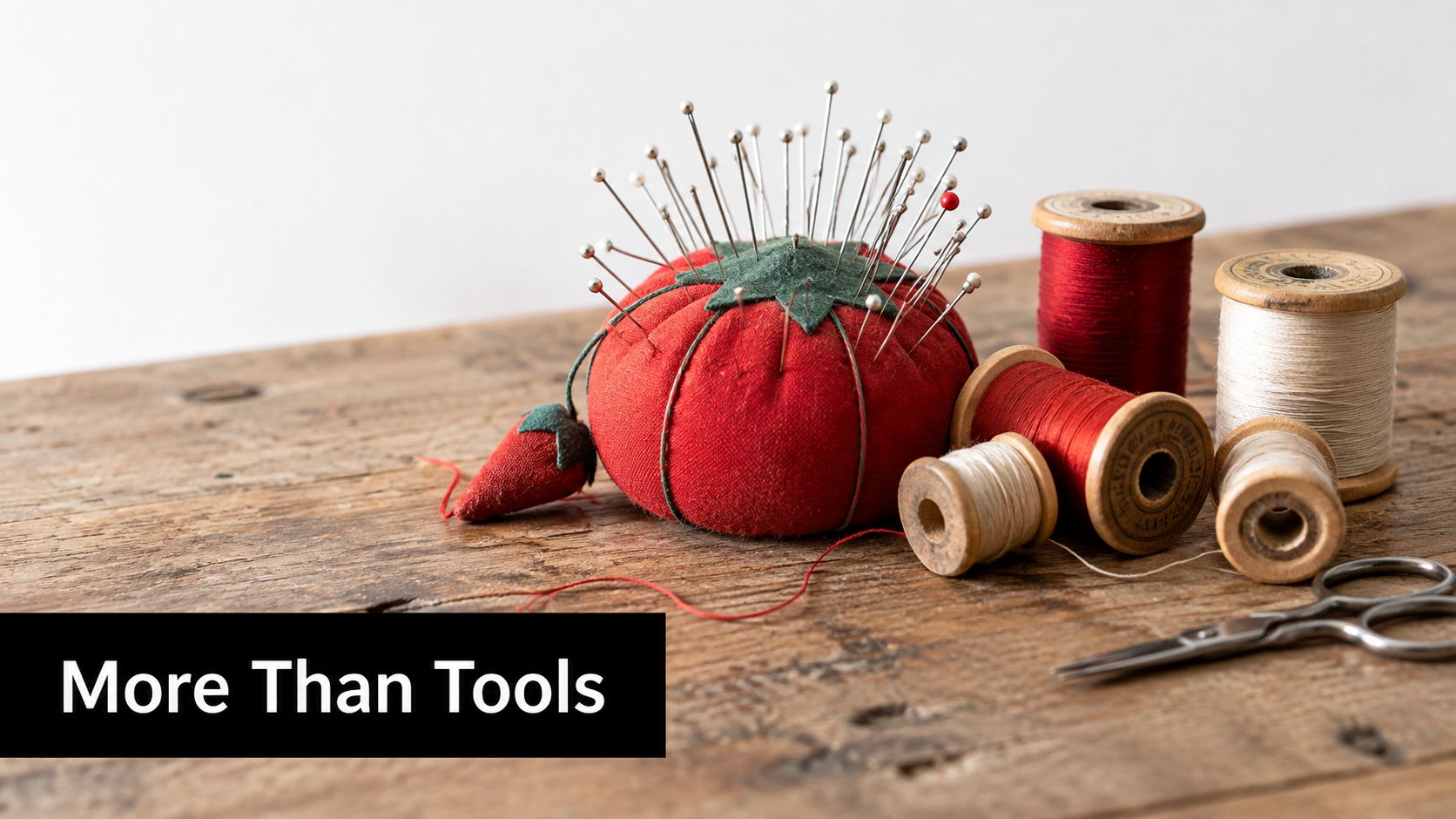
The small choices shape the finish
Think of thread as the joining material and the needle as the path-maker. The thread must suit the fabric, while the needle must carry it cleanly through the material. That pairing matters in hand sewing, machine work, tailoring, embroidery, and presentation details.
For anyone whose hands are less steady, a larger eye, a trimmed thread end, and good lighting make the job easier. These needle threading tips for shaky hands are useful before you start, especially when a small repair needs to look neat rather than merely hold.
The lesson extends beyond sewing. Choosing a matching colour, hiding the knot, and keeping tension even are presentation skills. Whether you're repairing a garment or finishing a hamper, precision comes from selecting the right basic tool before you begin.
Understanding Thread Types and Needle Sizes
Start with the thread, then choose the needle. Cotton can suit natural fabrics and decorative handwork, polyester is valued for everyday strength and consistency, and silk offers a refined appearance for delicate projects. Specialty threads may add sheen, texture, or a distinctive surface, but they often need more careful handling.
Tex is a direct measure of thread thickness. A higher Tex value indicates a heavier thread. Thread numbering can work differently, so read the product information instead of relying on the number alone. A&E literature links heavier constructions with larger needles such as 110/18 and 160/23, while lighter constructions use sizes from 65/9 to 100/16. The pairing helps the thread pass through the eye without unnecessary abrasion. (A&E thread and needle guidance)
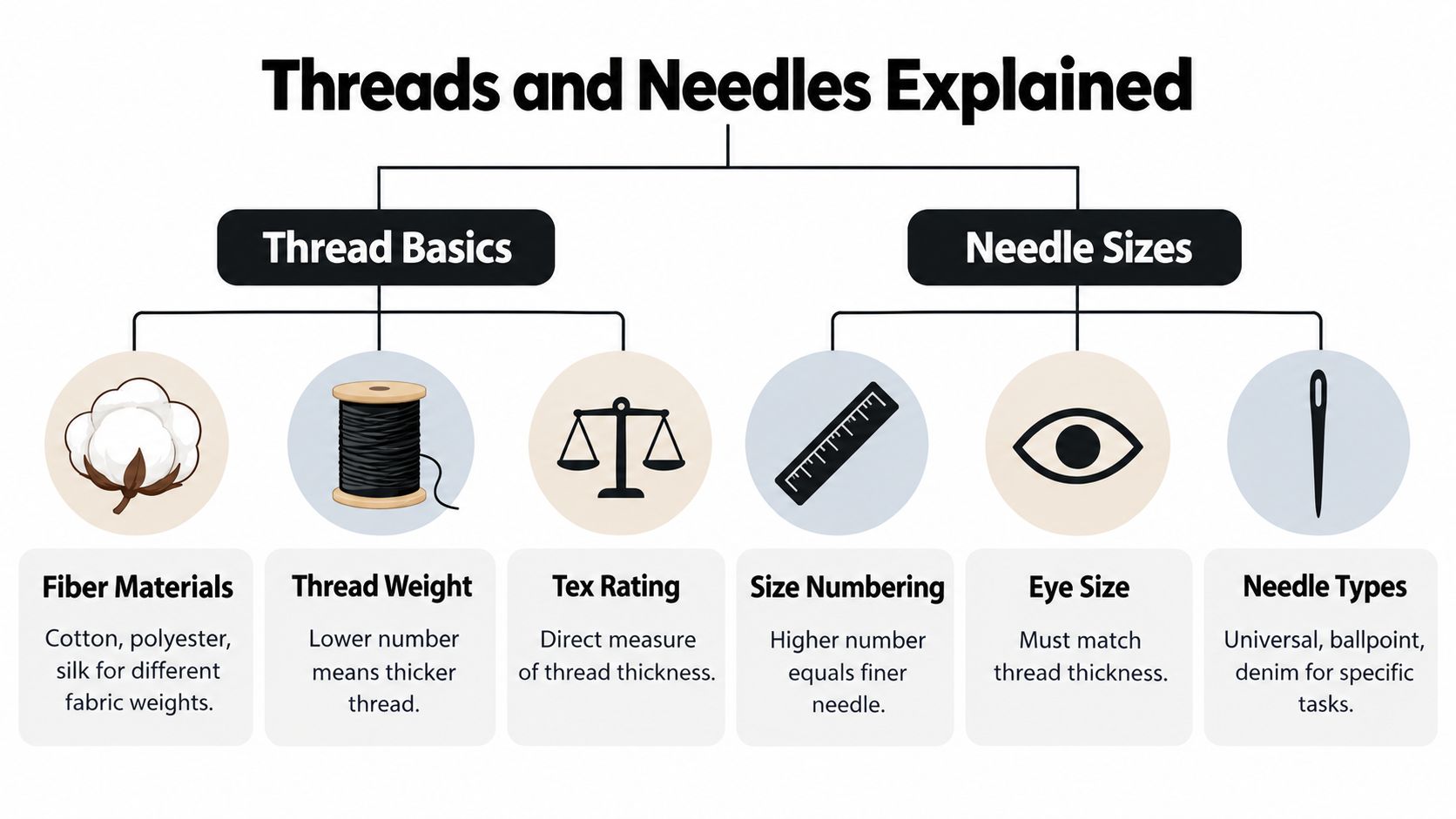
Read the numbers as a matching system
Needle sizing can feel backwards at first. In common systems, a higher number generally refers to a finer needle, while paired formats such as 65/9 or 110/18 show two sizing conventions. The eye must be large enough for the thread, but the shaft must also suit the fabric.
A&E technical literature illustrates why this isn't just a labelling exercise. One line lists Tex 60 with a recommended 100/16 needle and tensile strength of 5.88 lb, or 2,616 cN. A heavier footwear line lists Tex 180 with a 65/9 needle and 16 lb, or 1,108 cN, while Tex 35 uses a 75/11 needle and 30 lb, or 2,322 cN. These figures belong to specific products, so they shouldn't be treated as universal conversions. (A&E technical thread charts)
Use a universal needle for general woven fabric, a ballpoint for knitted material, and a denim or heavy-fabric needle when the material is dense. If you're attaching a label after sewing a garment, practical guidance on Get Spliced sew on labels can help you plan placement and stitch security.
Why the UAE Market Matters for Sewing Supplies
The UAE's sewing-supply demand is broader than hobby shelves suggest. Import-trade data records 873 sewing-thread shipments from October 2023 to September 2024, supplied by 76 foreign exporters to 105 UAE buyers. The same dataset records 27 shipments in September 2024, with India, Russia, and Vietnam together accounting for 90% of imports in that period. (UAE sewing-thread import data)
That activity reflects a working ecosystem of alteration shops, bespoke tailors, abaya ateliers, uniform producers, factories, and home sewers. A thread colour that seems minor to a casual buyer can matter greatly when a client expects a clean match against a particular fabric weight, surface, or finish.
A regional market with a strong UAE centre
The wider GCC imported 98,000 sewing-machine needle units in 2024, an increase of 28% from the previous year. Market value reached $4.1 million, up 11% year on year, while the UAE consumed 31,000 units. The UAE accounted for 92% of combined GCC consumption with Saudi Arabia and Qatar, and its average annual consumption growth from 2013 to 2024 was +9.9%. (GCC sewing-machine needle market data)
Per-capita consumption in the UAE reached 3.1 units per 1,000 people in 2024, compared with a world average of 1.4 units per 1,000 people. That difference points to demand connected not only with garment production, but also with tailoring and home stitching.
The sourcing picture still needs care. Available data records just one industrial sewing-machine needle shipment from May 2024 to April 2025, a 95% decline from the prior twelve months, with China, India, and Vietnam supplying 71% of imports. (UAE haberdashery wholesale and sourcing context) For professional buyers, that makes specification matching, alternative suppliers, and lead-time planning as important as unit price.
Common Product Types and How to Choose
The safest choice depends on four things: fabric, thread thickness, seam stress, and the finish you want. A shiny specialty thread may look beautiful on a decorative edge but perform poorly where the seam flexes. A strong polyester thread may be ideal for everyday repairs, yet feel too blunt for delicate hand embroidery.
Project need | Thread choice | Needle choice |
|---|---|---|
General woven repair | Polyester or cotton | Universal or sharp |
Delicate decorative work | Fine cotton or silk | Fine embroidery needle |
Stretch fabric | Suitable polyester or specialty stretch thread | Ballpoint |
Dense fabric | Strong polyester or heavier thread | Denim or heavy-fabric needle |
Labels and fabric tags | Smooth, durable thread | Sharp needle with an adequate eye |
Choose for performance, not appearance alone
Polyester is a dependable default for clothing repairs because it combines strength with broad availability. Cotton gives a natural look and can suit cotton garments or visible decorative work. Silk has a refined sheen, but its appearance should be matched with a fabric that benefits from that delicacy.
Specialty threads are useful when the surface is part of the design. Metallic, textured, embroidery, and heavier topstitching threads can create a clear visual effect, though they may need a larger eye, slower handling, or a different needle. The mistake is treating every spool as interchangeable.
Practical rule: If the thread rubs, shreds, or struggles through the eye, stop and change the pairing before adjusting your stitch tension.
For gift presentation, choose a thread that disappears when the work should be invisible, or one that deliberately complements the ribbon, label, or fabric detail. The best match is the one that supports the job without competing with it.
Practical Tips for Non-Sewers
A non-sewer usually doesn't need a full kit. A sharp hand needle, a small selection of smooth thread, thread snips, and a safe storage option cover many quick repairs. Keep the needle threaded between short tasks, and place it in a pincushion or case rather than on a table where it can disappear into fabric or packaging.
A simple hamper repair shows how little technique is needed. The outer ribbon has loosened, and the knot will not hold its shape. Instead of pulling harder, pass a few small stitches through the ribbon and the underlying fabric or tag, then hide the thread beneath the knot. The repair supports the decoration without changing its appearance.
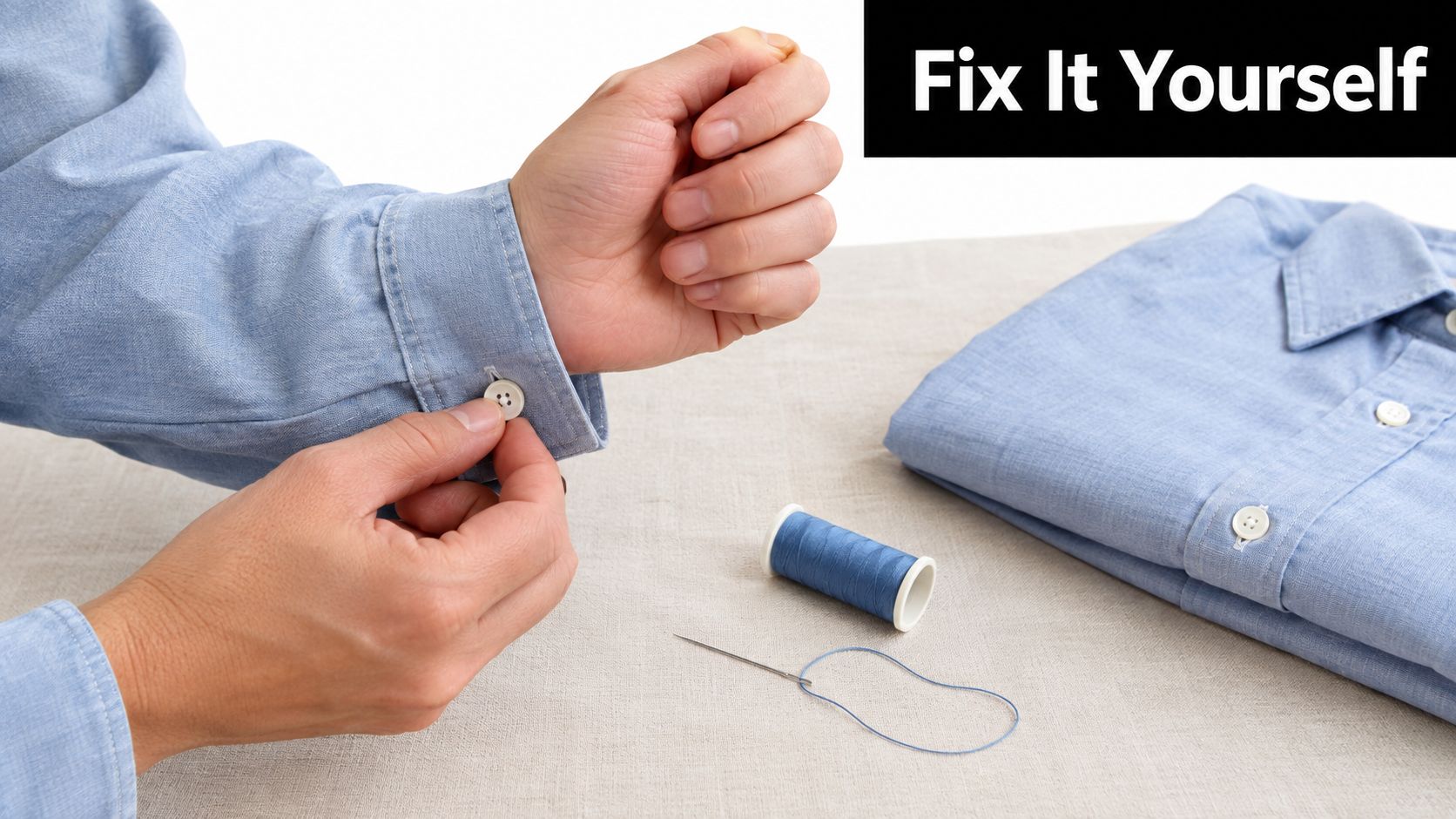
Three small fixes worth learning
Secure a loose label: Use a matching thread and short, even stitches through the label's edge. Avoid stitching through delicate printed areas.
Repair a fabric tie: Trim frayed fibres, fold the end under, and add a few tight stitches to stop further unravelling.
Reinforce a soft package: Place a small piece of fabric behind the stitch area if the material feels weak. This spreads the pull instead of concentrating it in one hole.
For children's celebrations or colourful hamper details, a carefully finished fabric tag can complement ideas for Italian candies at kids' food parties. The principle is the same as tailoring: keep the stitch small, keep the tension controlled, and stop once the detail is secure.
Don't force the needle through thick board or rigid packaging. For those materials, use a suitable adhesive or a pre-punched opening. Thread and needles work best when the material allows a clean, supported path.
Bringing It All Together for Better Gifting
A well-made garment and a well-presented gift share the same discipline. Both depend on proportion, clean edges, secure joins, and details that look intentional. A ribbon should sit where it belongs, a tag should remain straight, and any visible stitch should follow the rhythm of the material rather than fight it.
That's why basic sewing knowledge improves more than repairs. It trains the eye to notice tension, balance, texture, and colour. Those observations guide the choice between a matte cotton thread and a brighter polyester one, or between a hidden stitch and a decorative line.
Craftsmanship is a form of restraint
Luxury presentation rarely needs more decoration. It needs the right decoration, placed well and secured properly. A discreet thread can preserve a clean finish, while a contrasting thread can make a fabric label feel designed rather than added at the last moment.
The same thinking applies to collaborative craft projects. If you're exploring how textile skills can support a thoughtful present or branded experience, this example of a sewing collaboration at Linda's Electric Quilters offers useful context without reducing craft to a purely functional task.
For a final check, inspect the gift from the recipient's viewpoint. Look for loose ends, uneven tension, exposed knots, and colour clashes. Then test the attachment gently. If it holds without distorting the fabric, you've chosen the right tool and stopped at the right moment.
A curated food gift benefits from that same care. Use the visual balance of Italian gourmet categories as a reminder that presentation is built from coordinated details, not excessive decoration. Threads and needles may be humble, but they teach the exacting habits that make a gift feel personal.
Choose a thoughtful food gift from the range of chocolates, teas, cakes, sweets, savouries, and curated hampers available through IFM Gourmet Food Store. Visit the store to find a polished gourmet selection, then give the presentation the same care you'd give a well-finished seam.


Comments