True Cinnamon Powder Explained, from Bark to Kitchen

You're standing in a Dubai gourmet aisle or scrolling a spice listing on your phone, and the jar just says cinnamon powder. That's where the confusion starts. Some jars hold true cinnamon powder, some hold cassia, and once the bark is ground, the difference isn't obvious to the eye.
That matters more in the UAE than many shoppers realise. People here buy spices for daily tea, karak, baking, gifting, and elegant home cooking, so a small label choice can change the flavour in your cup, the feel of a dessert, and even how often you want to use it. If you've ever wondered why one cinnamon tastes soft and warm while another feels sharper and louder, you're already asking the right question.
The Spice in Your Kitchen May Not Be What You Think
A Dubai shopper can pick up three jars of brown powder in one gourmet aisle and still not know which one is true cinnamon powder. The labels may all look similar, the packaging may all feel premium, and the scent may seem close enough at first sniff. That's why so many people bring home a jar of “cinnamon” without really knowing what species it contains.
The word cinnamon is broader than most home cooks realise. It covers more than one bark, and those barks don't behave the same way in flavour, safety, or price. In a city where people buy spices for both weekday cooking and gifting, that difference can matter a lot.
IFM Gourmet Dubai fits neatly into that conversation because its whole world revolves around authenticity, elegant presentation, and carefully chosen gourmet products. If you're shopping for a hamper, a dessert ingredient, or a kitchen staple, a clear label matters just as much as a pretty jar.
Practical rule: if the pack only says “cinnamon powder”, treat that as a starting point, not proof of what's inside.
That's the reason this topic deserves a closer look. Once cinnamon is ground, you can't rely on stick shape or bark layers anymore. You need to know what true cinnamon is, how it differs from cassia, and what to ask for when you're shopping in the UAE.
What True Cinnamon Powder Actually Is
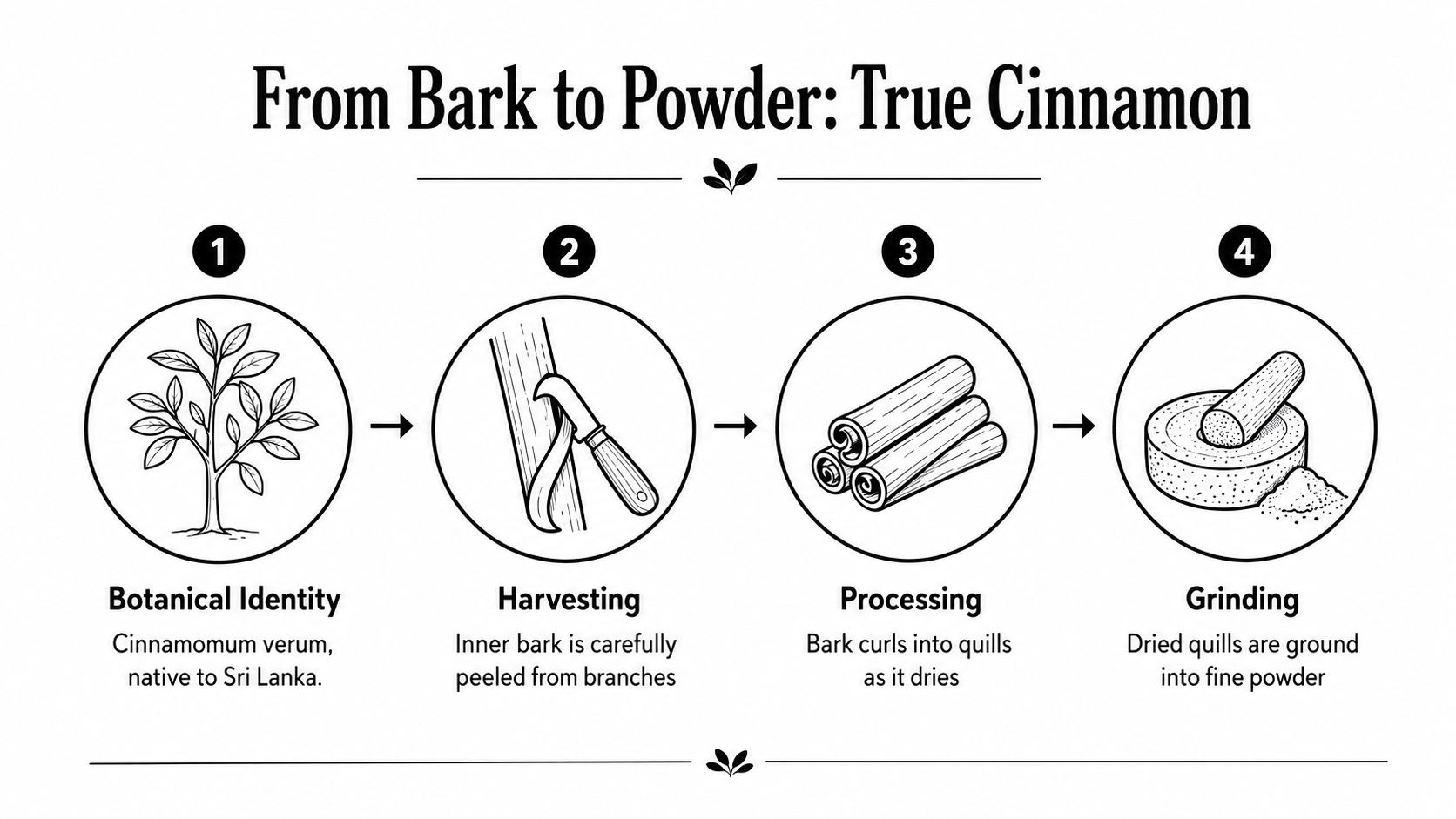
True cinnamon powder is the ground form of Cinnamomum verum, also called Ceylon cinnamon. It comes from the bark of a tree native to Sri Lanka, and it belongs to the Cinnamomum genus. Independent spice references describe the basic process clearly, the outer bark is removed, the inner bark is dried into quills, and those quills are ground into powder.
Imagine a tiny rolled scroll inside the bark. The tree provides a thin inner layer, which curls as it dries, and these curled quills become the source material for the powder in your spoon. That is why the powder is not a separate category at all, it's just the finished ground form of the bark people call true cinnamon.
The point sounds simple, but it solves a common shopping mistake. Many people look for “true cinnamon” only in stick form, then assume powder is too vague to verify. It isn't. The botanical name, origin, and paperwork still tell the story even after the bark has been ground.
For readers who like broader herb and spice context, the aromatherapy herb overview from Aroma Warehouse is a useful side read because it shows how carefully people often think about plant identity once a product is no longer in its raw form.
True Cinnamon Powder vs Cassia in Real Cooking
A jar of cinnamon can look straightforward on a UAE supermarket shelf, then behave very differently once it hits hot milk, coffee, or dessert. Cassia usually tastes bolder, sharper, darker, and cheaper. True cinnamon powder is softer, sweeter, more delicate, and usually lighter in colour. In the kitchen, cassia works like a strong espresso shot, while true cinnamon gives a smoother cup.
Attribute | True Cinnamon Powder (Cinnamomum verum) | Cassia Cinnamon Powder |
|---|---|---|
Flavour | Soft, sweet, layered | Bold, sharp, spicier |
Aroma | Gentle and nuanced | Stronger and punchier |
Colour | Lighter, often golden-brown | Darker, more reddish-brown |
Culinary feel | Better for delicate desserts and daily drinks | Better when you want a louder spice note |
Coumarin load | Very low, around 4 mg/kg in one product guide source | Very high, about 5,000 mg/kg in one product guide source |
That last line is why many health-focused shoppers pay attention. One product guide reports about 4 mg/kg for Ceylon cinnamon and about 5,000 mg/kg for cassia source, a huge practical gap when cinnamon appears every morning in coffee or tea. For a cake you bake once in a while, the difference may not feel dramatic. For a daily ritual, it can.
True cinnamon powder suits recipes where the spice should stay in the background. It blends well into delicate desserts, fruit cakes, and milky drinks. Cassia still has its place, especially when a recipe needs a stronger cinnamon note and you are not using it often.
A useful shortcut, use cassia when you want impact, use true cinnamon when you want refinement.
That is also why many supermarket jars cause confusion. They may all say cinnamon, but only one will give the mellow, elegant note many people expect from Ceylon cinnamon.
Coumarin, Safety and the Daily Dose Question
Coumarin is the part of this story that daily drinkers should pay attention to. The product guide in the brief reports very low coumarin in true cinnamon powder, while cassia can carry much higher levels. The question is not whether cinnamon is “good” or “bad”, it is how often you use it and how much ends up in your day.
That matters in UAE routines because cinnamon often shows up in more than one place. It goes into karak, sometimes into Arabic coffee, and sometimes into breakfast bowls, smoothies, and sweet drinks. A pinch here and a spoonful there can add up if the same jar is used every day.
The U.S. National Center for Complementary and Integrative Health warns that cinnamon can cause gastrointestinal problems or allergic reactions when used in larger amounts or for long periods, and it specifically says not to consume cinnamon powder as part of the cinnamon challenge because serious harm is possible. NCCIH's cinnamon guidance is worth reading if cinnamon is part of your daily routine.
WebMD notes that some experts suggest about 1/2 to 1 teaspoon, or 2 to 4 g per day WebMD's cinnamon overview, while studies have used 1 to 6 g WebMD's cinnamon overview. That does not mean every person needs to panic over a sprinkle on dessert. It does mean the daily drinker should think differently from the occasional baker.
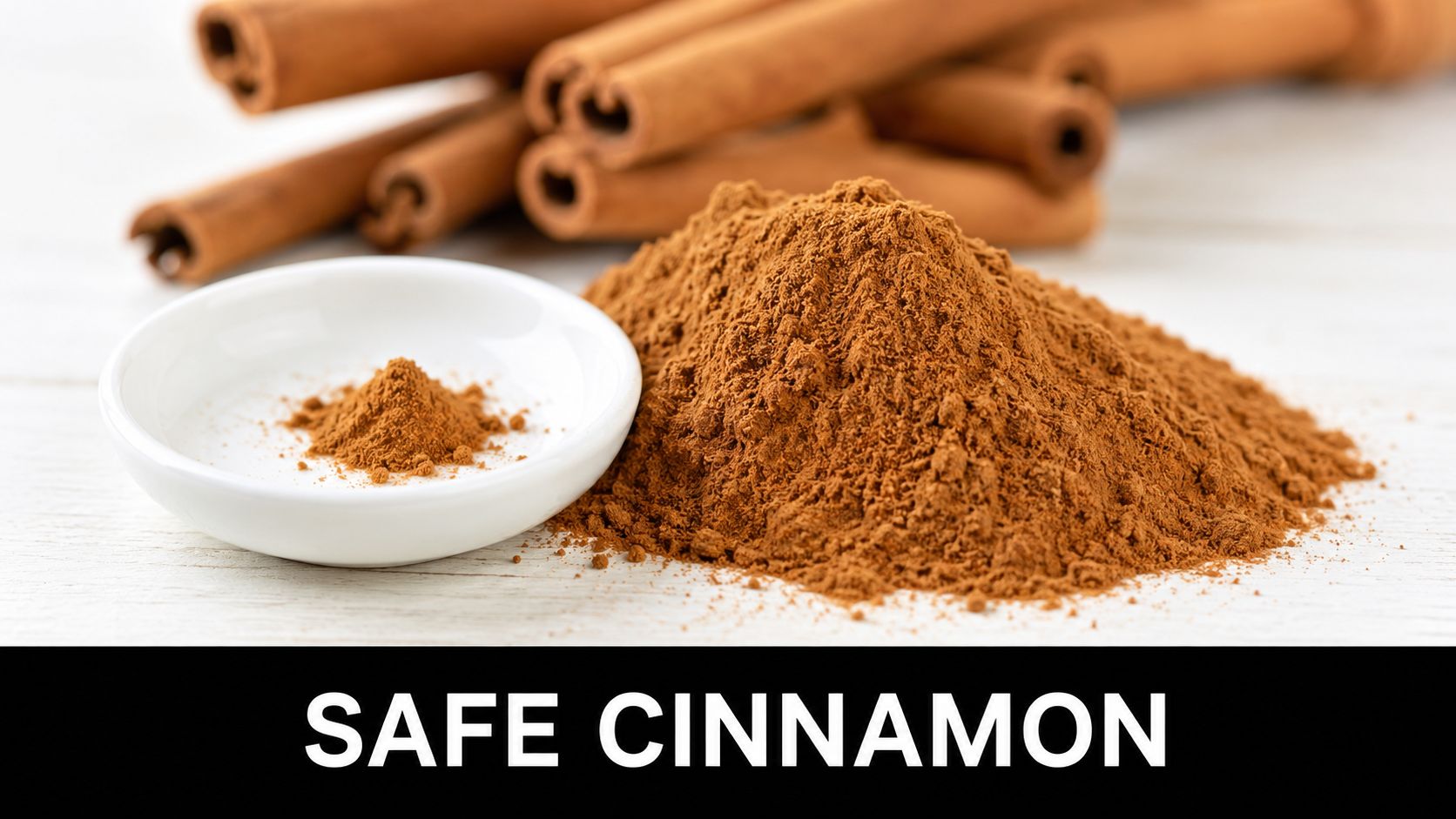
If cinnamon is a once-a-week ingredient, cassia may be perfectly fine for many people. If you add it every day to coffee, yoghurt, oats, or a wellness drink, true cinnamon powder gives you a more comfortable margin because the coumarin burden is much lower.
How to Judge Quality When the Cinnamon Is Already Ground
Once cinnamon is powder, the easy visual checks disappear. You can't look for layered quills or curled sticks in a jar of brown dust. That means quality control has to come from the label and the supplier, not from your eyes alone.
What a serious label should tell you
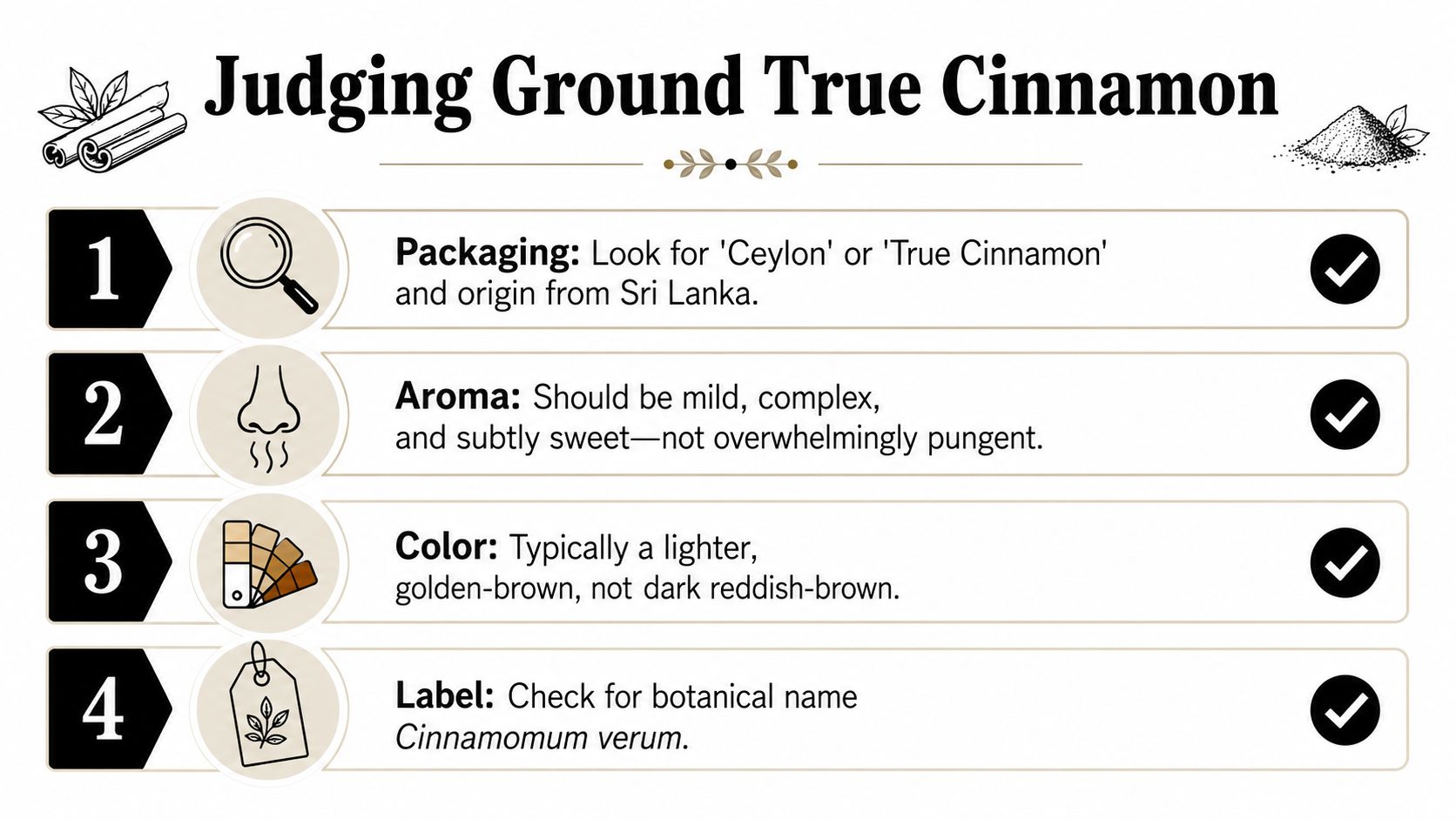
Look for the botanical name first. If the pack says Cinnamomum verum or Cinnamomum zeylanicum, that is a strong sign you're looking at true cinnamon. A declared Sri Lanka origin helps too, since that is where true cinnamon is native.
You should also look for technical details that tell you the powder was made for real handling, not just for vague retail display. The UAE-facing specification in the brief lists a fine, free-flowing powder, 98% passing 60-mesh (≤250 µm), moisture ≤10%, total ash ≤9%, acid-insoluble ash ≤1.5%, and volatile oil ≥1.0 mL/100 g. Those details matter because they signal a powder that is less likely to clump, carry extra mineral residue, or behave inconsistently in bakery premixes and gourmet blends.
What not to trust on its own
Colour and aroma can help, but they can't prove authenticity once the bark is ground. Both true and false cinnamon can be milled into powders that look similar, and sensory traits can be mimicked or adjusted. That's why a serious UAE buyer should ask for batch-level traceability and third-party lab testing when the product is sold as premium.
If you're shopping from a polished gourmet retailer, transparency should feel easy to find rather than hidden. One option in the UAE market is IFM Gourmet Food Store, which sits within a broader gourmet and gifting context where product origin, ingredient identity, and presentation matter together.
Pairing True Cinnamon Powder Across Italian and UAE Kitchens
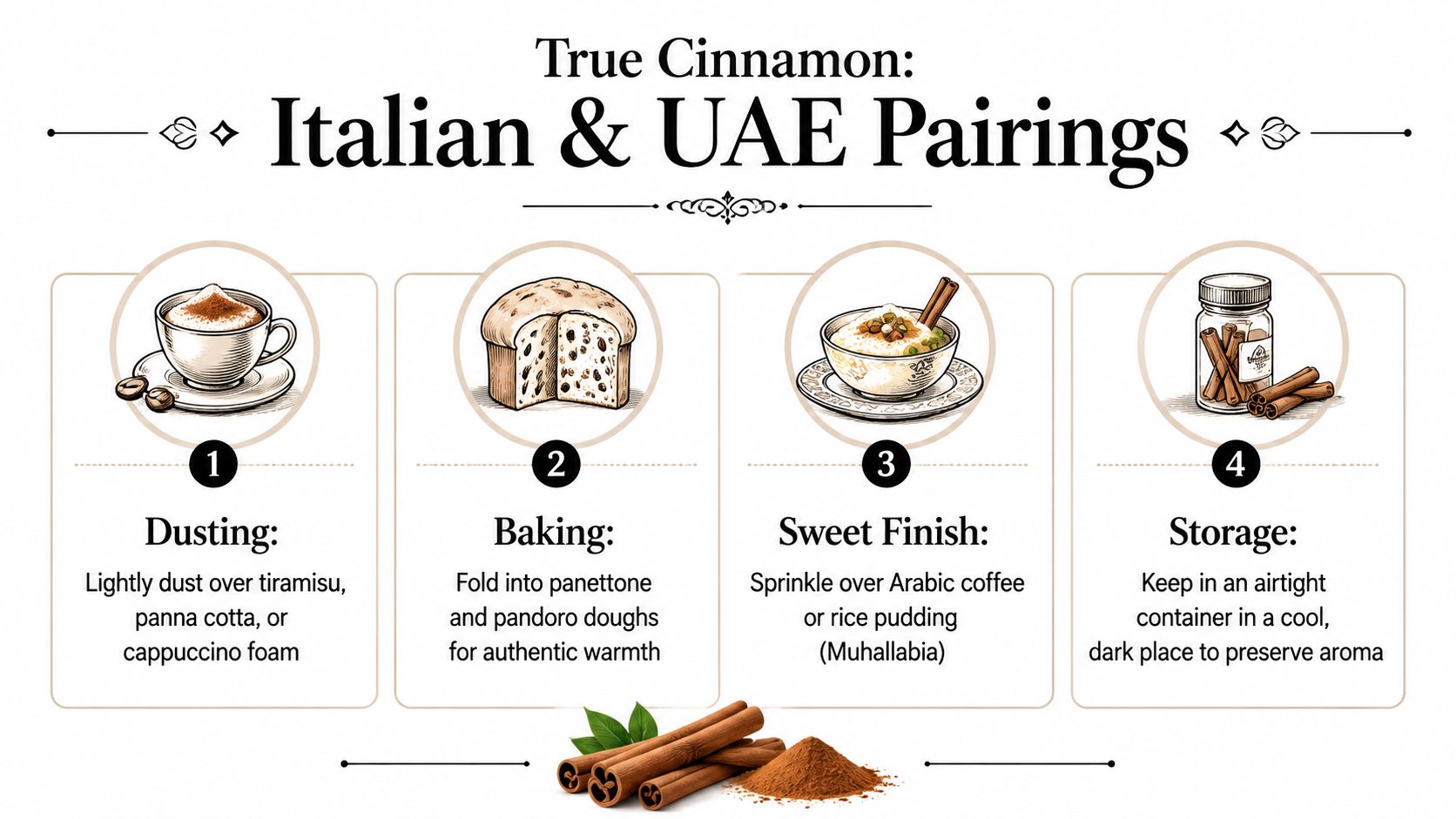
True cinnamon powder shines when a recipe needs warmth without shouting. That is why it works so naturally in Italian desserts such as tiramisu dusting, panettone, pandoro, panna cotta, and apple or pear cakes. The spice doesn't crowd out the dessert, it rounds it off.
The same logic works in UAE favourites. A light hand in karak chai can soften the tea without drowning out the cardamom. In Arabic coffee, a small amount can add depth. In luqaimat and saffron desserts, a gentle cinnamon note can support the sweet profile instead of taking over.
If you're making a recipe that calls for cinnamon and only cassia is available, use the same amount as a starting point, then taste carefully. If the recipe is delicate, such as a cream dessert or a dessert with saffron or rose, slightly less cassia usually keeps the flavour from turning heavy. If the recipe is hearty, such as a baked apple dish, the difference is easier to absorb.
For home cooks who want a visual cue for dishes that benefit from fine finishing, the pasta image at this recipe-style visual gives a similar sense of how a simple ingredient can change the tone of a finished plate.
Kitchen rule: use true cinnamon powder where you want elegance, not force.
That's the easiest way to think about it. If the dish already has bold cardamom, saffron, chocolate, or caramel, true cinnamon behaves like a quiet finishing note. If the dish needs a loud, direct spice hit, cassia can still make sense.
Storage, Fresh Grinding and Gifting with True Cinnamon Powder
Powder loses aroma faster than whole bark, so storage matters more than you might expect. Keep true cinnamon powder in an airtight glass or tin container, away from light and heat, and use a dry spoon every time. The fridge is a poor choice because moisture can creep in and spoil the texture.
If you enjoy grinding at home, quills give you more freshness, just like whole beans do in coffee. Pre-ground powder is convenient, especially for everyday use, but freshly ground quills usually keep more of the fragrance alive for the moment you need it. The choice is really about routine, if you use cinnamon often, a good powder is practical, if you use it for special dishes, quills can be worth the extra step.
For coffee storage habits, storing beans for better brew from PureHQ Inc. is a useful parallel, because the same basic rule applies, air, moisture, heat, and light shorten freshness.
True cinnamon also fits neatly into gifting. In Dubai, a small jar can sit comfortably in festive hampers for Ramadan, Diwali, Christmas, corporate gifts, and housewarmings. A short note about Sri Lanka origin and the spice's softer flavour profile makes the gift feel thoughtful rather than random.
Quick Answers for UAE Shoppers and Curious Home Cooks
If a shelf jar only says cinnamon, check the botanical name, origin, and whether the seller can show batch documentation. If those details are missing, you still don't know whether it's true cinnamon powder or cassia. For children, cinnamon in normal dessert amounts is generally a cooking ingredient rather than a supplement, but the safer habit is still to keep servings modest and avoid turning it into a daily heavy-dose drink.
An opened jar usually stays useful for a long time in a UAE kitchen if it's stored properly, but aroma is the best clue that it's getting tired. If it smells flat, dusty, or weak, it won't lift your coffee or dessert the way fresh powder does. For a first try, the smartest starting point is usually a small gourmet jar or tin, not a large container.
The IFM Gourmet logo at this store image is a good reminder that a trustworthy gourmet shop should make origin and product identity easy to understand.
If you want a thoughtful way to bring true cinnamon powder into your kitchen, browse IFM Gourmet Food Store for gourmet ingredients that suit both everyday cooking and gift boxes. It's a simple place to look for a cinnamon product that feels right in coffee, desserts, and curated hampers across Dubai and the wider UAE.


Comments