

What Is Luxury Chocolate and How to Choose It Well

If an expensive chocolate bar tastes mostly of sugar, what exactly are you paying for? A beautiful box can make a gift feel special, but it can't tell you whether the chocolate inside has been made with care.
Luxury chocolate is a craft-led experience, not confectionery with a higher price. To choose it well, follow the cocoa from its origin to its final texture, then consider how the chocolate will be stored, served, and enjoyed.
Why Luxury Chocolate Matters in Dubai's Gourmet Scene
In Dubai's gourmet market, chocolate rewards the same attention as a composed dish: ingredients matter, but decisions about balance and emphasis shape the result. Fine cocoa can offer depth, while careful handling helps preserve its aroma and texture. A costly ingredient alone cannot guarantee a memorable bar.
So, what is luxury chocolate? It is chocolate whose provenance, formulation, production, and presentation work together. Price is easy to see; quality is something you can investigate and experience in the taste, aroma, and feel.
A premium niche with familiar tastes
UAE premium-chocolate revenue was estimated at USD 137.9 million in 2024, with a projection of USD 198.0 million by 2029 and 7.5% compound annual growth from 2025 to 2029. Milk chocolate accounted for 46.19% of premium revenue in 2024, according to Grand View Research's UAE premium-chocolate outlook.
These estimates point to an established premium niche with room to develop. They do not show that every expensive bar earns its position. The milk-chocolate share also shows that luxury need not mean dark or austere. A well-made milk chocolate can be approachable while still offering balanced flavor and a pleasing texture.
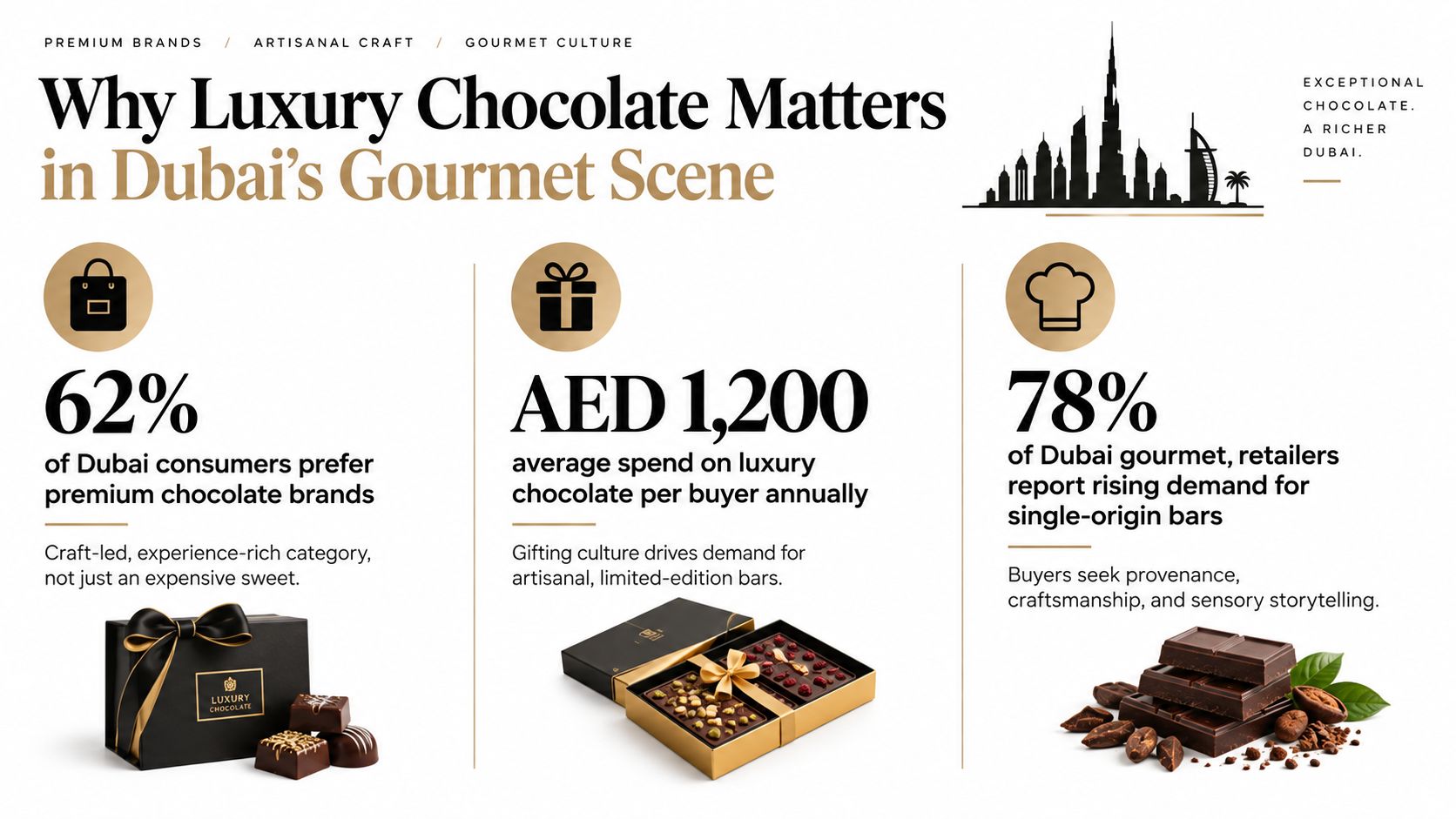
The visual below introduces the category's craft and gifting context.
Buy for the person and the occasion
In Dubai, the right choice depends on how the chocolate will be enjoyed. A corporate gift benefits from clear ingredient information and practical delivery arrangements. A festive hamper should suit its recipient, while a personal tasting purchase might focus on an intriguing cocoa origin.
Provenance: Look for a named origin and an explanation of what it brings to the flavor.
Craftsmanship: Consider how the maker's choices shape the chocolate's taste and texture.
Gift suitability: Check preferences, dietary needs, protective packaging, and when the recipient will open it.
For a broader cultural comparison, Clos Pegase art and wine offers a way to consider food, place, and presentation together. The same perspective can help with chocolate, while remembering that an elaborate story does not guarantee better flavor.
Buying principle: Choose chocolate with something meaningful to taste, as well as something impressive to unwrap.
From Cocoa Pod to Finished Bar
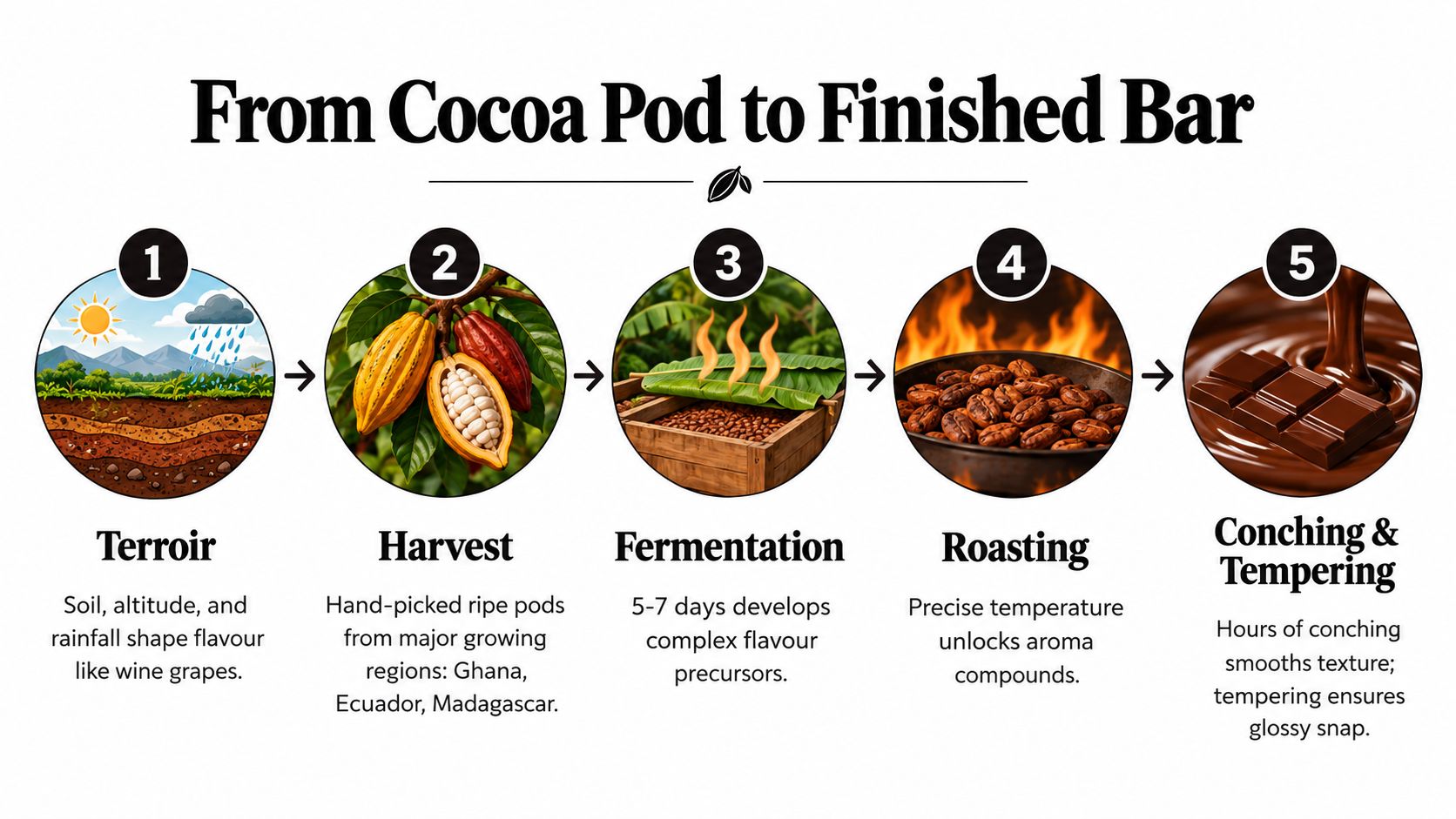
Chocolate begins inside a cocoa pod, not in a mold. Its potential develops through growing conditions and the maker's handling of the harvested beans. Terroir is the shorthand for the influence of place, including soil, altitude, and rainfall, much as it is for wine grapes.
Labels may name Ecuador, Ghana, Madagascar, Venezuela, or the Dominican Republic. Treat these origins as starting points for curiosity, not fixed flavor guarantees. A country name can't tell you everything about a particular farm, harvest, or roast.
Origin and the maker's choices
A single-origin bar uses cocoa from a defined geographic source. Check how precisely the maker defines that source: a country is a broader claim than a named estate. A blend combines beans to achieve balance, consistency, or complexity, and isn't automatically less accomplished.
The cocoa-to-chocolate journey is easier to understand as a connected process.
Bean-to-bar describes a maker's involvement in transforming cocoa beans into finished chocolate. Small-batch production can allow close attention, but batch size alone isn't proof of quality. What matters is how consistently the maker manages each stage.
Sorting and fermentation: Sorting helps the maker reject unsuitable beans. Fermentation develops the foundations of chocolate flavor, so care at this stage matters before roasting begins.
Drying and roasting: Drying prepares beans for storage and processing. Roasting is like toasting spices: the maker can bring out attractive aromas or overwhelm delicate ones.
Winnowing and grinding: Winnowing removes the shells, leaving cocoa nibs. Grinding turns those nibs into cocoa mass, also called chocolate liquor, which contains no alcohol.
Why the journey matters to your palate
Stone-grinding is a production method, not a promise that every resulting bar will taste better. Likewise, an unusual origin isn't a substitute for careful processing. Evaluate the finished chocolate alongside the maker's explanation of how it was produced.
For readers curious about another cocoa format, the Maximum Health Products cocoa guide is a related resource on cocoa powder, rather than a guide to judging finished luxury bars.
UAE chocolate consumption is estimated at approximately 2.5–3 kilograms per person annually, among the highest levels in the Middle East, according to Mordor Intelligence's UAE chocolate-market overview. For an interested eater, exploring origin and processing offers a way to turn a familiar food into a more attentive experience.
Cocoa Percentage, Conching, and Tempering Explained
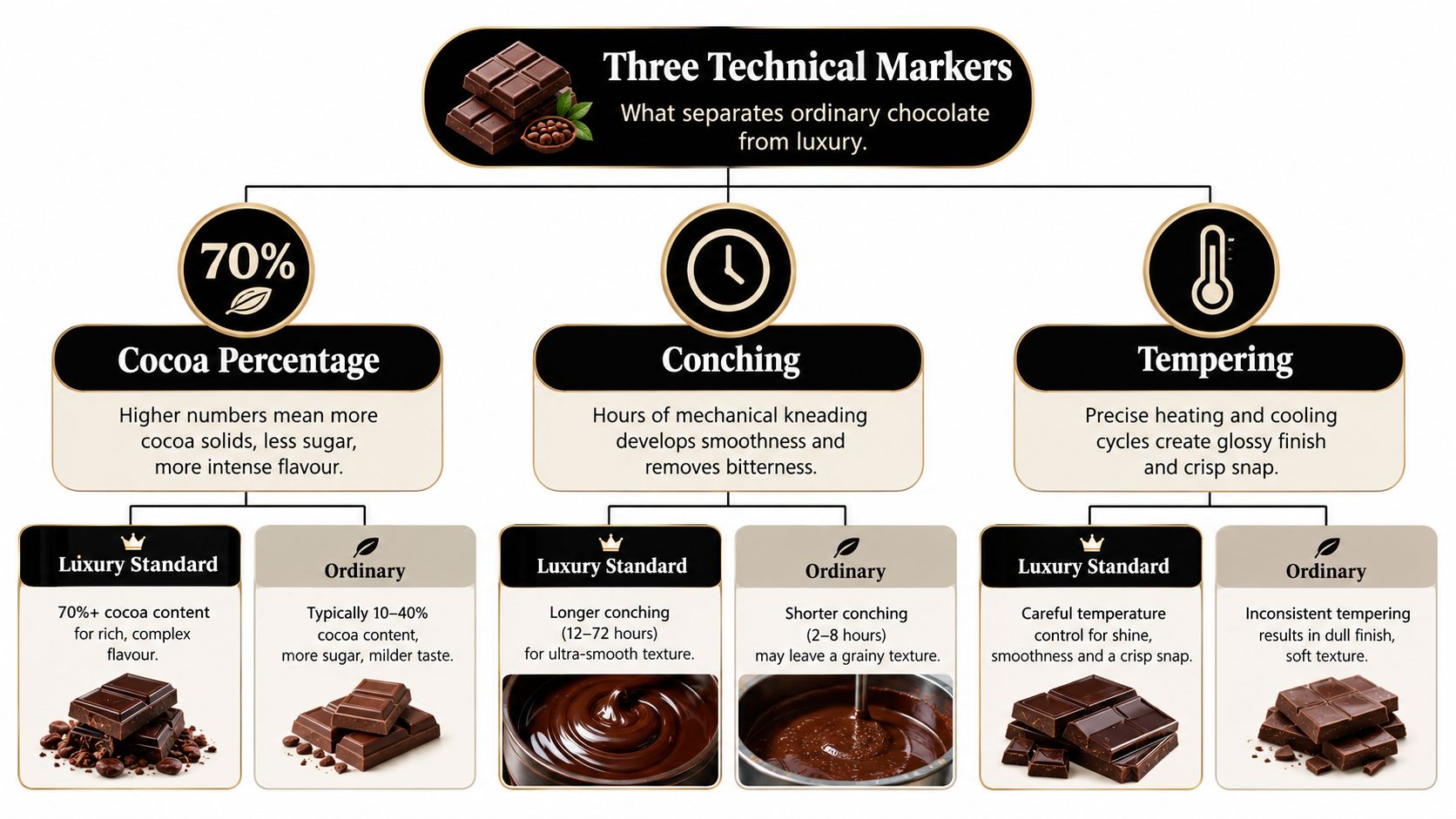
A cocoa percentage describes a chocolate's composition, not its overall quality. Cocoa-derived ingredients include both nonfat cocoa solids and cocoa butter, so a higher percentage does not automatically mean more bitterness or better flavor.
Within otherwise similar recipes, more cocoa generally leaves less room for sugar. Milk, added cocoa butter, and other ingredients also shape the taste and texture. Compare styles, not just numbers: this image of dark and milk chocolate shows how different chocolate types can look.
Composition is only part of the story. Processing also affects what you taste and feel.
Read the fat system as well as the percentage
Abu Dhabi's code requires cacao-solids percentages for applicable chocolate products and cocoa-butter declarations for couverture, milk couverture, and skimmed-milk couverture. The applicable percentage is calculated on the chocolate portion after other ingredients are deducted, as set out in the Abu Dhabi general food-labeling requirements%20of%202019%20General%20Food%20Labelling%20Requirements.pdf).
What to compare | Why it matters |
|---|---|
Couverture | Its cocoa-butter system helps professionals judge how it will temper, mold, dip, and perform in pastry work. |
Compound chocolate | Substitute fats affect handling and how the chocolate feels when eaten. It does not necessarily behave like cocoa-butter-based couverture. |
Milk versus dark chocolate | Compare each within its intended style. A darker color is not a quality ranking. |
Smoothness and structure are different achievements
Conching mechanically works chocolate over time, helping create a smoother mouthfeel and soften sharp flavor edges. It is active processing, more like polishing than passive aging such as whisky maturation. On the palate, that work can make flavors feel more rounded.
Tempering controls how cocoa butter crystallizes through heating and cooling. It helps produce a glossy surface, a satisfying snap, and a clean melt. Conching shapes the eating texture; tempering gives the chocolate a stable physical structure.
Smoothness alone cannot reveal an exact conching time, and a decorative finish cannot prove good tempering. Composition, processing, and intended style belong together when assessing a bar.
Inclusions and Flavour Composition in Premium Bars
What should a filling add when you bite into a chocolate? Ideally, it gives the bar a second texture or flavour while letting the chocolate remain recognisable. Inclusions are ingredients mixed into or added to chocolate; a filling sits in a separate center. Their role is more than adding an impressive-sounding name.
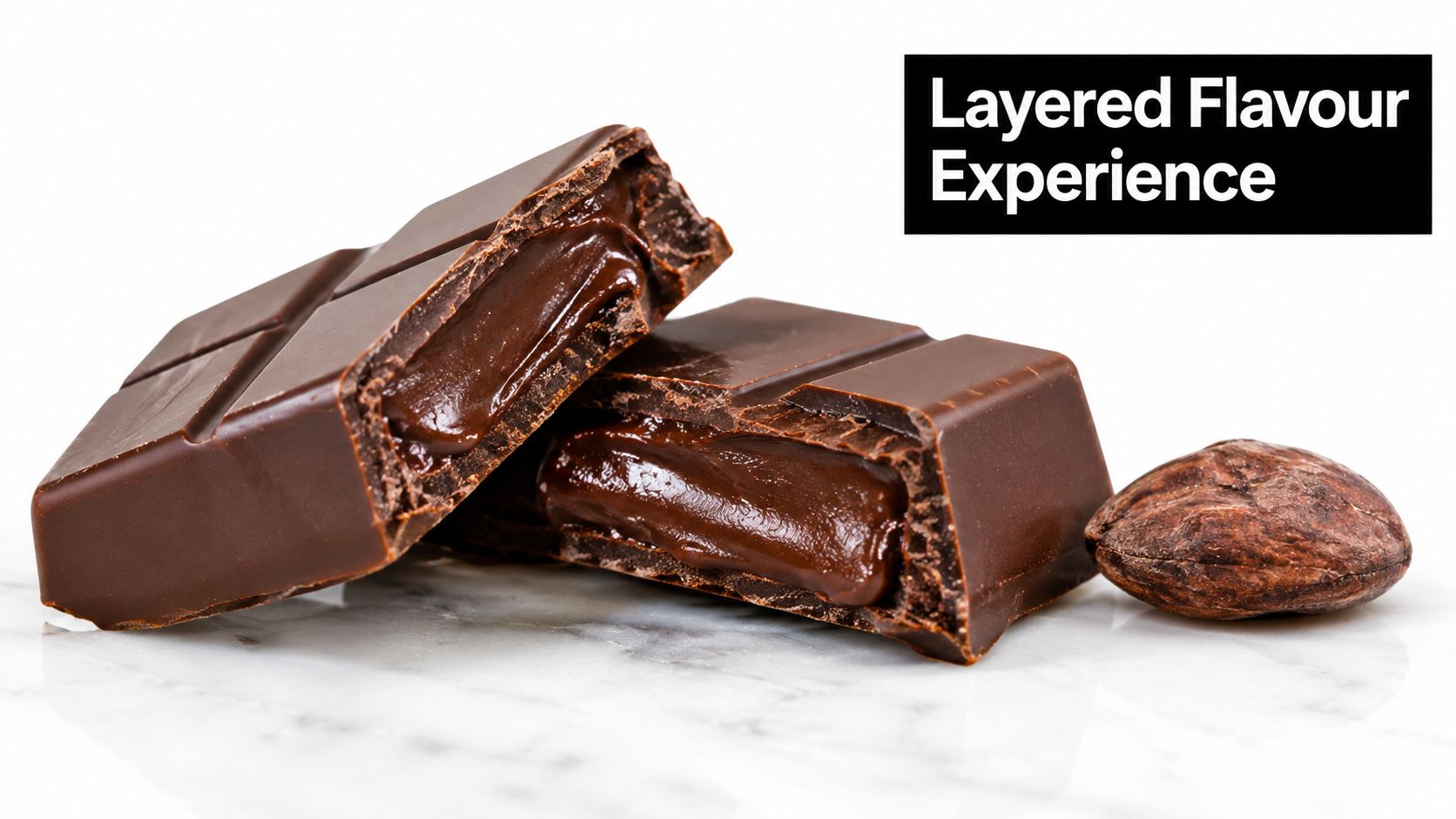
A piece of chocolate with a ganache center shows how texture shapes the experience. Ganache, commonly made with chocolate and cream, can be soft and yielding in a truffle or firm enough to slice. The shell and center should suit each other, like two parts of one recipe. If a delicate shell gives way to a dense filling with no balance, the bite can feel disjointed.
Read the name, then consider the ingredients
Praline can mean different things in different confectionery traditions. In European confectionery, praline paste commonly uses caramelized nuts such as almonds or hazelnuts. Almond paste, by comparison, is not necessarily caramelized. Gianduja blends chocolate with finely ground hazelnuts, giving the mixture a closely integrated chocolate-and-nut texture.
When tasting a flavoured bar, start with its base chocolate. Then notice whether the fruit, coffee, or nuts bring a clear supporting note. A touch of sea salt, spice, or a food-grade aromatic ingredient can add contrast. Finally, check the finish: does the combination stay balanced, or does sweetness, salt, or perfume take over?
Let each addition earn its place
Coffee can echo roasted notes, while fruit may create contrast. These are useful ways to assess a combination, not guarantees of a good match. The maker's choices around sweetness, aroma, texture, and the amount of filling determine whether the flavours work together. In Dubai, where premium bars may also be chosen as gifts, ingredient and allergen declarations help you select with care. Check for milk, nuts, and soy, and consider allergens that may come from biscuit or cake components.
A successful filling adds another dimension while keeping the chocolate easy to taste.
Tasting and Pairing Luxury Chocolate
You don't need a professional vocabulary to taste chocolate thoughtfully. Start with familiar references: toasted nuts, dried fruit, flowers, coffee, warm spice, or damp earth. Describe what you notice rather than trying to reproduce the maker's tasting notes.
Choose a quiet moment and avoid tasting immediately after a strongly flavored meal. Begin with the gentler chocolate so a powerful bar doesn't overwhelm your first impressions.
A simple tasting ritual
Look: Examine the surface and color in good light. Use appearance as an observation, not a verdict on cocoa quality.
Snap: Break a plain piece and listen. Judge it within its style and temperature, because milk chocolate and filled pieces won't behave exactly like a dark bar.
Smell: Bring the broken surface close to your nose. Look for recognizable aromas without forcing a description.
Melt: Let a small piece soften in your mouth. Notice whether the texture feels smooth, waxy, gritty, or pleasantly creamy.
Finish: After swallowing, consider what remains. A long finish is appealing only if you enjoy its character.
Pair by intensity, then experiment
Choose the chocolate first and match the drink to its actual flavor. A gentler chocolate usually needs a gentler drink; an intense pairing can hide the details you bought the bar to enjoy.
Chocolate you're tasting | A pairing to try |
|---|---|
A nutty Ecuadorian bar | Coffee that complements rather than overwhelms its roast character |
A delicate Madagascar bar | Jasmine tea, served without excessive heat |
A darker Ghanaian blend | Tawny port, if you enjoy fortified wine |
A complex single-origin Ecuadorian bar | Whisky chosen for compatible intensity |
A cream-filled praline | Champagne as an experiment in richness and freshness |
These are suggestions, not fixed rules based on geography. On a dessert plate, try a plain accompaniment before adding strongly flavored fruit or sauces. Between samples, keep water available; the Lurisia water product image provides a simple serving reference.
If guided wine tasting interests you, consider a Carneros AVA tasting room trip through Viansa as a separate opportunity to practice sensory attention. At home, keep a small chocolate diary recording what you liked, what you noticed, and what changed with a pairing. Tasting is a skill you develop, not a talent you either possess or lack.
Packaging, Provenance, and Storage in a Warm Climate
A gift box can travel from a cool shop into a warm car, then wait in an office before anyone opens it. That journey matters: heat can soften cocoa butter, while moisture and nearby aromas can change the chocolate's surface or scent. Good packaging helps protect the bar, but appearance alone does not show how well it is protected.
Foil or layered wrappers can limit exposure to light, moisture, and surrounding smells. Ask the seller how the chocolate will be packed for delivery and where it should be kept once it arrives. For a gift, the recipient's storage options matter as much as the delivery time.
Dubai's Food Code calls for temperature-controlled handling where necessary and approximately 60–65% humidity control where product quality could be compromised. Its technical storage guidance places premium chocolate around 17–22°C, while product-specific instructions take priority, according to the Dubai Food Code and chocolate-storage guidance. The humidity provision is not a universal target for every bar. Sensitive fillings may need a cooler, drier place.
Temperature swings can partly melt cocoa butter, then cause it to recrystallize as fat bloom, seen as dullness or gray streaks. Sugar bloom has a different cause: moisture dissolves sugar on the surface, and the sugar recrystallizes into a pale, rough coating. Keep sealed chocolate away from strong-smelling foods and direct sunlight, and avoid leaving a gift box in a warm vehicle. If delivery includes an insulated pack, arrange a cool place for the box after handover.
Packaging can also help establish what you are buying. Check for a batch identifier, production or expiry information, and a specific origin claim. A maker's story is useful when it clarifies those details; it cannot replace them.
Refrigeration is not automatically the answer. Follow the product's instructions if chilling is needed, and keep the chocolate sealed as it returns to serving temperature. This reduces condensation on the surface.
Delivery check: Confirm where the gift will wait after arrival, not only when the courier will deliver it.
Provenance explains the chocolate's identity. Careful storage helps preserve the texture and aroma that make it worth giving.
How IFM Gourmet Dubai Fits Into This World
A chocolate's journey from maker to buyer also shapes the experience: who sells it, how it sits among other foods, and whether it suits a particular occasion. IFM Gourmet Dubai is the luxury online gourmet arm of IFM Investments LLC, a culinary-focused company based in the UAE. Its parent company was founded in 2011 by Corrado Chiarentin and Ottavia Molinari, and is based at Dubai Investments Park 2. The platform serves customers throughout the UAE, according to IFM Gourmet's company introduction.
The group's structure helps explain the store's role. IFM Investments LLC describes Italian Food Masters as its trade-distribution division, supplying Italian food products to hotels, restaurants, and retailers. IFM Gourmet, by contrast, offers gourmet products to individual consumers through its online platform, as outlined in the IFM Investments group overview.
That distinction matters when shopping for chocolate. A specialist chocolate shop may focus on bars and their origins; IFM Gourmet brings chocolate into a broader collection of foods and gifts. Its range includes sweets, savories, fine chocolates, premium teas, cakes, and curated gift hampers, as well as artisanal Italian pasta, sauces, condiments, extra-virgin olive oil, balsamic vinegar, coffee, panettone, and nougat.
For a curious buyer, that mix can make comparison easier. A dark chocolate beside coffee or tea invites a simple tasting: notice whether its bitterness complements the drink or makes it seem sharper. For gifting, chocolates can join panettone or nougat in a hamper for Ramadan, Diwali, or Christmas. The occasion helps guide the selection, while the recipient's preferences should guide the chocolate itself.
A curated assortment is a starting point, not a guarantee that every bar will suit every palate. Read each product description and ingredient list, and treat claims about quality or authenticity as reasons to look closer, rather than as substitutes for details about the chocolate.
For corporate orders, ask about ingredients, presentation, storage instructions, and delivery arrangements before selecting an assortment. These practical details connect the polished gift on arrival with the chocolate's taste and texture when it is opened. Keep the questions concrete: What is it made from? What does the maker disclose? How should the recipient enjoy it?
A Quick Checklist for Choosing Real Luxury Chocolate
Choose with evidence you can read and qualities you can experience. A persuasive description is useful only when the product gives you something concrete to assess.
Declared cocoa content: Read the percentage alongside the full ingredient list.
Specific origin or blend story: Prefer a clear explanation over vague claims of rare or exceptional beans.
Identifiable fat system: Check cocoa-butter information where applicable, especially when comparing couverture with alternatives.
Intentional texture: Assess smoothness within the chocolate's style. Texture alone can't reveal an exact conching time.
Appropriate finish: Look for a well-kept surface and a melt that suits the product.
Transparent ingredients: Check allergens and any additional dietary requirements before gifting.
Traceable dates: Find production, expiry, or best-before information and a batch identifier where provided.
Protective packaging: Consider the inner wrapper and delivery conditions, not only the decorative box.
Craftsmanship should be perceptible, and provenance should be checkable.
Don't let a high cocoa percentage, unfamiliar origin, or elaborate presentation make the decision for you. Choose a style you enjoy, then look for evidence that the maker and retailer have handled it carefully. Buying luxury chocolate is less about spending more and more about paying attention to better.
IFM Gourmet Food Store offers fine chocolates alongside Italian gourmet ingredients, teas, panettone, nougat, and curated gift hampers. Visit IFM Gourmet Food Store to explore the assortment, compare product details, and choose chocolate or a complementary gourmet gift suited to your recipient and occasion.


Comments