

Avocado Price in UAE: 2026 Costs by Variety and Store

An avocado can carry three different prices in the UAE: the customs import value, the wholesale quotation, and the shelf price at your store. Each measures a different stage of the supply chain, and each retailer sets its own offer on top.
A supermarket avocado includes services that a shipment valuation doesn't: selection, handling, ripening, convenient pack sizes and retail availability. To judge the avocado price in UAE shops fairly, identify the supply-chain stage first, then ask how much usable fruit your purchase will deliver per dirham.
Avocado Prices in the UAE Right Now
About US$2.24 per kg is what UAE avocado imports cost at the border in 2021, on average. That number anchors every price discussion that follows, and it measures trade rather than what a shopper pays at the till.
Customs records measure trade, wholesale quotations measure commercial lots, and shop prices measure a finished retail offer. Reading one stage as another turns an ordinary retail margin into a phantom price surge. No single national shelf price exists, so the only live figure is the one a given store displays.
Avocado price benchmarks in the UAE by stage
Stage | Benchmark | Approx. AED per kg | Notes |
|---|---|---|---|
Import value, 2021 | US$2.24/kg | AED 8.23 | Customs value before downstream freight, handling and margins |
Import value, 2023 | US$2.23/kg | AED 8.19 | Volume up 24.6% with unit value almost unchanged |
Wholesale, commercial lots | Indicative market quotation | Sits between import value and shelf price | Historical benchmark, not a guaranteed buying price |
Retail shelf price | Current store quotation | Check the displayed AED/kg | Store, origin, grade and ripeness determine the offer |
The import rows reflect World Bank WITS avocado trade figures: implied average import values of roughly US$2.24/kg in 2021 and US$2.23/kg in 2023, alongside a 24.6% increase in import volume. AED conversions use US$1 at AED 3.6725.
What the flat unit value actually shows
A 24.6% rise in import volume with an almost unchanged unit value undercuts a common assumption: that a growing market automatically pays more for supply. Buyers can absorb demand growth by changing origins, shipment mixes and purchasing terms, so volume and unit cost move independently.
The average also hides movement inside it. Variety, grade and timing differ across shipments, so individual lots can become markedly dearer or cheaper while the mean barely shifts.
Customs value is an incomplete cost base either way. Freight to market, cold-chain handling, packaging, distributor and retailer margins, applicable taxes and spoiled stock all accumulate between the border and the shelf.
Price-tag rule: Compare a shop offer with another shop offer of equivalent fruit, not with a customs average.
A shelf price above wholesale can reflect convenience, grade and channel costs, and none of those guarantee better flesh, better ripeness or less waste. The cleanest test of value is cost per usable kilogram of fruit: before paying a premium, identify what the seller adds beyond the avocado itself.
Price Ranges by Variety, Origin and Size
A Kenyan Hass shipment and a Fresh Fuerte shipment can carry markedly different import values without proving which variety is generally cheaper. Volza's UAE avocado import records include a 24,000 kg Kenyan Hass shipment at about US$0.69/kg and a 23,040 kg Fresh Fuerte shipment at about US$1.28/kg.
The Fuerte transaction ran almost twice the Kenyan Hass value per kilogram. Variety alone cannot explain that gap. Grade, ripeness stage, packaging format and the commercial terms of each deal all sit inside a recorded unit value, and neither shipment record says which factor did the work. These are transaction benchmarks at the import stage, so treat them as evidence of dispersion rather than as competing offers you could buy at.
Transaction values by variety and origin
Variety and origin | Import value per kg | Approx. AED per kg | What it signals |
|---|---|---|---|
Kenyan Hass, 24,000 kg shipment | US$0.69/kg | About AED 2.5 | Large commercial shipment with a low recorded unit value |
Fresh Fuerte, 23,040 kg shipment | US$1.28/kg | About AED 4.7 | Different variety and shipment specification at almost twice the unit value |
Read the specification before the price
Hass typically has bumpy skin that darkens as it ripens, with rich, creamy flesh. Fuerte has smoother green skin and a lighter flavour. Skin colour alone will not tell you ripeness across both varieties.
Size introduces a second comparison problem. Suppliers pack fruit by count per carton, and a per-fruit price cannot show how much usable flesh you are buying. A size comparison only works once you have the supplier's carton count and net weight, because then you can divide the carton price by net kilograms and compare like with like.
Origin needs context too. Kenyan, Mexican and South African fruit reach buyers through different harvest schedules and commercial routes; a cheaper origin does not automatically mean inferior quality.
Before comparing listings, confirm:
Variety: Match Hass with Hass unless your recipe allows substitution.
Origin: Record the producing country rather than relying on a generic imported label.
Carton specification: Ask for fruit count and net weight, excluding packaging.
Ripeness: Separate firm-stage fruit from fruit intended for immediate use.
The strongest comparison is between equivalent specifications delivered for the same intended use. A transaction record without a ripeness or grade specification can explain price dispersion, but it cannot establish what you should pay for tonight's salad.
What Moves Avocado Prices Up and Down
Three different figures get called “the avocado price”: a customs-side import unit value, a wholesale carton quotation, and a retail shelf tag. Tridge price records summarised in CropGPT's Middle East avocado market analysis show the ranges below and a 2024 import unit-cost estimate of about US$1.56/kg; the 2024 minimum is about 52% below 2023 and the maximum about 36% lower.
UAE avocado import price range by year
Year | Lowest import price | Highest import price | Lowest price vs prior year |
|---|---|---|---|
2022 | US$1.80/kg | US$7.05/kg | Baseline |
2023 | US$1.63/kg | US$6.98/kg | About 9% lower |
2024 | US$0.79/kg | US$4.44/kg | About 52% lower |
These are import or transaction prices. They sit upstream of the store shelf, so a low consignment value does not translate dirham-for-dirham into a cheap retail avocado. The spread is still useful: it shows how wide the arrival-cost band can be before freight, handling, margin and waste are added.
Most movement is decided before a shopper reaches the produce aisle.
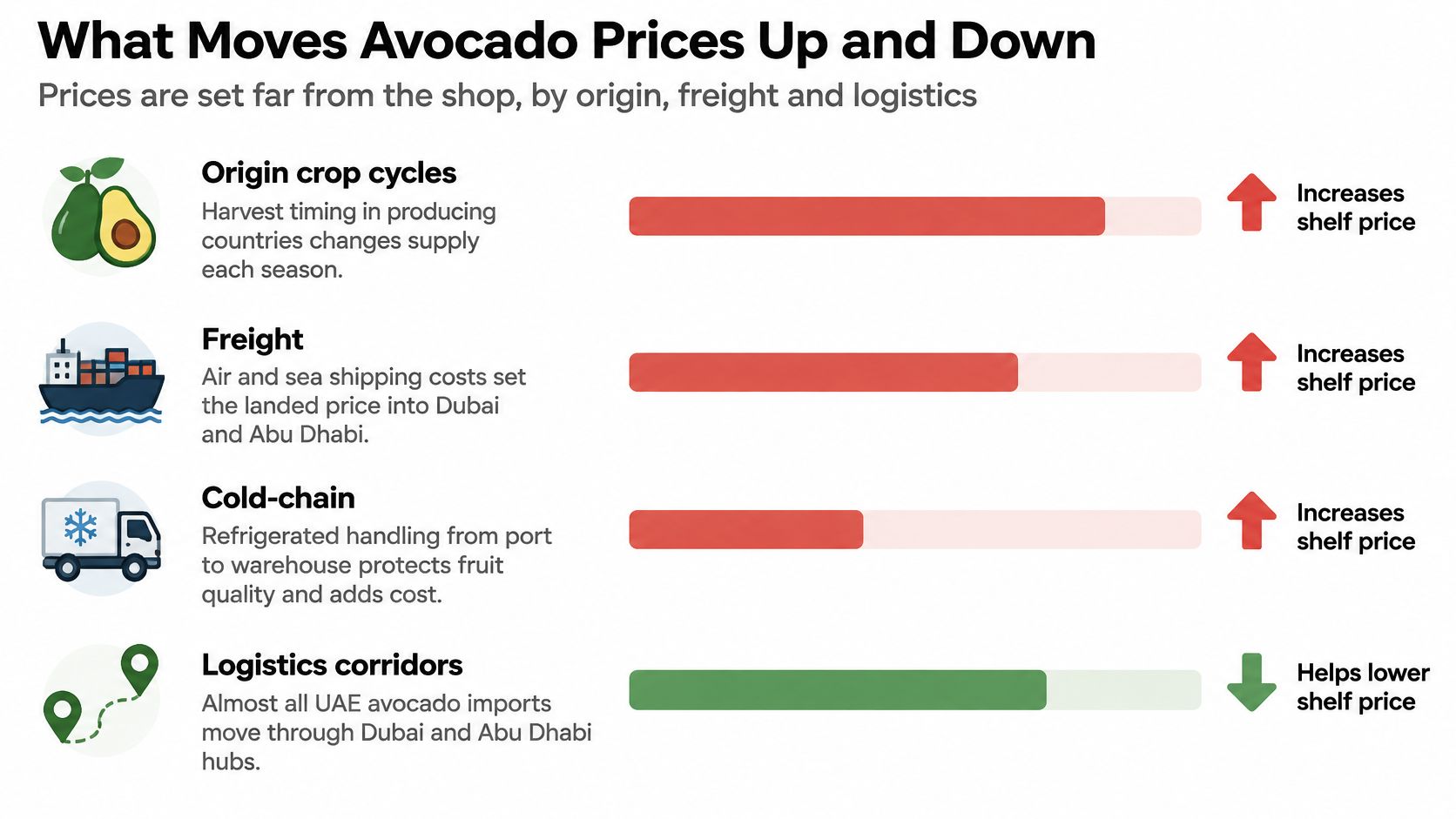
Harvest timing and the journey into the UAE
The UAE relies on imported supply entering mainly through Dubai and Abu Dhabi logistics corridors, as described in Tridge's UAE avocado market overview. Buyers source across origins to maintain availability, exposing procurement costs to crop cycles, freight, cold-chain handling, exchange rates and import compliance.
At peak harvest, exporters may offer more competitively priced shipments. During a transition between origins, buyers may pay more to secure the grade and maturity they need.
Refrigeration protects quality but adds expense. Freight arrangements affect arrival cost, while phytosanitary certificates, meaning plant-health documents, and entry inspections affect whether consignments reach saleable stock without interruption. A delayed or rejected consignment can tighten effective supply even when fruit remains available at origin.
If a shelf price rises after weak arrivals, ask when replacement shipments are expected. A short-lived gap can firm wholesale quotations for weeks without meaning that every later shipment will land at the same cost.
The video below puts the same cost stack in visual form.
Why published averages disagree
A UAE import unit-cost estimate near US$1.56/kg for 2024 measures consignment value at the border, not a carton price in Al Aweer or a retail tag in Dubai. Before using any average, check product definitions, shipment mix, valuation method and reporting period.
Judge an offer against comparable quotations available in the current month, then convert it to cost per usable kilogram after trimming, peel and seed loss. Last year's lowest transaction is not a realistic purchasing target unless its specification and commercial conditions match yours.
Where to Buy Avocados in the UAE
A supermarket shelf price and a wholesale carton quotation measure different stages of the same supply chain, so settle the channel before comparing the numbers.
For a single-fruit purchase, a supermarket or hypermarket is usually the most practical channel. You can inspect firmness and condition directly without taking responsibility for a wholesale carton.
For regular household orders, online grocers offer convenience, but check substitution rules, delivery windows and the ripeness description before scheduling. A delivery slot only works in your favour if the fruit suits the day you intend to eat it.
Where to buy avocados in the UAE
Channel | Best for | Minimum or delivery terms | Price level |
|---|---|---|---|
Supermarket or hypermarket | One or two fruit, quick top-up | Walk-in; no order minimum for loose fruit | Retail shelf quotation |
Specialty gourmet store, IFM Gourmet | Gourmet gifts and orders bundled with other items; confirm fresh avocado availability | Dubai: AED 35 under AED 300; free from AED 300; express AED 50 | Confirm availability and product quotation |
Online grocer or delivery app | Convenience and scheduled delivery | Check platform minimum, delivery fee and window | Listed retail price plus applicable fees |
Al Aweer wholesale market | Bulk lots for kitchens and hospitality | Bulk lots; minimums set by the trader | Wholesale quotation for the specified lot |
What IFM Gourmet Dubai offers
IFM Gourmet Dubai is the luxury online gourmet arm of IFM Investments LLC, a culinary-focused UAE company selling premium Italian gourmet food online in Dubai and the UAE. Its range covers artisanal sweets, breakfast items, beverages, condiments and spices, pasta, cheeses, seafood and curated gift hampers for occasions including Diwali, Christmas, Ramadan, UAE National Day and weddings.
Fresh avocado stock isn't confirmed here, so treat it as a bundling option rather than a primary produce source.
The store's delivery information covers ordering arrangements. Within Dubai city, orders of AED 300 or more qualify for free delivery, smaller orders carry an AED 35 fee, and express delivery within the same day or 4 to 8 working hours costs AED 50. Deliveries to other emirates are priced by order size and destination, while remote areas outside city boundaries are quoted individually.
For bulk buying, assess whether your kitchen can receive, store and use the lot promptly. Choose the channel by quantity and timing first, then compare prices at the matching supply-chain stage so a shelf price never gets measured against a wholesale lot.
How to Get the Most Usable Fruit per Dirham
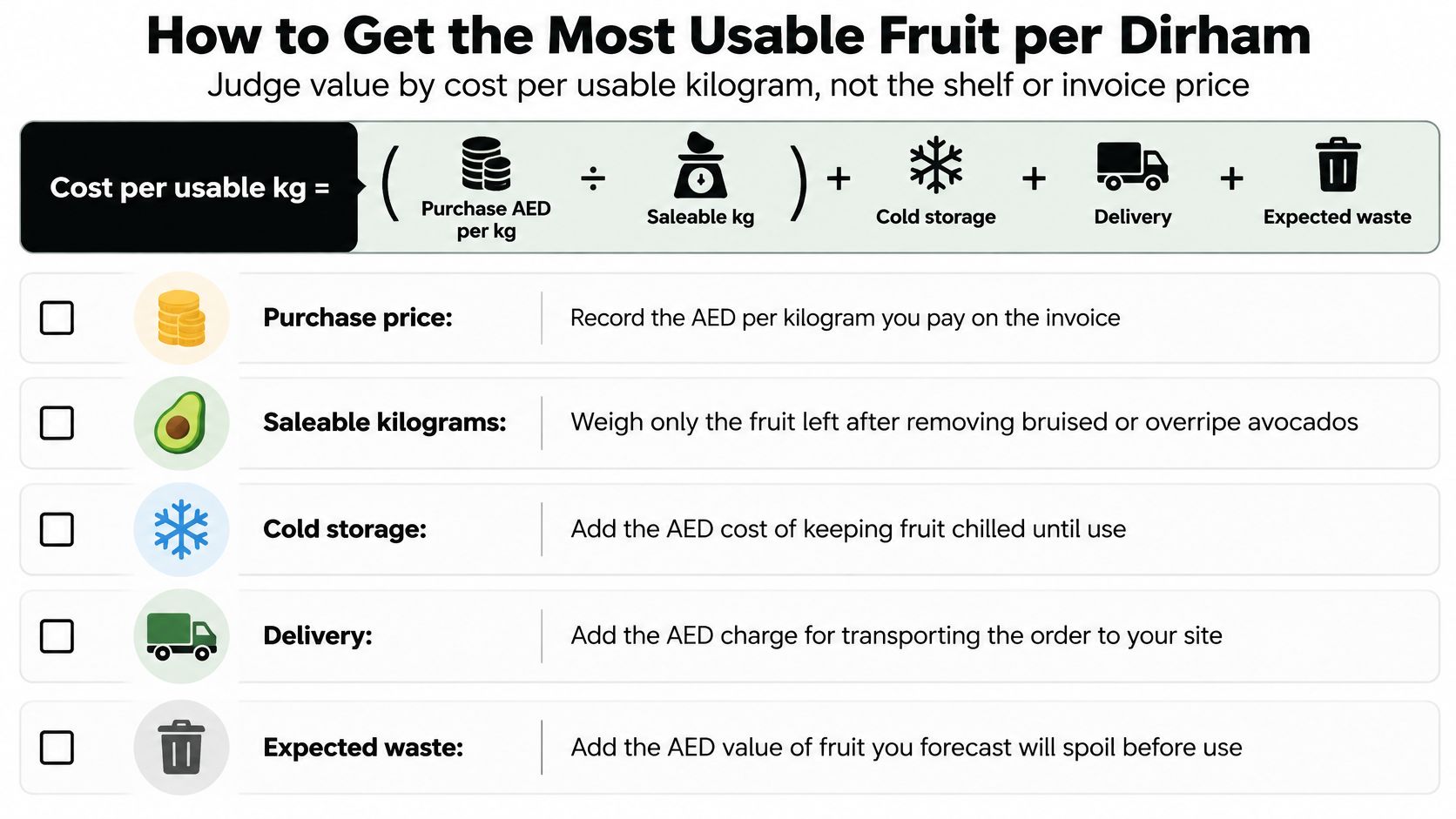
The kilogram that reaches the plate usually costs more than the kilogram on the invoice. Cost per usable kilogram equals total purchase cost divided by usable kilograms, with storage and delivery costs allocated to that usable output. If you start with a purchase price per kilogram, divide it by the usable fraction, not by the total weight remaining.
That distinction keeps the calculation dimensionally correct. Account for spoiled fruit through reduced usable output, then avoid charging the same loss again as a separate waste cost.
The following visual highlights the cost components; use the calculation above when entering your own weights.
Handle fruit to match the meal
Ready-to-eat fruit needs tighter stock and temperature management than firm fruit. Buying everything ripe can leave you paying for convenience that disappears into the waste bin.
Match maturity to timing. Buy firm fruit for meals three to five days away as a planning guide, not a ripening guarantee. Reserve ripe fruit for immediate use.
Check the carton count. Compare net weight and the usable flesh your kitchen gets in practice.
Ripen gently. Keep firm fruit at room temperature in a paper bag and check daily.
Refrigerate when ready. Once fruit yields to gentle pressure, move it to the fridge to slow further ripening.
Protect cut surfaces. Leave the stone in a retained half, brush exposed flesh with lemon juice and press cling film against it. The stone only shields the flesh it covers.
Freeze surplus flesh. Mash with lime juice and freeze for sauces rather than expecting fresh-sliced texture after thawing.
Include delivery without buying unnecessary stock
Our delivery schedule gives free delivery from AED 500 in Sharjah, Ajman, Ras Al Khaimah, Fujairah and Umm Al Quwain, with an AED 55 fee below that threshold. Deliveries within Abu Dhabi and Al Ain require a minimum order of AED 600 for free delivery, so confirm the applicable checkout charge before paying.
Delivered baskets can also be compared on credits as well as price. Some shoppers capture savings through delivery credits to bring the final bill down, and any credit should count as money off what you pay; it should never justify ordering more perishables than the kitchen can use.
A cheaper carton is only cheaper if your kitchen can use it.
For a hypothetical comparison using Freshela's Dubai wholesale benchmarks, fruit bought at AED 8.38/kg with an assumed 30% spoilage costs about AED 11.97 per usable kilogram, calculated as 8.38 ÷ 0.70, versus AED 11.46/kg for a fully used case. That example excludes stones, skins and additional costs, but it demonstrates why the dearer invoice can produce the better result.
Choose Your Avocado Buy by Kitchen Size and Use
For a home cook, buy to the meal rather than the discount. Select a small quantity with staggered firmness so you're not forced to use every avocado at once. Paying a retail premium can be sensible when it prevents an unfinished carton.
A household or small café using avocado regularly should seek a repeatable specification. Firm fruit from a consistent origin is easier to plan around than changing between unspecified offers, but wholesale buying only makes sense when storage space and consumption justify it.
Match purchasing discipline to service demands
For restaurants and hospitality kitchens, a dependable supplier should provide a written ripeness specification, carton count and net weight. Agree on a backup origin and acceptable substitutions before a shortage, rather than negotiating while service is approaching.
Event and catering teams need a fixed quantity, an agreed delivery window and fruit ready for the menu's preparation schedule. A higher purchase price may be justified by suitable maturity and reliable delivery, but document what that premium buys.
Buying verdict: Optimise for the dish and service date, not the lowest advertised number.
For a mixed menu, use a recipe such as our Italian pasta salad to organise the wider ingredient order, while sourcing avocado to its own freshness requirements. Combining pantry shopping is useful; forcing fresh fruit into the same purchasing schedule isn't always sensible.
Take a planned recipe or your regular kitchen volume, estimate the usable kilograms required, and calculate the purchased weight needed to deliver them. Choose the appropriate buying channel, then request current-month quotations with matching variety, origin, size and ripeness before ordering.
IFM Gourmet Food Store offers authentic Italian ingredients, artisanal delicacies and curated hampers for home dining, professional kitchens and gifting. Visit IFM Gourmet Food Store to build the pantry side of your next meal, and confirm fresh avocado availability before finalising an order that depends on it.

Comments