

Dried Sweet Basil: Buying, Storing, and Cooking Guide

You're stirring tomato sauce in a Dubai kitchen, reaching for the basil jar while a wilting bunch of fresh leaves sits in the fridge. The dried herb should make dinner easier, but the sauce still tastes flat. Before adding another spoonful, check the jar. Good dried sweet basil earns its place in the pantry; tired leaves in attractive packaging don't.
What Dried Sweet Basil Actually Is
Dried sweet basil is sweet basil, Ocimum basilicum, with its moisture removed. It isn't interchangeable with every product labelled basil, and it isn't fresh basil with a longer storage life. Drying changes the aroma, leaving an ingredient that behaves differently in the pan.
This is the everyday kitchen decision: which basil suits the dish you're cooking?
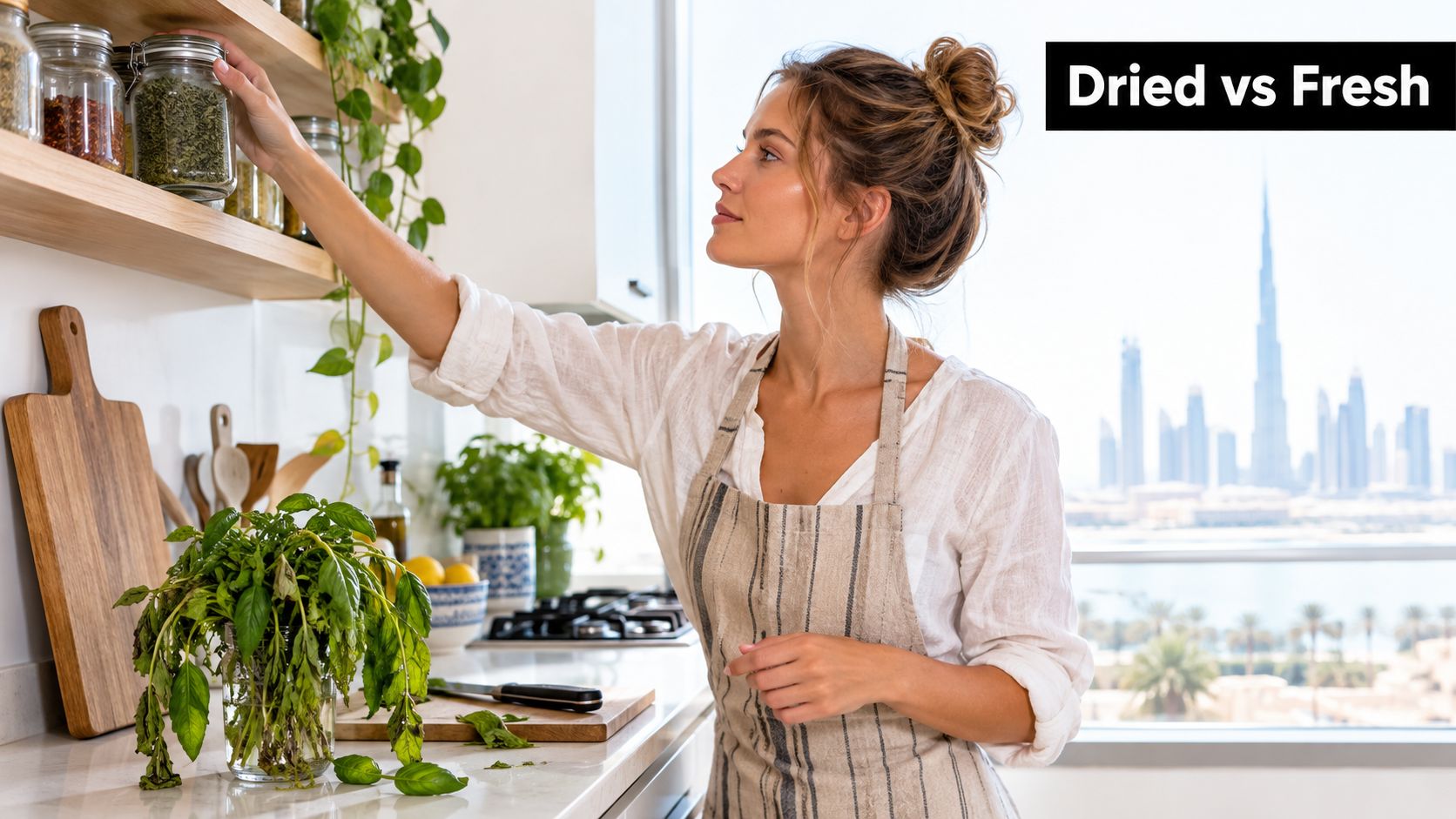
For an Italian tomato sauce, I want the warm sweetness and gentle anise character of sweet basil. The Savory Spice basil guide describes its dried flavour as “warm, sweet, slightly peppery flavor with mild anise undertones.” That's a useful description of what to look for, not a promise that every supermarket jar will deliver it.
Buy the herb your recipe actually needs
Check the product name before judging the packaging. Sweet basil is the sensible choice for Italian and Mediterranean cooking. Thai basil, lemon basil and holy basil shouldn't be treated as automatic replacements just because they share the word basil.
My purchasing rule is simple: if you want a familiar Italian flavour, buy a clearly identified sweet-basil product. If the label only says mixed herbs, you're buying a blend, not a direct substitute.
Pantry principle: Keep dried basil for flavour worked into food, and fresh basil for dishes where the leaf itself matters.
Think of a bubbling tomato sauce beside a plate of sliced tomatoes and mozzarella. The sauce gives dried leaves a chance to hydrate; the salad needs fresh leaves for their texture and bright finish. Neither ingredient is inferior. They have different jobs.
Why it makes sense in a UAE pantry
Local basil production faces a regional challenge beyond an occasionally neglected fridge drawer. A UAE aquaponics study conducted at Falaj Hazza Research Station in Al Ain examined sweet basil under controlled growing conditions and discussed local basil-and-coriander trials achieving more than 90% water savings compared with conventional soil agriculture.
That research isn't evidence of retail quality. It does explain why protected cultivation and imported dried herbs belong in the UAE supply picture. For the cook, a dependable dried product offers a practical companion to fresh basil, particularly when buying a fresh bunch would leave more unused than eaten.
Fresh-to-Dried Substitution Ratios That Actually Work
Use a conversion ratio to start seasoning, not to finish it. A recipe measures volume; your tongue judges the result. The right amount depends on the condition of your basil and whether the recipe cooks it into sauce or scatters it over a finished plate.
The familiar 1:3 dried-to-fresh starting ratio, one teaspoon dried for one tablespoon fresh, is stated in the basil guide cited above. It's useful for cooked applications, but it doesn't recreate the texture or character of fresh leaves.
Fresh-to-Dried Basil Conversion Guide
Recipe Calls For Fresh | Standard Ratio (Dried) | Long-Simmered Dish | Quick Finish Dish |
|---|---|---|---|
One tablespoon chopped fresh basil | One teaspoon dried, using the cited starting ratio | Add during cooking, then taste before serving | Hydrate in the sauce rather than sprinkling directly over the plate |
Fresh basil stirred into soup | Apply the starting ratio to the recipe's measure | Allow the leaves to soften in the broth | Use a restrained amount and taste |
Torn leaves over pasta | No equivalent finishing substitution | Put dried basil into the sauce instead | Choose fresh leaves |
Basil as the main ingredient in pesto | No equivalent flavour or texture conversion | Use dried basil for a cooked herb sauce instead | Buy fresh basil |
Don't compensate for a faded jar by blindly increasing the dose. The sometimes-repeated 1:4 adjustment is especially unhelpful unless the writer explains which ingredient goes on which side of the ratio. No conversion can restore aroma that has disappeared.
Rub a pinch between clean, dry fingers and smell it. I'm looking for a recognisable sweet, herbal scent with an anise-and-clove impression, not dust. If the aroma barely registers, replace the basil rather than filling dinner with flavourless fragments.
When another herb is the better choice
Alternative | How I'd use it | What to expect |
|---|---|---|
Oregano | Tomato sauces and pizza seasoning | A different, more assertive Italian herb profile |
Marjoram | Gentle vegetable sauces and lighter dishes | A softer alternative, not an exact basil match |
Thyme | Bean soups and roasted vegetables | A savoury direction rather than basil sweetness |
These are recipe adjustments, not botanical equivalents. Add cautiously, taste after cooking, and decide whether the dish needs more herb at all.
A sensible substitution preserves the dish's balance. It doesn't pretend that different herbs taste identical.
Cooking With Dried Sweet Basil in Real Recipes
The useful question isn't whether dried basil can replace fresh. It's where you can give dried leaves moisture and time to contribute flavour. Build it into the cooking liquid instead of expecting dry flakes to perform like a fresh garnish.
These applications give you a practical starting point.
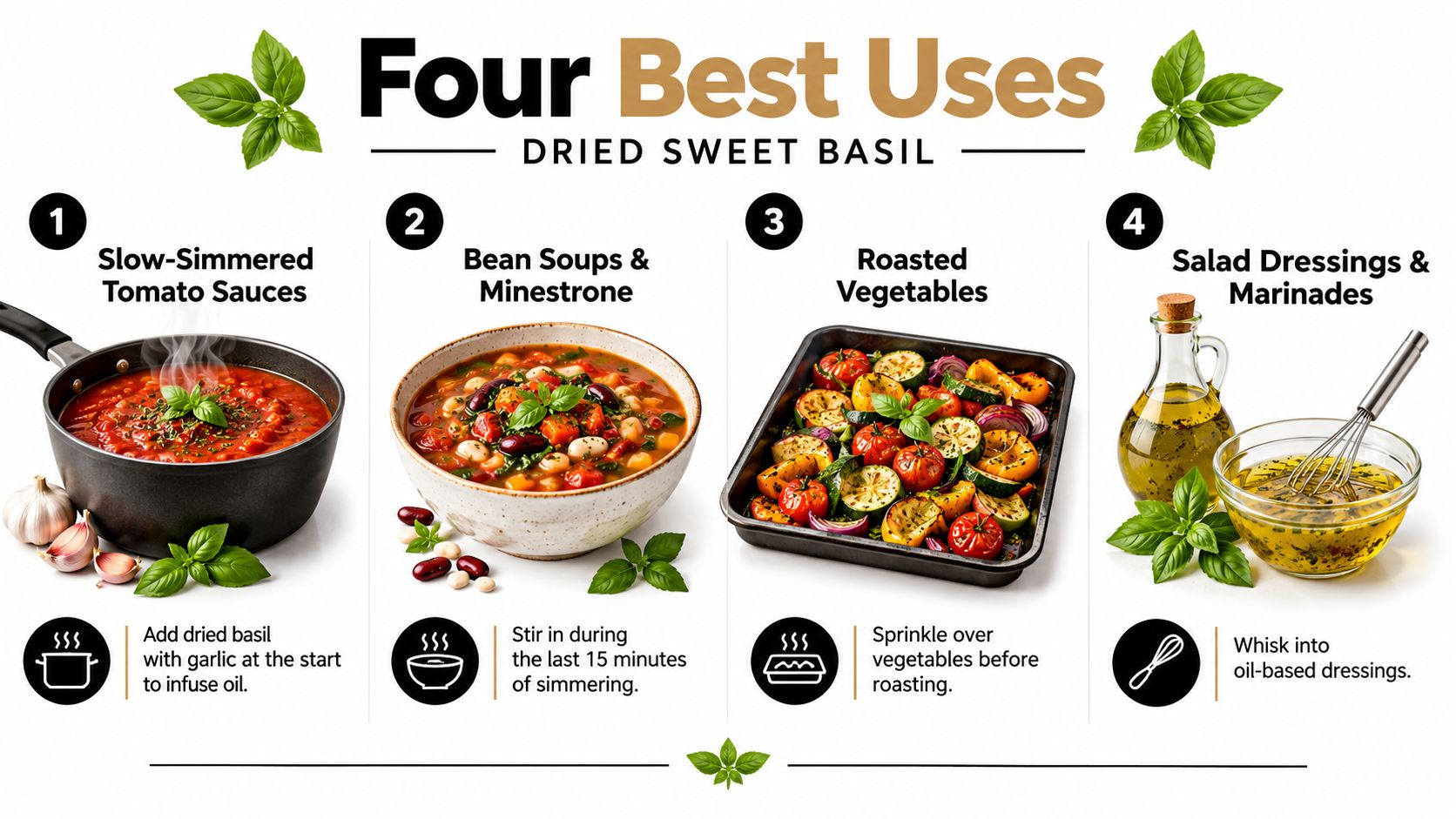
Tomato sauces and bean soups
For a straightforward tomato-and-garlic pasta sauce, soften garlic gently in olive oil. Add dried basil briefly, then introduce the tomatoes before the herb or garlic scorches. Simmer, stir and taste before adjusting the seasoning.
You're using oil as an introduction, not frying the leaves until dark. I prefer this approach to tipping basil into a finished sauce and serving immediately, when the flakes can remain noticeably dry.
For cannellini-bean minestrone, soften onion, carrot and celery, then add tomato, stock and cooked beans. Stir the basil into the simmering broth while the vegetables finish cooking. If you're cooking dried beans separately, follow their preparation requirements rather than treating herb timing as the deciding factor.
The advantage is integration: the basil becomes part of the soup rather than a loose topping. There's no need to insist that it must cook from the moment the beans enter the pot.
Oils, dressings and marinades
For a basil oil to spoon over roasted courgettes, gently warm olive oil with dried leaves, remove it from the heat and strain before serving. Make it for the dish at hand, not as an improvised shelf-stable product. A clean-looking oil isn't proof of safe long-term storage.
A basil-and-vinegar dressing is another useful option. Moisten the leaves in the vinegar before whisking in oil, then taste for balance.
For lemon-basil chicken, hydrate the herb in a little warm water, let that mixture cool, then combine it with lemon juice, olive oil and garlic. Coat the chicken and keep it refrigerated until cooking. The same seasoning approach works for fish, with the herb incorporated into the marinade rather than sitting dry on the surface.
You can also use the tomato sauce as a seasoning base for an Italian-style pizza serving idea, adding fresh leaves after baking if you want that finishing character.
For Caprese and traditional fresh pesto, buy fresh basil. Dried basil is useful in cooked food and hydrated dressings, but it won't reproduce a fresh leaf's appearance or texture.
How to Spot High-Quality Dried Sweet Basil
Pay for the herb, not the jar. A handsome label, an Italian flag or a gourmet gift box tells you little about the condition of the leaves inside. Start with identifiable contents, intact packaging and a supplier who can answer straightforward questions.
Curated retail presentation is useful, but it shouldn't replace checking the product itself.
Read the leaves and the label
Leaf cut: I prefer recognisable leaf pieces over a jar dominated by powder. They make the contents easier to inspect.
Colour: Choose a reasonably green product over visibly faded, yellowed or browned material.
Aroma: Expect a clear herbal smell when opened. Strong packaging design can't compensate for weak scent.
Traceability: Look for country of origin, a lot code and an identifiable supplier. Ask for clarification if those details are missing.
Don't assume Italian origin guarantees better drying. Carefully handled Italian basil can be a worthwhile purchase, but claims about small-batch air-drying or superior aroma need product-specific support.
Tridge's UAE dried-basil market data identifies 13 import partner companies and 14 export partner companies, with three sampled import transactions in 2025 priced from USD 0.98 to USD 8.71 per kilogram. Those are shipment benchmarks, not a national average or retail price guide. My conclusion is that a premium price needs an explanation in the product specification, not just the word gourmet.
What IFM Gourmet Dubai is
IFM Gourmet Dubai's company background identifies it as the luxury online gourmet arm of IFM Investments LLC, a UAE-based culinary company founded in 2011 by Corrado Chiarentin and Ottavia Molinari. It belongs to the broader Italian Food Masters business context rather than operating as an unrelated standalone retailer.
The IFM Investments assortment description includes artisanal sweets, savouries, fine chocolates, premium teas, cakes and curated gift hampers. Its positioning centres on quality, authenticity and culinary elegance. For basil, ask about current availability, origin and pack details rather than assuming that positioning verifies a particular batch.
The accompanying video provides another visual reference.
Safety needs more than a sniff test
A Dubai study of herbs bought from approved shops and supermarkets analysed 81 samples and found that 80% of the basil samples exceeded the study's cited FAO/WHO cadmium limit; basil also appeared among herbs with high lead findings. This historical study isn't a current recall and doesn't establish that every basil product is contaminated.
It does justify asking for batch traceability and accredited testing, especially for hospitality purchasing or frequent high-volume use. Colour and aroma assess culinary condition, not heavy-metal safety.
Storing Dried Sweet Basil in UAE Heat and Humidity
Keep moisture out before worrying about the printed date. In a Dubai kitchen, a jar beside the hob is a poor arrangement even if it looks convenient. Steam, repeated opening and an unreliable lid are avoidable problems.
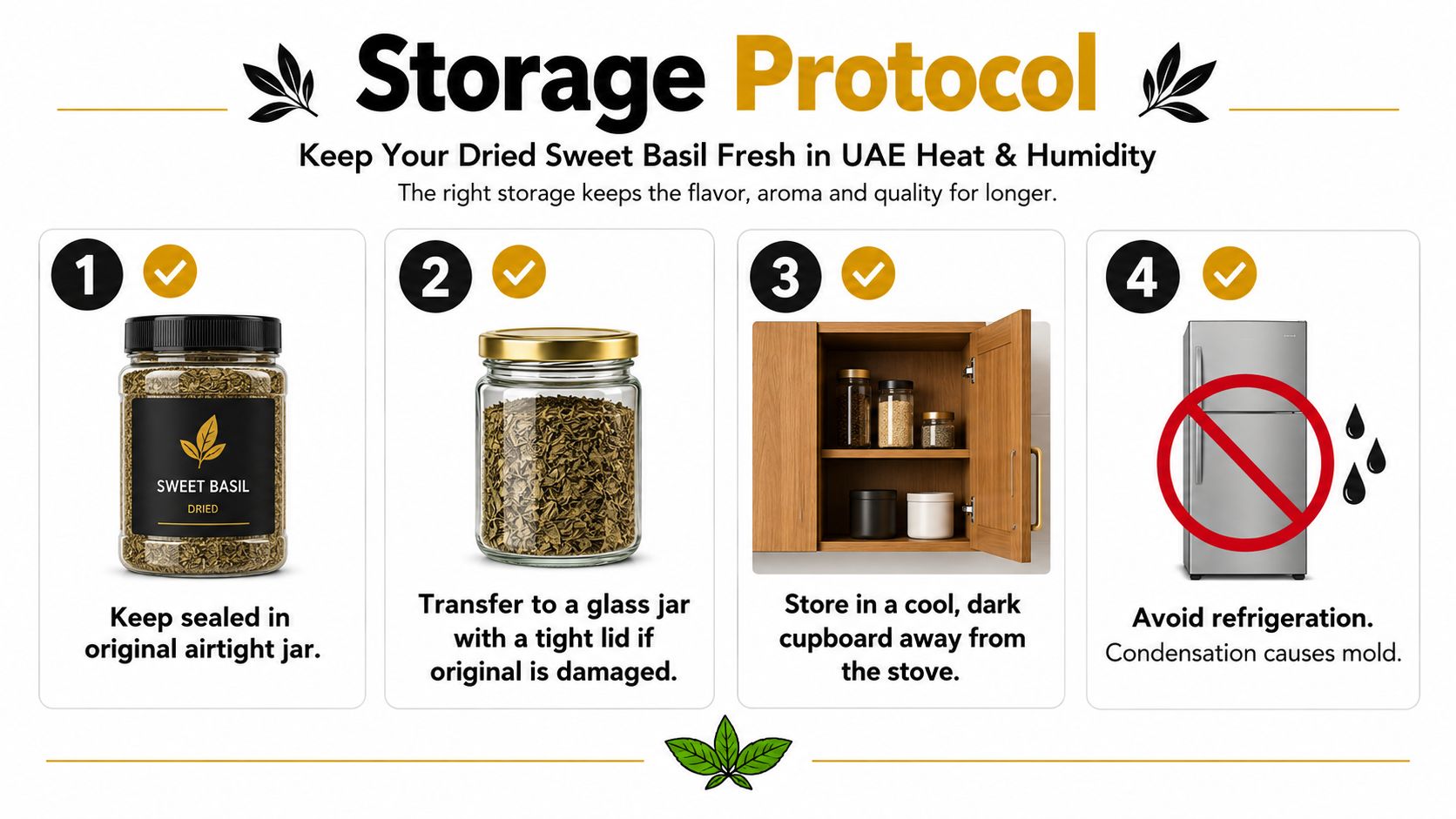
Use this basic cupboard protocol for everyday home storage.
Set up a dependable storage routine
Keep the original container if its closure works properly. Otherwise, transfer the basil to a clean, completely dry food-grade jar with a tight gasket. Keep the label or copy the lot details so decanting doesn't erase traceability.
The Canadian storage guidance for dehydrated foods supports a benchmark of no more than 20°C and 60% relative humidity, with sealed moisture-resistant packaging; controlled cold storage around 0–7°C can further protect volatile-oil quality when condensation is managed.
For a home cook, I recommend a cool, dark cupboard rather than routine refrigeration. Commercial cold storage and a household fridge opened throughout the day aren't the same operating environment. If you do chill sealed packs, let them equilibrate before opening in warm, humid air.
Measure away from steam: Spoon basil into a dry dish before carrying it to the saucepan.
Protect against light: Keep clear jars inside a cupboard or use opaque secondary packaging.
Track opening: Mark the opening date and retain the lot code.
Buy manageable packs: Choose a size that suits your cooking frequency instead of buying bulk solely for the unit price.
Storage rule: Never shake the jar directly over a steaming pot.
What proper UAE handling should include
For UAE/GCC handling, GSO CAC/RCP 42:2017 explicitly covers dried basil and requires controls across harvesting, drying, cleaning, grading, packaging, transport, storage and microbial-load reduction.
For hospitality buyers, that means requesting evidence of supplier traceability, sanitation controls and batch-release criteria. Drying alone shouldn't be treated as a kill step: microbial reduction needs separate validation, with representative testing appropriate to the product.
At home, inspect for clumping, insects, unusual odour and visible mould. Faded colour and weak aroma suggest declining culinary quality; mustiness or mould calls for rejection. Don't blend suspect basil into a newer jar, and don't assume cooking will rescue it.
I wouldn't promise a universal opened-pack lifespan in a UAE pantry. Pack quality and handling matter too much. When contamination is suspected, throw it out.
Putting It All Together for Your Dubai Kitchen
A useful basil jar is one you can identify, assess and finish while it still contributes something to dinner. Buying a large premium pack and handling it carelessly makes less sense than choosing a modest sealed pack that matches your cooking habits.
Keep your decisions straightforward:
At the shop: Choose clearly labelled sweet basil with intact packaging and traceable origin. Treat Italian provenance as a preference, not a substitute for evidence.
At the cupboard: Follow the storage protocol rather than trusting the expiry date alone.
At the saucepan: Use the conversion guide as a starting point, then judge the cooked result.
At serving: Decide whether you need integrated herb flavour or actual fresh leaves. That choice prevents disappointing substitutions.
For an uncomplicated dinner, build basil into a tomato sauce and serve it with pasta. Use this pasta presentation reference for serving inspiration, while letting the sauce's flavour guide your seasoning.
The payoff isn't a pantry full of expensive ingredients. It's fewer abandoned fresh bunches, less stale seasoning and a repeatable way to make everyday Italian food taste considered.
Check your current jar before your next shop. Inspect the closure, read the label and assess the aroma. If it's no longer useful, replace it with a pack you'll realistically use rather than another oversized jar.
IFM Gourmet Food Store offers authentic Italian ingredients, artisanal delicacies and curated gift hampers for UAE kitchens and gifting. Visit IFM Gourmet Food Store to explore the assortment and ask about current herb availability, origin and packaging before choosing your next pantry purchase.

Comments