
Grated Parm Cheese: How to Choose, Use and Store It

Does a tub of grated parm cheese taste the same as the wedge it came from? Home cooks often swap one for the other, then wonder why the same pasta tastes sharp one night and flat or salty the next. The name on the front is only the first clue.
Grating works like opening a bottle: once more surface meets air, aroma starts to slip away, and a fine, dry mound can measure very differently from a fluffy handful. Storage time, grate size and whether you portion by spoon or scale all steer the final bite.
IFM Gourmet Food Store in Dubai is a specialty emporium for Italian ingredients, with a range spanning sweets and fine chocolates, beverages, condiments and spices, pasta, rice and flour, pizza and breads, cheeses, vegetables, seafood, and gifts and hampers. In an import market, that range is a reminder to read the pack closely: the cheese may be excellent, but the journey from wedge to tub still shapes what lands in the bowl.
Real Parmigiano-Reggiano or Generic Grated Cheese
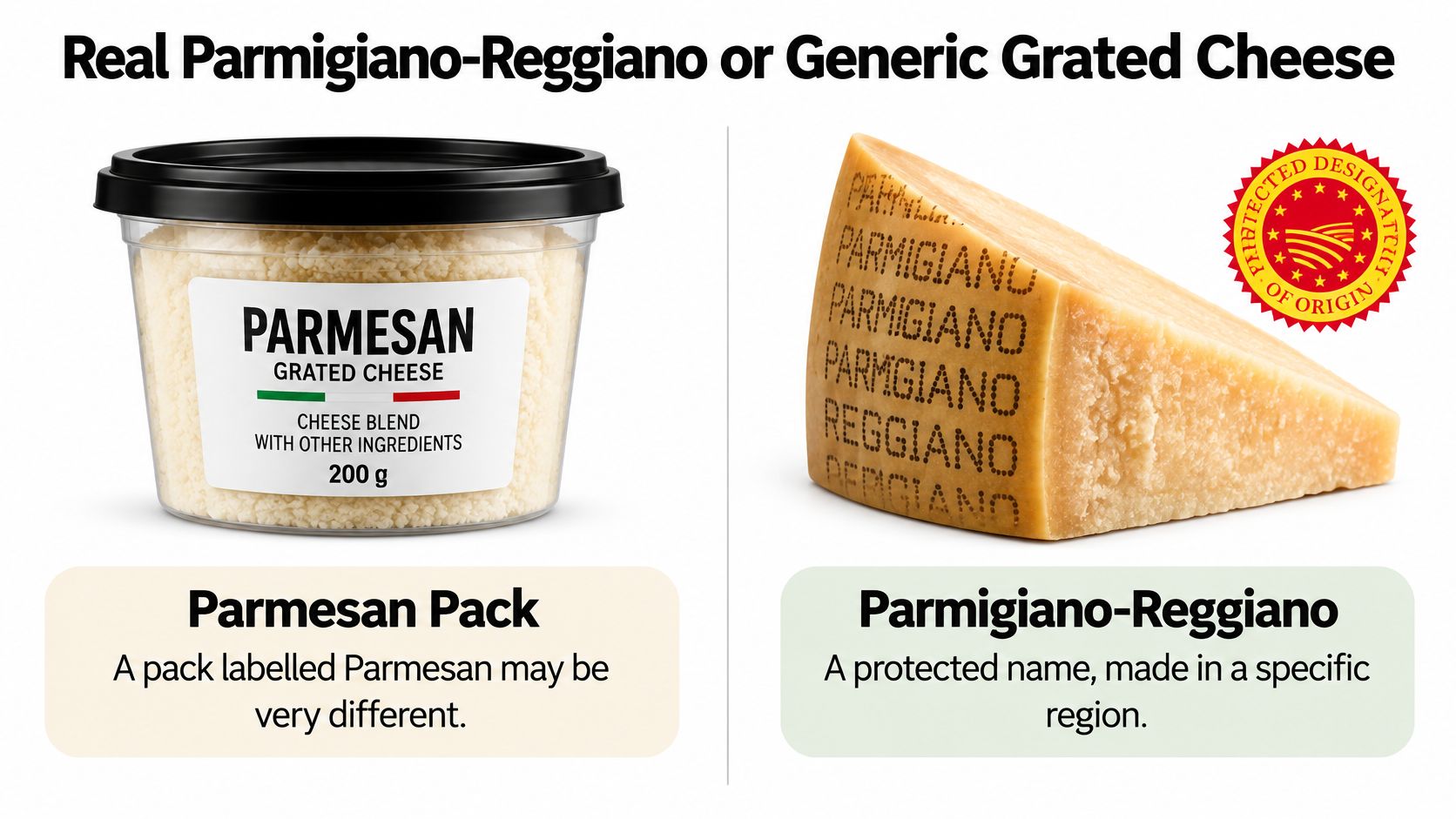
A pack labeled Parmesan can be a very different food from a wedge of Parmigiano-Reggiano. The protected name is made in a designated area of northern Italy, aged at least 12 months and often 24 to 36 months, and whole wheels carry a dotted rind stamp. Grating doesn't rewrite that identity. It only exposes more surface to air, so aroma fades faster than it would in an intact piece.
Type | Origin and rules | Minimum ageing | Flavour | Best for |
|---|---|---|---|---|
Parmigiano-Reggiano | Protected name, made in a designated area of northern Italy | At least 12 months, often 24 to 36 | Nutty, savory, crystalline | Finishing and eating |
Grana Padano | Protected name, made in a wider area of northern Italy | At least 9 months | Milder, less sharp | Everyday cooking and baking |
Generic grated Parmesan | Made in many countries, not a protected name | Often not stated on the pack | Milder, sometimes sharp or salty | Budget cooking |
Pre-grated blend | Parmesan mixed with other cheeses | Stated only if the maker prints it | Mild when other hard cheeses are added | Quick sprinkling |
Parmigiano-Reggiano is the one to reach for when you want nutty depth and those tiny crunchy crystals. The long age concentrates flavor, so a small weigh-out still tastes like cheese, not like salt alone.
Grana Padano is also a protected northern Italian cheese, made across a wider zone and aged at least nine months. It is gentler, which is why it behaves well in baked dishes where a very sharp cheese can dominate.
Generic grated Parmesan can come from many countries. The word Parmesan by itself doesn't guarantee Italian origin. Flavor runs from mild to oddly salty, and the pack often skips any age statement, so you can't tell how mature the milk was.
Pre-grated blends mix Parmesan with other cheeses. Some tubs also list cellulose, an anti-caking powder that keeps shreds from clumping and also means part of each gram isn't cheese.
Match the pack to the job
For nutty depth, choose a pack that names Parmigiano-Reggiano and shows a date. For weeknight cooking, a milder grated cheese does the job without the price of a long-aged wheel. A wider look at how Italian dairy is named sits in this guide to Italian dairy products.
Practical rule: If the front says only Parmesan, read the origin line before you decide it is the same cheese you grate from a stamped wedge.
How to Read a Grated Parm Label Before You Buy
Two tubs can sit side by side at the same price, one filled with cheese grated from a stamped Italian wheel, the other holding a generic blend. The label is how you tell them apart before money changes hands. Under the UAE's federal food-control framework, manufacturers, producers, and importers must register food products before they circulate, and packaged foods must carry nutrition information that meets the applicable rules, as set out in UAE food legislation. Labels must state the country of origin and, where it differs, the country of packing. The wording has to be clear, truthful, and in Arabic.
UAE labels may be Arabic-only or bilingual Arabic-English, and they normally carry the product name, the ingredient list, the country of origin, storage conditions, instructions for use where those apply, and nutritional information where that applies. Production and expiry dates must sit on the original manufacturer's label, and the date format depends on whether shelf life is three months or less or longer. Read that pair of dates the way you would read a countdown. It tells you how much flavour life is left after the trip from dairy to shelf.
What to scan, in order
Product name. It should say Parmigiano-Reggiano or Parmesan in plain words, so you know which cheese you picked up.
Ingredient list. True Parmigiano-Reggiano is milk, salt, and rennet only, so any anti-caking agent has to show up here if one was added.
Origin and packing country. Origin tells you where the cheese was made. A different packing country means it was grated somewhere else, and cheese grated far from home has often spent more time exposed to air before you buy it.
Net weight. You pay for grams of cheese. A larger tub with less inside costs you more per gram.
Production and expiry dates. These show how much shelf life remains after shipping, which matters more for grated cheese than for a sealed wedge.
Storage instructions. Grated cheese has far more surface exposed to air than a wedge, so it dries and oxidizes faster. Follow the printed temperature exactly.
Nutrition information. This lets you compare salt and fat on the same per-100-g basis across tubs, then again when you weigh a portion at home.
A label that is hard to read, peeling, or missing these items is a reason to choose another pack. Each line does one job, and together they separate a genuine Italian-origin cheese from a generic grated product once both are sitting in similar tubs.
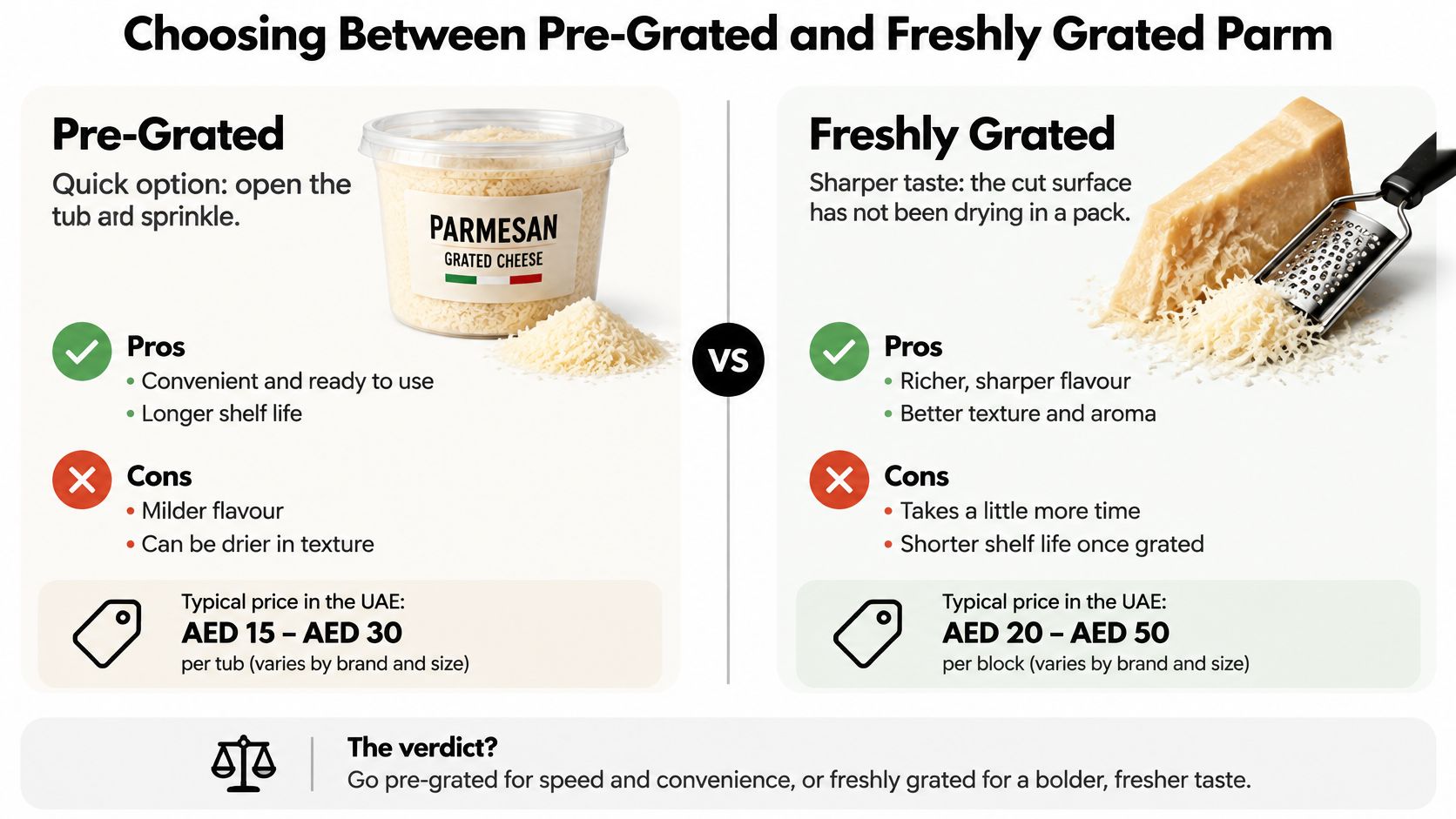
Choosing Between Pre-Grated and Freshly Grated Parm
A tub of grated parm and a wedge of the same cheese start in different places. The grated cheese was cut weeks or months ago, and every extra day of exposed surface lets aroma escape, the way a sliced apple dulls faster than a whole one. Grate a wedge at the counter and that flavour stays locked in until the moment it hits the pasta.
Shelf-ready grated cheese is a normal part of UAE shopping, not a niche. The UAE ranks among the largest Middle Eastern markets for grated, powdered, and blue-veined cheese, and among the region's leading importers of the category, according to IndexBox's Middle East market overview. That coverage spans the whole category rather than Parmesan alone, yet it explains why both tubs and wedges are easy to find here.
A short clip shows the texture difference between the two grates before you choose a format.
Pre-grated tubs
The case for a tub is speed and certainty.
Ready in seconds. A weeknight pasta doesn't wait for a microplane.
The net weight is printed on the pack. You portion from a known quantity instead of guessing how much a wedge will yield.
Sensible for occasional use. If parm shows up once a month, an opened wedge may dry out before you finish it.
The trade-offs are real. Grated cheese carries far more surface exposed to air, so aroma fades once the seal breaks, and the same cheese can taste flatter or saltier than it did fresh off the wedge. Anti-caking agents also mean each gram holds slightly less cheese. Buying a ready grate online is a format choice, not a shortcut around the label: you can browse the Oh Grate cheese and still apply the same ingredient check.
A wedge you grate yourself
More cheese in every gram. Nothing else is taking up the weight.
You pick the grate. Fine for a sauce, coarse for a finish you want to see.
An uncut wedge keeps longer than an opened tub, because less surface meets the air.
Choose the wedge if you cook with parm most weeks and you notice when flavour has gone dull. Choose the tub for occasional meals or when you need a set amount tonight. If the tub is bigger than a week of cooking, split it into small bags and freeze the spare. Compare price by cost per gram, so a heavy wedge is judged fairly against a light tub of powder.
Measuring Grated Parm by Weight, Not Volume
Grated cheese is mostly air by volume. A tablespoon of fluffy microplane snow and a tablespoon of packed coarse shreds can differ by several grams, which is enough to push a sauce from balanced to salty. The spoon looks identical. The cheese inside it is not.
Weighing fixes that. Nutrition panels on cheese declare values per 100 g, so grams on a scale translate directly into the fat, protein and salt a portion carries, and a recorded number repeats exactly the next time you cook the same dish. A spoonful cannot do that, because its contents change every time you grate finer, press harder, or scoop from a more humid tub.
A five-step weigh-out
Tare the bowl. Place it on the scale and zero it so the bowl's weight never enters the recipe.
Add cheese to the target. Stop at the amount you planned, for example 20 g, rather than "a small handful."
Write the weight down. The next batch of the same sauce starts from a number, not a memory.
Keep the original details if you repack. Product identity, allergens, origin, date coding, and storage instructions should stay with any food-service container, because a wrong label is treated as a food-safety violation.
Check the scale monthly. Compare it with a known weight so a drifting zero doesn't change every portion.
A small digital scale costs little and removes most of the guesswork. Volume still earns its place when you finish a salad at the table, where a rough pinch matters less than speed. It belongs nowhere near a recipe you want to taste the same twice.
Best Ways to Use Grated Parm in Everyday Cooking
More grated parm doesn't automatically mean more flavor. A pasta that tasted balanced a minute earlier can tip into too-salty after one generous handful, because finely grated cheese dissolves almost at once and spreads salt through every bite. How salty that handful reads depends on the cheese's formulation, moisture and maturation, and on the salt already sitting in the sauce, the cured meat, the stock or the olives around it.
One fix is blending. Interest is growing across the Middle East and North Africa in pizza-cheese blends that pair Parmesan with milder cheeses such as cheddar, Gouda or Emmental for extra flavor complexity, according to a U.S. Dairy Export Council report on the region's pizza cheese sector. The logic transfers directly to a home kitchen: the mild cheese supplies melt and body, while a smaller dose of aged parm carries the aroma, so the dish keeps its depth without stacking salt.
The ranges below assume a typical aged grated parm. Start at the low end, taste, then move up.
Dish | When to add | Typical amount |
|---|---|---|
Spaghetti with tomato sauce | Off the heat, after tasting the sauce | 15 to 20 g per portion |
Risotto | Last minute, stirred in with the butter | 30 to 40 g per portion |
Pizza | Light layer before baking, extra after | About 20 g per 30 cm pizza |
Soup | Stirred in at the end | 10 to 15 g per bowl |
Salads and vegetables | Sprinkled just before serving | 5 to 10 g per serving |
Three habits that keep salt in check
Taste before you salt. The cheese may already carry the seasoning the dish needs, and a sauce that has simmered down is saltier than it was at the start.
Add it late. Heat drives off aroma. Cheese stirred in early fades into the background, which tempts a second handful you didn't need.
Use less beside salty ingredients, or blend. Next to anchovy, olives or cured meat, cut the amount. Or split it between parm and a milder grated cheese so the aroma arrives without the salt load.
Blending matters most where cheese leads rather than finishes. A cheese-forward baked dish like this mac and cheese from Smokey Rebel sits at the opposite end of the scale from a 10 g sprinkle over a salad, because the cheese carries the dish rather than finishing it. Even there, a mild melting base with a smaller measure of something aged keeps richness and salt in proportion.
If a dish tastes flat, reach for acid or herbs before another handful. A squeeze of lemon or a few basil leaves often fixes dullness that extra parm would only make saltier. The building blocks around the cheese, from tomatoes to olive oil, are laid out among these essential ingredients in Italian cooking.
Add grated parm late, taste, then decide. A second sprinkle is easy. You can't unscramble a sauce that is already too salty.
How to Store Grated Parm So It Keeps Its Flavour
Grating multiplies the surface that meets air. Moisture moves faster, milk fat oxidizes sooner, and aroma leaves more quickly than it does from an intact wedge. Shelf life has to be judged against composition, processing, packaging, storage temperature, and handling, which is why Abu Dhabi food labeling guidance%20of%202019%20General%20Food%20Labelling%20Requirements.pdf) treats the durability period as part of the label, not a guess at the fridge door.
Format | Fridge storage | Freezer storage | Signs it has turned |
|---|---|---|---|
Whole wedge, wrapped | Several weeks after opening, when wrapped well | Up to 2 months, double wrapped | Dry, cracked surface or sour smell |
Freshly grated, in an airtight container | 3 to 5 days | Up to 3 months | Flat aroma, damp clumps |
Pre-grated, opened pack | About 1 to 2 weeks, check the pack | Up to 3 months | Clumping, mold, or sour smell |
Pre-grated, sealed pack | Until the best-before date | Only if you won't finish it by the date, then up to 3 months | Swollen or damp pack, off smell |
Wrapping that actually helps
Wrap a wedge in parchment first, then put it in an airtight container. Plastic straight on the rind traps moisture and encourages a wet surface. Grate only what you need for the meal. Keep leftover grated cheese in a sealed container in the fridge, and freeze spare portions in flat, small bags so you can break off a piece and use it from frozen.
A receiving check
Reject packs with illegible or removable labels, damaged seals, condensation, caking that doesn't match the product, or a temperature history that could shorten the declared durability. At home, the same signs mean the tub shouldn't go into the sauce. A sour or flat smell, visible mold, or damp clumps means the cheese has turned, even if the printed date still looks fine.
Purchasing notes worth keeping are simple: cheese identity, ingredient list, allergen declaration, net weight, lot code, origin, best-before date, and storage conditions. Imported packs also have to meet Dubai labeling and shelf-life requirements, and products in UAE markets are subject to registration and local authority oversight.
How Grate Size Changes Flavour and Salt
The same wedge can taste saltier, milder, or stale depending on the holes you grate it through. A fine, fluffy grate from a microplane puts more surface on the tongue, so salt and savory notes hit faster and the cheese melts into a sauce almost at once. A coarser grate from the large holes of a box grater stays in distinct bites, tastes milder per spoon, and suits a finish you want to see on pasta or a salad.
Fine shreds also lose aroma within hours because that extra surface is the same problem storage creates, only quicker. Grate just before serving when you can.
Pick the grate for the dish
Silky sauces want a fine grate. For risotto, soup, or a cream sauce, add it off the heat so it dissolves instead of clumping into strings.
Pasta, vegetables, and eggs want a medium grate. You get aroma without a salty dust that coats every bite.
A crunchy top wants coarse pieces. Mix them with a little olive oil and add them near the end of baking so they brown instead of drying out in the oven.
Grate at the last minute. Fine shreds dull fast, so a bowl grated at lunch can taste flat by dinner.
If a fine grate makes the dish too salty, change the cut or the weight. Switch to a coarser grate, or cut the weight by about a third, instead of piling on more cheese to “fix” a flavor that is already sharp.
A microplane and a box grater are two different seasonings, even when both piles came off one wedge five minutes ago.
Say you finish a tomato pasta with 15 g of microplaned cheese and it tastes salty, while 15 g of coarse shreds on the same sauce tastes rounded. The cheese didn't change. The surface in your mouth did. That is the lever most recipes never mention, and it costs nothing once the wedge is already on the board.
IFM Gourmet Food Store in Dubai stocks the cheeses, olive oils, San Marzano tomatoes, and pastas that sit beside grated parm in everyday Italian cooking, along with curated hampers when the same ingredients are meant as a gift. If you want packs you can read for origin, age, and ingredients before you grate or sprinkle, visit IFM Gourmet Food Store and choose the wedge or tub that matches how often you cook.


Comments