
How to Make Salt and Caramel Ice Cream

You're planning dessert, the kitchen is warm, and you want something richer than vanilla without another layer of sweetness. Salt and caramel ice cream fits that moment: toasted sugar, soft dairy, and a clean salt finish that makes the next spoonful inviting.
The balance comes from treating salt as a measured ingredient, not a handful of decoration. Start with a restrained caramel, taste the base cold, and choose one accompaniment for the table. Dates, pistachios, cardamom, or Arabic coffee can each make it feel at home on a Dubai dessert spread.
Salt and Caramel Ice Cream Base Formula
Plan a one-quart batch, about 950 ml, or roughly eight half-cup servings. Treat that as a working yield rather than an exact fill line, because your machine's air incorporation affects the final volume.
Weigh the sugar, butter, yolks, and salt. Measure the dairy carefully, or weigh your measured portions into separate jugs so you don't lose track of which cream belongs in the caramel.
One-quart salt and caramel ice cream formula
Ingredient | Amount | Job in the base |
|---|---|---|
Granulated sugar | 200 g | Caramel sweetness and body |
Water | 60 ml | Dissolves the sugar for the caramel |
Unsalted butter | 30 g | Gloss and a stable caramel emulsion |
Heavy cream | 480 ml | Richness and a smooth, full dairy texture |
Whole milk | 240 ml | Lighter dairy body |
Egg yolks | Five large, about 90 g | Custard thickness, tempered with hot dairy |
Vanilla extract | 1 tsp | Rounds burnt-sugar flavour |
Fine sea salt | Up to 4 g, about 3/4 tsp | Savoury finish, whisked into the chilled base |
Divide the cream equally between the caramel and custard. Keep the milk and yolks beside the custard pan, and leave the salt aside until the base is cold.
Read the ingredients before heating
Use unsalted butter so you control the seasoning. Choose cream labelled for whipping or heavy cream rather than a light cooking cream; understanding the differences between Italian dairy products helps when you're choosing ingredients for frozen desserts.
This is a rich custard formula, intended to sit around or above 20 percent fat when made with sufficiently high-fat cream. Cream labels differ, so don't treat that percentage as a guaranteed nutrition figure or expect richness alone to prevent hard freezing.
Fine salt dissolves evenly. Flakes suit a finishing sprinkle, but they don't occupy a teaspoon like fine salt does. If you prefer keeping flakes for the table, Vitamin Planet's Maldon sea salt flakes 1.4kg is a useful reference for that salt format; weigh any flakes used inside the base.
Keep three checkpoints in mind
Caramel: Aim for deep amber near 340°F (171°C), using colour and aroma alongside the thermometer.
Custard: Aim for 170–175°F (77–79°C) and a thin coating on the back of a spoon, without boiling.
Chilled base: Bring it to 40°F (4°C) before churning, especially in a warm kitchen.
Seasoning rule: Keep salt out of the hot sugar. Dissolve it in the chilled base gradually, then stop when you can still taste caramel before salt.
How to Cook Caramel and Churn the Base
Set out a heavy saucepan, a heatproof spatula, a balloon whisk, a fine sieve, and a probe thermometer. Have a larger bowl of ice water ready before you cook the custard, and freeze your machine's canister according to its instructions.
The sequence is simple, but the handover from hot sugar to dairy needs attention. Keep children away from the hob and use a pan with generous headroom, because cream makes caramel bubble vigorously.
Follow the cooking sequence
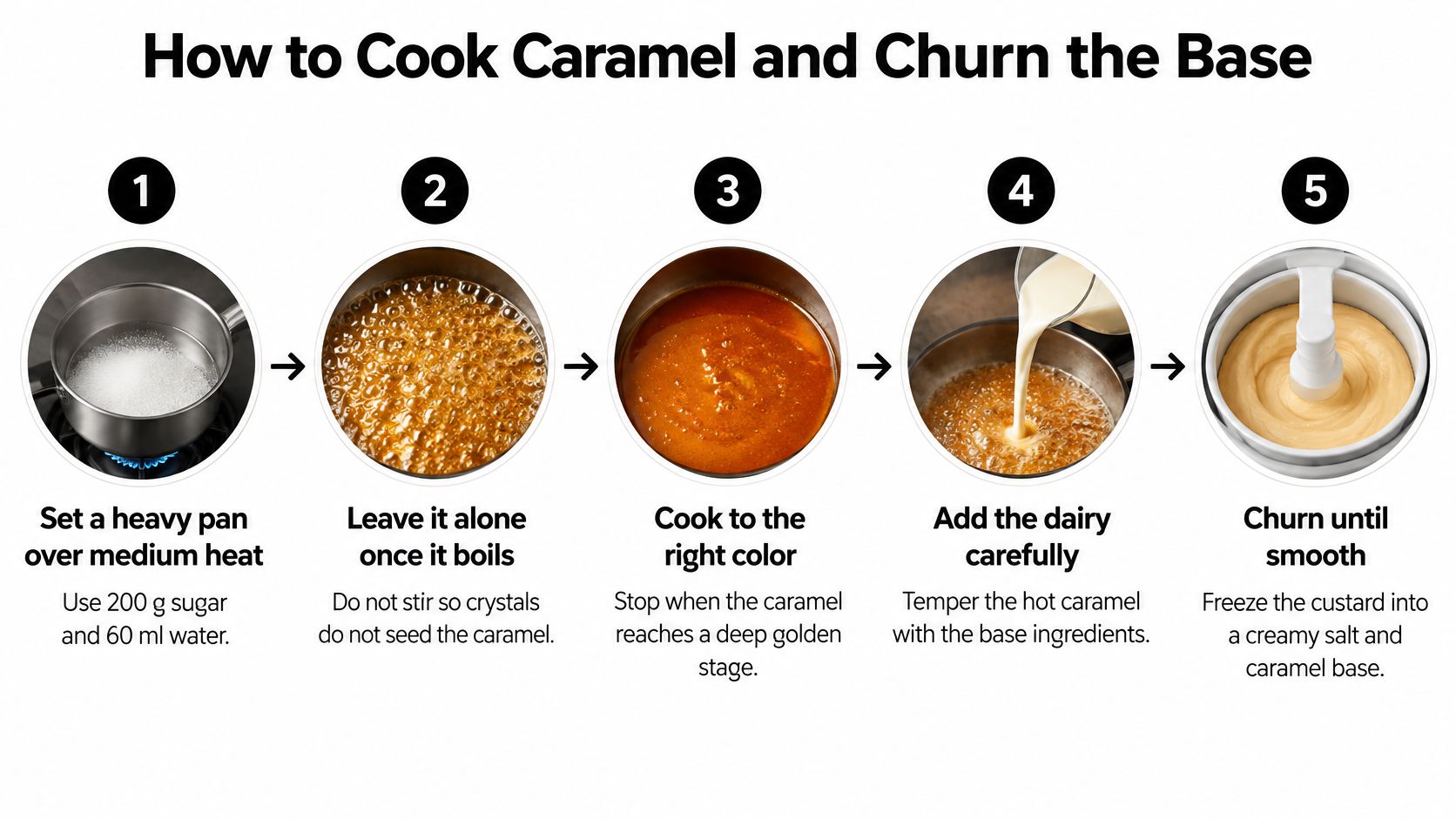
Start the syrup. Put 200 g sugar and 60 ml water in the heavy pan over medium heat, stirring gently only until the sugar is evenly wet.
Once the syrup boils, stop stirring and watch for clear bubbles becoming golden at the edges. A gentle swirl of the pan distributes colour without dragging sugar crystals through the syrup.
Cook towards deep amber near 340°F (171°C), allowing about 8–12 minutes as a working guide rather than a deadline. Pull the pan before the aroma turns acrid or the temperature passes 355°F.
Take the pan off the heat and let the most vigorous bubbling settle, then whisk in 30 g butter carefully. Stream in 240 ml warmed cream, keeping your hands clear of the rising steam.
If a caramel lump remains, return the pan to gentle heat and stir until it dissolves into a glossy sauce. Don't increase the heat sharply to force it smooth.
In a separate saucepan, warm the remaining 240 ml cream and 240 ml milk until steaming with small bubbles around the edge. Whisk the yolks in a heatproof bowl until smooth, without trying to make them foamy.
Temper the yolks by slowly whisking a ladle of hot dairy into them, then add another small pour. Return the warmed yolk mixture to the saucepan so the eggs heat gradually rather than setting on contact.
Stir constantly over gentle heat until the custard reaches 170–175°F (77–79°C) and coats a spoon. Keep the spatula moving across the bottom and into the corners, and don't let the custard boil.
The illustration below summarises the main hand movements, from undisturbed syrup to churning.
Cool fully before freezing
Whisk the loosened caramel into the custard, then strain into a clean heatproof bowl and stir in the vanilla. Set the bowl in the ice bath, stirring regularly and keeping bath water out of the mixture.
Chill the base to 40°F (4°C), then whisk in the fine salt gradually, tasting as you approach the proposed 4 g dose. Refrigerate until thoroughly cold throughout, not merely cool around the edges.
Pour into the prepared machine and churn until it resembles soft-serve, often around 20–25 minutes, depending on the machine. Follow its capacity limit and stop when the mixture holds soft folds rather than waiting for a hard scoop.
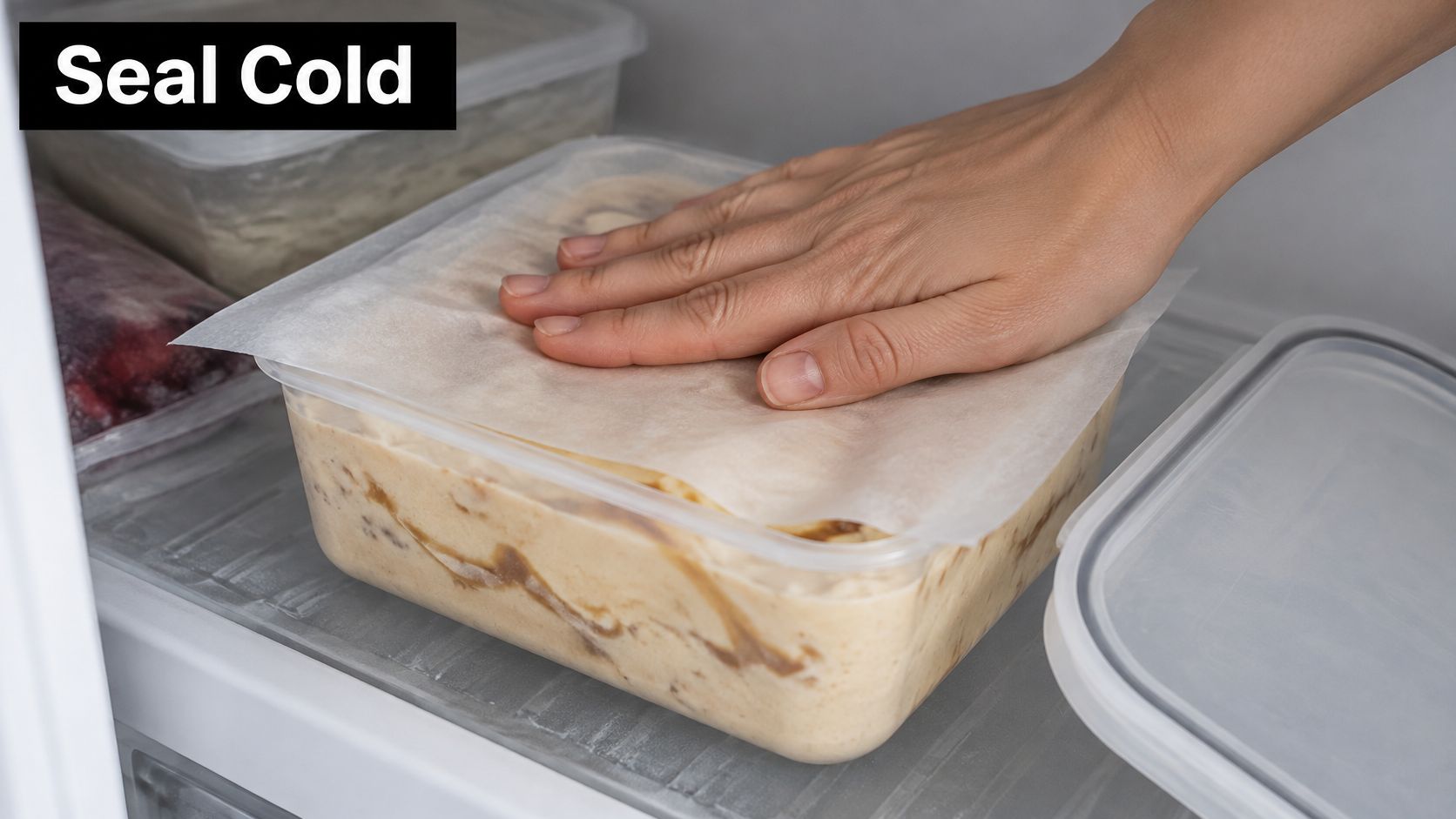
Pack into a shallow freezer-safe tub, press parchment against the surface, and seal. Harden at 0°F (−18°C) for at least four hours, allowing longer if the centre remains soft.
Without a machine, pour the chilled base into a shallow tray and freeze, whisking firmly about every 30 minutes for three to four hours. Scrape the frozen edges into the centre each time, then pack and harden when the mixture holds a soft scoop.
Check the finished result for glossy caramel flavour, no eggy curds, and a scoop that bends rather than shatters. A hand-stirred batch may be denser, but it should still feel creamy rather than crunchy.
Keep sweetener experiments for another batch. A honey-sweetened citrus frozen dessert from Topanga Quality Honey offers a useful contrast in flavour direction, but honey isn't a straight substitution for the sugar you need to caramelise here.
Tips for a Smooth Scoop Every Time
The tub matters as much as the churn. Choose a shallow container with a tight lid, and press parchment directly onto the surface so there's little exposed ice cream beneath the lid.
This close contact is what you're aiming for.
Store cold and serve briefly
Store at the back: Use the coldest stable part of the freezer, not the door, and enjoy the batch within a few weeks for its cleanest texture.
Soften with attention: Allow roughly 8–10 minutes on the counter as a starting point, checking sooner in a hot room.
Scoop cleanly: Warm the scoop, dry it, and draw it across the surface rather than digging straight down.
Plan party portions: Pre-scoop into chilled cups and keep them frozen until needed, so the main tub stays closed.
Around 10°F (−12°C) is a useful serving trial for this recipe, not a storage setting. Taste a small spoonful: it should yield smoothly without running, with caramel first and a clear salt finish.
Protect the cold chain
For UAE commercial handling, the Dubai Municipality Food Code requires high-risk food to cool to 5°C or below within four hours, specifies frozen storage at −18°C, and recommends journeys of no more than 30 minutes unless effective temperature-control equipment is used. An approved commercial pasteurisation process and continuous handling records are separate requirements from following a home custard recipe.
For home transport, pack the tub frozen solid in an insulated carrier with frozen packs. A cold bag alone doesn't prove that the product stayed safely frozen, particularly during a Dubai journey.
Use the video as a visual companion while checking your handling and texture.
Freeze cold, serve slightly soft, and never refreeze a melted puddle.
Fixes for Grainy Caramel and Icy Texture
Bitter caramel needs a fresh start, not extra vanilla. If it smells burnt before you add the dairy, stop there rather than spending cream and yolks on a flavour you won't enjoy.
A dark colour alone isn't a failure. Taste a safely cooled dab: you're looking for toasted sugar with a pleasant bitter edge, not smoke, ash, or an unpleasantly sharp finish.
Match the symptom to the cause
Salt and caramel ice cream problems and fixes
Symptom | Likely cause | Fix |
|---|---|---|
Bitter, sharp caramel | Sugar cooked too dark, often beyond about 355°F, or excessive salt sharpening bitterness | Remake caramel to 340°F and add salt only to the chilled base |
Grainy or seized sugar | Crystals formed while the syrup boiled | Wipe pan sides with a wet brush, don't stir once boiling, and start over if seized |
Curdled custard | Yolks heated too quickly or cooked too far, often around or above 180°F | Temper slowly, strain, and blend only if the curds are tiny |
Icy, crunchy scoop | Warm inclusions, slow freezing, or a refrozen melt | Cool caramel fully, churn to soft-serve, and harden at −18°C |
Too salty after it softens | Salt tastes stronger near serving temperature | Use about 3 g next time and serve closer to 10°F (−12°C) |
Greasy, split caramel | Butter hit very hot sugar and the emulsion separated | Cool the caramel briefly, then whisk butter in off the heat |
Decide what can be saved
Grainy sugar and a temporary caramel lump aren't the same thing. Cream can make hot caramel tighten into a smooth, hard mass that dissolves with gentle warming; crystallised syrup looks sandy or forms opaque clumps.
For slightly split caramel, try gentle warmth and steady whisking before abandoning it. If it remains greasy or grainy, remake the caramel rather than hiding the fault inside the custard.
Tiny egg flecks may strain out, and a brief blend can smooth mild curdling. Large curds, a scrambled-egg smell, or questionable temperature handling mean the batch shouldn't be rescued for serving.
Taste before committing: Cool a little caramel on a spoon before adding it to the custard. That small check can save the rest of your ingredients.
Icy texture needs a diagnosis too. If the batch stayed safely cold but froze slowly, a better-chilled base and faster hardening may improve the next attempt; if it melted or its temperature history is uncertain, colder storage won't undo the problem.
Don't add extra salt to make a bland frozen spoonful more interesting. Let a sample soften first, then decide whether the issue is seasoning, overcooked sugar, or a serving temperature that hides the flavour.
Flavor Twists That Keep the Caramel Character
Choose the variation for what's already on the table. With dates and Arabic coffee, a restrained caramel often feels more balanced than an intensely sweet base covered in sauce.
Regional accompaniments aren't an afterthought. IndexBox's UAE ice cream market overview describes interest in premium and artisanal ice cream alongside flavours such as pistachio, saffron, dates, and karak chai, as well as interest in reduced-sugar and plant-based choices.
Change one ingredient at a time
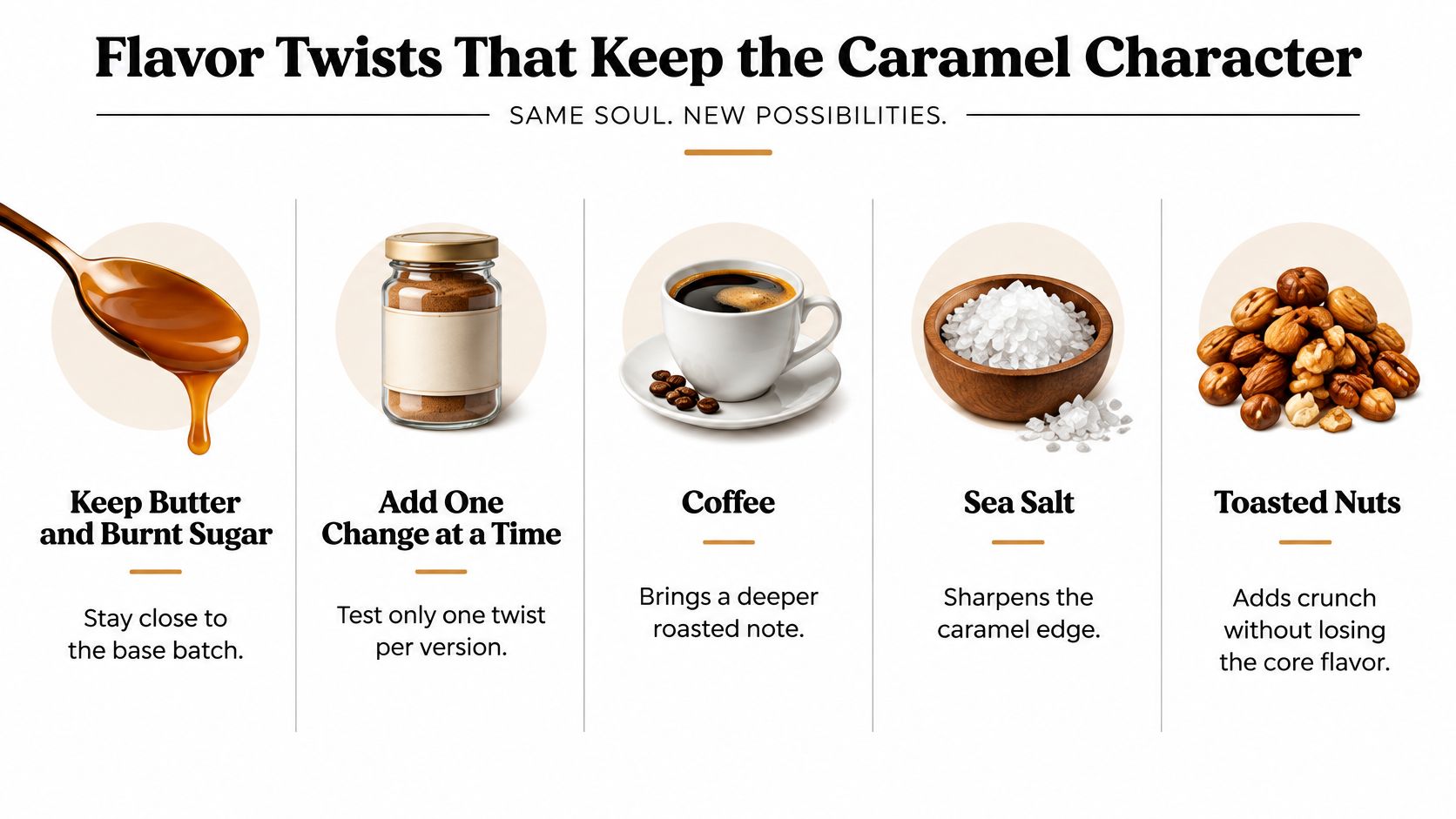
Keep butter and burnt sugar at the centre of the dairy version. Test one variation before combining several, and keep the original sugar and fat close to the starting formula wherever the variation permits.
Use these options as proposed kitchen trials rather than interchangeable recipes.
Salt and caramel variations for one quart
Twist | What changes | What stays the same | Best served with |
|---|---|---|---|
Standard balance | 4 g fine sea salt whisked into the chilled base | Full dairy custard and 200 g sugar | Warm brownies or plain biscuits |
Shy salt | Drop salt to 2 g in the chilled base | Same caramel and dairy | A very sweet cake or guests who prefer gentle seasoning |
Bold salt | Raise salt towards 6 g in the chilled base, tasting gradually | Sugar and fat unchanged | Dates or a tahini drizzle |
Date molasses | Stir in 30 g date molasses once the caramel is cool | Butter-and-burnt-sugar base | Arabic coffee |
Pistachio | Fold in 40 g chopped toasted pistachios at the end of churning | Salt stays at 4 g | Fine chocolate |
Cardamom | Steep four crushed pods in warm milk, then strain | Caramel cook unchanged | Festive platters |
Coconut base | Use 500 ml full-fat coconut milk and 220 ml coconut cream, with 1 tbsp cornstarch made into a slurry instead of yolks | Same 200 g sugar and 4 g salt | Plant-based guests |
The flavour guide below keeps the main decision simple: preserve the caramel, then choose one supporting note.
Make the accompaniment do useful work
Dates add sweetness as well as flavour. Date molasses changes the base's sugar balance, so it isn't a reduced-sugar option; chopped dates served alongside offer more control over each mouthful.
Toast pistachios, then cool them completely before chopping and folding them in. Their dry crunch contrasts with the custard without requiring another sweet sauce.
Cardamom needs restraint. Strain out the pods before making the custard, and taste the infused milk so the perfume supports the caramel instead of covering it.
For a tahini variation, swirl 2 tbsp cooled tahini into the packed tub rather than blending it through the whole base. Its sesame flavour works especially well with a darker caramel and a modest salt finish.
The coconut version needs more than a dairy swap. Omit the butter as well as the dairy and yolks, use part of the coconut cream to loosen the caramel, and cook the cornstarch slurry in the remaining coconut mixture until thickened before combining.
Coconut brings its own flavour and won't reproduce the dairy custard exactly. More premium doesn't mean more sugar: a measured scoop, a date, and a small cup of Arabic coffee can make a more satisfying finish than several competing toppings.
Serve Salt and Caramel Ice Cream Tonight
Set out a bowl of salt and caramel ice cream after dinner, then taste before adding anything. If the tub is firm, leave it out just long enough for the scoop to glide. Finish with one accent: a few flakes of salt, a little warm caramel, toasted pistachios, or chopped dates. Salt works best as a measured finish, like a final seasoning at the table.
If the centre is still loose after churning, give it more time in the freezer to harden. A soft mixture melts quickly under warm caramel, blurring the contrast between cold creaminess and warm sauce. For a Dubai-inspired plate, pair restrained caramel with dates, pistachios, and a small cup of Arabic coffee.
Choose the serve-now option
Short on time? Spoon a little warm caramel over vanilla gelato and add a small pinch of salt. For an affogato, pair a scoop with coffee instead.
IFM Gourmet's Gelato Vanilla is made with high-quality vanilla beans and premium ingredients, without artificial flavours or preservatives. Its slower churning incorporates less air than traditional ice cream, giving it a dense texture. Keep it frozen, then let it stand at room temperature for a few minutes before scooping. Serve it with fresh berries, chocolate sauce, or nuts, or use it for sundaes, milkshakes, and affogatos. The 1.5kg/2.5lt tub is currently listed as out of stock.
Small bowls or chilled plates help keep a scoop tidy, especially beside a warm accompaniment. These ideas for luxury dessert plates can help you arrange dessert without crowding it with extra sweetness.
Bring something thoughtful to the table
IFM Gourmet Dubai offers artisanal sweets, savouries, fine chocolates, premium teas, cakes, and curated gift hampers for customers across Dubai and the wider UAE.
For a shared dessert or festive gift, choose chocolate, nougat, sweets, or coffee to accompany the ice cream. IFM Gourmet's sweets range also includes biscuits and cookies, gelato and ice cream, and panettone and pandoro cakes. A small, considered pairing keeps the caramel in focus.
For your next homemade batch, use the 4 g salt formula, adding the salt gradually after chilling. Taste as you go, then note the amount that balances the caramel with your chosen accompaniment.
IFM Gourmet Food Store offers fine chocolates, coffee, artisanal sweets, and curated gift hampers for a thoughtful dessert table. Choose a chocolate pairing for your salt and caramel ice cream or a gourmet hamper for your next shared celebration.


Comments