

Salted Cashew Nuts Guide: Sodium, Flavour and Buying Tips

Would you choose salted cashew nuts because the box looks premium, or because you know how much sodium is in the handful you'll really eat? Those aren't the same buying decision. A beautifully presented cashew can still carry more salt than you expect, while a simpler pack may give you clearer information.
The useful starting point is the nutrition panel, not the packaging. Once you understand how cashews are prepared, how serving sizes work and what good kernels should taste like, you can choose a snack, cooking ingredient or gift with more confidence.
What Salted Cashew Nuts Are and How They Are Made
What are you really buying when you pick up a bag of salted cashew nuts? Usually, you're buying cashew kernels that have been shelled, skinned, roasted and coated with salt. Think of an unseasoned cashew as a blank canvas, with salting much like seasoning a finished dish at the table.
The familiar curved kernel is only the edible part of a more complicated fruit. It develops inside a shell attached to the cashew apple, and it needs careful commercial processing before it reaches your kitchen.
From fruit to finished kernel
The preparation follows a practical sequence:
Harvest and dry. Producers separate the nuts from the cashew apples and dry them for handling and processing.
Treat and remove the shell. The shell contains irritating substances, so processors use controlled treatment and specialised shelling methods. Shell-on cashews aren't a home-shelling project.
Peel the skin. The thin skin around the kernel is removed, revealing the pale edible cashew.
Roast and season. Processors roast the kernels, then apply salt, often while the nuts are warm so the seasoning adheres.
Cool and pack. Cooling helps preserve the finished texture before the nuts are sealed.
The result is the familiar ready-to-eat snack.
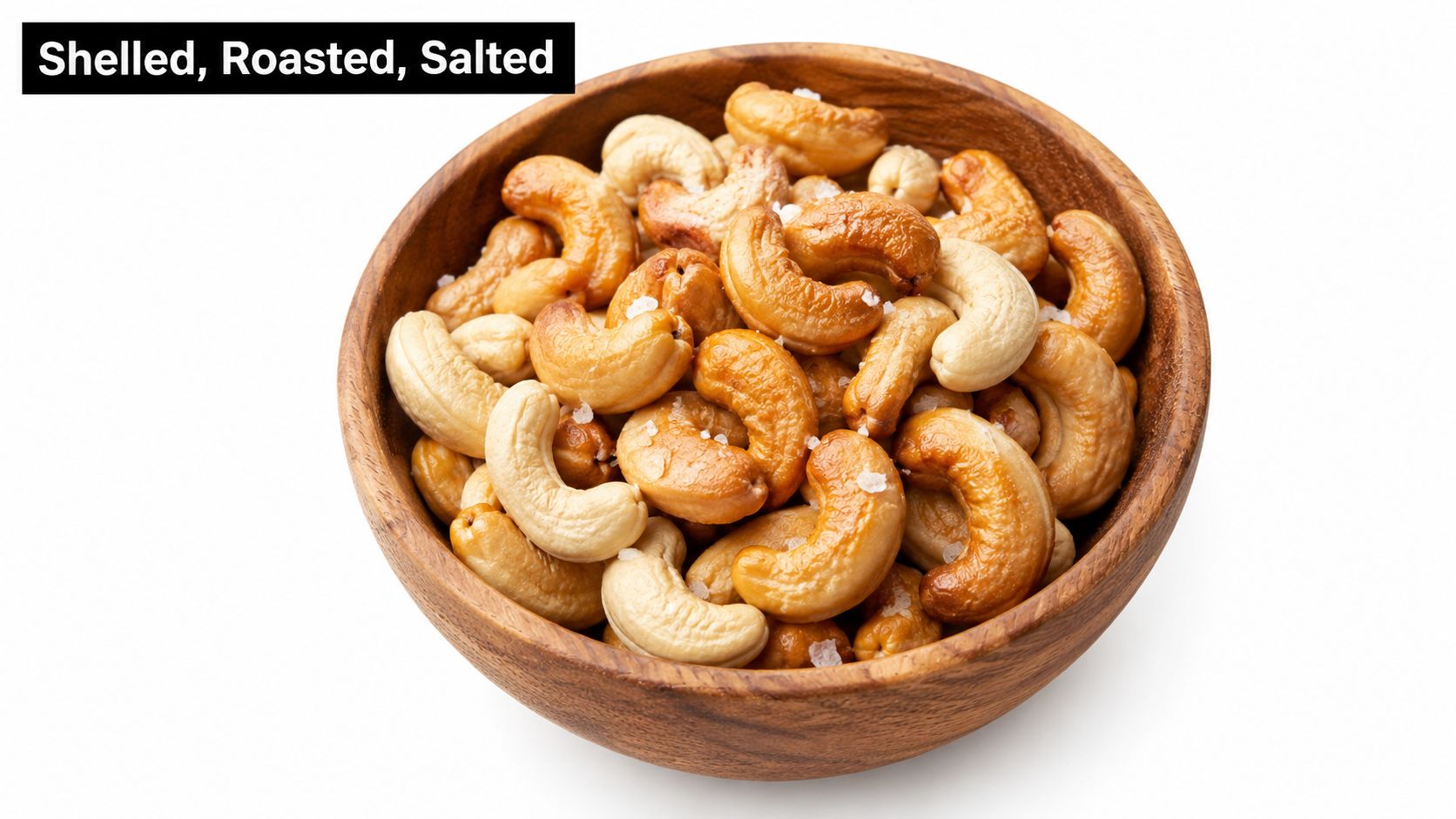
The main shelf styles
Dry-roasted, lightly salted cashews aim for a restrained seasoning. Standard dry-roasted salted versions usually have a more noticeable salty finish, although those words alone don't establish the sodium content.
Oil-roasted and salted varieties use oil during preparation. Seasoned or coated cashews add another layer, such as chilli, herbs, smoke flavour or a sweet glaze, so their ingredient lists deserve closer attention.
For a plain salted product, the sodium comes principally from added salt, alongside the small amount naturally present in the kernel. Seasoning blends can introduce other sodium-containing ingredients, so surface salt isn't always the whole explanation.
Practical rule: Compare the finished product, not just the word cashew. Roasting, oil and seasoning are separate choices made during preparation.
Sodium and Nutrition per Serving Compared
The label per handful is a more useful guide than a product's name or packaging. “Lightly salted” and “heavily seasoned” describe a style, not a guaranteed sodium level. Check the declared sodium, then compare the same serving size.
Style | Sodium per 100 g | Sodium per 30 g handful | Against 280 mg benchmark |
|---|---|---|---|
Raw unsalted cashews | Check the product label | Multiply the per-100 g value by 0.30 | Generally below salted versions |
Lightly salted dry roasted | 280 mg in this worked example | About 84 mg | Below the benchmark in this example |
Standard salted dry roasted | Check the product label | Multiply the per-100 g value by 0.30 | Compare the declared value with the benchmark |
Heavily salted or seasoned coating | Check the product label | Multiply the per-100 g value by 0.30 | The label shows whether it is above the benchmark |
The lightly salted row shows how to calculate a serving: 280 mg per 100 g multiplied by 0.30 gives about 84 mg in 30 g. It is an example, not a typical value for every lightly salted product. Use the package's own figure for a real comparison. A handful can also weigh more or less than 30 g, so weighing your portion gives a closer estimate.
Salt and sodium aren't interchangeable
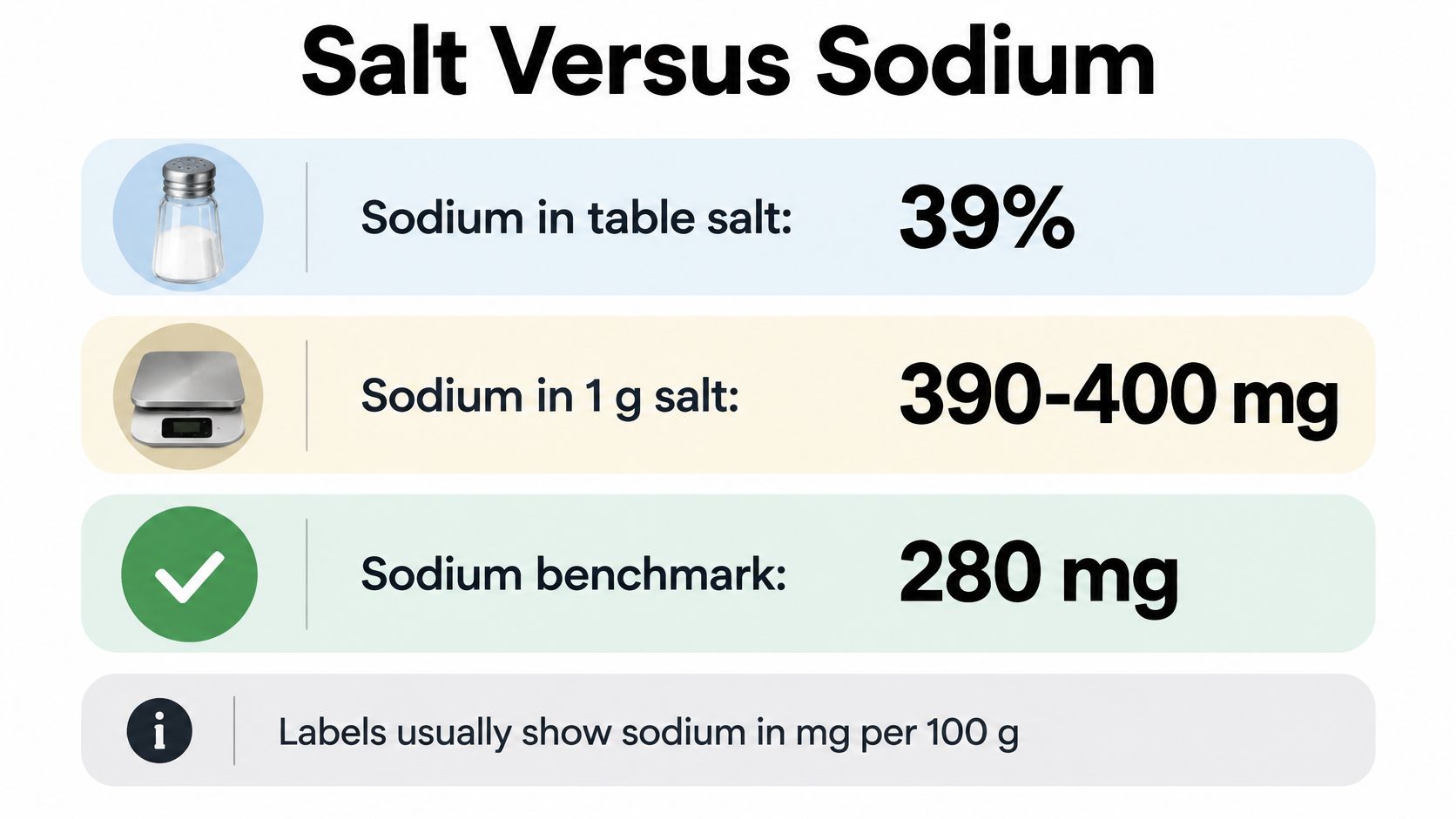
Salt is an ingredient; sodium is a component reported in nutrition information. Their quantities are not the same, so don't read a salt figure as though it were sodium. Check the label's units, too. Grams and milligrams differ, and a small serving can make a per-portion figure look lower than it would on a shared basis. Compare products per 100 g, or convert them to the same portion size.
Use the UAE benchmark carefully
Gulf News's report on the UAE sodium-reduction framework says the announced maximum for packaged salted nuts and seeds is set to fall from 336 mg to 280 mg sodium per 100 g, with phased implementation. Treat 280 mg as an announced target, not proof that every product already meets it. The framework covers locally manufactured and imported packaged foods, so accurate nutrition information matters to both shoppers and hospitality buyers.
To estimate sodium in your portion, multiply the label's per-100 g value by the portion's weight as a fraction of 100 g. For example, 30 g is 0.30 of 100 g. This lets you compare a real handful with the label without assuming all handfuls weigh the same.
For food records, calorie and macronutrient tracking topics can help organise what you eat. Track sodium separately, since calories do not show how much sodium a snack contains.
Cashews provide energy, fat, carbohydrate and protein, and salting does not remove those nutrients. A product meeting a category maximum is not automatically low sodium. If you follow a clinician-set sodium allowance, consider the snack alongside the rest of your day's intake.
Flavour Profiles and How Salt Changes Taste
Salt works like a volume knob on a cashew's buttery, mild and slightly sweet character. At a balanced level, it makes the roasted flavour easier to notice without replacing it. Too much, and you mainly taste the seasoning.
Cashews have a gentle flavour, so differences in salt texture and accompanying spices are easy to recognise. Choosing well is partly about deciding whether you want the kernel or the coating to lead.
Match the seasoning to the occasion
Fine table salt gives a relatively even, immediate salty impression. It suits a straightforward snack where you want a consistent bite.
Flaky sea salt creates more distinct bursts as crystals meet your tongue. A visibly generous crystal doesn't tell you the pack's total sodium, though.
Smoked paprika or chilli-lime puts spice, smoke or acidity at the front. These work when you want a lively snack rather than a quiet nutty flavour.
Rosemary and black pepper give an aromatic, savoury finish that fits an Italian-inspired aperitivo board.
Honey or maple glaze combines sweetness with salt. The coating changes both the flavour and the ingredient profile, so don't treat it as plain roasted cashews with a decorative finish.
Taste beyond the first salty hit
Try a kernel slowly rather than judging only the first impression. Notice the initial seasoning, the roasted middle and the flavour left after swallowing. A good coating should still let you recognise the cashew underneath.
Strong seasoning can obscure a disappointing kernel. That doesn't mean spicy cashews are poor quality, but a coating shouldn't be your only evidence of freshness or careful roasting.
Choose the seasoning you enjoy, then check whether you still enjoy the nut underneath it.
If a cashew tastes only of salt, choose another kernel from the pack before deciding. Uneven coating can create an unusually salty bite, while a consistently harsh finish suggests that particular product isn't balanced for your taste.
For shared bowls, a milder version is often easier to pair with other foods. You can add herbs or spice at home, but you can't reliably remove salt already applied during manufacture.
Origin, Grades and Quality Markers to Know
A cashew's journey can involve different countries for growing, processing, roasting and packing. Cashew trees grow in tropical regions, including African producing countries such as Côte d'Ivoire, Nigeria, Benin and Tanzania, while Vietnam and India are important processing locations.
Those stages answer different questions. Origin tells you where the crop grew; processing location helps explain where shelling and preparation happened. Neither alone guarantees a fresh, well-roasted retail pack.
What grades can tell you
Cashew grades commonly distinguish whole kernels from pieces and separate kernels by size and appearance. Whole-kernel size grades use a count-based system, so a lower count generally means larger individual kernels.
Cashew grades and typical uses
Grade | Approx. kernels per pound | What it looks like | Best use |
|---|---|---|---|
W180 | About 180, as indicated by the size designation | Very large whole kernels, ideally uniform | Premium snacking and gifting |
W240 | Count-based whole-kernel grade | Large whole kernels | Presentation bowls and snacking |
W320 | Count-based whole-kernel grade | Medium whole kernels | Everyday snacking and mixes |
W450 | Count-based whole-kernel grade | Smaller whole kernels | Baking and mixing |
LWP (large white pieces) | Not applicable | Broken pieces, mostly large | Cooking, pastes and sauces |
Treat a grade as a sorting description, not a complete quality certificate. It doesn't tell you the salt content, how recently the nuts were roasted or how the opened pack was stored.
Large whole kernels look attractive in a gift bowl, but pieces can be the sensible choice for pesto-style sauces or chopped toppings. Paying for flawless whole nuts makes less sense when you're about to blend them.
Inspect the product, not just the designation
Retail packs don't always show a commercial grade. When they don't, use the visible kernels and your senses:
Colour: Look for a reasonably consistent cream-to-golden appearance appropriate to the roast. Roasted nuts needn't remain pale ivory.
Uniformity: Similar sizes help produce a more even eating experience.
Texture: A roasted cashew should have a pleasant crisp bite, not a leathery bend.
Aroma: Expect a clean, nutty smell rather than an oily, paint-like or otherwise unpleasant odour.
Coating: Look for reasonably even seasoning rather than a thick, dusty accumulation at the bottom.
For a broader comparison of whole nuts, pieces and fruit accompaniments, our guide to nuts and dried fruit provides useful selection context.
Transparent packaging can help you inspect size and colour. It still can't prove freshness, so combine appearance with the pack's date, seal condition and, once opened, aroma.
Culinary Uses, Pairings and a Quick Snack Recipe
Salted cashew nuts are useful wherever you want a rich, crisp contrast. The main decision is whether they'll be the snack itself, a finishing ingredient or part of a shared board.
These serving ideas show how the same ingredient can play different roles.
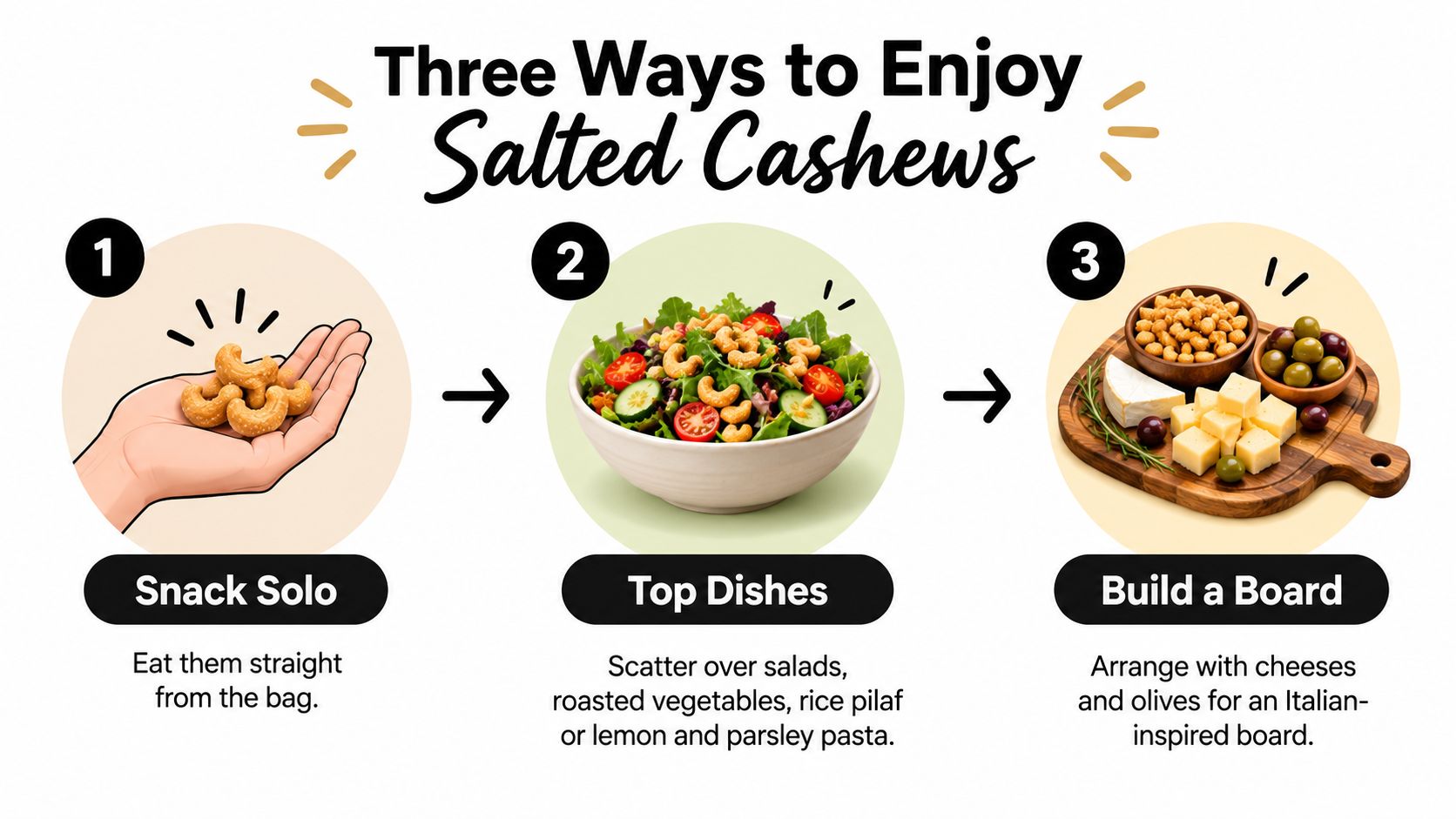
Choose the role before adding more salt
For snacking, put the portion in a bowl instead of repeatedly reaching into the bag. It's easier to judge what you've eaten when the amount is visible.
For topping dishes, roughly chop the kernels and scatter them over salads, roasted vegetables, rice pilaf or lemon-and-parsley pasta. Add them shortly before serving so they retain their texture, then taste before salting the finished dish.
For a board, balance richness with fruit, acidity and softer textures. Pecorino, figs and a little honey make an Italian-inspired combination; dates, cardamom-spiced coffee, labneh with olive oil or a small drizzle of pomegranate molasses offer other useful directions.
Remember that cheese, olives and prepared dips can contribute salt too. A varied board creates more choices, but it doesn't automatically reduce the sodium someone eats.
For adults choosing a beer pairing where appropriate, Carbon 6 Brewing Pty Ltd's guide to contrast and complement flavours with beer explains a useful tasting principle. Decide whether the drink should echo the roasted character or contrast with the snack's richness.
Rosemary and lemon cashews
Use this as a small home-kitchen recipe, not a nutrition-certified formulation. Flaky salt differs in crystal size and packing density, so a teaspoon measure can't establish an exact sodium concentration.
Heat the oven to 160°C. A moderate temperature gives you more control while the herbs and kernels toast.
Combine the ingredients. Toss 200 g raw unsalted cashews with 1 tablespoon olive oil, 1 teaspoon chopped rosemary, the zest of half a lemon and ¼ teaspoon flaky sea salt. Mix thoroughly so the seasoning doesn't collect in patches.
Spread on a lined tray. Keep the nuts in a single layer so they roast rather than crowd together.
Bake for about 10 to 12 minutes, shaking once. Start checking early and use a light golden colour and toasted aroma as your guides.
Cool fully on the tray. The nuts become crisper as they cool, so don't judge the final texture straight from the oven.
Transfer to an airtight jar. Only pack them once cool, avoiding trapped warmth and moisture.
For a visual cooking reference, use the video below alongside the recipe's own doneness checks.
Don't assign this batch a precise sodium value from the spoon measure. For a dietary calculation, weigh the salt, use its nutrition declaration and account for the finished batch weight and other ingredients. Homemade seasoning isn't evidence that a product meets a commercial category limit.
If you prefer less salt, reduce it and let rosemary and lemon provide more of the flavour. Avoid pulling the tray solely because the surface looks dry, but remember that hot kernels will feel softer than cooled ones.
Our snacks and savouries guide offers more ideas for building a varied serving selection.
Storage, Shelf Life and Signs of Staleness
Shelf life of salted cashew nuts by storage condition
Condition | Approx. shelf life | Key precaution |
|---|---|---|
Unopened pack, cool dry cupboard | Use the pack's best-before date as the quality guide | Keep away from heat and sunlight |
Opened, airtight jar at room temperature | Follow any after-opening instruction and check freshness | Transfer promptly and avoid humid kitchens |
Opened, airtight jar in the fridge | Use the manufacturer's storage guidance | Bring the sealed jar to room temperature before opening |
Frozen in airtight bag or jar | Follow product guidance rather than assuming a fixed duration | Freeze in small portions and protect against moisture |
Oil-roasted and salted, opened | Check frequently and use promptly | Don't assume the same keeping quality as another product |
A universal storage timetable sounds convenient, but packaging, roasting, added ingredients and handling all affect keeping quality. The manufacturer's instructions take priority over a generic estimate. A best-before date is a quality guide for the product under its stated storage conditions, not a promise that an opened pack will remain unchanged.
Heat, air, moisture and light are the main things to control. In a humid kitchen, leaving the bag open while you cook gives moisture an easy route in.
Make the storage container work properly
Transfer opened nuts to a clean, dry, airtight glass or food-safe steel container. Choose a container close to the amount you have, and keep it away from the hob, dishwasher steam and direct sunlight.
For refrigerated storage, let the sealed container reach room temperature before opening it. This helps avoid condensation forming on the cold nuts. If you freeze them, portion first so you don't repeatedly warm and refreeze the whole supply.
A tightly closed jar helps only if the nuts and the jar are dry before you seal it.
Recognise when quality has changed
Soft or bendy texture: Moisture may have reduced the crispness.
Oily or paint-like smell: Don't dismiss an unpleasant odour as normal nuttiness.
Bitter or flat flavour: Stop eating if the flavour is distinctly wrong.
Damp, clumped seasoning: Check for moisture exposure and other signs of deterioration.
Don't taste nuts with visible mould or obvious spoilage. Discard them rather than trying to rescue them by roasting.
Oil-roasted products deserve particular attention to their own storage instructions. Added oil and formulation can affect stability, but the label and condition of the actual product are more useful than assuming every oil-roasted cashew has the same shelf life.
Choose the Right Salted Cashews to Buy or Gift
How can you choose salted cashews with confidence? Start with the sodium printed on the label per handful, not the premium packaging or the general reputation of cashews as a healthy snack. Then check whether the flavour and presentation fit the occasion.
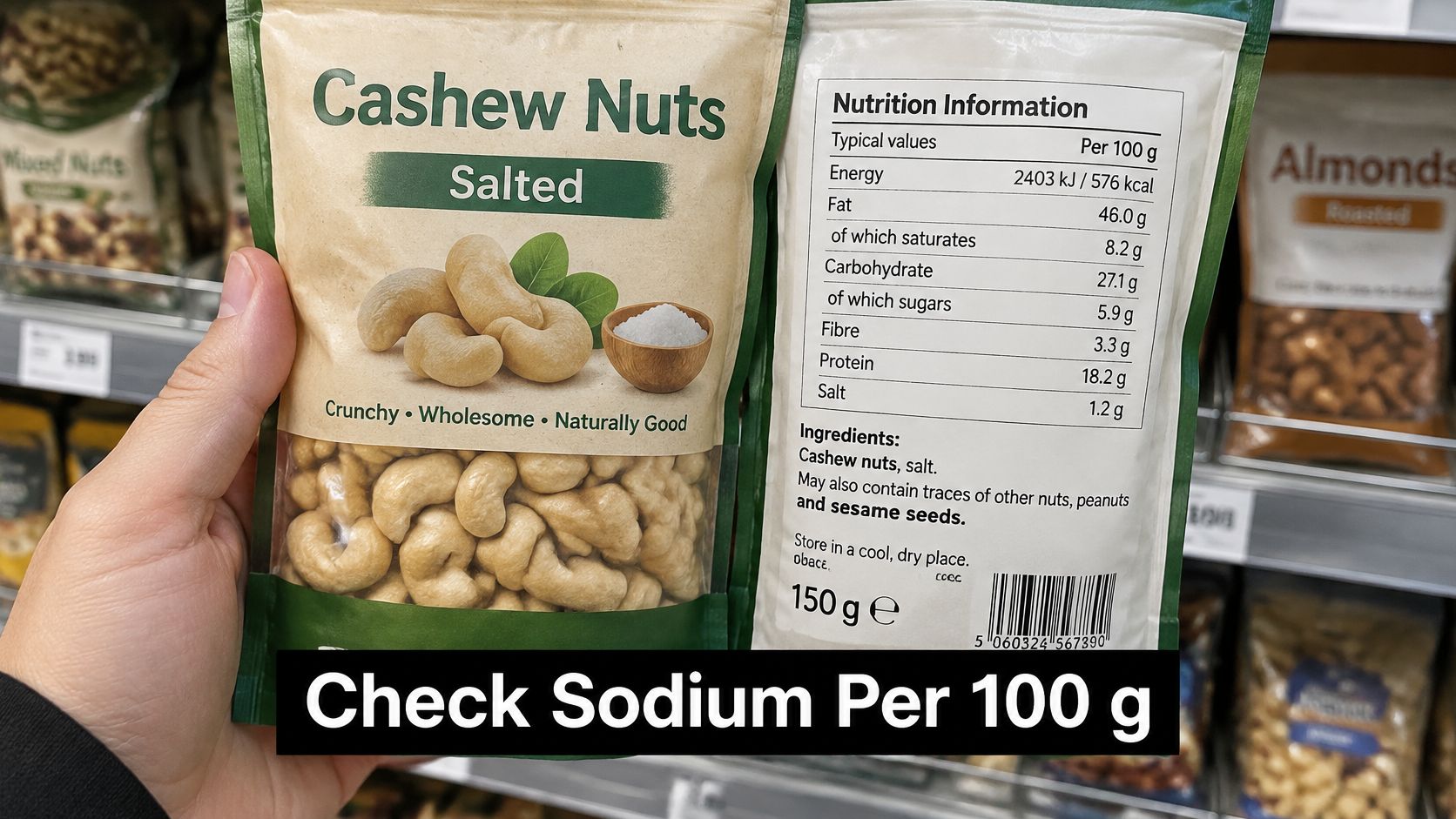
Read the claim and the declaration separately
The Abu Dhabi Agriculture and Food Safety Authority's health and nutrition claims guidance describes a mandatory nutrition declaration covering energy, fat, saturates, carbohydrate, sugars, protein, fibre and salt. It also sets the low-sodium or low-salt claim threshold at no more than 120 mg sodium per 100 g or 100 ml.
That threshold is separate from a broader category maximum. A product can meet applicable requirements without qualifying as low in sodium, so treat descriptions such as “lightly salted” as a cue to check the declaration, not a substitute for it.
Use this checklist:
Sodium concentration: Compare similar declarations, and distinguish sodium from salt.
Portion basis: Check whether the figures apply to a reference weight or the manufacturer's serving. To judge a handful, match the label amount as closely as you can.
Ingredients: Look for cashews, salt, any oil, and the components of a seasoning or glaze.
Net quantity: Choose a pack size suited to how the nuts will be used.
Allergen information: Check for cashew and other tree-nut warnings, especially for a gift.
Date and seal: Choose intact packaging with a suitable best-before date.
Arabic information: Look for clear local-market labelling. The ADAFSA general food-labelling code%20of%202019%20General%20Food%20Labelling%20Requirements.pdf) explains Arabic food-information requirements.
Make a gift fit the recipient
For an edible gift, match the contents to the recipient's tastes and any allergies or dietary restrictions. A well-presented hamper can make a thoughtful choice, but check its contents rather than assuming it includes cashews.
IFM Gourmet Food Store sells premium Italian gourmet food online in Dubai and the UAE. Its range includes sweets, breakfast items, beverages, condiments and spices, pasta, rice and flour, pizza and breads, cheeses, vegetables, seafood, and gifts and hampers. Hamper Santa 25 is priced at AED 270.00 and is curated with luxurious food items from Italy and beyond. It may provide a starting point for a salty-sweet gift, though the recipient's preferences should guide the choice.
For a simpler present, choose a cashew pack that passes the label checks and suits the recipient. If you are unsure about the flavour, try a small pack before choosing a larger quantity or gift selection.
IFM Gourmet Food Store offers Italian pantry ingredients, artisanal delicacies and curated hampers for home dining and gifting across the UAE. Visit IFM Gourmet Food Store to explore accompaniments for a cashew snack board or choose a gift around the recipient's tastes, checking ingredient and nutrition information before you buy.

Comments