
Sorbet Ice Cream: Differences, Flavors and How to Choose

If sorbet is made from fruit and contains no cream, does that automatically make it the lighter choice? Not necessarily. Sorbet ice cream can feel refreshing while still containing plenty of sugar, and a carefully balanced recipe can lose its smooth texture during a hot journey home in Dubai.
Choosing well means separating three questions: what's in the dessert, how it feels when you eat it, and how it's been handled. Once you understand those differences, choosing between sorbet, gelato and dairy ice cream becomes much easier.
Sorbet and Ice Cream at a Glance
A frozen dessert can look light in the cup and still carry a heavy sugar load. Sorbet is a frozen dessert made from fruit purée, juice or water, sugar and sometimes a little alcohol or flavoring, with no dairy. Dairy ice cream starts with milk and cream, often includes egg yolks, and usually contains more fat. Gelato generally uses more milk and less cream than traditional ice cream, with less incorporated air.
Sorbet ice cream is a handy label, not a single recipe. Ingredients set the texture. The name does not settle sugar, calories, or how the dessert will behave after a warm ride home in Dubai.
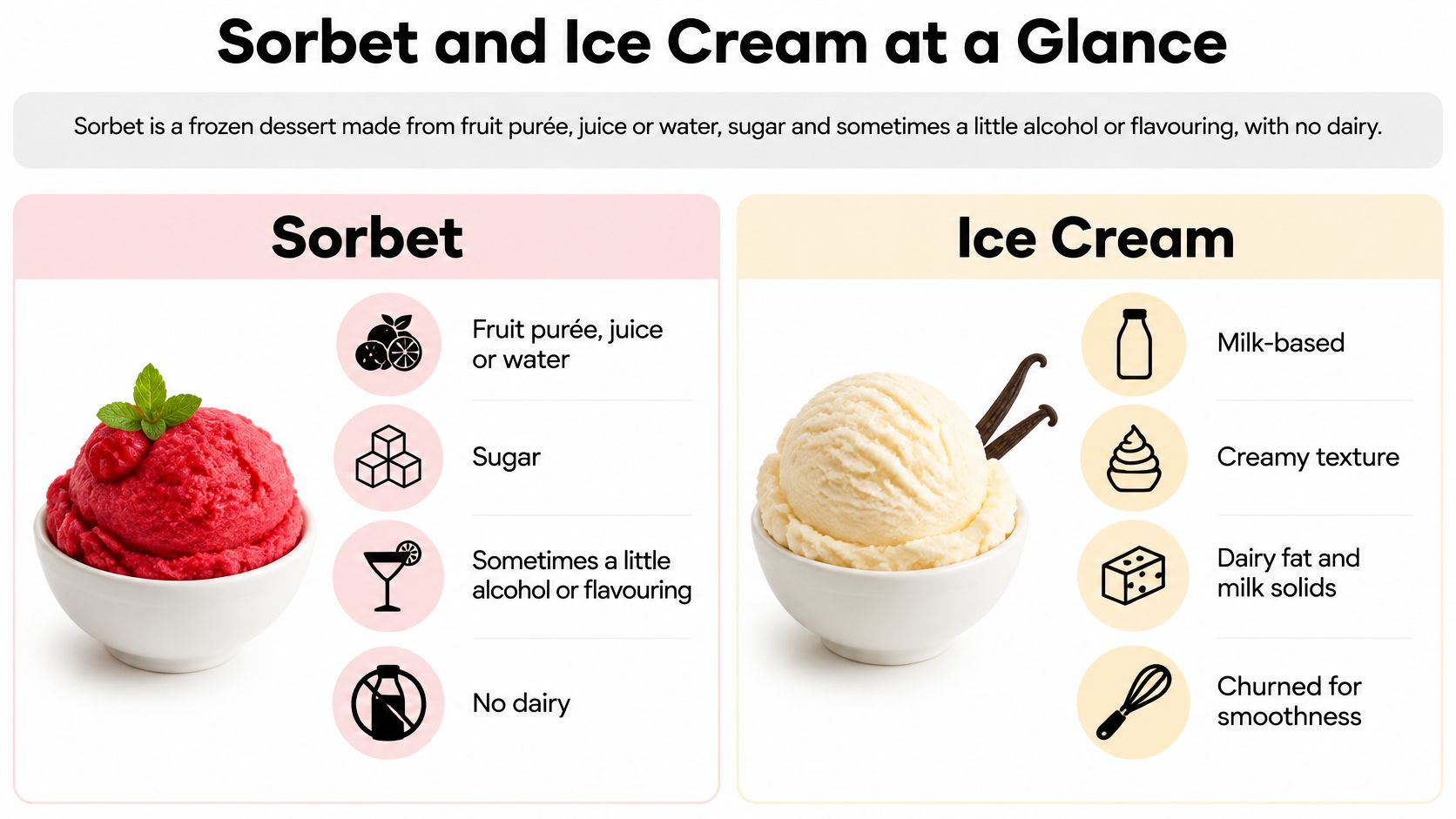
Sorbet, gelato and ice cream compared
Feature | Sorbet | Gelato | Dairy ice cream |
|---|---|---|---|
Main base | Fruit purée, juice or water | Milk with some cream | Milk and cream |
Milk fat | Usually none or very low | Less cream in a typical milk-led recipe | Usually higher in a cream-led recipe |
Dairy and eggs | Dairy-free, egg-free base | Contains dairy, usually few or no eggs | Contains dairy, often egg yolks |
Texture | Light, clean, slightly icy | Dense, silky, less air | Rich, creamy, coats the tongue |
Sugar per 100 g | Typically about 20–30 g | Typically about 15–25 g | Typically about 15–25 g |
Calories per scoop | Often lower with little fat, but sugar and scoop size matter | Milk fat, sugar and scoop weight set the result | Often higher with more cream, but check the portion |
Fruit-based doesn't mean low-sugar
Fruit sugar and added sugar both contribute to total sugars. A sorbet made with fruit purée, syrup and concentrated juice can match dairy ice cream by weight. Removing cream takes out fat. It does not remove the sweetener that keeps the mixture soft enough to scoop.
Heat makes that sugar easy to misread. In a Dubai kitchen, or after a short walk from the shop, a sorbet can slump at the edges and look "lighter" only because it has warmed. Softness is temperature, not fewer calories. Let the tub firm up, then compare a level scoop with a level scoop.
Those sugar bands in the table are typical ranges, not a promise for every brand. The declaration on the tub is the final check. The UAE packaged-food labeling guidance requires nutrition declarations covering energy, carbohydrates, sugars, protein, fat, fiber and salt, generally per 100 g or 100 ml, subject to category-specific scope and exceptions. Compare products on the same basis, preferably weight, rather than assuming equal-looking scoops contain equal amounts.
A café serving an unpackaged scoop may not present information in the same format as a supermarket tub. Ask about ingredients and portion size. A menu word such as "fruit" is not a nutrition claim.
Shopping rule: Choose the dairy row for an ingredient restriction, the fat and sugar rows for nutrition, and the texture row for enjoyment.
For a milk or egg allergy, also check allergen declarations and shared equipment. A dairy-free recipe is one question. Cross-contact is another.
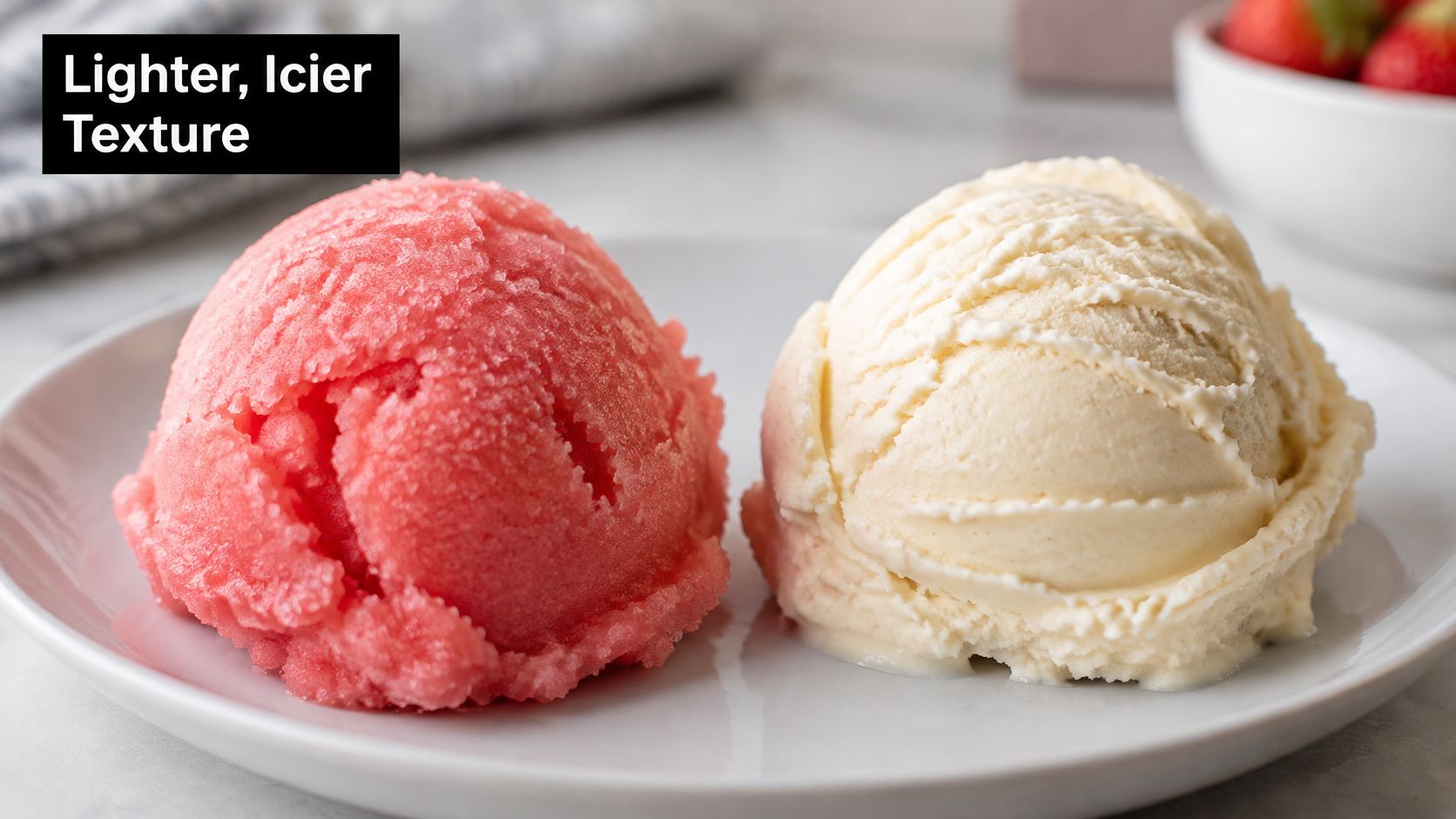
Why Sorbet Feels Lighter and Icier
Think of the fat-rich structure in ice cream as a soft blanket around its frozen water. That's an analogy rather than a literal coating around every crystal, but it helps explain why cream makes a frozen dessert feel cushioned rather than sharply icy.
Sorbet doesn't have that milk-fat structure. You notice its frozen water more directly, so a spoonful can feel crisp and cold before the fruit flavor opens up.
Sugar does more than sweeten
Sugar lowers the mixture's freezing point, leaving some water unfrozen at freezer temperatures. That unfrozen portion helps you push a scoop through the dessert instead of meeting a solid block.
This is why removing sugar from a successful recipe can produce a disappointing result. The mixture may taste pleasantly fruity before freezing, yet become stubbornly hard afterward.
Fruit pulp matters too. Mango purée supplies body, while strained lemon juice contributes little pulp, so the same amount of sweetener won't necessarily give both mixtures the same texture.
Air changes the spoonful
Churning freezes the mixture while incorporating air. Traditional ice cream often holds more air than sorbet, making it lighter in weight even when it tastes richer; gelato commonly has a denser structure.
Try lemon sorbet beside vanilla ice cream. Use separate spoons, take small tastes, and notice the difference between the sorbet's clean finish and the creamy coating left by the ice cream.
Notice the melt: Watch how each softens rather than assuming all sorbets melt faster.
Notice the finish: Lemon's acidity makes the contrast especially clear.
Notice the weight: Similar-looking scoops needn't weigh the same.
Texture comes from fat, sugar, air and fruit solids working together. The same fruit can produce a soft, smooth sorbet or a brittle, icy one when the recipe or churning changes.
Popular Sorbet Flavors and What Each Suits
Mango and raspberry are useful starting points for a UAE summer dessert menu. MarkNtel Advisors' UAE ice-cream market coverage identifies both as strong summer performers, with mango demand peaking seasonally while classic flavors remain year-round sellers.
Beyond those favorites, sorbet flavors fall into tropical, berry, citrus, stone-fruit and floral families. Each gives you a different way to finish a meal, but flavor alone doesn't tell you how well a scoop will hold outside.
Popular sorbet flavors and their best uses
Flavor | Taste profile | Best paired with | Hot-weather notes |
|---|---|---|---|
Mango | Sweet, tropical, smooth | Fresh mint, lime zest | Strong summer seller, demand peaks seasonally |
Raspberry | Tart, bright, berry-forward | Fresh berries, cream-free shortbread | Strong summer seller, refreshing acidity |
Lemon | Sharp, clean, citrusy | Mixed berries, basil | Refreshing, a classic year-round choice |
Lychee | Floral, delicate, perfumed | Rose water, pistachio | Fragrant dinner-party option, serve promptly |
Peach | Soft, sweet, aromatic | Almond biscuits, fresh peach slices | Mellow choice for a cooler evening |
Passion fruit | Tangy, tropical, intense | Coconut flakes, mango | Bold enough for small scoops |
Match intensity to the occasion
Sharp citrus works well alongside a heavy dessert because it contrasts with richness. Sweet tropical fruit suits a lighter meal or a children's party, where an assertive lemon sorbet might be less welcome.
For lychee, use rose water sparingly. Both are perfumed, and too much can obscure the fruit rather than support it. With raspberry, check that cream-free shortbread also meets any other dietary restrictions your guests have.
Fruit-heavy sorbets can feel particularly refreshing on a terrace, but refreshing acidity isn't heat resistance. A thin, low-solids mixture can freeze hard and then lose its shape quickly once served; a substantial purée gives a different result.
Choose flavor for the meal, then choose the serving setup for the weather.
Don't judge mango against lemon solely by how long each scoop stands upright. Recipe balance, starting temperature, bowl temperature and exposure to sun all affect that comparison.
For a summer evening, choose a bright option such as raspberry or passion fruit. For a dinner party, peach offers a softer stone-fruit finish that won't compete with a delicate final course.
Serving, Storage and Pairing Tips for Sorbet
Keep sorbet in a monitored freezer at −18°C or colder. Dubai Municipality's Food Code and transport guidance gives that preferred frozen-storage temperature, requires frozen-food vehicles to maintain −18°C or lower at full load, and sets 20°C or below for cold high-risk preparation areas.
For a Dubai kitchen, the main handling concern is temperature abuse, not whether the recipe contains milk. Dairy-free doesn't mean a thawed dessert can be handled casually.
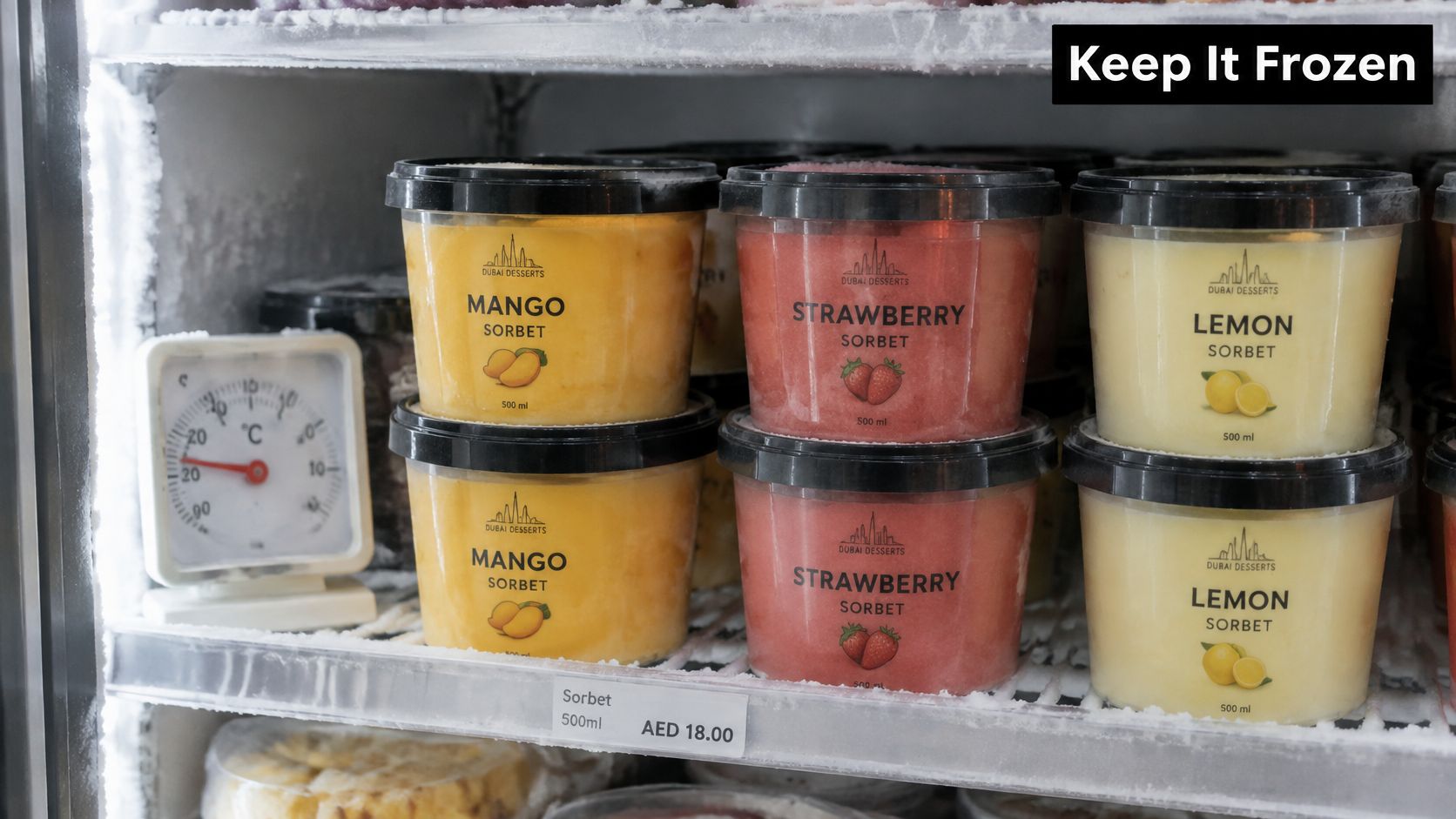
Storage and serving checkpoints for sorbet
Checkpoint | Target | Why it matters |
|---|---|---|
Freezer storage | −18°C or colder | Maintains the frozen structure and limits crystal growth |
Delivery vehicle at full load | −18°C or lower | Prevents partial thawing in transit |
Transit time | Keep as short as possible | Limits temperature rise and food-safety risk |
Cold high-risk prep area | 20°C or below | Limits bacterial growth during preparation |
Opened tub | Reseal and return to freezer at once | Limits melt-and-refreeze cycles |
Serving tempering | Rest a few minutes before scooping | Eases scooping without melting |
Refreezing after softening | Don't refreeze a visibly thawed delivery | Avoids accepting compromised product and texture |
Repeated partial melting and refreezing lets larger ice crystals develop, creating a coarse texture and watery drips. Store tubs away from frequently opened freezer doors, and use an insulated carrier for the journey home.
At receiving, check that the product is hard-frozen and transfer it promptly into storage. In a professional kitchen, document temperature checks; at home, contact the seller if a delivery arrives soft or visibly thawed rather than freezing it again.
Finish with a careful serve
Temper only until the sorbet yields to gentle pressure. Dip a scoop in warm water, shake off the excess, and portion into chilled bowls; don't leave the whole tub on the table.
Add contrast: Try berries, mint, toasted pistachios or dark chocolate shards.
Choose suitable tableware: These luxury dessert plate ideas can help with presentation, but chilled bowls better contain a softening scoop.
Build a drink pairing: Add sparkling water for an alcohol-free float, or prosecco for adults who drink alcohol. For complementary alcohol-free combinations, BeeHive Mobile Bar mocktail ideas offer useful inspiration.
Basic Sorbet Recipe Outline in Six Steps
A home recipe is a starting point, not a fixed formula for every fruit. Ripe mango, sharp raspberry and juicy peach bring different amounts of sweetness, water and pulp.
For a worked kitchen example aiming for about one liter, try the quantities below. The final yield will change with the fruit and the air incorporated during churning, so leave room in your storage container.
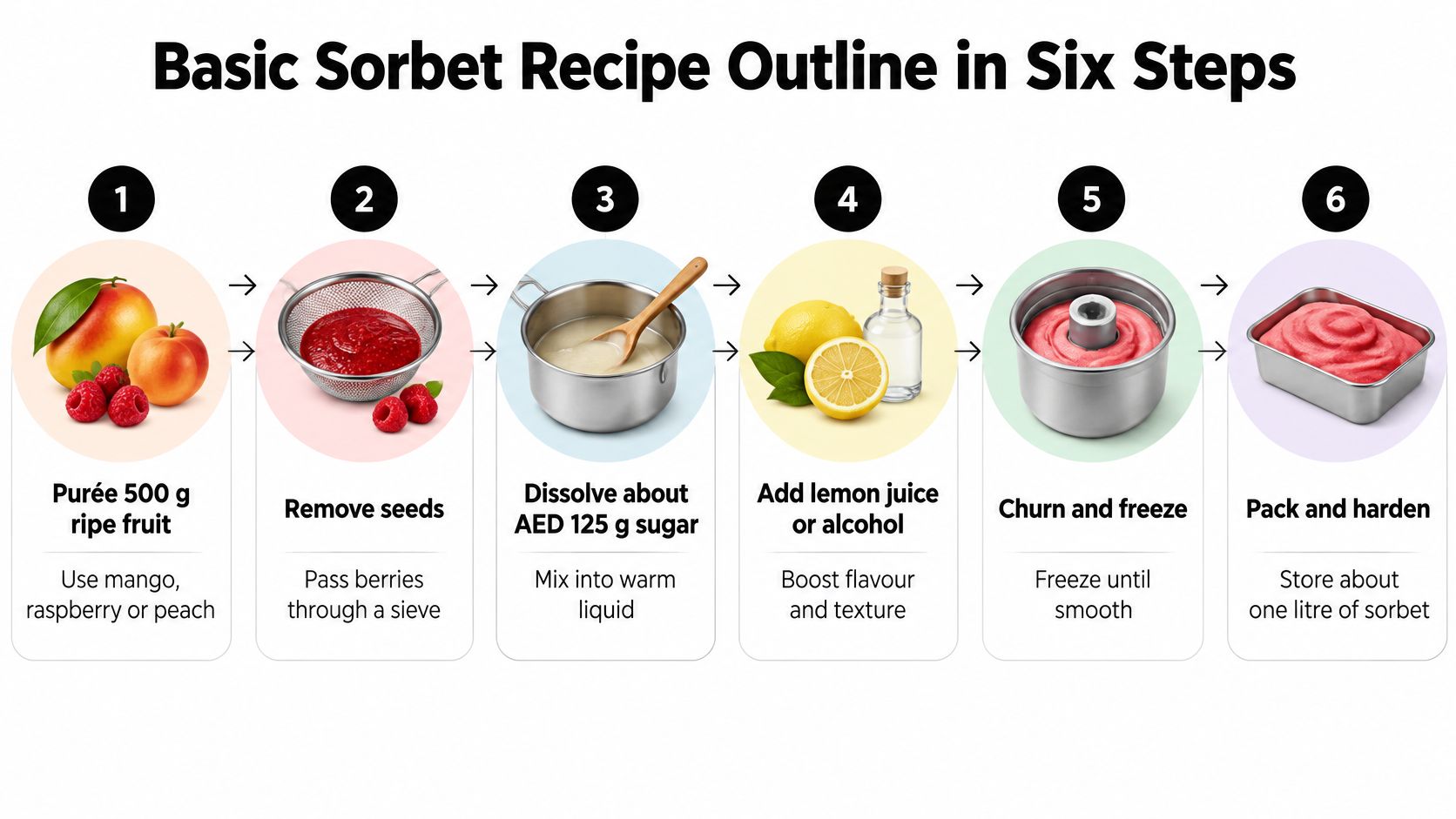
From ripe fruit to a frozen scoop
Prepare the fruit. In this example, purée 500 g of ripe mango, raspberry or peach in a blender. Remove stones, peel where necessary, and pass berries through a fine sieve if you want a seedless finish.
Dissolve about 125 g sugar in 125 ml warm water to make a syrup, then cool it completely. Dissolving the sugar first prevents gritty pockets in the finished mixture.
Balance the flavor. Combine the purée and cooled syrup with one tablespoon of lemon juice. Taste before adding more acidity, especially with raspberries; aim for slightly sweeter than you want the finished dessert because cold reduces perceived sweetness.
Cover and refrigerate the mixture. For this example, allow two to four hours, checking that it's thoroughly cold before churning. Starting cold helps the machine freeze the mixture efficiently.
Churn until thick and softly frozen. Use the ice-cream maker's instructions as your main guide; about 20 to 25 minutes is an illustrative window, not a promise for every machine. Stop when the mixture gathers into a substantial, soft mass.
Transfer into a freezer-safe container and press parchment against the surface before sealing. Allow four to six hours as an example hardening period in a properly cold freezer, then check the center rather than judging only the edges.
Fix the next batch thoughtfully
Too hard: Try slightly more sugar in the next batch. A little juice may help only if its sugar contribution outweighs the extra water, so don't dilute blindly.
Too icy: Reduce unnecessary water and start with a thoroughly chilled base. Churn until properly thick, but don't expect extra machine time to repair thawing damage.
Melts too fast: Try a fuller-bodied fruit purée and protect the serving temperature. Don't automatically add more sugar, since excessive sugar can make sorbet too soft.
Recipe notebook: Record the fruit, its ripeness and each adjustment. Change one ingredient at a time so you can tell what improved the result.
Choosing Sorbet Over Dairy Ice Cream in Practice
Which frozen dessert still tastes right when the kitchen is already warm? Pick the eating experience you want. Dairy-free is not a promise of a lighter dessert.
Sorbet works like frozen fruit syrup: water, fruit and sugar frozen together, with little or no fat to slow the melt. Sugar is what keeps the crystals small enough to scoop. In UAE heat that same sugar, plus a warm plate, can turn a scoop soft faster than a creamier dairy dessert. A dairy-free label does not mean low sugar, and a bright fruit taste does not mean fewer calories. Check the fruit percentage and the ingredient list the way you would check a cold drink: fruit is the flavor, sugar is the structure.
Sorbet, gelato or ice cream by situation
Situation | Choose | Why |
|---|---|---|
Guests avoid dairy or eggs | Sorbet | Dairy-free and egg-free base, with allergen checks |
Hot afternoon, light dessert wanted | Sorbet | Bright and fruit-forward, in small portions before it softens |
Rich main course before dessert | Sorbet | Acidity contrasts with richness |
Dessert eaten alone, creamy texture | Gelato or dairy ice cream | Creamy body; milk-led gelato often has less fat |
Flavor depends on dairy, such as vanilla, caramel or chocolate | Dairy ice cream | Dairy supports the familiar rich expression |
After lamb biryani or a rich Italian dinner, mango sorbet gives a sharp, cool contrast. A bowl of vanilla or caramel on its own wants cream, not a fruit sorbet asked to imitate it. Vanilla, caramel and chocolate can also appear in dairy-free recipes, so the table is a preference, not a ban. For a richer direction, explore salt and caramel ice cream.
If the priority is a stated nutrition profile rather than fruit, compare specialist products one by one. Fitwhip frozen treats on Loyaltie are another category to judge by ingredients, allergens and the serving on the pack.
Buy sorbet last, pack it against other frozen food, and put it in the coldest part of the freezer, not the door. Soften it only a few minutes. Weeping edges mean it has already warmed once.
What is IFM Gourmet Dubai?
IFM Gourmet Dubai is the luxury online gourmet division of IFM Investments LLC, selling premium Italian gourmet food online in Dubai and the wider UAE. The range includes sweets, fine chocolates, cakes and curated gift hampers. Sorbet Grape 40% fruit is made with 40% real fruit and comes in a 1.5kg/2.5lt tub. Customers can reach the store by mobile at +971 (0)50 3848115, by office phone at +971 (0)4 8829791, or by email at contact@ifmgourmet.com.
Sorbet fits when fruit and a clean finish matter more than cream, and when the serving is planned around the heat.
IFM Gourmet Food Store offers Italian gourmet ingredients, frozen desserts and artisanal delicacies for home meals and celebrations in the UAE. Visit IFM Gourmet Food Store to explore sorbet and complementary dessert ingredients, then choose a flavor and serving format that suit your guests.


Comments