
Puck Heavy Cream in the UAE: Types, Uses and Storage

If a recipe says heavy cream, does the carton really matter? Most cooks in Dubai answer no. They reach for the nearest white tub with the familiar red logo, and dinner usually works out. Then one evening a mousse won't hold its shape, or a pasta sauce goes thick and gluey, and the same brand that worked last week seems to have let them down. It didn't. A different carton went into the trolley, or the recipe asked the cream to do a different job.
Puck sells more than one cream in the UAE, and the three main formats behave nothing alike. One whips into stiff glossy peaks. One is built to sit in a hot pan without breaking. One pours. All three are cream, all three carry the same brand, and only one of them is what a pastry chef means when writing "heavy cream" on a recipe card.
Getting this right takes about ten seconds at the chiller and saves a dessert. Here is how to tell the cartons apart, which one suits which dish, how to whip it without splitting, and how to keep it safe once you're back in a Dubai kitchen.
What Puck Heavy Cream Is and How the Range Differs
Which carton should you pick when a recipe calls for heavy cream? In Puck's range, the name on the front is only the first clue. Fat content and intended use show how each cream behaves, much like checking whether a tool is built for whisking or pouring.
Puck's history in Gulf kitchens goes back further than many shoppers assume. The brand began as a spreadable cream cheese in Germany and entered Middle Eastern markets in 1983 with a range of processed dairy products, mainly cheese, as Arla's Puck history explains. By 1988, its principal jarred spreadable-cheese product had exceeded 1,000 tonnes in sales. That milestone concerned spreadable cheese, not cream, and offers background on the brand's familiarity in the region.
The three cartons side by side
Puck cream | Fat content | Energy and fat per 100 g | Best use |
|---|---|---|---|
Puck Whipping Cream UHT | 34% minimum | , | Whipping, piping, pastry fillings |
Puck Cooking Cream | 27% | 268 kcal, 17 g saturated fat | Pourable sauces, soups, heat-stable cooking |
Puck Thick Cream 250 ml | 25% | 1,023 kJ, 25 g fat, 19.8 g saturated fat | Pouring, enriching sauces, cold desserts |
The whipping cream's fat level supports whipping, while cooking cream is intended for hot dishes. Thick cream is a different kind of product. According to the UAE product listing for Puck Thick Cream 250 ml, it contains water, butter, hydrogenated palm-kernel oil, skimmed-milk powder, emulsifier E471 and stabilizer E401, and is UHT treated. That ingredient list shows why it behaves differently from cream made only with dairy fat: the blend provides body and stability, rather than the structure needed to trap air for whipping.
Reading the carton in ten seconds
Check three things on the pack: the fat percentage, the words “UHT treated,” and the pack size. Fat content helps identify the cream's intended job. UHT treatment indicates heat processing, so follow the carton's refrigeration instructions after opening. Pack size helps you choose what fits the recipe, whether you need cream for one sauce or several batches of baking.
Labels can differ between markets and batches, so use the information on the carton in your hand. For context on other dairy products from Italy, see this guide to Italian dairy products.
Which Puck Cream to Use for Each Dish
The most common mistake in UAE home cooking is assuming the word "cream" on a label tells you how the contents will behave. It doesn't. Fat percentage, intended use, stabilizers and storage instructions decide that, and Puck's range splits cleanly along those lines.
Take the two cartons people confuse most. According to this comparison of heavy cream available in Dubai, Puck whipping cream is listed at at least 34% fat, while Puck cooking cream sits at 27% fat with 268 kcal and 17 g saturated fat per 100 g. Seven percentage points of fat doesn't sound like much. In the bowl it's the difference between a ribbon that holds its shape on a spoon and a puddle.
The two questions cooks ask most
Can cooking cream be whipped? In practice, no. Whipping depends on dairy-fat globules partially coalescing around air cells, and at 27% fat with a different fat system there aren't enough globules to build that network. You'll get foam that collapses within minutes. Keep going and you'll end up with something closer to butter specks floating in buttermilk.
Can whipping cream replace cooking cream in a hot pasta sauce? Yes, and it will taste rich and good. It will also thicken far more aggressively as it reduces, coat the pasta more heavily, and add noticeably more saturated fat per serving. Use roughly a third less than the recipe states, add it off the heat, and loosen with a spoonful of pasta water.
Practical rule: match the fat level to the job. Volume and aeration need 34% and up. Body and heat stability need 27%.
Which carton fits which recipe
Recipe | Best Puck cream | Why | Result if swapped |
|---|---|---|---|
Whipped topping for desserts and hot drinks | Whipping cream | Fat network traps air and holds peaks | Thick or cooking cream will not hold peaks |
Panettone or pandoro filling | Whipping cream | Stable structure for piping and filling | Cooking cream stays loose and runny |
Creamy pasta sauce | Cooking cream | Pours smoothly and stays stable with heat | Whipping cream thickens heavily and adds more saturated fat |
Soup finishing swirl | Cooking or thick cream | Adds body without a heavy result | Whipping cream adds richness but a heavier result |
Cold dessert mousse base | Whipping cream | Holds volume after folding | Thick cream gives a denser, less airy texture |
Grouping the dishes by carton
Whipping cream earns its place wherever air matters. Whip it softly for a spooned topping on hot chocolate, coffee or sliced fruit, and serve it cold so the peaks survive the trip from kitchen to table. For a panettone filling, whip it stiff with a little sugar and vanilla and pipe it into the wedges just before serving, never hours ahead.
For a cold mousse, whip to soft peaks and fold it into melted chocolate that has cooled to barely warm. If the chocolate is still hot, the cream slackens and the mousse sets flat. The same discipline of chilling and gentle folding carries into frozen desserts, and this walkthrough of bakery-quality frozen custard at home shows how a custard base is chilled before churning for exactly that reason.
Cooking cream belongs in the pan. Finish a mushroom or chicken sauce at a gentle simmer rather than a rolling boil, stir it in off the heat for a tomato pasta sauce, and swirl it into soup once the pot is off the flame. Heat stability is the whole point of the 27% format.
Thick cream is a pouring cream. Use it over warm date pudding or a slice of warm cake, straight from the fridge, where its body reads as luxury rather than thinness.
During Ramadan and larger family gatherings, portions matter more than cartons. Serve smaller spoonfuls of whipped cream alongside dates and pastries, and pour cooking cream more lightly through soups and grain dishes. The meal still feels generous, and nobody leaves the table over-served.
Where to Buy Puck Heavy Cream in the UAE
Wherever you buy it, the carton should come out of a working chiller, not an ambient shelf. Cream sold warm has already lost some of its margin for error, and in a UAE summer you want every degree in your favour. The category is expanding, which means more cartons competing for the same shelf space: the Research and Markets report on the UAE cream market records a compound annual growth rate of 9.26% from 2019 to 2024, reaching AED 39.19 million in 2024, a 2.49% increase over 2023. That data aggregates soured cream, crème fraîche, clotted cream, single cream, double cream, whipping cream and canned cream, so it tracks the shelf, not Puck alone. More choice means more label-reading.
Five checks, in this order, will get you the right carton:
Fat percentage before brand. Find the number before you admire the logo. It decides whether the cream whips, pours or simmers.
Pack size against your recipe. A 1 L whipping carton suits repeated baking and entertaining. A 250 ml thick cream suits a single sauce or a dessert for four.
Date and seal. Check the best-before date and run a thumb around the rim to confirm the seal is intact and unbroken.
Printed storage instruction. Read what the carton itself asks for, then plan the trip home around it.
Chilled delivery for online orders. Ask whether the order ships cold, and unpack the cream into the fridge the moment it arrives.
For Italian pantry and dessert ingredients, IFM Gourmet Food Store in Dubai offers Italian gourmet ingredients across the United Arab Emirates. Check whether a Puck carton is listed before you order.
Compare two or three sources before committing. Stock rotates, pack sizes differ between retailers, and the carton you want may be a 1 L in one shop and a 250 ml in another.
Storing Puck Cream in the Dubai Heat
Picture the gap between the shop and your fridge: a car park, a hot boot, a delivery van making six stops before yours. That gap is where most cream problems begin, and it's the part almost no label addresses directly.
Two storage figures matter, and they don't match. The whipping cream specification gives a storage range of 0–5 °C, while Puck Arabia's cream page describes the product as requiring refrigeration, with storage below 8 °C. Work to the colder figure and treat 8 °C as the outer limit, not a target. An unopened UHT carton is more tolerant than an opened one, but tolerance isn't the same as indifference.

Unopened and opened are two different problems
Before opening, the clock is set by the best-before date and the printed storage instruction. After opening, the cold chain restarts: cover the carton or transfer the remainder to a lidded container, refrigerate it promptly, and never leave it on the counter while you finish a recipe.
The practical target is simple. Get the cream from the shop into the fridge as fast as the trip allows, and treat any carton that sat warm for a long stretch as doubtful rather than fine.
Condition | Temperature guidance | Action |
|---|---|---|
Unopened carton in the fridge | 0–5 °C per whipping specification; retailer lists below 8 °C | Follow the best-before date |
Carton left in a hot car or delivery van | Warmer than the fridge range | Refrigerate at once; treat as doubtful if warm for a long period |
Opened carton | Below 8 °C, covered | Refrigerate promptly and check before each use |
Frozen carton | Not recommended | Never freeze; freezing damages the emulsion |
Time limit after opening | Set by the printed date, not a fixed day count | Check smell, curdling, swelling and separation |
Never freeze cream. The emulsion breaks, the fat separates, and no amount of whisking brings it back.
Four checks at the fridge door
Run these in order before the cream goes into anything you're serving to guests.
Read the date and the storage instruction on the carton you bought, since formats differ across the range. Smell it for a sour or sharp note. Look for curdling, lumps, or a pack that has swollen. Stir and watch for separation that won't recombine, which tells you the emulsion has gone.
Taste alone won't settle it. A carton that fails any of these checks gets discarded, not blended into a sauce to hide it. No fixed number of days after opening is printed on the pack, so let the date and the checks carry the decision.
How to Whip Puck Heavy Cream Without Splitting
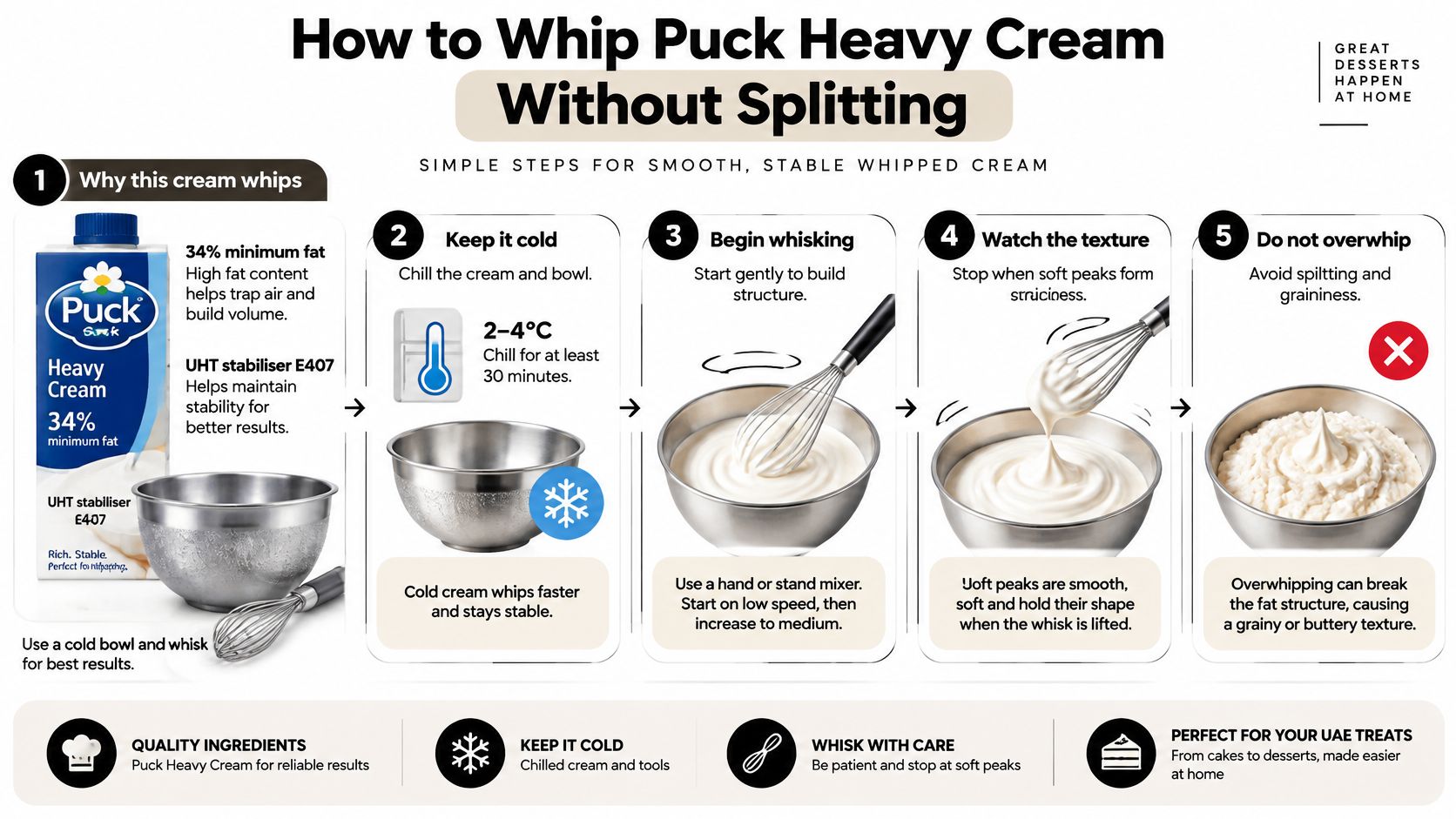
Whipping works because of fat and cold, in that order. Puck Whipping Cream UHT sold in the UAE is a homogenised, ultra-high-temperature-treated cream containing at least 34% fat and the stabiliser E407 (carrageenan), per the UAE product specification for Puck Whipping Cream 1 L. When the cream is well chilled and mechanically aerated, milk-fat globules partially coalesce around air cells and build a stable structure. E407 supports viscosity and helps reduce serum separation, which is why the foam holds long enough to pipe.
Six steps, and the reason for each
Chill everything first. Keep the unopened carton at 0–5 °C until you start, and put the bowl and whisk in the fridge for about 15 minutes. Warm equipment softens fat before it can trap air, and the whip takes twice as long.
Pour cold cream into a cold bowl. Fill it no more than a third full so the cream has room to move and you don't wear it.
Start on low speed for the first minute. Low speed keeps the cream inside the bowl and gives the fat network a gentle start. Rushing straight to high splashes and aerates unevenly.
Raise the speed as it thickens, and watch the surface. Stop looking at your phone here. The window between soft peaks and over-whipped is short.
Stop at the stage your dish needs. Soft peaks for folding into mousse, stiff peaks for piping and panettone fillings. Lift the whisk and judge by what hangs from it.
Use it straight away. Whipped cream loses volume fast in warm air, so hold the bowl over a larger bowl of ice if the kitchen is hot, and pipe at the last moment.
The most common slips are a bowl straight from the dishwasher, and a mixer left running while you fetch the piping bag. Both end the same way: graininess, then separation.
A note for Dubai kitchens
Whip in the coolest room in the house, ideally early morning or late evening, and keep the work surface away from a window. Prolonged exposure to ambient heat accelerates melting and volume loss after whipping, so a cream that looked perfect at 7 a.m. can slump by the time guests arrive. Chill the serving bowl too.
Here's the technique in motion if you'd rather watch the stages than read them.
Whipping stages and when to stop
Stage | What you see | Best use |
|---|---|---|
Soft peaks | Cream drips slowly off the whisk and folds back | Folding into mousse or soft toppings |
Stiff peaks | Peaks stand upright and look glossy | Piping, pavlova, panettone and pandoro fillings |
Over-whipped | Grainy texture that starts to separate into butter | Stop at once; do not use for piping |
A correct result looks glossy, holds a clean trail from the whisk, and tastes of cream rather than butter. If it has gone grainy, stop the mixer immediately and fold a splash of cold unwhipped cream through it to pull it back, once.
Check the Label Before You Buy
One line of small print settles most cream confusion: the fat percentage. The front of the carton can say heavy, whipping or cooking cream, yet the printed fat figure tells you what it will do in the pan or under the whisk.
Read the number as a match to the job:
34% or higher for whipped toppings, piped fillings, mousse and anything that needs to hold a shape.
27% for pourable hot sauces, soups and dishes finished at a simmer.
25% for pouring over warm desserts and building cold dessert bases where body matters more than air.
The same habit works across the dairy shelf. Straining sets Greek yogurt's texture much as fat sets cream's behavior, so the name matters less than the process; our guide to authentic Greek yogurt takes the same label-first approach.
Make it a two-step check: read the fat percentage in the aisle, then confirm the carton again at the chiller door before it goes into the basket. That takes seconds and can save a sauce that refuses to thicken or a bowl of cream that will not hold peaks.
Do it now: open your chiller and turn the nearest cream carton around until you find the fat percentage. If it does not say 34% or more, choose another carton for whipping.
The right carton makes the technique easier, and IFM Gourmet Food Store exists to shorten the search: a Dubai-based specialist pantry for Italian ingredients, from bronze-die pasta and San Marzano tomatoes to panettone, pandoro and the dessert staples that sit beside cream in your kitchen. The store serves customers across Dubai and the wider UAE, with curated hampers for gatherings and gifting. Browse the shelves at IFM Gourmet Food Store before your next baking session and check the fat percentage on every carton you add to the basket.


Comments