

Chicken Stock Cube Guide for Better Flavour

If a chicken stock cube makes your soup taste of chicken, does that tell you what's inside it, or whether it suits everyone at the table? In a Dubai weeknight kitchen, a small wrapped cube can turn hot water into a useful savoury base, but flavour alone doesn't answer either question.
The better choice starts with the ingredients, then follows the seasoning into the finished dish. A cube can be a sensible shortcut without being a substitute for every quality of homemade stock.
Stock Cube Types Compared
A chicken stock cube is a concentrated ingredient, not a single recipe. A stock-style cube starts with chicken stock that has been reduced and dried; a bouillon or flavour cube often relies more heavily on salt, fat, yeast extract, starches and flavourings. Homemade stock is the simmered liquid itself, kept chilled or frozen rather than dried into a seasoning.
The names on the shelf aren't perfectly consistent. A pack labelled bouillon may contain chicken stock, while a product with chicken prominently pictured may contain little chicken material. Treat these as useful culinary categories, not guarantees attached to a name.
The formats have distinct strengths and limits.
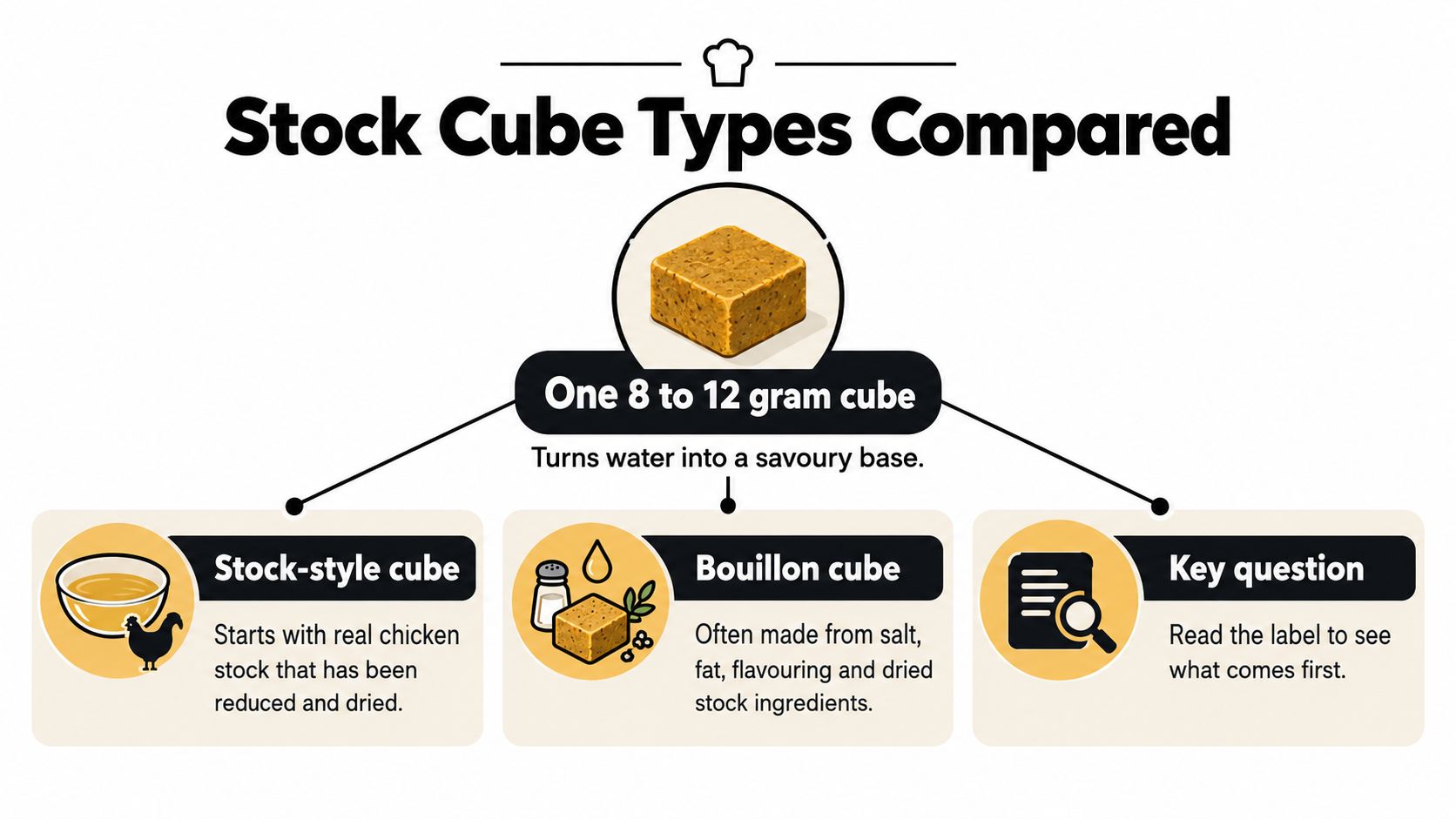
Chicken stock cube types at a glance
Format | Usual contents | Chicken presence | Best kitchen job | Main limit |
|---|---|---|---|---|
Stock-style cube | Reduced chicken stock, salt, sometimes fat and vegetables | Look for chicken meat, bones or stock high on the list | Soups, risotto and light sauces | Still a salty concentrate |
Bouillon or flavour cube | Salt, vegetable or palm fat, yeast extract, starches, flavourings | Often chicken flavour rather than much meat | Fast weeknight broth | Additives to assess and potentially high sodium in the dry concentrate |
Granules or powder | Same seasoning family, portioned by the spoon | Check for named chicken ingredients | Large pots and catering batches | Easy to overshoot the spoon |
Frozen homemade stock | Bones, aromatic vegetables, herbs, little or no salt | Real chicken | Pan sauces and reductions | Short refrigerated life; freeze promptly for longer storage |
Granules are the same broad idea measured by the spoon. They're convenient when a cook needs to adjust a large pot gradually, but a heaped spoon isn't a repeatable measure. Use a level measuring spoon, or weigh the powder when consistency matters.
Frozen homemade stock offers a different advantage. Depending on the bones, water and cooking method, it can provide gelatin that gives a sauce body. A seasoning cube may supply plenty of savoury flavour without producing that same texture.
Choose the job before the format
For a quick noodle broth, a straightforward bouillon cube may be entirely suitable. For a delicate chicken sauce, a strong yeast-extract note or heavy seasoning can cover the flavour you're trying to preserve. Neither choice makes sense without the dish.
According to Deep Market Insights, the UAE bouillon-cubes market was valued at USD 86.65 million in 2025. That figure covers bouillon cubes broadly, not just chicken products, and says nothing about the quality of an individual pack.
Before comparing price, inspect the leading ingredients and the suggested water volume. A cheaper pack isn't necessarily better value if you need other ingredients to soften its flavour, and a premium wrapper doesn't establish a stock-rich recipe.
Buying rule: Choose the flavour profile your dish needs, then check whether the ingredients support it.
Salt at the top of the list doesn't automatically make a cube unusable. It tells you to treat it primarily as seasoning rather than assume it behaves like an unsalted stockpot. Ultimately, chicken flavour isn't proof of chicken, and a cube is only as complete as what it was made from.
Where a Cube Works in Home and Professional Kitchens
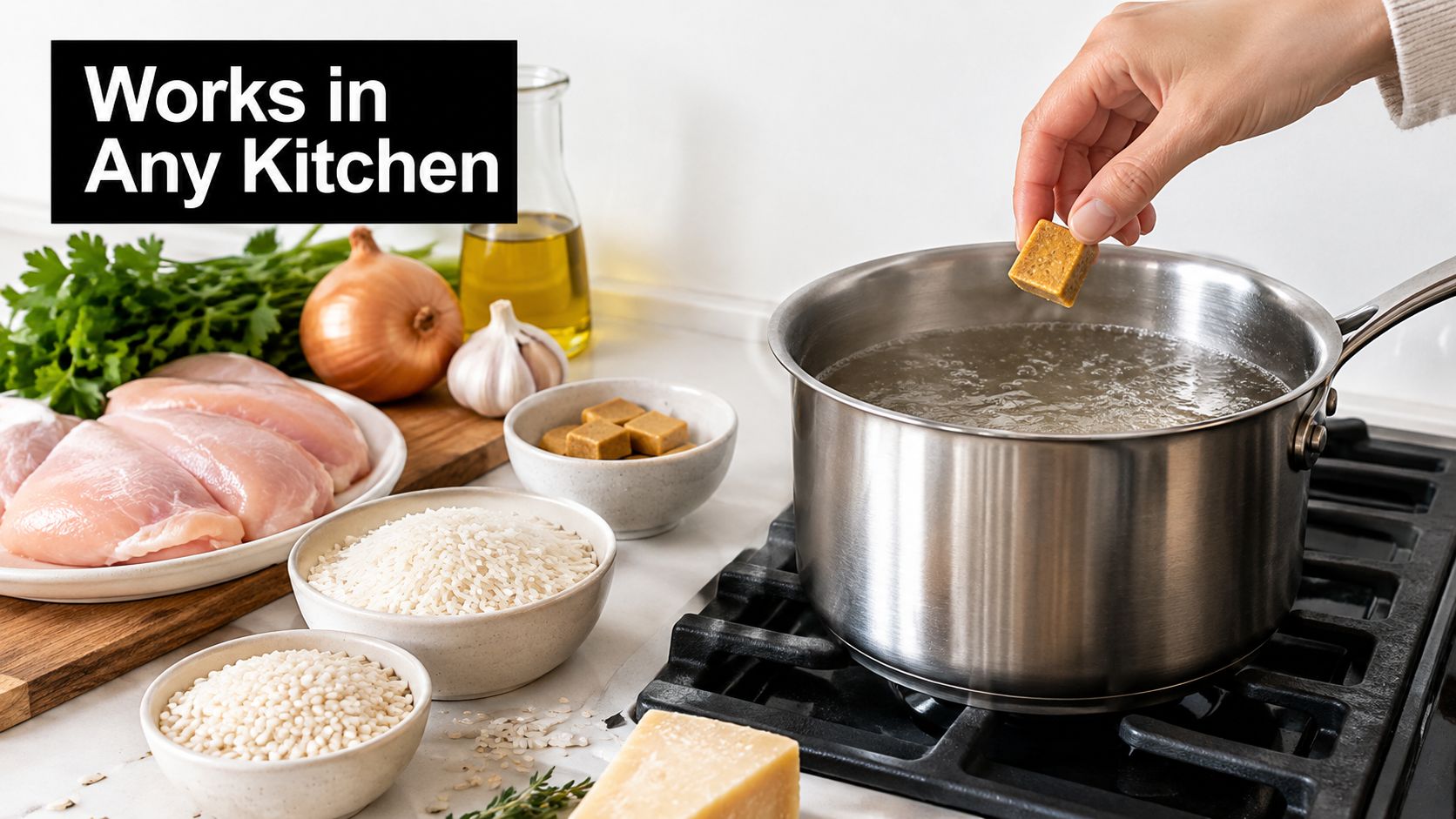
A cube earns its place when you need a dependable savoury liquid without starting a stockpot. Dissolve it in the amount of hot water stated on the pack, then add the liquid to the food rather than leaving a whole cube to break down unevenly.
Dissolving first makes it easier to control what reaches the pan.
Match the strength to the pan
For chicken rice, use the prepared broth as the cooking liquid and leave extra salt out until you can taste the finished rice. For a simple risotto, keep the dissolved stock hot beside the saucepan and add it by the ladle. This avoids pockets of concentrated seasoning.
Poached vegetables need a lighter touch than a substantial braise. When parmesan, anchovy or salted butter is already present, start with a smaller portion of cube and make up the liquid with water. You can increase flavour later; removing dissolved salt is much harder.
Herbs can change the direction of a simple broth without adding another salty ingredient. Our guide to dried sweet basil is useful when building a tomato-and-chicken soup or a gentle sauce for vegetables.
Use it differently during service
In a professional Dubai kitchen, a cube is useful as a service backup rather than automatically becoming the foundation of a signature sauce. It can keep a straightforward soup consistent or supply liquid when the prepared stock runs out. The chef should still approve the finished flavour.
The US Department of Agriculture's UAE poultry report describes a food environment shaped by international sourcing and hospitality demand. For kitchens buying packaged ingredients, clear origin information and dependable distribution matter alongside convenience.
Watch what happens during reduction. In a hypothetical pan sauce, reducing a litre of seasoned liquid to a small jugful leaves the salt behind while water evaporates. A broth that tasted balanced at the start can become harsh by the time it coats a spoon.
The cooking demonstration below offers another view of using bouillon in the kitchen.
Taste the finished ladle, not the dry cube.
For a sauce that must reduce heavily, begin with unsalted stock or water and reserve seasoning for the finish. For a soup served without much evaporation, the pack's dilution instructions are a more useful starting point.
How to Choose a High-Quality Cube in Dubai
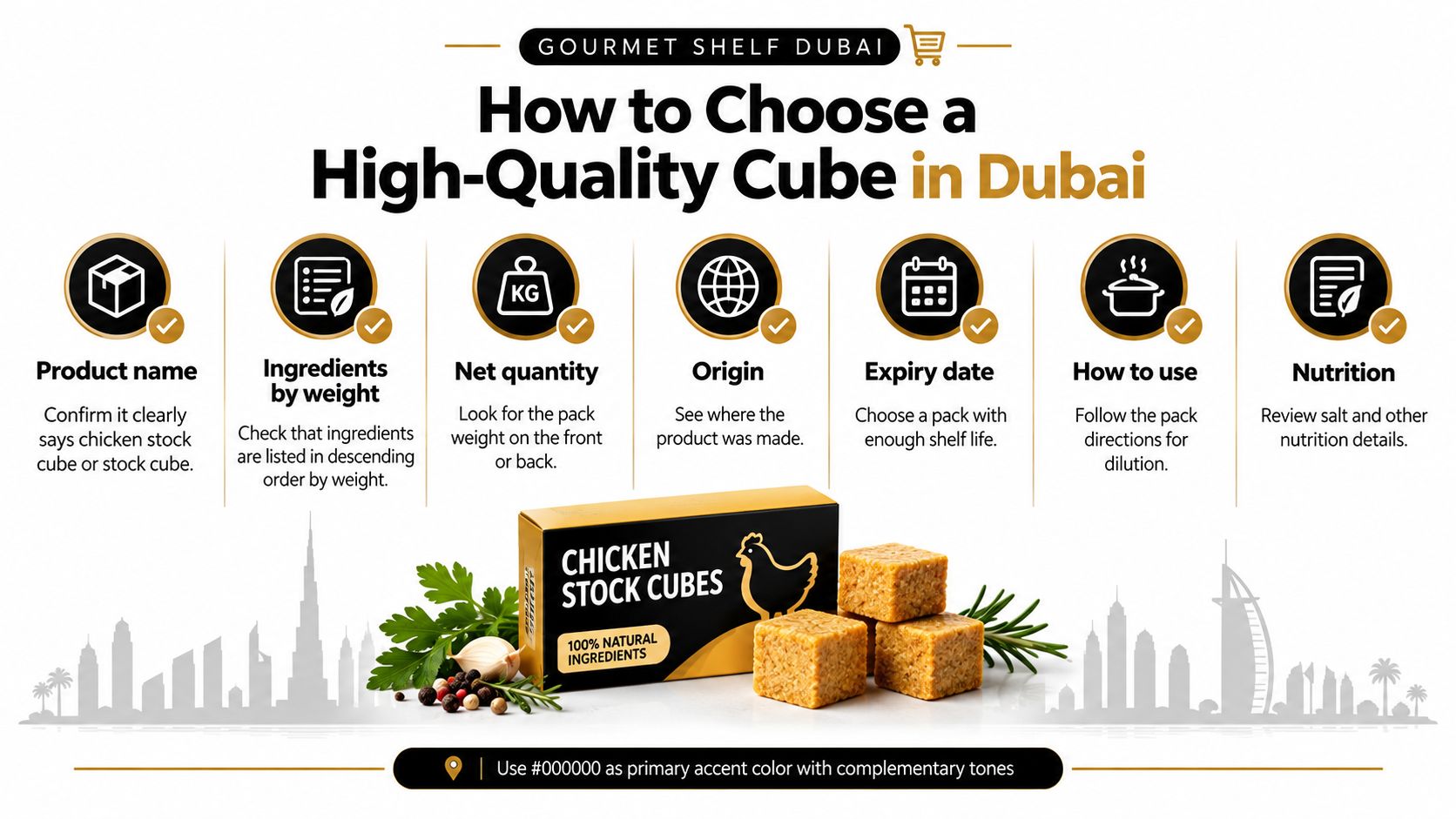
Start with the back of the pack, not the serving photograph. A useful label should let you identify the product, understand its ingredients and prepare it consistently.
Under UAE food-labelling requirements, food information must be accurate, available in Arabic and include required details such as ingredients, origin, expiry information, preparation instructions and nutrition. Ingredients are listed in descending order by weight, so their position helps you understand the formulation.
Use this shelf checklist before deciding whether a pack belongs in your basket.
Separate flavour from dietary suitability
Scan for poultry derivatives, animal fats, yeast extract, hydrolysed proteins and flavour enhancers. These ingredients perform different jobs; their presence isn't, by itself, a verdict on quality.
For guests with dietary restrictions, inspect compound ingredients and allergen declarations for wheat, milk, celery and sulphites. If a component is unclear, don't assume it's suitable. Gluten avoidance and a wheat allergy also require different checks.
For halal requirements, verify appropriate certification and the ingredient list rather than relying on the country of origin. A cube containing chicken derivatives isn't suitable for a vegetarian guest. With a chicken allergy, don't use an ambiguous chicken-flavoured product without reliable confirmation of suitability.
Read sodium in the form you'll eat
The UAE National Health and Nutrition Survey found that 96.2% of people aged 18–69 consumed more sodium than recommended, according to Gulf News's coverage of the survey. That makes the whole meal's seasoning more useful to assess than the cube in isolation.
The Abu Dhabi Agriculture and Food Safety Authority's labelling guidance%20of%202019%20General%20Food%20Labelling%20Requirements.pdf) defines low sodium/salt as no more than 0.12 g sodium per 100 g or 100 ml, equivalent to 120 mg on that basis. Check whether the declared values describe the dry product or the prepared liquid before comparing packs.
For a worked calculation, take sodium per prepared serving and multiply it by the number of labelled servings used in the pot. Divide that total by the portions you'll serve, then add the contribution from parmesan, cured meat or salted butter. Compare the result with your appropriate daily target, especially if you've been given individual dietary advice.
Label checks before a cube goes in the basket
Check | Where to look | Passes when | Leave it when |
|---|---|---|---|
Identity | Product name and Arabic information | It says chicken stock or bouillon plainly | Chicken flavour is claimed but the list is vague |
Ingredient order | List by descending weight | Chicken or stock appears near the top for a stock-rich choice | Salt, fat or starch leads and meat is absent when you want real chicken stock |
Allergens | Ingredients and allergen statement | Relevant allergens are clearly identified and suitable for the guest | A compound ingredient leaves gluten or milk unclear |
Halal and diet fit | Certification mark and poultry ingredients | Certification and ingredients meet the guest's requirements | Origin country is the only evidence offered |
Sodium | Dry-product and prepared-serving values | The diluted serving fits the meal | A low-sodium claim exceeds the applicable threshold |
Traceability | Seal, expiry and batch information | The pack is sealed, dated and traceable | Cubes are loose, damaged or undated |
For repeat kitchen use, record the dilution and sodium per finished litre. If the recipe changes, calculate from the actual finished yield rather than assuming the original serving information still applies.
Storage Life and Pantry Care
Keep commercial cubes in a cool, dry cupboard, away from the hob, dishwasher steam and direct sunlight. In Dubai, a cupboard beside a hot appliance can be a poor choice even when the kitchen itself feels comfortable.
Leave unopened cubes in their original packaging and use the printed expiry date. Once a wrapper is opened, fold it tightly or place the remaining pieces in an airtight container, keeping the label so the ingredients and batch information stay available.
Protect the fat and aroma
A cube contains more than dry salt. Its fats can turn stale, and its aromatic ingredients can lose their freshness or absorb surrounding smells.
Keep it dry. Use clean, dry hands and utensils when breaking or measuring cubes.
Separate strong smells. Don't leave unwrapped pieces beside coffee, tea or open spice jars.
Discard damaged stock. Leave swollen packs unused, and throw away cubes with an unexpected rancid smell, moisture damage or a marked change in texture.
An oily texture alone isn't always spoilage because some formulations contain substantial fat. Judge an unexpected change against the product's normal condition, and don't taste a suspect cube to test it.
Homemade stock needs refrigeration
Homemade stock isn't shelf-stable. Strain it, divide it into shallow containers and cool it promptly, using an ice-water bath when helpful, before refrigerating or freezing.
Don't leave a large warm stockpot cooling slowly on the counter, and never pour fresh stock into a container holding an older batch. Freeze portions you won't use promptly and label the containers with their contents and preparation date.
Before guests arrive: Check that the seal is intact, the date is readable and the smell is clean. A normal smell doesn't make damaged or poorly stored food safe.
Substitutes and a Fast Homemade Stock
An empty cube box doesn't have to stop dinner. First decide what the recipe is missing: cooking liquid, savoury depth, richness or the body of a proper stock.
Water can handle the first job. Aromatics and butter can help with flavour, but they won't reproduce everything chicken stock contributes.
Choose a swap that suits the dish
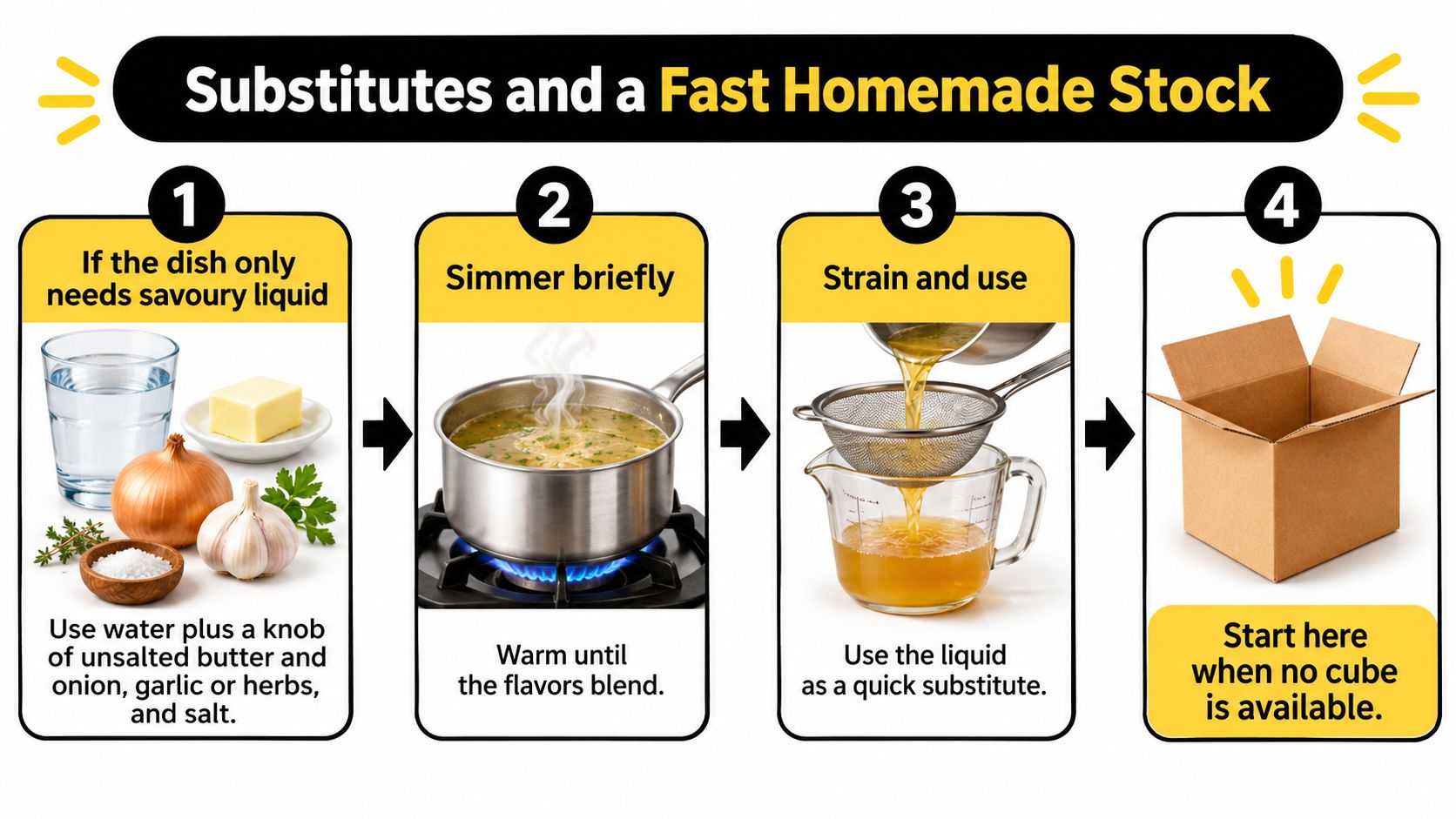
For simple savoury liquid, use water and unsalted butter. Soften onion or garlic, add water and herbs, and season at the end. This works when the pan already contains flavour from browned chicken or vegetables.
Choose light vegetable stock for a mild soup. It supplies an aromatic base without asserting chicken flavour. Check its ingredients too if you're cooking for guests with allergies.
Use pasta cooking water only when it's lightly salted. Its starch can help bind a sauce, but heavily salted water is a poor choice for a sauce that will cook down.
Deglaze a pan with shallot and a splash of white wine or lemon. Wine contributes aroma and acidity, not the gelatinous body of chicken stock. Use lemon and water where alcohol isn't suitable, and keep the acidity restrained.
Avoid stacking salty substitutes. Soy sauce, miso and extra cheese can provide savoury depth, but don't add them automatically on top of full-strength cube stock. Choose a direction and taste before combining.
A quick aromatic liquid is useful when you need moisture more than a pronounced chicken taste.
Make an unsalted control stock
For genuine chicken flavour with adjustable seasoning, use a small stockpot, a fine sieve and shallow cooling containers. A light stock is enough for rice, soup and many everyday sauces; it doesn't need to become a thick restaurant reduction.
Cover chicken bones or a carcass with cold water. Use enough to submerge them without filling the pot unnecessarily. Too much water gives you a weaker result.
Add onion, carrot, celery and a bay leaf. Leave the salt out so you can use the stock in dishes with different seasoning needs.
Simmer gently and skim the foam. Keep the surface moving softly rather than boiling hard. Taste for a rounded chicken flavour; a quick stock will be lighter than a long-simmered batch.
Strain through a fine sieve, then cool promptly in shallow containers. Don't press the vegetables aggressively if you want a cleaner-looking liquid.
Freeze in an ice tray or small containers. Transfer frozen blocks to a labelled freezer bag and add them to the pan as needed. Their strength won't have a fixed equivalence to a commercial cube, so adjust by taste.
An unsalted frozen block gives you a control knob that a salted commercial cube doesn't: you can increase chicken flavour without automatically adding more salt.
Dishes Worth Making and Where to Shop Next
Choose the dish first, then the cube. A lemon chicken soup wants a clean, gentle base, while roast-tray juices can carry a more assertive savoury note.
For lemon chicken soup, soften onion, add the prepared chicken broth and simmer with cooked chicken and vegetables. Add the lemon near the finish so its fragrance stays fresh. Keep the broth light enough that the citrus doesn't have to fight heavy seasoning.
Put the cube to a specific use
A simple risotto. Dissolve the cube fully in hot water, then ladle the prepared liquid into the rice as it cooks. Taste before adding parmesan, because the cheese brings its own salt and can tip a well-seasoned risotto over the edge.
Roast chicken and vegetables. Lift the cooked food from the tray, pour off excess fat and loosen the browned juices with a little diluted cube stock. Use a restrained portion, since the roasting juices already carry flavour and salt.
Clear broth for a majlis or catering line. Pick a product that dissolves cleanly and check every guest's dietary needs before making a shared pot. A clear appearance tells you nothing about allergen or halal suitability, and a chicken-tasting broth is not proof that the cube contains chicken. Read the ingredient list.
Rice offers another practical route from cupboard to table. Our guide to Sella basmati rice can help you choose a rice dish suited to a family meal or a hospitality setting.
Build a useful cook's basket
Two questions decide the right cube, and they are separate ones. Does it suit the dish? This covers flavour strength and how cleanly it dissolves. Is it suitable for the people eating it? This covers the ingredient list, allergens and halal needs. A cube can pass the first test and fail the second.
Salt builds up across the whole plate rather than in the cube alone. Broth, parmesan, roasting juices and any seasoning added at the table all contribute, so a lightly salted cube can still produce a salty dish once everything reaches the plate.
For a food gift, place a suitable cube beside pasta, rice and tomatoes rather than presenting it as a luxury object on its own. The value sits in a basket the recipient can turn into dinner, with ingredients that make sense together.
IFM Gourmet Food Store is a specialty emporium in Dubai offering authentic Italian gourmet ingredients and artisanal delicacies across the UAE: bronze-die pasta, rice, San Marzano tomatoes, fine chocolates, premium teas and curated gift hampers for occasions such as Christmas, Ramadan and Diwali. The team can help customers select food products and offer cooking advice and presentation tips, whether for a home cook, a hotel buyer or a festive table.
The most useful choice isn't necessarily the richest-sounding cube. Pick the product whose leading ingredients and sodium per prepared serving suit your meal, then build the basket around the soup, risotto or roast you want to cook.
IFM Gourmet Food Store offers Italian pantry ingredients and artisanal delicacies for everyday cooking, hospitality and thoughtful food gifts. Visit IFM Gourmet Food Store to build a basket around your next chicken soup, rice dish or risotto, with help choosing complementary ingredients and presenting the finished meal.

Comments